Friday, July 22, 2016

Trump's Dystopia

Trump's Dystopia: Trump’s dark warnings and grandiose pledges that he alone can save the troubled nation sound an ominously authoritarian note.

Harold Meyerson
Yes, Donald Trump’s acceptance speech was remarkably dystopian, painting a picture of America in which good citizens cower in their homes, afraid to stir lest they be mowed down by marauding immigrants. Yes, it was a law-and-order speech—he used the phrase four times—modeled after those of Richard Nixon, whose 1968 campaign came at a time of devastating urban riots, generational upheaval, and a bloody war that would not end. And yes, it was a speech that hurled absurd accusations, backed up by fictitious facts, at Hillary Clinton—the last in a parade of such speeches at this year’s convention.
But what made Trump’s speech truly ominous and without precedent in American politics was the role he assigned himself—and the rest of us. We are mute and defenseless. He is our voice. He alone can fix our problems. That doesn’t really leave much for the other 300 million-plus citizens of our democracy to do. It doesn’t leave much for other elected lawmakers to do, either.
Were Trump to win, he would claim not merely a mandate, but a kind of personal and mystical authority.
Were Trump to win, he would claim not merely a mandate, but a kind of personal and mystical authority. He would amend the phrase vox populi vox dei— “the voice of the people is the voice of God”—to vox Trump vox populi vox dei. Indeed, he so amended it last night.
What Trump has to offer, then, is not merely the right-wing xenophobic populism of, say, a Marine Le Pen. To this already toxic mix, he’d bring a level of personal authority and legitimacy that Le Pen and her ilk don’t claim for themselves. Armed with this additional authority and legitimacy, which no other governmental figure could claim, Trump could govern in a way that unbalances some of our checks and balances, moving our system towards a more personalist and authoritarian regime.

Monday, July 18, 2016

Chicano History Will be in the California Text Books in 2017

By Duane Campbell
History and social science textbooks in public schools in California and most of the nation are racist, class-biased, and ignore LGBT history. This condition will change in California in 2017 when new textbooks are adopted.

It is over. We won !

 At 2:45 PM July 14, 2016,  the California State Board of Education unanimously endorsed a new History /Social Science Framework for California’s public schools that includes a substantial addition of Chicano/Latino history, improved history of LGBT people, and improvements in several other histories.
This completes a 6 year effort against substantial opposition to revise the Framework.  As a result textbooks in California in 2017 will be the most inclusive ever required, and all students will be taught an inclusive history. This has been the major campaign of this blog and the Mexican American Digital History project since 2009. 

Under this decision California students will finally be encouraged to know the history of Latino civil rights leaders like Cesar Chavez and Dolores Huerta and Filipino labor leaders like Larry Itliong, as well as an accurate and inclusive history of LGBT activists  as a part of the history of California and the nation. These topics are currently substantially absent from public school textbooks and curricula in California.

Thursday, July 14, 2016

antiracismdsa: We Won ! Chicano History Will be in the California...

antiracismdsa: We Won ! Chicano History Will be in the California...: By Duane Campbell History and social science textbooks in public schools in California and most of the nation are racist, class-biase...

Tuesday, July 12, 2016

Teachers and Violence This Week


Letter Opposing Violence from National Association of Multicultural Education, 
The deaths of Alton Sterling and Philando Castille and Delrawn Small serve as yet another round of reminders that the criminal justice system was born out of American racism, that our police are born in a colonial settler-state country that enforces racism in every way. Whether it is fear or hate that drives our rage and violence against each other, underneath this violence rests an impossible commitment to maintain racism. The hateful attack on Dallas police, during what had been a peaceful protest, further reinforces the violence of our nation. 
This settler-state enforced, media-encouraged violence is not limited by our racism, as the mass shooting in Orlando attests. Yet racialized, gendered, and sexualized violence is not limited to national borders. In South Africa, Black lesbians and transgender communities are regularly violently targeted, while corporal punishment is the norm in Black and Coloured schools. Recent extrajudicial killings in Kenya, persecution of people with albinism in Tanzania, the maintenance of apartheid-like conditions in Palestine, and anti-immigrant violence across Europe reminds the world of a settler-state enforced – or at least silently tolerated – violence against those we frame as “the other.”
While not everyone embodies what we are taught as children, and certainly many educators fight against these notions every day, NAME reminds us that our schools do frame such racism as normal, and the everyday operation of schools fosters a context that allows violence against particular groups of people to be seen as normal. 

While we must continue the long-term struggle to transform schools and society, we must also respond today. Schools and colleges must be at the forefront of addressing the context that justifies the dehumanizing that encourages the killing of particular people. We cannot continue as normal, when our normal justifies the violence we see around us. 

http://www.nameorg.org/docs/2016_Letter_from_NAME_opposing_violence_final-7-10-2016.pdf

http://www.nameorg.org/index.php

Tuesday, July 05, 2016

Stop Trump's Wall


The Berlin Wall symbolized cold war between the east and west through 1989. The Wall in Jerusalem symbolizes undeclared war today between Israelis and Palestinians.
Completing the Border Wall would be a step towards militarization of the relationship between the US and Mexico and a harbinger of things to come.
The US Mexico Border Is Under Control and Stable
The fact is the US-Mexico border is already under control according to US official reports. Numerous laws and appropriations have been enacted over the last 15 years by the US Congress and three Presidents from both parties resulting in construction of 700 miles of wall and quadrupling the border guard to nearly 20,000 members today. Radar and drones are already in use.

Register and Vote. 
With a Trump victory, we face a serious growth in officially sanctioned racism and anti immigrant prejudice.  Trump’s campaign has made an anti immigrant narrative acceptable in the main stream media- and this strategy works.  It mobilizes right wing voters.

Friday, July 01, 2016

Extension of Education Tax Initiative on the Ballot for November

 Sacramento, in front of California Middle School, leaders and members of unions and community groups stood before a large group of reporters and announced that the coalition they belonged to had just turned in more than a million signatures to place the "California Children's Education and Health Care Protection Act" on the November state ballot.
CFT vice president Joanne Waddell said, "During the recession colleges and universities cut classes, laid off faculty and staff, and increased tuition and fees, pricing higher education out of the reach of many working families. We don't want to go back to class cuts and skyrocketing tuition rates.  Our children, our puiblic schools and our community colleges cannot afford tax cuts on the wealthy."  Waddell is also president of the Los Angeles College Faculty Guild, AFT Local 1521.   
This measure proposes to extend Proposition 30.  Prop 30 has been a game changer for public education in California.  The new ballot measure will ask to extend the top bracket income taxes for the wealthiest 2% of Californians, and drop the modest sales tax that had been part of the original Prop 30.  The revenue will help ensure that California continues to move forward toward funding education for all students from pre-school through university.

Tuesday, June 28, 2016

Report Cites Equity Gaps in Public Education


New Report Underscores Serious “Equity Gaps” in Public Education
https://www.washingtonpost.com/news/education/wp/2016/06/07/five-eye-opening-figures-from-the-u-s-education-departments-latest-civil-rights-data-dump
Author:  Emma Brown

Washington Post


The nation’s public schools suspended significantly fewer students in 2014 than they did in 2012, according to new federal data released Tuesday, but stark racial gaps persisted — not only in the way students were disciplined but also in their access to experienced teachers and advanced math and science courses.

Nationwide, 2.8 million students were suspended from public schools during the 2013-2014 school year, according to the Civil Rights Data Collection, which the U.S. Education Department releases every two years. That represents a drop of nearly 20 percent compared to the 2011-2012 school year.

But black students were nearly four times as likely to be suspended as white students, and nearly twice as likely to be expelled. The same pattern showed up in preschool: Black children represented 19 percent of all preschoolers but accounted for 47 percent of those who received suspensions.

“Fewer suspensions is an important sign of progress,” said Education Secretary John B. King Jr. “But I don’t think there’s any way you can look at this data and not come away with a tremendous sense of urgency about continuing to close our equity gaps.”

Thursday, June 23, 2016

President Obama Delivers a Statement on the Supreme Court's Ruling on Im...


No change for current dreamers !
For more history see www.antiracism.dsa.blogspot.com 

Thursday, June 16, 2016

How Long Can Big Money Keep Democrats in the Charter School Camp ?


Jeff Bryant
It’s obvious 2016 is an election year when Democratic candidates need to draw a bright line to differentiate themselves from Republican opponents.

With Donald Trump leading the GOP ticket, and most leaders of his party getting in line behind him, it’s doubtful Democrats will find urgent need to “meet in the middle” on issues such as civil rights, women’s reproductive health and equal pay, immigration, minimum wage, gender equity, and climate change.

There may be some issues that still tempt Democrats to collude with conservatives in order to woo mythological “swing voters.” But the number one fear among top Republican strategists is that Democrats will run “a base campaign, directed toward liberals, maximizing that vote, and electing a devastating ticket.”

How then, do you explain the results of the recent California primary?

A Toxic Mix

As Harold Meyerson recently wrote in an op-ed for the Los Angeles Times, while the Democratic Party’s presidential candidates, Vermont Senator Bernie Sanders and former U.S. Secretary of State Hillary Clinton, ran on populist platforms denouncing “the corrosive role of money in politics” and “condemning the plutocratic consequences of the Supreme Court’s Citizens United decision,” many Democratic Party candidates down ticket funded their campaigns with big money from two corporate interests.

Monday, June 13, 2016

antiracismdsa: Trump, Racism and the Left in 2016

antiracismdsa: Trump, Racism and the Left in 2016: by Max Elbaum, Donald Trump’s Indiana victory and now unstoppable march toward the Republican presidential nomination underscores ...

Friday, June 10, 2016

What Do Californians Do Now ?


Bernie lost. What do liberal Californians do now?


Former state Assemblyman Henry Perea of Fresno, seen above, headed the caucus of moderate Democrats from 2012 to 2015, when he resigned to take a government relations job with Chevron. (Los Angeles Times)
Harold Meyerson


What should California’s Bernie Brigades do now? How should they proceed with the revolution once the Democratic convention formally bestows its nomination on Hillary Clinton?

If Sanders backers (or, for that matter, Clinton supporters) want to involve themselves in politics, there are a number of elections right here in California in which a keystone issue of the socialist’s campaign – breaking the hold that big money has on our system – is effectively on the ballot.

The big winners in California's open primaries: big spenders

For even as Sanders was thundering against the corrosive role of money in politics and Clinton was condemning the plutocratic consequences of the Supreme Court’s Citizens United decision, corporate money was carving an ever larger role for itself in California politics – California Democratic politics.

Over the past two years, oil companies and “education reform” billionaires have been funding campaigns for obliging Democratic candidates running against their more progressive co-partisans under the state’s “top-two” election process. In this week’s primary, independent committees spent at least $24 million, with most of that money flowing to Democrats who opposed Gov. Jerry Brown’s effort to halve motorists’ use of fossil fuels by 2030, and a substantial sum going to Democrats who support expanding charter schools.

Thursday, June 09, 2016

In Defense of Public Education


In just a few weeks, thousands of educators, parents and activists—including many friends and supporters of Rethinking Schools—will gather in Washington, DC for three days of action in defense of public education. Rethinking Schools editor Jesse Hagopian will be a featured speaker, along with Jonathan Kozol, Karen Lewis, Diane Ravitch, Rev. William J. Barber II, and many others. We urge all of you who can to support these events:
A People's March for Public Education and Social Justice on July 8
Save Our Schools Activists Conference on July 9
Coalition Summit and Organizing Session on July 10
In an election year filled with daily examples of how desperately our nation and our planet need stronger movements for democracy and social justice, Rethinking Schools is pleased to support the coalition’s call for:
Full, equitable funding for all public schools
Safe, racially just schools and communities
Community leadership in public school policies
Professional, diverse educators for all students
Child-centered, culturally appropriate curriculum for all
No high-stakes standardized testing
These are themes Rethinking Schools readers will readily recognize as part of every issue we have published for over 30 years. We urge you to support these movement-building efforts and to help Rethinking Schools connect with new layers of activists and advocates from across the country.

In solidarity,
Stan Karp
Rethinking Schools

Monday, June 06, 2016

School Solutions and Turn Arounds

Bobbi Murray & Bill Raden
June 3, 2016
Capital and Main
 
California has become ground zero for the national battle over charter school expansion. Some of America’s richest individuals and largest foundations are pouring resources into what critics view as the privatization of public education. Based on six months of reporting and interviews with experts, elected officials, educators and advocates on both sides of the debate, “Failing the Test” is a comprehensive portrait of how charter schools are changing public education.


Yolanda Rodriguez, Pandora Young, 
 
 
Elana Goldbaum was happy working at Burbank Junior High School, a public school located in Los Angeles’ Highland Park neighborhood, until she was let go during the recession in 2008. She now works with what Goldbaum calls “a talented and amazing team” of educators at the Alliance Gertz-Ressler charter school, one of a network of 27 high schools and middle schools spread across the Los Angeles area. She loves teaching history to 10th graders, even though she finds herself embroiled in some of the teacher-management conflicts that have defined charters. 

Thursday, June 02, 2016

Trump University : For Profit Education

by Jeff Bryant
Revelations from documents connected to Trump University are generating outrage across the political spectrum, from my colleague Terrance Heath, who called it “a scheme to transfer wealth from people who had little,” to the conservative journal National Review which carried an editorial proclaiming it “a massive scam.”
Much of the commentary has focused on the “playbook” that guided sales reps for Trump U in how to coerce prospective students to sign up for the bogus degree program. A review of the document by CBS News highlights the hard sell tactics Trump U staffers used to push prospects into committing many thousands of dollars – upwards of $35,000 – to a course of study that many of those students now concede turned out to be “useless information.”
The outrage is much deserved, but we shouldn’t lose sight of the fact that making a buck off people’s urges to fulfill their education destinies has become commonplace in American society.
As reports of the Trump U documents were breaking, Politico reported on how the Obama administration is currently engaged in a struggle to rein in the practices of for-profit colleges that lure students into degree programs that plunge them deeply into debt without advancing their financial well beings in the long run.

Sunday, May 22, 2016

Charter School Advocates Spend Heavily to Gain Control of County Board of Education.


BY DIANA LAMBErt, The Sacramento Bee

Charter school advocates have spent nearly $300,000 backing candidates for three seats on the board of the Sacramento County Office of Education, positions that once were considered sleepy political outposts.
Besides providing oversight for Sacramento County school districts, the education board reviews the charters of countywide charter school systems and hears appeals from charter schools whose applications have been rejected by local school districts.
In recent years, the California Charter Schools Association has emerged as a major player in supporting candidates for the board. This year, the advocacy group has focused its donations on three candidates: Joanne Ahola, who works for the association; Heather Davis, who is married to Elk Grove Mayor Gary Davis, an employee of the charter schools group; and Roy Grimes, a former county education board member challenging an incumbent who has voted against reauthorizing charter schools.
Carlos Marquez, senior political director for the Charter Schools Association, said it views the Sacramento County Office of Education as “a really strong safeguard, a strong backstop for (preventing) politically motivated denials (of charter schools) at the local level.”
“We are happy with the board,” he added. “It’s really important right now that we maintain continuity.”
The county Office of Education has so far chartered five schools – all part of a network operated by Margaret Fortune that focuses on closing the achievement gap between African American and other students. Fortune recently finished serving as a California State University trustee and was an adviser for former Govs. Arnold Schwarzenegger and Gray Davis.

Saturday, May 21, 2016

Teachers Are Increasingly Frustrated With Their Work

And That's Bad for Students
Jeff Bryant
Last week was Teacher Appreciation Week. So some folks thought it might be a swell idea to ask teachers how “appreciated” they feel. The short answer? Not so much.
Results of a wide-ranging new survey of 3,328 K-12 classroom teachers finds the nation’s frontline educators are committed to their students and generally satisfied with their schools and their colleagues but are deeply frustrated with how they’re being treated.
Most teachers believe their voices are ignored by policy makers at the district (76 percent), state (94 percent), and national (94 percent) levels.
Although most teachers say what would really help their work would be smaller class sizes and more time for planning and collaboration with colleagues, what a majority of them report is too much emphasis on testing, especially in high- and medium-poverty schools where teachers say they are way more apt to spend more than a month on test-prep activities for district and state tests.
“A majority of teachers believe they spend too much time preparing students for state-mandated tests (62 percent) and district-mandated tests (51 percent),” the survey summary states. “Very few teachers believed they spent too little time preparing students for district and/or state-mandated tests.”
In the meantime, the tests have an impact on the evaluations of most teachers, even though a majority of these teachers say these evaluations are only minimally or not at all helpful.
The discontent teachers feel in the workplace is actually the continuation of a long and alarming trend with undoubtedly negative impacts on students.
Teachers Are “Clearly Frustrated”

Thursday, May 19, 2016

How the Bros Are Undermining Bernie

How the Bros Are Undermining Bernie: If the Sanders Revolution is ever to come to fruition, the Bernie Brigades will have to vote for and work for Hillary Clinton’s election in the fall.

Tuesday, May 10, 2016

California to Re Write History Books -Include Chicano History

California to adopt a new guide to Mexican American (Chicano) history, (and everyone else)

Cesar Chavez and Duane Campbell 1972
"Once social change begins, it cannot be reversed.  You can not un-educate the person who has learned to read.. You cannot oppress the people who are not afraid anymore.
Cesar Chávez. November 9, 1984.

Update. the decision was made May 19. The proposed new framework passed the Quality Instructional Materials Committee. It is most likely to be adopted as is. 

History will change in May of 2016 for the students of California, and in subsequent years students throughout the nation. Teachers. Are you prepared to teach all history?

We have a unique opportunity to change the history books in California  K-12 to include Chicano/Mexican American history.
Mexican American/ Chicano history is currently substantially absent from public school textbooks and curriculum in California- and it has been since 1986.  Latino student political non participation and alienation from school is significantly caused by Latino absence from the K-12 textbooks and curriculum.

For the last two years the Mexican American Digital History Project and a broad group of allies have been working for to add Chicano history to the California History/Social Science Framework, the document that determines what goes into textbooks in California. See https://sites.google.com/site/chicanodigital/

Sunday, May 08, 2016

Bernie Rally in Sacramento on Monday

Progressive Alliance/Campus 4 Bernie

Bernie Sanders for President

Dear Friends -
Bernie is coming to California on Monday and Tuesday to hold two "A Future to Believe In" rallies — don't miss this chance to see him in person! Join us for a conversation about the issues that matter: making college tuition-free, getting big money out of politics, combating climate change, and much more.
With the California primary coming up, we need everyone to get involved to make these events a success. Can Bernie count on you to join him?
A Future to Believe In Sacramento Rally
Monday, May 9

Doors open at 5:00 pm
Bonney Field at Cal Expo
1600 Exposition Blvd, Sacramento CA

Friday, May 06, 2016

Sacramento Teachers Deserve a Pay Raise

BY CHESSHUWA BECKETT
Printed in  The Bee

California’s Day of the Teacher is coming up next week, but teachers in the Sacramento City Unified School District aren’t feeling appreciated.
Superintendent José Banda says the district can’t afford a 5 percent raise that I and other members of the Sacramento City Teachers Association are seeking (“To help students and teachers, district must be financially stable,” Viewpoints, May 2).

My husband and I are both teachers at Rosemont High School, and our three children attend city schools. Every day, we experience first-hand the effects of misplaced spending priorities in our district.
This school year, for example, some Rosemont students taking a Spanish-language course have been taught by a series of substitute teachers who don’t speak Spanish.
It’s no fault of the substitutes, or of the principal. Rosemont is a school where teachers want to be assigned, in part because of the quality of our administrative leadership team.
Rather it’s because our salaries are so low that the district can’t recruit and retain enough teachers to fill vacancies. The district is in the best financial position that it has been in for a long time and should provide wages comparable to our surrounding districts.

Thursday, May 05, 2016

Sacramento Bee Editorial Endorsement -Sleazy or Inept?

Sleazy or inept?
The Bee editorial today endorses Hillary Clinton OK . But, it uses out of context, edited  sound bites as if they were evidence which leads to bad history. That is too bad.
Yes, Sanders said positive things about the Sandinistas in Nicaragua in their first period when they  overthrew the U.S. backed Somoza dictatorship. They then established a mixed economy (not socialist) and  U.S. citizens joined them to teach  poor children to read and to write. 
So did I.
Later the Sandinistas were defeated after a brutal war with the U.S. financed Contra rebels with arms and training acquired illegally from Iran.  They lost an election and left power.
To use the out of context phrases selected to imply a conspiracy is the  kind of phony reporting found in the Republican media machine,  or the National Enquirer, not in responsible news papers.

The Bee editorial uses a similar out of context about Sanders support for Cuba.
Here is what he actually said,

“What that was about was saying that the United States was wrong to try to invade Cuba, that the United States was wrong trying to support people to overthrow the Nicaraguan government, that the United States was wrong trying to overthrow in 1954 the democratically elected government of Guatemala," Sanders said. There is video of him speaking highly of both Castro and Daniel Ortega's Sandinista movement in Nicaragua, where Sanders traveled in 1985.
BuzzFeed News posted the video, which originally aired on Channel 17/Town Meeting Television, in June 2015. Sanders remarked that people "forgot that [Castro] educated their kids, gave their kids healthcare, totally transformed the society.”

antiracismdsa: Happy Cinco de Mayo - Support California Farmworke...

antiracismdsa: Happy Cinco de Mayo - Support California Farmworke...: Since Cesar Chavez’ March 31st birthday, nearly 10,000 farm workers took to the streets up and down key California agricultural regions to...

Wednesday, May 04, 2016

Sanders Wins Indiana - and the Political Debate

Bernie Sanders Wins Indiana – and the Political Debate

https://ourfuture.org/20160504/207226 
Robert Borosage
 
Wednesday, May 4, 2016
Campaign for America's Future
Bernie Sanders, the democratic socialist insurgent, won Indiana convincingly Tuesday night – 52.5 percent to 47.5 percent – over Hillary Clinton, the establishment moderate. This is a remarkable victory, a statement of the extent and scope of the Sanders surge.
Indiana is a Wonder bread state – Midwestern, centrist, largely white, religious. It gave us the blond and bland Evan Bayh, the former New Democrat governor and senator who thought Barack Obama was too liberal. Its current senators – Democrat Joe Donnelly and Republican Dan Coats – are centrists. Sanders has been already been counted out in the mainstream media. But young voters, liberals flooded into the polling booths and swept Sanders to victory. Picking up a net of five delegates, Sanders may not be winning his struggle against the delegate math, as the mainstream media keeps reminding us, but he is winning the political debate.
Sanders’ victory was completely overshadowed by Trump’s romp on the Republican side, which led Ted Cruz to “suspend” his campaign at the end of a sonorous, cliché-ridden, insufferably pompous concession speech. In both parties, insurgents took Indiana, and the party establishments lost. Suddenly the presumptive nominee of his party, Trump couldn’t rise to the occasion, but managed to say nice things about Cruz and his family while vowing to “go after Hillary.”

Remembering Kent State: May 4, 1970.

Remembering Kent State: May 4, 1970.: Photo by John Filo. This photo won the Pulitzer Prize of 1971. Murray Polner, It’s been 45 years since draft-deferred Ohio National...

Tuesday, May 03, 2016

Some Corporate Reformers Described: but Many are Hidden

Mercedes Schneider,
Pam Vogel is the education program director of the nonprofit Media Matters. She has been with Media Matters since August 2015. Her previous experience includes four months in 2014 as an intern in the office of Vice President Joe Biden. For another six months in 2014, Vogel interned at the Clinton Foundation. Vogel graduated from Whitesboro High School (NY) in 2008; Vasser College in 2012, and Teachers College in 2014.
On April 27, 2016, Vogel published this piece for Media Matters, entitled, “Here Are The Corporations And Right-Wing Funders Backing The Education Reform Movement: A Guide To The Funders Behind A Tangled Network Of Advocacy, Research, Media, And Profiteering That’s Taking Over Public Education.”
Now, from the title, it sounds like Vogel’s piece is exhaustive — “a guide to the funders.” However, as one continues reading, one finds this summation:
Media Matters outlines the many overlapping connections in an echo chamber of education privatization advocacy groups, think tanks, and media outlets that are increasingly funded by a handful of conservative billionaires and for-profit education companies — often without proper disclosure.
Interestingly enough, Vogel’s “many overlapping connections” fails to include the Big Three corporate-reform-purchasing philanthropies: Gates, Walton, and Broad.
Amazing.
But she does include such notable names as the Scaife Foundations, Thomas A Roe Foundation, and Adolph Coors Foundation. (Tongue in cheek, my friends. Tongue in cheek.)
Also remarkable is that Vogel includes the Thomas B. Fordham Foundation, which has received to date $2.6 million from the Gates Foundation just to remain in existence (i.e., for “general operating support”). She also includes Stand for Children (to date, $17 million from Gates). Still, Vogel omits Gates.

California Decision Protects Teachers' Rights to Due Process


Lily Eskelsen Garcia 
Today is National Teacher Appreciation Day,
On Thursday, April 14,  the California Court of Appeal, in a unanimous decision, overturned the deeply-flawed lower court ruling in Vergara v. State of California issued in 2014, which held that laws governing so-called teacher “tenure” were unconstitutional.
“Today was a win for our educators, our schools and most importantly, our students,” NEA President Lily Eskelsen García said responding to the ruling. “Now we must return to working on real solutions to ensure all of our students succeed. Only when teachers, school boards, and administrators work together can we ensure that there is a great public school for every student.”
While the decision was good news for educators, said California Teachers Association President Eric C. Heins, it was a huge win for students.
“Today’s ruling reversing Judge Rolf Treu’s decision overwhelmingly underscores that the laws under attack have been good for public education and for kids,” said Heins. “Stripping teachers of their ability to stand up for their students and robbing school districts of the tools they need to make sound employment decisions was a wrong-headed scheme developed by people with no education expertise and the appellate court justices saw that.”

Monday, May 02, 2016

May Day and the U.S. Labor Movement


Erica Smiley May 1, 2016
The American Prospect
Some cast the labor movement as dying or even dead, but even amid attacks on collective bargaining workers are finding innovative ways to organize.

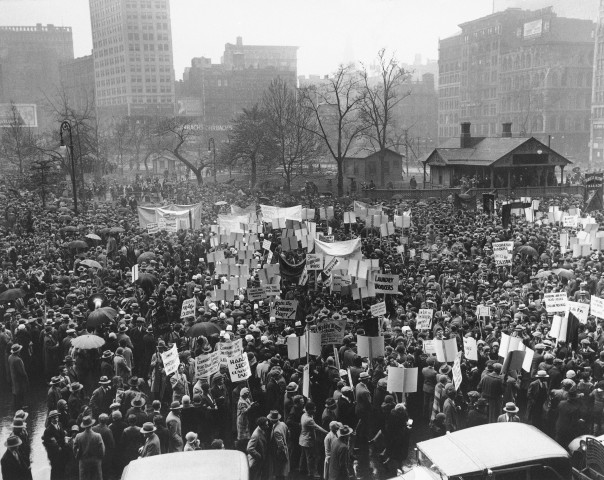
General view of the great crowds of organized and unorganized workers who took part in the May Day demonstration in Union Square, New York, May 1, 1929. , AP, 
On May 1, 1886, hundreds of thousands of railroad, mine, and factory workers in the United States put their livelihoods on the line and participated in a national strike to demand an eight-hour workday. They were attacked by strikebreakers and police, but their uprising led to the creation of a holiday to honor workers—May Day—now known as International Workers Memorial Day in many countries around the world.
These working men and women also achieved their immediate demand: a standard workday limited to eight hours. And while it took several more decades of struggle, the U.S. labor movement eventually won a much bigger victory: the legal right to form unions and collectively negotiate with their employers.
Today, this right is under attack in the face of some employers’ and lawmakers’ successful efforts to undercut unions through legal restrictions, retaliation, and intimidation. Indeed, only a small share of the U.S. workforce retains the right to consistently negotiate binding contracts.
Yet collective bargaining remains workers’ best weapon to fix an out-of-balance economy. According to the International Monetary Fund, the decline in unionization in the United States and many other countries over the past few decades is directly associated with an increase in the share of national income going to the top 10 percent of the population. Most CEOs are free to negotiate their own salaries and bonuses. Working people deserve the same freedom to engage in negotiations over how they will be compensated for their hard work. 

Friday, April 29, 2016

antiracismdsa: Violence Against Donald Trump Will Help Him to Win...

antiracismdsa: Violence Against Donald Trump Will Help Him to Win...: by Duane Campbell Although well meaning, the violent protests against Trump this weekend  for his racism will help him to get elected. ...

Tuesday, April 26, 2016

Stop with the Clinton campaign message that Bernie should end our campaign


Nation of Change 
I would like my friends who are campaigning for Hillary to stop telling us all that Bernie should withdraw from the race.  Your whining  serves no useful purpose.
Bernie’s campaign is about building a left opposition in the U.S. Great progress has been made in this effort.  Some 40% of Democrats now consider themselves socialist, some mean social democrats.
We still have much to do, particularly the election in California.  We are building an opposition movement.  I read the generational divide.   You haven’t convinced the millennial generation that he should drop out.  You don’t seem to get it.  Your advice has not been taken, so you give more advice.
And your campaign message that Bernie is getting too divisive is hollow.  You are obviously only listening to the Clinton campaign.  If you follow both campaigns, or progressive media, you will find that the Clinton campaign has been at least as divisive and taunting.
We need to build an opposition movement to defeat Trump.
Continuing the Bernie campaign contributes to our effort to defeat Trump.  Continuing the Bernie campaign is a statement that we support democracy, we want democracy to work.
As Bernie has said,  “The answer is, we are in this race until the last vote is cast,” Mr. Sanders said. “The people of California have a right to determine who they want to see as president of the United States and what kind of agenda they want the Democratic Party to have.

Hillary has problems.  The problems  are not created by Bernie.  Her support for Wall Street, her support for the coup in Honduras, among others,  are of her making.  Yes, they will cost her votes.  It is her history, her actions that are costing the votes- not the Bernie campaign.  See Robert Borosage’s piece on Hillary and campaign money. https://ourfuture.org/20160425/clintons-defense-of-big-money-wont-cut-it
 Those millions of us who have worked on the campaign will get together June 17- 19 in Chicago in a National People's Summit.  We will make our own decisions. thank you. 

Friday, April 22, 2016

We Need an Electoral Strategy Now

Why Progressives Need a National Electoral Strategy - and Fast

http://www.alternet.org/election-2016/why-progressives-need-national-electoral-strategy-and-fast
Bill Fletcher 

Every electoral cycle gives me the sense of "Groundhog Day" within progressive circles. It feels as if the same discussion take places over and again. No matter what has transpired in the intervening years; no matter what mass struggles; no matter what theoretical insights; progressives find themselves debating the relative importance of electoral politics and the pros and cons of specific candidates. These debates frequently become nothing short of slugfests as charges are thrown around of reformism, sell-outs and purism. And then, during the next cycle, we are back at it.
 
What has struck me in the current cycle are two related but distinct problems. First, progressives have no national electoral strategy to speak of. Second, elections cannot be viewed simply or even mainly within the context of the pros and cons of specific candidates. In fact, with regard to the latter, there are much bigger matters at stake that are frequently obscured by the candidates themselves.
 
Let's begin in reverse order. In a recent exchange on Facebook I had with a friend, he raised the point that Hillary Clinton holds some positions to the right of Donald Trump. His, apparent, point was that in a final election, should it come down to Clinton vs. Trump, it would actually not make much of a difference who won. Someone I do not know responded to my friend by pointing out that Hitler was to the "left" of certain candidates as well and that the issue of intolerance needed to be the point of focus.

Monday, April 18, 2016

Thousands of California's Register - in error- to ...

SACRAMENTO PROGRESSIVE ALLIANCE: Thousands of California's Register - in error- to ...: A survey of 500 members of the American Independent Party found nearly 3 of 4 people did not realize they had enrolled in a political part...

Friday, April 15, 2016

Teachers Win Ruling on Vergara Lawsuit

Educators Applaud Appellate Ruling in Meritless Vergara Lawsuit

Stinging Reversal of Lower Court Decision Vindicates Due Process, Benefits of Challenged Laws to Students, School Districts
Contacts: For CTA, Frank Wells at 562-708-5425; For CFT, Fred Glass at 510-579-3343
LOS ANGELES – In a sweeping victory for students and educators, the California Court of Appeal today reversed a lower court decision in the deeply flawed Vergara v. California lawsuit. The unanimous appellate opinion is a stinging rebuke to Judge Rolf M. Treu’s poorly-reasoned ruling, and to the allegations made and millions of dollars spent by wealthy anti-union “education reformers” to bypass voters, parents, and the legislature with harmful education policy changes. The reversal affirms the arguments of educators, civil rights groups, legal scholars and education policy experts that the state statutes affirming educator rights do not harm students.
“This is a great day for educators and, more importantly, for students,” said California Teachers Association President Eric C. Heins. “Today’s ruling reversing Treu’s decision overwhelmingly underscores that the laws under attack have been good for public education and for kids, and that the plaintiffs failed to establish any violation of a student’s constitutional rights. Stripping teachers of their ability to stand up for their students and robbing school districts of the tools they need to make sound employment decisions was a wrong-headed scheme developed by people with no education expertise and the appellate court justices saw that.”
In their 36-page decision, Justices Roger Boren, Judith Ashmann-Gerst and Brian Hoffstadt outline the numerous ways in which the plaintiffs’ arguments were wrong and Judge Treu’s decision declaring the statutes unconstitutional could not be affirmed. “We reverse the trial court’s decision. Plaintiffs failed to establish that the challenged statutes violate equal protection, primarily because they did not show that the statutes inevitably cause a certain group of students to receive an education inferior to the education received by other students. …the statutes do not address the assignment of teachers; instead, administrators—not the statutes—ultimately determine where teachers within a district are assigned to teach. Critically, plaintiffs failed to show that the statutes themselves make any certain group of students more likely to be taught by ineffective teachers than any other group of students. With no proper showing of a constitutional violation, the court is without power to strike down the challenged statutes. The court’s job is merely to determine whether the statutes are constitutional, not if they are “a good idea.”…The judgment is reversed. The matter is remanded to the trial court with directions to enter judgment in favor of defendants on all causes of action.”

Monday, April 11, 2016

The Common Core

The Rotten Core

By SETH SANDRONSKY

Spring is time for high-stakes tests under the Common Core State Standards for public K-12 school students in the United States. This leaves teachers with scant time to impart critical thinking to students, a harm to democracy, or rule of the people.
We can thank a “teach to the test” approach to learning and teaching for this attack on democracy. The assault has a history.
On that note, teachers played no part in establishing the CCSS. These circumstances speaks volumes about democracy and public K-12 school education.
The origin of the CCSS points to the Council of Chief State Officers (CCSO) and the National Governors Association (NGA). These entities hold the copyright for the CCSS, and are subject to zero public accountability.
“The national command center of this corporate-based education reform movement is located in the quasi-governmental agencies of the CCSO and the NGA,” according to an editorial in the March edition of Monthly Review, “both consisting of governmental officials but functioning outside political jurisdictions as private, non-governmental organizations.”

Friday, April 01, 2016

Historic Minimum Wage Increase in California

Steven Mikalan
(updated) March 31.
California is on track to become the first state to officially raise its minimum wage to $15 an hour. On March 31, California’s official celebration of labor leader Cesar Chavez, Democratic legislators  agreed to raise the wage from its current $10 hourly mark to $10.50 beginning January 1, 2017, followed by continuous upticks that will result in the wage leveling off at $15 an hour by 2022. (Businesses employing fewer than 26 workers would get an extra year to institute the increases.) The Governor has said he will sign the bill on Monday. 
After that the minimum can rise – but not fall – according to inflation. The agreement includes a provision giving workers three days of paid sick leave annually; it also permits California governors to freeze the wage in times of extreme economic downturn.
The movement toward a $15 wage has not followed a straight line, with individual city electorates or governments passing ordinances raising local wages higher than the state minimum (which cities will still be allowed to do under the proposed law), but making little headway outside of California’s liberal coastal belt. The issue has recently been complicated by the emergence of two competing union-sponsored measures that have sought placement on this November’s state ballot.
 
Creative Commons License
This work is licensed under a Creative Commons Attribution-NonCommercial 3.0 Unported License.