Wednesday, June 18, 2014

Separate and Unequal continues

Sixty Years after Brown v. Board, Segregation Ensures That Schools Are not only Separate, but Sharply Unequal

“Though we made significant progress closing race-based gaps during the 1970s and 1980s, we have since reversed those gains, and students are segregated by both race and income as early as kindergarten,” said Garcia. “The segregation that so many of our children experience at school entry and, assuming it continues similarly, throughout their education, impedes their odds of success, and appears to pose particular disadvantages for black and Hispanic children.”
Minority students are not only much more likely than their white counterparts to be in heavily minority schools, but also to be surrounded by peers from low-income families. Three-fifths (60.5 percent) of white kindergartners are in classrooms in which only about 12 percent of their classmates are poor. Among black and Hispanic students, nearly as great a share (56.5 percent and 55.2 percent, respectively) are in classrooms in which nearly half of their peers are poor, while less than 5 percent of white children are in such heavily poor classrooms.
While the family characteristics of white children vary relatively little depending on the type of classroom they are in (unless that classroom is very heavily minority), family characteristics of black and Hispanic children vary substantially by their type of school. In extremely heavily minority schools, mothers of all racial groups are less educated than their average counterparts. Hispanic mothers are only half as likely to have at least a bachelor’s degree than the average Hispanic mother (2.5 percent versus 5.6 percent). Even in these schools, mothers of white children are no less likely to have bachelor’s degree, although these white moms are slightly more likely than average white moms to have no more than a high school diploma. These numbers reflect added disadvantage for minority students in two respects. First, the large proportion who attend heavily minority schools are disproportionately poor and their moms less educated. Second, the very few minority children in heavily white schools have a constellation of socioeconomic advantages that are extremely rare among their families.
Academic performance varies greatly, depending on the school’s level of segregation; the more heavily minority the school makeup, the less prepared students are on average in the fall, and the smaller their relative gains by spring. White, black, and Asian kindergarten students with better-than-average performance in the fall assessment are all clustered in schools with proportions of minority students between 10 and 50 percent. In contrast, the white students with the weakest school readiness skills attend the most heavily minority schools. Among Hispanic kindergartners, too, the highest-performing are in schools with a very low proportion of minority students, while Hispanic students in schools with 50 percent minority students or more start off less prepared than the average Hispanic student.
Finally, the authors’ findings appear to support more sophisticated analyses’ suggestions that income segregation underlies many apparent negative consequences of racial segregation. They recommend further research to determine whether this segregation persists through children’s later years and, more critical, the degree to which the patterns they find regarding the interactions among race, social class, and peer and school characteristics have independent impacts on children’s development.
“Instead of addressing ongoing school segregation, current policies not only dismiss segregation’s impacts but in some cases perpetuate and compound them,” said Weiss. “Factors such as families’ backgrounds and resources, peer effects, and school resources must all be considered when ensuring that future education policies are better aligned and more comprehensive.”
Published by the Economic Policy Institute. 

Note: a prior post chronicled how California schools were the most segregated and unequal for Latino Students.  

Monday, June 16, 2014

We Won't Give Up- Attacks on Teachers


National Education Association President Dennis Van Roekel is angry at people who would treat our children as commodities in order to yield profits, attack educators and create conflict rather than actually work to improve public education for all our students. Watch and hear what he has to say.

Tenure important for teachers

Due Process Prevents Capricious Firings: Diane Ravitch

Diane Ravitch, a historian of education, is the author of several books, including "The Great School Wars," a history of the New York City public schools.
A century ago, teaching was one of the few white-collar jobs open to women. Classes were large, salaries were low, and working conditions were poor. Supervisors and school boards, male-dominated, made many rules governing teachers' lives. In some cities, for example, school boards fired teachers if they married, or if they were allowed to marry, they were fired if they became pregnant.
In the early days of the formation of teachers' unions, teachers cared most about two issues: tenure and pensions. Teachers wanted some guarantee that they would not retire to a life of poverty. And they wanted assurance that they could not be fired for arbitrary and capricious reasons. They wanted to be sure that they could not be fired by a school board that wanted to hire a colleague's daughter or sister, or fired by a principal who didn't like their looks or their religion.
The Vergara decision in California strikes at one of the issues that matters most to teachers today. Unlike tenure in higher education, public school tenure is not a guarantee of a lifetime job. In elementary and secondary education, tenure is a guarantee that a teacher can be fired only for just cause, with due process.

Frankenstein Fears His Monster: The Gates Foundation Wants You To Boycott High-Stakes Tests | Common Dreams

Frankenstein Fears His Monster: The Gates Foundation Wants You To Boycott High-Stakes Tests | Common Dreams

Interesting. And Common Core Assessments in California ?

Thursday, June 12, 2014

Vergara v. State of California Decision |


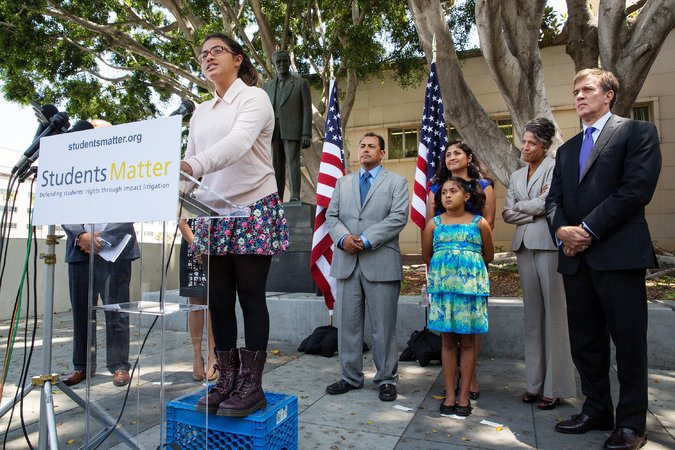
Vergara v. State of California is a meritless lawsuit brought by Students Matter, an organization created by Silicon Valley multimillionaire David Welch and a private public relations firm for the sole purpose of filing this suit. Students Matter is supported by Michelle Rhee and Students First, Parent Revolution Executive Director Ben Austin, Billionaire and school privatizer Eli Broad, former lawmaker Gloria Romero, and other corporate education reformers with an interest in privatizing public education and attacking teachers’ unions. The suit challenges California statutes governing due process in teacher dismissals, using experience as a criteria during school layoffs, and the two-year probationary period for teachers. The suit wrongly alleges those laws are unconstitutional and hurt students. The defendant in the suit is the State of California. CTA and the California Federation of Teachers (CFT) intervened in the case to ensure all stakeholders have input in educational policy decisions and to protect the rights of educators. 
Simply put, this lawsuit highlights the wrong problems, proposes the wrong solutions, and follows the wrong process. This is yet another attempt by the usual corporate special interests to undermine the teaching profession and push their agenda on California public schools and students. Circumventing the legislative process to strip teachers of their due process rights will not improve student learning, will make it harder to attract and retain quality teachers in our classrooms, and ignores all the research that shows experience is a key factor in effective teaching. This is a blatant effort to legislate from the bench, keeping parents and educators out of education policy decisions.  

What the media avoids about the Vergara decision

Wednesday, June 11, 2014

A victory for the corporate "reformers" in the Vergara v California case


California judge Rolf Treu ruled Tuesday  in the Vergara  v.California case that California teacher tenure laws deprive students of their right to an education that is guaranteed  under the state Constitution and violates their civil rights. The decision is a major defeat for teachers’ unions and will presumably lead to challenges of tenure laws in other states.  The ruling overturned five state statutes giving California teachers firing protections and rights to tenure and seniority.
The implementation of the ruling has been stayed while under appeal.
The Sacramento Bee editorial board and Bee columnists Marcos Breton and Dan Walters, along with their candidate Marc Tucker each applaud the court ruling. Note what they say in their columns. They applaud this defeat of the teachers unions, they do not deal with the critical issue of adequate school funding.
What do the  sides  agree upon?
It is clear that many students in California receive a substandard education and that failing schools are concentrated in poor and minority neighborhoods.   The judge cites the long history of  successful law suites Serrano V. Priest I, II. III, and more that mandated changes in state funding to provide equal funding.  There is also general agreement that teacher quality is a significant factor in improving education.
The problem is that the remedy of the corporate “reformers”  and of  the court does not resolve the basic issues.  It deals with teacher placement, tenure, and freedom of speech, not the adequate funding of schools.   It may at most respond to the 1-3 % of  poor teachers in the classrooms.
California is one of a number of states that require  in their state constitution  that the state provide  adequate public education.  This has been reaffirmed numerous times in Serrano v. Priest 1,2,, 3 and cited again in this court ruling.  

Tuesday, June 10, 2014

Corporate Democrats win first round against teachers in California

Jennifer Medina
June 10, 2014
The New York Times
The decision, which was enthusiastically endorsed by Education Secretary Arne Duncan, brings a close to the first chapter of the case, Vergara v. California, in which a group of student plaintiffs backed by a Silicon Valley millionaire argued that state tenure laws had deprived them of a decent education by leaving bad teachers in place.

Julia Macias, at a news conference Tuesday, was one of nine students who claimed tenure laws left bad teachers in place.,Monica Almeida/The New York Times ,


“It's surprising that the court, which used its bully pulpit when it came to criticizing teacher protections, did not spend one second discussing funding inequities, school segregation, high poverty or any other out-of-school or in-school factors that are proven to affect student achievement and our children." Randi Weingarten. President. American Federation of Teachers.
LOS ANGELES — A California judge ruled Tuesday that teacher tenure laws deprive students of their right to an education under the state Constitution and violate their civil rights. The decision hands teachers’ unions a major defeat in a landmark case, one that could radically alter how California teachers are hired and fired and prompt challenges to tenure laws in other states.
“Substantial evidence presented makes it clear to this court that the challenged statutes disproportionately affect poor and/or minority students,” Judge Rolf M. Treu of Los Angeles Superior Court wrote in the ruling. “The evidence is compelling. Indeed, it shocks the conscience.”
The decision, which was enthusiastically endorsed by Education Secretary Arne Duncan, brings a close to the first chapter of the case, Vergara v. California, in which a group of student plaintiffs backed by a Silicon Valley millionaire argued that state tenure laws had deprived them of a decent education by leaving bad teachers in place.Observers on both sides expect the case to generate more like it in cities and states around the country. David Welch, a Silicon Valley technology magnate, spent several million dollars to create the organization that brought the Vergara case to court — Students Matter — and paid for a team of high profile attorneys, including Theodore J. Boutrous Jr., who helped win a Supreme Court decision striking down California’s same-sex marriage ban. While the next move is still unclear, the group is considering filing lawsuits New York, Connecticut, Maryland, Oregon, New Mexico, Idaho and Kansas and other states with powerful unions where legislatures have defeated attempts to change teacher tenure laws.

Local Control FF and Parent Engagement in LAUSD


The video shows parent engagement in the Local Control Budget Funding in Los Angeles. In Sacramento a community coalition has formed and conducted similar forums.  Feedback from the forums became a proposal by the Community Coalition on the LCAP budget  to the Sacramento City Unified School Board on June 5.  A final budget, including LCFF funds, will be passed at the regular board meeting on June 19.  The Education and Democracy Institute is a member of the Community Coalition.  See prior posts on Local Control Funding 

Monday, June 09, 2014

Did Bill Gates fund an "educational coup?"

Valerie Straus,   The Answer Sheet.
 The Washington Post.
Education historian and activist Diane Ravitch, in a post on her blog about Layton’s story, called the Gates involvement an “educational coup.”
This is the closest thing to an educational coup in the history of the United States. Our education system is made up of about 14,000 local school districts; most education policy is set at the state level. But Bill Gates was able to underwrite a swift revolution. It happened so quickly that there was very little debate or discussion. Almost every consequential education group was funded by the Gates Foundation to study or promote the Common Core standards. Whereas most businesses would conduct pilot testing of a major new product, there was no pilot testing of the Common Core. These national standards were written with minimal public awareness or participation, and at least one state — Kentucky — adopted them before the final draft was finished.
Read the entire column. Fascinating.

Thursday, June 05, 2014

antiracismdsa: Latino Lawmakers Unveil Legislation to Repeal Un-...

 Latino Lawmakers Unveil Legislation to Repeal Un-...: SACRAMENTO – Announcing a campaign to erase the stain of Proposition 187, the most mean-spirited proposition in California’s history, to...

Sunday, June 01, 2014

SACRAMENTO PROGRESSIVE ALLIANCE: June 3 Voter Guide

SACRAMENTO PROGRESSIVE ALLIANCE: June 3 Voter Guide: Sacramento Progressive Alliance Voter Guide SAC PROGRESSIVE ALLIANCE ENDORSEMENTS: June 2014 Superintendent of Public Instruction...

Thursday, May 29, 2014

Vote for Torlakson - Important to vote on Tues.

From the LA Times.
In the June 3  contest to lead the state's public schools, the two front-runners represent opposing forces within education over how best to improve student achievement.
Tom Torlakson, the Democratic incumbent, champions teachers and their unions, which dislike the nation's growing reliance on standardized tests, call for more funding and fight against eroding job protections.
Marshall Tuck, the favorite of a core of philanthropists and activists, wants more limited job security for instructors as a way to weed out weak performers and improve the teaching corps. Also a Democrat, he talks of shaking up a system that has settled for gradual improvement in test scores and graduation rates. Before raising new revenue, he said, he would spend existing dollars more effectively.


"I try to channel my energy on things that can make a big difference. I'm focused on the big picture," says state Supt. of Public Instruction Tom Torlakson. (Gary Friedman / Los Angeles Times)
The nonpartisan race for the state superintendent of public instruction has become a window into differing, and influential, visions for public schools.
"These fights are very much playing out in the states, between the union wing and the education-reform wing," said Frederick Hess, director of education policy studies at the American Enterprise Institute, a conservative think tank in Washington, D.C.
"This is probably the highest-profile referendum that we're going to see this year," said Hess, who generally sides with the union critics he regards as reformers. See video ad below. 

Teacher Evaluation- James Popham

Sunday, May 25, 2014

Memorial Day - Remembrance and Resolve

 Memorial Day - Remembrance and Resolve: "As we approach Memorial Day, we need to think not only of remembering our fallen sons and daughters, but also to resolve to protect ...

Friday, May 23, 2014

Drop Student Debt

By  Thom Hartman,
Never in the history of the developed world has an entire generation had to go into debt just to get an education and a job. Until now.
Back in January, 31-year-old Tony Muzzatti, who at the time owed around $60,000 in student loan debt to Sallie Mae and always made on-time payments, was told that he had to immediately make a payment of $10,000, or face asset seizures.
That's because his grandmother, who also happened to be his cosigner on the student loans, had just died.
Christopher Kibler was also told by Sallie Mae that he had to immediately pay back nearly $22,000 in student loan debts after his father, the cosigner on his loans, had passed away.
Muzzatti and Kibler are just two of the many victims of what the Consumer Financial Protection Bureau refers to as "auto-defaults," or when banks immediately say that private student loan debts are in default after the death or bankruptcy of a cosigner.

Monday, May 19, 2014

Progressives take control of UTLA Teachers Union

For seven years, the 31,000 members of United Teachers Los Angeles, the largest local on the West Coast, have gone without a salary increase. Their contract has been expired for nearly three of those. And the teachers, counselors and school nurses that make up the UTLA can still be sent to so-called “teacher jail”—housed in district offices until they’re either fired or restored to their position, a process that can take months—when they’re accused of misconduct .
All of this, activists say, has left United Teachers Los Angeles disengaged and disillusioned. This was evidenced by the low turnout for the union election in late April, in which only 7,235 members—fewer than 25 percent of the UTLA—participated.
The results of that election, however, are perhaps an even greater indication that the UTLA is ready for a change. On April 29, social studies teacher and longtime union activist Alex Caputo-Pearl was elected as president of UTLA following a run-off with incumbent Warren Fletcher.

Thursday, May 15, 2014

California Schools- The Most Segregated State for Latino Students

California The Most Segregated State for Latino Students

Date Published: May 14, 2014
State Has Little to Celebrate 60 Years After Brown v Board of Education.

Related Documents
LOS ANGELES--Marking the 60th anniversary of the landmark U.S. Supreme Court decision Brown v Board of Education, the UCLA’s Civil Rights Project/Proyecto Derechos Civiles assessed California's progress in addressing school segregation, and found that California students are more racially segregated than ever.  In their new study, Segregating California’s Future: Inequality and its Alternative 60 Years after Brown v. Board of Education, the report authors conclude that California is the third worst state when it comes to school segregation for African Americans, behind New York and Illinois.  California is, however, the state in which Latino students are most segregated.
The Brown decision challenged the legitimacy of the entire "separate but equal" educational system of the South, and helped accelerate the march toward racial and social equality across the United States, but Brown impacted California very little. According to the report, various subsequent state court decisions resulted in California having no school integration policy, which allowed segregation to grown substantially in the past two decades.

Career Tech | Tom Torlakson

Tuesday, May 13, 2014

Brown V Board of Education at 60 !


Richard Rothstein
April 17, 2014
Economic Policy Institute
 
The Brown decision annihilated the “separate but equal” rule, previously sanctioned by the Supreme Court in 1896, that permitted states and school districts to designate some schools “whites-only” and others “Negroes-only.” But Brown was unsuccessful in its purported mission—to undo the school segregation that persists as a central feature of American public education today.


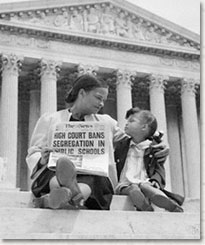
Mother (Nettie Hunt) and daughter (Nickie) sit on steps of the Supreme Court building on May 18, 1954, the day following the Court's historic decision in Brown v. Board of Education. ,Reproduction courtesy of Corbis Images,
 
 
May 17 is the 60th anniversary of Brown v. Board of Education, the U.S. Supreme Court’s 1954 decision that prohibited Southern states from segregating schools by race. The Brown decision annihilated the “separate but equal” rule, previously sanctioned by the Supreme Court in 1896, that permitted states and school districts to designate some schools “whites-only” and others “Negroes-only.” More important, by focusing the nation’s attention on subjugation of blacks, it helped fuel a wave of freedom rides, sit-ins, voter registration efforts, and other actions leading ultimately to civil rights legislation in the late 1950s and 1960s. But Brown was unsuccessful in its purported mission—to undo the school segregation that persists as a central feature of American public education today. This issue brief highlights key elements of the American education system that have evolved in the wake of Brown:

Monday, May 12, 2014

Chicago Teachers Union joins opposition to Common Core Standards

by ctu communications  |  05/07/2014

CHICAGO – Today, members of the House of Delegates (HOD) of the Chicago Teachers Union (CTU) passed the following resolution that enjoins the city’s educators to growing national opposition to the Common Core State Standards, saying the assessments disrupt student learning and consume tremendous amounts of time and resources for test preparation and administration.
Now that the resolution has passed, the CTU will lobby the Illinois Board of Education to eliminate the use of the Common Core for teaching and assessment; and be it further and will work to organize other members and affiliates to increase opposition to the law that increases the expansion of nationwide controls over educational issues.
Common Core’s origins can be traced to the 2009 Stimulus Bill which gave $4.35 billion to the federal Department of Education which created the “Race to the Top” competition between states. In order to qualify for funding, the states needed to adopt Common Core  with the added incentive that participating states would be exempted from many of the more onerous provisions of George Bush’s “No child left behind” program.

Sunday, May 11, 2014

More on Common Core

by Diane Ravitch

...Alexander ( a writer at Newsweek)  also seems never to have read the joint report by the American Educational Research Association and the National Academy of Education, which spelled out why it is wrong to judge teachers by student test scores because of the many factors affecting test scores that are beyond their control.
Newsweek writer Alexander says that some critics of Common Core are “conspiracy theorists who deem the whole project a massive payout to test maker Pearson.” That may or may not be true, but Common Core is certainly creating a huge national marketplace for Pearson and McGraw-Hill, as well as vendors of software and hardware (all Common Core testing is done online, which is diverting billions of dollars from school budgets). Perhaps Alexander has heard of the regular conferences for entrepreneurs devoted to the subject of monetizing the education industry and cashing in on the opportunities presented by Common Core.

Wednesday, May 07, 2014

Chicago Teachers Join National Opposition to Commo...

Schools Matter: Chicago Teachers Join National Opposition to Commo...: BY CTU COMMUNICATIONS   |  05/07/2014 CHICAGO – Today, members of the House of Delegates (HOD) of the Chicago Teachers Union (CTU) passe...

Funding for California schools is changing

Funding of California’s k-12 public education system is changing fundamentally.  Some schools will get much more money to educate kids.  It is critical that teachers, parents, and educational advocates get involved now. The centerpiece of the change  is the Local Control Funding Formula, designed to send additional funds to districts where  “the need and the challenge is greatest.”  The law requires that  parents, students, teachers, and other community members be involved in the process of deciding how new funds are spent. Ed Source has an excellent guide to these changes.

A recent PPIC poll revealed that over 70% of public school parents do not know that the funding process has changed and that they are invited to participate in making budget decisions.

The ACLU of California and Public Advocates have prepared materials in English and Spanish to assist community members to understand the Local Control Funding.
Sacramento City Unified’s plan for Local Control Funding is here.
·      LCAP Timeline and Process- Within a PowerPoint presentation, which the district provides on its website, SCUSD outlines its LCAP development process, Community Planning Process,  timeline, and lists potential community partners to engage with in LCFF implementation.
It tells you how you can get involved.


Other districts will have their plans up on web sites or School Board Agenda. This is an important time to get involved. 

Sunday, May 04, 2014

Thursday, May 01, 2014

Resistance to the Common Core Mounts

While the Sacramento Bee editorial board and several corporate education "reformers" castigate local teachers for opposing the imposed Core Waiver ( see below)..

The editorial board and the partisan advocates presenting themselves as leaders ignore the fact that Common Core is encountering more resistance around the country.  It is not a local, personal agenda. Nor is it just a union campaign.  There are substantive reasons why teachers oppose the imposed Core Waiver, and many oppose Common Core until weaknesses are remedied.

From Education Week.
Resistance to the Common Core Mounts
Critics span the political spectrum, from tea partyers to union leaders

After more than a year of high-profile and contentious debate over the Common Core State Standards in Indiana, Gov. Mike Pence signed legislation last month to formally reverse the state's adoption of the standards. The legislation set the state on course to replace those standards with ones "written by Hoosiers, for Hoosiers," the Republican governor proclaimed.
The same month, the Democratic-controlled New York Assembly approved a measure that would require a two-year delay in using assessments aligned with the common core for teacher and principal evaluations.
In some sense, the measures in Indiana and New York represent two dominant poles of the growing—and evolving—resistance to the standards. The common core has drawn criticism from both the political left and right, though much of it seems aimed not so much at what the standards say, but rather who drove their adoption or the tests and accountability policies connected with them.
 
Creative Commons License
This work is licensed under a Creative Commons Attribution-NonCommercial 3.0 Unported License.