Showing posts with label teachers unions. Show all posts

Tuesday, May 16, 2023

NYT. War on education and teachers' unions


The New York Times Magazine ran a cover story that platforms the conservative war on education


Instead of unpacking this manufactured attack on public schools, the Times found its villain in teachers and teachers unions

WRITTEN BY CHARIS HOARD & JASMINE GEONZON

PUBLISHED 05/09/23 1:17 PM EDT

The New York Times Magazine recently dedicated a multipage spread to the conservative war on public education, often legitimizing the political right’s advocacy for school choice vouchers and crusade against obscure concepts like "critical race theory.” 

In doing so, the magazine placed a target on the back of public education advocate and teachers union leader Randi Weingarten, gratuitously framing right-wing attacks on education as an organic result of the political climate, rather than as a manufactured onslaught spurred by conservative media.  


https://www.mediamatters.org/new-york-times/new-york-times-magazine-ran-cover-story-platforms-conservative-war-education


Monday, August 16, 2021

Unions and Covid - What Needs to be Negotiated

 What Needs to Be Negotiated?

Teacher Unions, the COVID Pandemic and Safe School Reopenings


by Leo Casey


What needs to be negotiated for U.S. K-12 schools to be reopened safely?


Quite a bit.


That statement may seem counterintuitive. We are now witnessing a potential unraveling of the hard-won progress in beating back the COVID-19 pandemic — and it is largely because of the failure of many of our fellow citizens to be vaccinated. Our patience is exhausted. Understandably, there is growing sentiment to simply mandate vaccines. For the frustrated, mandates — in schools and elsewhere — seem like an obvious step that would address the current crisis and put us back on track to controlling the pandemic. What is left to negotiate?


Yet the challenges are more complex. Yes, mass vaccination — over 90 percent of the population, such as countries like Iceland are well on their way to achieving — is an indispensable front in winning the fight against the COVID pandemic. Mandates can play an important role in getting to mass vaccination, and so they can and should be employed, particularly in healthcare, public safety, public education, mass transportation and other critical services. But it will require more than mandates to get us where we need to be with mass vaccination, and the mass vaccination that is now within our reach will not, by itself, be sufficient for schools to reopen safely this fall.


Let’s start with why mass vaccination is a positive, but not sufficient, condition for the safe reopening of schools. In fact, educators are already vaccinated at very close to the rates we need for the general population: both the AFT and the National Education Association calculate that somewhere in the vicinity of 90 percent of their K-12 educator members are vaccinated. This achievement comes in part because of the prodigious work of teacher unions to get their members vaccinated. A vaccination mandate for educators could improve that rate, and so is worth doing, but we need to be clear that it will be improvement largely at the margins: the numbers of unvaccinated educators are relatively small, and they include people who have genuine medical reasons and sincere religious beliefs for not being vaccinated and people who will leave teaching rather than be vaccinated. (Part of what must be negotiated is the procedures for identifying authentic medical and religious exemptions.)


More importantly, the most critical challenge of a safe reopening of schools is not the status of educators, with their high rates of vaccination, but that of students. In pre-K through 7th grade, none of the students will be vaccinated this fall, and in the higher grades, we have yet to reach a 50 percent vaccination threshold. So, vaccination will provide essential protection to the adult educator in the classroom, but that protection will be missing for the 15 to 30 students in the class who are unvaccinated. While as a rule the severity of the COVID disease declines with age, the ability to transmit the virus does not. If students communicate the virus to each other in the classroom — and here we must take into account the much greater transmissibility of the now dominant Delta variant — they will become vectors for the spread of the COVID virus to their families and to the community at large. And that would be very bad news for containing the pandemic.


Schools may be able to require vaccinations for students down the road, much as we currently require vaccinations for measles and mumps, but that is just not within our reach now — and the danger of a resurgence of the pandemic is now. So, the safe reopening of schools will depend not just on the vaccination of educators, but on employing mitigation strategies that reduce and abate the potential for transmission among students — the use of masks, physical distancing, appropriate ventilation, and regular and full cleaning of classrooms. The critical battle in the safe reopening of schools is around employing these mitigation strategies, especially universal masking. We must be able to turn back the efforts of elected officials like Florida’s governor, Ron DeSantis, who is doing everything in his power to try to undermine universal masking in Florida’s schools, even as his state leads the nation in the resurgence of the pandemic with its highest daily number of new COVID cases — including cases among children — since the start of the pandemic. (It is telling that the reflexively anti-union commentators who were quick to attack teacher unions for saying that negotiations over these matters are necessary, like New York magazine’s Jonathan Chait, have managed to overlook DeSantis’ attacks on mask mandates.)


The experience of teachers and their unions throughout the last year and a half is that left to their own predilections, too many school districts and local and state governments will not employ these mitigation strategies in the comprehensive ways that are required. The strategies can be costly (retrofitting poorly maintained school buildings with appropriate ventilation) and logistically difficult (finding space for smaller classes that allow for physical distancing). Even the easiest of these strategies to implement — universal masking — can become a subject of contention in an era where science and public health have been under attack by public figures like DeSantis. Moreover, the challenges to implementing these mitigation strategies are greater in schools that serve working-class and poor communities and communities of color, as their buildings are often aged and in poor repair and their class sizes are larger. Taking on the necessary work of mitigation strategies in schools is not for the faint-hearted.


Add to this on-the-ground reality a likely scenario for how vaccine mandates would roll out. There will certainly be legal challenges, and it is probable that courts will hold the mandates in abeyance while the issue is adjudicated. It is by no means certain that this Supreme Court would rule in favor of mandates, despite clear precedents for them. As a consequence, vaccine mandates will not be immediate fixes, but — assuming the Supreme Court does not strike them down — more medium- and long-range tools in the pandemic. It is essential that other means of achieving mass vaccination — education campaigns, incentive programs and requirements of weekly and even twice weekly COVID testing of the unvaccinated working in critical services such as education — not be abandoned in the name of pursuing mandates, but instead intensified.


In sum, vaccination mandates are not a “magic bullet” in the fight against COVID but one of many tools that need to be employed. We need all the tools we can muster in this battle, so mandates should be supported, but we also need to be clear about all that is needed to safely reopen schools and contain the pandemic. The common good of achieving both of these objectives is best met when teachers and their unions have a voice in the pandemic-related policies and practices of their schools, and when local school districts are required to negotiate these matters with them.


Leo Casey is the former director of the Albert Shanker Institute and is currently assistant to the president of the AFT.


Leo Casey

Assistant to the President

American Federation of Teachers

555 New Jersey Avenue N.W.

Washington, D.C. 20001


LCasey@AFT.ORG

202-879-4552


https://aftvoices.org/what-needs-to-be-negotiated-a65af72e067b


Monday, September 24, 2018

Charter Schools Money Pouring in to Superintendent Race


Both sides of California’s neoliberal divide will find something to like in “Getting Down to Facts II,” the sweeping new report on the state of public education released this week by Stanford University and PACE (Policy Analysis for California Education). The good news: Overall test scores and high school graduation rates are improving, the achievement gap is narrowing, and out-of-school suspensions and school expulsions are decreasing. The bad: This progress has been limited, and California’s education landscape continues to be rife with inequality.
Some highlights:
·      California will need to find an additional $22.1 billion per year to give all kids an adequate education.
·      The state’s charter authorization, oversight and renewal laws are a hot mess, though urban charters score well for academic growth.
·      California lags behind most states in providing medical and mental health services, as well as school counselors.
·      California’s highest-needs schools get stuck with the least-experienced and worst-paid principals.
·      All the progress with new standards, curriculum, instruction and assessments is under threat by the qualified-teacher shortage crisis.
EdSource is predicting that this year’s race for California Superintendent of Public Instruction will be the most expensive ever. Again. With seven weeks to go before Election Day, the same pro-privatization billionaires that in 2014 unsuccessfully poured $10.4 million into unseating current state schools chief Tom Torlakson have already surpassed that amount in new fundraising for Marshall Tuck. That leaves the teachers-backed candidate, Assemblyman Tony Thurmond(D-Richmond), at a two-to-one money disadvantage.

Thursday, June 28, 2018

Teachers' Unions in a Post _ Janus World

Excellent piece.  Concrete ideas.

https://rethinkingschoolsblog.com/2018/06/26/transforming-teacher-unions-in-a-post-janus-world/

Monday, February 22, 2016

Teachers Hold Walk-In Protests in 30 Cities

Samantha Winslow, Labor Notes 


After a wave of teacher protests around the country, unions are coordinating nationally.
 
In 900 schools in 30 cities—from Houston to Miami, Patterson to Pittsburgh—teacher unions participated in “walk-ins” yesterday to “reclaim our schools.”
 
The walk-in tactic was inspired by North Carolina teachers, who organized a series of these grassroots protests across the state in 2013 against education cuts. Other teacher unions soon picked up the idea.
 
Teachers gather 30-40 minutes before work, often wearing union T-shirts or colors. They meet with parents, school employees, and education activists; take pictures; talk to media and elected officials; and then all walk into school in unison.
 
In Minnesota, the St. Paul Federation of Teachers held walk-ins at every school during its 2014 contract campaign, helping to test the union’s strength as it prepared for a potential strike over staffing, class sizes, and over-testing.

Sunday, July 26, 2015

Another Attack on Teachers' Unions


Harold Meyerson.
About a month ago, the Supreme Court closed out its term in a blaze of nonpartisan glory. Or nonpartisan obloquy, depending on one’s reaction to the court’s legalization of same-sex marriage and its upholding of Obamacare — but nonpartisan either way. A court with a Republican-appointed majority upheld a Democratic president’s health insurance program and a marital policy that most Republican officeholders felt obliged to oppose (even if most Republican political consultants felt relieved to see gay marriage rendered a fait accompli).
But that was then. In the term that will begin this fall, the court has a splendid opportunity to deliver the most partisan decision it has rendered since Bush v. Gore. When the court rules in Friedrichs v. California Teachers Association , which will be argued in the coming months, the Republican-appointed justices will be able, if they so choose, to create a long-term advantage for their party over the Democrats.
Friedrichs is a case brought by a California teacher who objects to paying dues to the union that has bargained the contract that secures her pay and benefits. The union does not collect any money from her to support its political activities, but, by virtue of the court’s 1977 Abood decision, and hundreds of later decisions based on Abood, she is obliged to pay that portion of her dues that goes to bargaining and administering her contract. That obligation, the court ruled in Abood, is essential if public employees are to have an effective right to collective bargaining. If employees can benefit from union representation without funding the union, the court reasoned, the union could be weakened to the point that it couldn’t represent those employees adequately, if, indeed, at all.

Thursday, July 02, 2015

The Next Effort to Break Teachers' Unions

Friedrichs v. California Teachers Association 
Randi Weingarten

The anti-worker forces that are trying to break our union just got a big break from the United States Supreme Court. This morning, the court agreed to hear the case Friedrichs v. California Teachers Association during its next term.

Make no mistake: This case is not about individual liberty or the First Amendment. It is an outright attack against unions to prevent us from representing our members and using our voices to fight for our families, our schools, our colleges, our healthcare facilities and our communities.

We’re preparing a national campaign to mobilize our members and communities across the country to fight for an America where everyone’s voice matters. Sign up to join when we launch later this summer.

This case would undermine our unions and challenge nearly 40 years of precedent—and the court agreed to hear it barely a year after it dealt a blow to workers with its decision in Harris v. Quinn. In fact, the conservative justices on the court used the Harris v.Quinn ruling to invite cases like this one, showing just how political they really are.

Saturday, December 20, 2014

Democracy, Schools, and Teachers' Unions

Leo Casey 
Over the course of the last 12 weeks, I have been thinking about our conversations here on democracy, schools, and teachers' unions. We write under the banner of "bridging differences," and notwithstanding our broad agreement on most important questions we have discussed, there are "differences" that could be teased out of the dialogue.
At the outset, I must confess that I am deeply suspicious of efforts to identify "differences" with those who share most of our view of the world. The impulse to draw "lines of demarcation" around ourselves takes an almost pathological form among many on the American left, a "narcissism of small differences" in which the main political fire is invariably aimed at those who are politically nearest. It creates a political culture where vanguard politics fades into Puritanism: The moral purity of the self-anointed elect is preserved, but at the price of complete political marginality and irrelevance. I have no taste for such political fare.
But let us see if we can arrive at a more productive discussion of our political differences. You ask "Do teachers' unions truly practice democracy?" I could point to the literature on union democracy and to the organizational features that it identifies as crucial for union democracy, and demonstrate how teachers' unions not only possess those features, but possess them in greater measure than other unions.[1]
But there is a more fundamental disagreement at work here: I think your query is the wrong question. When I think about such matters, I ask myself different questions. "At a time that teachers' unions face existential threats, how do we defend the democratic voice that they provide teachers?" "How can we strengthen the voice that unions provide teachers, making teachers' unions more democratic?"

Thursday, July 17, 2014

The Democratic Party's Divide on Education - Teachers Unions

Democratic Party’s Divide on Education Policy gets Worse
Jeff Bryant
Political pundits who try to tamp down talk of divisions within the Democratic Party must not be paying any attention to education policy.
For quite some time, close observers of the nation’s education policy have been calling attention to the fault lines between education progressives in the Democratic Party and Third Way-style centrists, such as Secretary of Education Arne Duncan and Democrats for Education Reform, who lean toward a market-based, econometric philosophy for public education governance.
As Furman University education professor Paul Thomas recently wrote for Alternet, “While the Obama administration has cultivated the appearance of hope and change, its education policies are essentially slightly revised or greatly intensified versions of accountability reform begun under Ronald Reagan.”
But the Democratic Party’s divergence from real progressive values for governing our schools mostly went unnoticed in major media outlets until recently when a few light bulbs went off among political observers. Writing for Slate, Matt Yglesias noticed, “Education reform, not ‘populism’ divides Democrats.” Then, Connor Williams of the New America Foundation saw the light and explained for The New Republic, “In 2016, Democrats have good reason to run against Obama’s education record.”
Now, Jonathan Chait has penned a piece for New York Magazine, “Teachers Unions Turn Against Democrats,” in which he postulates that a “backlash” to President Obama’s education policies, energized by education historian Diane Ravitch, could lead to an alliance between teachers unions and, gulp, Republicans.

Sunday, July 06, 2014

Breton repeats deeply flawed Vergara claims

Sacramento Bee opinion columnist Marco Breton published a piece on Sunday,  July 6, noting that Progress ( on race relations) has been slow since the 1994 campaign of California  Proposition 187. The first half of the article where he recounts the history of the Prop. 187 effort is reasonably  well done.  The second half, where he uses Prop. 187 as a means to blame teachers for low school performance does not have evidence to support it.  He takes up the Vergara case, a topic of several posts here.  Breton cites the opinion of Judge Rolf M True. 
 Here is a response to Breton’s assertions by Jeff Bryant.
The campaign against public school teachers and their unions has evolved from casting insults to inflicting real injury. The recent ruling by a California judge in the Vergara v. California case made it a legal precedent to equate teachers’ employment security to an affront to students’ rights to a quality education.

Tuesday, June 10, 2014

Corporate Democrats win first round against teachers in California

Jennifer Medina
June 10, 2014
The New York Times
The decision, which was enthusiastically endorsed by Education Secretary Arne Duncan, brings a close to the first chapter of the case, Vergara v. California, in which a group of student plaintiffs backed by a Silicon Valley millionaire argued that state tenure laws had deprived them of a decent education by leaving bad teachers in place.

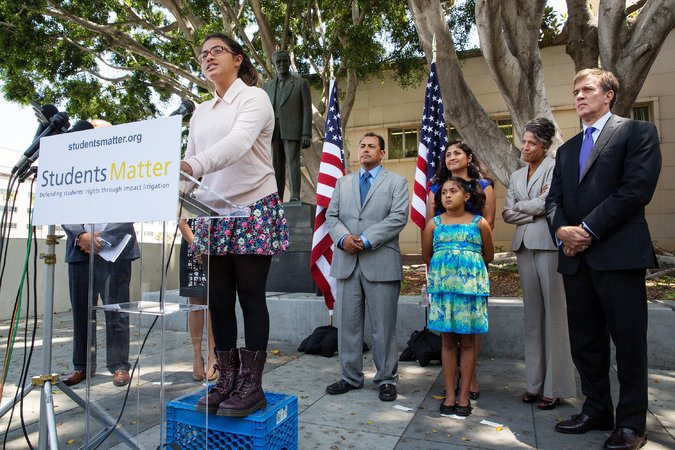
Julia Macias, at a news conference Tuesday, was one of nine students who claimed tenure laws left bad teachers in place.,Monica Almeida/The New York Times ,


“It's surprising that the court, which used its bully pulpit when it came to criticizing teacher protections, did not spend one second discussing funding inequities, school segregation, high poverty or any other out-of-school or in-school factors that are proven to affect student achievement and our children." Randi Weingarten. President. American Federation of Teachers.
LOS ANGELES — A California judge ruled Tuesday that teacher tenure laws deprive students of their right to an education under the state Constitution and violate their civil rights. The decision hands teachers’ unions a major defeat in a landmark case, one that could radically alter how California teachers are hired and fired and prompt challenges to tenure laws in other states.
“Substantial evidence presented makes it clear to this court that the challenged statutes disproportionately affect poor and/or minority students,” Judge Rolf M. Treu of Los Angeles Superior Court wrote in the ruling. “The evidence is compelling. Indeed, it shocks the conscience.”
The decision, which was enthusiastically endorsed by Education Secretary Arne Duncan, brings a close to the first chapter of the case, Vergara v. California, in which a group of student plaintiffs backed by a Silicon Valley millionaire argued that state tenure laws had deprived them of a decent education by leaving bad teachers in place.Observers on both sides expect the case to generate more like it in cities and states around the country. David Welch, a Silicon Valley technology magnate, spent several million dollars to create the organization that brought the Vergara case to court — Students Matter — and paid for a team of high profile attorneys, including Theodore J. Boutrous Jr., who helped win a Supreme Court decision striking down California’s same-sex marriage ban. While the next move is still unclear, the group is considering filing lawsuits New York, Connecticut, Maryland, Oregon, New Mexico, Idaho and Kansas and other states with powerful unions where legislatures have defeated attempts to change teacher tenure laws.

Thursday, May 01, 2014

Resistance to the Common Core Mounts

While the Sacramento Bee editorial board and several corporate education "reformers" castigate local teachers for opposing the imposed Core Waiver ( see below)..

The editorial board and the partisan advocates presenting themselves as leaders ignore the fact that Common Core is encountering more resistance around the country.  It is not a local, personal agenda. Nor is it just a union campaign.  There are substantive reasons why teachers oppose the imposed Core Waiver, and many oppose Common Core until weaknesses are remedied.

From Education Week.
Resistance to the Common Core Mounts
Critics span the political spectrum, from tea partyers to union leaders

After more than a year of high-profile and contentious debate over the Common Core State Standards in Indiana, Gov. Mike Pence signed legislation last month to formally reverse the state's adoption of the standards. The legislation set the state on course to replace those standards with ones "written by Hoosiers, for Hoosiers," the Republican governor proclaimed.
The same month, the Democratic-controlled New York Assembly approved a measure that would require a two-year delay in using assessments aligned with the common core for teacher and principal evaluations.
In some sense, the measures in Indiana and New York represent two dominant poles of the growing—and evolving—resistance to the standards. The common core has drawn criticism from both the political left and right, though much of it seems aimed not so much at what the standards say, but rather who drove their adoption or the tests and accountability policies connected with them.

Monday, July 22, 2013

The War on public school teachers

Michael D. Yates
July 22, 2013
The Bullet
 
If those who are prosecuting this onslaught against our public schools succeed, they will have made workers more insecure, created a compliant, alienated, and low-wage labour force, and devised new ways to make money – a massive testing industry, for-profit schools, consulting services. They will also have put another nail in the coffin of democracy.


The U.S. working-class was slow to respond to the hard times it faced during and after the Great Recession of 2007-2009. Finally, however, in February, 2011, workers in Wisconsin began the famous uprising that electrified the country, revolting in large numbers against Governor Scott Walker's efforts to destroy the state's public employee labour unions.

Saturday, April 20, 2013

The Fight Against Teachers Unions

by Leo Casey

Michelle Rhee and others, on teacher unions.
How does that compare to the resources and spending of the leading education reform actors? In a matter of days after she publicly announced the formation of StudentsFirst, an explicitly anti-union political lobbying organization, Michelle Rhee had raised pledges of more than $100 million, with a goal of raising $2 billion over five years. Rhee’s donors list includes many high profile corporate leaders and foundations with an anti-union bent, including Murdoch (NewsCorp), Walton Family (Wal-Mart), Fisher (The Gap), Langone (Home Depot), Tepper (Appaloosa), Arnold (Enron), New York City Mayor Bloomberg (Bloomberg Inc.), Fournier (Pennant), Loeb (Third Point), Tudor Jones (Tudor Investment) and Broad (SunAmerica-AIG). [8]
And StudentsFirst is only one of many such organizations. Wealthy individuals and foundations are literally pouring billions of dollars into various anti-union, privatization and corporate “education reform” efforts on a scale that teacher unions could never hope to match. [9]…

As one examines the issues, the struggles over the future of public education and teachers unions in America comes to resemble the classic populist conflict of wealth and money on the one side and masses of ordinary people on the other. One cannot understand the real power and role of teacher unions, nor the balance of political power between unions and their corporate-funded opponents, without coming to grips with this central premise. And, in truth, when attacks on pubic education and teacher unions are cast as a concerted campaign by the rich and powerful against ordinary working teachers, they lose a considerable portion of their potency. [16]
By Leo Casey.  The Shanker Institute.
Read the entire essay. http://shankerblog.org/?p=8177

Wednesday, November 14, 2012

Teachers' Unions and School Reform - Diane Ravitch


How Teachers Unions Lead the Way to Better Schools

    Diane Ravitch upends the "bad teachers" narrative.

By Amy Dean

I have a concern: Teachers are getting pummeled. Too often,
they are being demonized in the media and blamed by
politicians for being the cause of bad schools. Right-wing
governors, power-hungry mayors and corporate "reformers" -
all ignoring root issues such as poverty and inequality -
have scapegoated the people who have devoted their lives to
educating our children. Moreover, these forces are seeking
to destroy the collective organizations formed by educators:
teachers unions.

The stakes for our country could not be more profound. The
labor movement and the public education system are two
critical institutions of American democracy. And they are
two that go hand in hand. Teachers unions have played a
critical role in advocating for public education, but you'd
never know it from mainstream media coverage. Therefore,
there is a great need to lift up this tradition and
highlight the efforts of teachers to collectively push for
top-notch public schools.

To figure out how we can push forward on this issue, I
talked with Diane Ravitch, one of the country's leading
education historians and public school advocates. A
professor at New York University, Ravitch is a former
Assistant Secretary of Education and the author of several
books, including 2010's The Death and Life of the Great
American School System: How Testing and Choice Are
Undermining Education.

Monday, September 03, 2012

Mayor Kevin Johnson and the next anti teacher union film


On Monday afternoon - Labor Day _ , a Hollywood film called "Won't Back Down" -- will be shown   in Charlotte, Los Angeles Mayor Villariagosa  is scheduled to speak on a panel at the theater, joined by Michelle Rhee of StudentsFirst, Ben Austin of Parent Revolution, and Sacramento, Calif., Mayor Kevin Johnson. Newark, N.J., Mayor Cory Booker will also speak at the event.
"Won't Back Down" stars Maggie Gyllenhaal as a single mother determined to get her daughter out of their failing public elementary school and Davis as a teacher at the school who joins with her to gather parent and teacher signatures behind a It's a movie about the push for school choice, a movement that has been gaining momentum around the country for the past several years. It is also a film about teachers' unions, who are one of the Democratic Party's biggest and most loyal sources of political contributions.
Randi Weingarten, president of the American Federation of Teachers, the nation's second largest teachers' union, blasted the film in an open letter this past week, calling it "divisive" and saying it "resorts to falsehoods and anti-union stereotypes."
"The film contains several egregiously misleading scenes with the sole purpose of undermining people's confidence in public education, public school teachers and teachers unions," Weingarten wrote.

Tuesday, August 28, 2012

It wasn't Wall Street Bankers - it was the Teachers' unions.


The looting of the U.S. and the economic crisis were not caused by Wall Street and the corporations,  it was the Teachers’ Union.
Chris Christie.
At the Republican convention.


"Now having squandered trillions on mismanaged wars, tax cuts designed especially for the rich, a gigantic real estate bubble, and massive bailouts for its banks, the United States is confronting a major fiscal problems.  At the same time, America’s fundamental economic competitiveness has declined severely, as its physical infrastructure, broad band services, educational system, workface skills, health care and energy policies have failed to keep pace with the needs of the advanced economy. ….
The principal reason for this is that politically powerful interest groups have been able to block reform: the financial services, energy, defense, telecommunications, pharmaceutical, and processed food industries, the legal, accounting, and medical professions; and to a lesser extent, several unions- these and other groups , including, of course, lobbyists and politicians, have ferociously resisted efforts to improve  America’s future at their expense.
            Meanwhile, both political parties are ignoring, lying about, and/or exploiting the country’s very real economic, social, and educational problems."
Charles H. Ferguson,   Predator Nation; Corporate Criminals, political corruption, and the Hijacking of America.  2012.

Monday, March 26, 2012

How the anti tax argument is framed


Well. The Sacramento Bee certainly found a conservative voice for the attack on the proposed tax measures  to be faced by voters in fall 2012.  Lets look at the distractions Ben Boychuk  throws up and the issues he chose to not discuss in his piece in the Sacramento Bee for March 22,2012.
First,   in arguing that “Progressives are deluding themselves”   he describes  Governor Brown and SEIU as moderates, then he labels the California Federation of Teachers as  “ far left”.  The reason for this name calling approach to argumentation?  To criticize the compromise tax proposals worked out by Governor Brown, the various unions and the California Federation of Teachers  last week.
 Boychuk    goes on to make the argument that the very wealthy should not be taxed more  and to claim that those who argue for more taxes are “ far left”.  This is a ploy.
If you are standing as far right as the Boychuk’s employer the  Manhattan Institute then almost everyone appears to be on the far left. See the conservative Manhattan Institute web page at  www.city-journal.org   Under the label “make the rich pay” Boychuk  accurately  calculates  how much the wealthy currently pay, but he does tell you that the wealth pay less as a percentage of the income on taxes than do all the rest of us- the 90%. 
A report of the California Budget Project notes that “measured as a share of family income”, California’s lowest-income families pay the most in taxes. The bottom fifth of the state’s families, with an average income of $12,600, spent 11.1 percent of their income on state and local taxes.  In comparison, the wealthiest 1 percent, with an average income of $2.3 million, spent 7.8 percent of their income on state and local taxes.”

Thursday, December 29, 2011

The Assault on Teachers' Unions


The Assault on Teachers’ Unions
By Richard D. Kahlenberg
Teachers’ unions are under unprecedented bipartisan attack. The drumbeat is relentless, from governors in Wisconsin and Ohio to the film directors of Waiting for “Superman” and The Lottery; from new lobbying groups
like Michelle Rhee’s StudentsFirst and Wall Street’s Democrats for Education Reform to political columnists such as Jonathan Alter and George Will; from new books like political scientist Terry Moe’s Special Interest and entrepreneurial writer Steven Brill’s Class Warfare to even, at times, members of the Obama administration. The consistent message is that teachers’ unions are the  central impediment to educational progress in the United States. Part of the assault is unsurprising given its partisan origins. Republicans have long been critical, going back to at least 1996, when presidential candidate Bob Dole scolded teachers’ unions: “If education were a war, you would be losing it. If it were a business, you would be driving it into bankruptcy. If it were a patient, it would be dying.” If you’re a Republican who wants to win elections, going after teachers’ unions makes parochial sense.

Monday, October 24, 2011

Teachers Union supports Occupy Wall Street


by Leo Casey
Leo Casey
Over the last few weeks, a small team of New York City building inspectors descended upon UFT headquarters, responding to a mysterious 311 call. Our building has been placed under police surveillance, and at times police have been posted as guards at our doors.
The One Percent appears to be a tad bit irritated by the UFT’s support for the Occupy Wall Street movement. We were one of the unions who took the lead in organizing the October 5th rally and march which brought out thousands of New York’s working people to express their solidarity with Occupy Wall Street. UFT President Mulgrew has been at Zuccotti Park a number of times, speaking to the assembly, and was joined by AFT President Weingarten on one occasion. Our headquarters are a few blocks away from Zuccotti, and we have provided space for meetings of different groups supporting OWS. We have also given over a major section of our street level space to storage for OWS, for donations of materials and supplies sent to them and for the stowing of personal belongings on the morning when Bloomberg threatened to “cleanse” Zuccotti. This was the space that the building inspectors suddenly needed to inspect.

Oh, and last weekend, we sent forty sandwiches left from our conference for charter school educators over to Zuccotti. I had not thought much of that donation until Fox Business Network senior correspondent Charles Gasparino called the UFT on Monday. It seems that Gasparino had visited Zuccotti over the weekend and decided that it was a haven for communists. And he had witnessed the masses at Zuccotti eating our sandwiches. Why, he demanded to know, was the UFT providing sustenance to violent revolutionaries? Confronted with the results of Gasparino’s crackerjack investigative reporting, I decided that it is time to confess. Yes, I authorized that sandwich smuggling operation.
 
Creative Commons License
This work is licensed under a Creative Commons Attribution-NonCommercial 3.0 Unported License.