Showing posts with label segregation. Show all posts

Tuesday, June 11, 2019

West Sacramento Charter Schools

Have West Sacramento Charters Become Self-Segregated Enclaves?
Borders, boundaries and barriers have been a way of life in the lower Sacramento Valley since the Gold Rush days. The newest form of green line here are charter schools.


Valuable description of charters and their claims.

Wednesday, June 18, 2014

Separate and Unequal continues

Sixty Years after Brown v. Board, Segregation Ensures That Schools Are not only Separate, but Sharply Unequal

“Though we made significant progress closing race-based gaps during the 1970s and 1980s, we have since reversed those gains, and students are segregated by both race and income as early as kindergarten,” said Garcia. “The segregation that so many of our children experience at school entry and, assuming it continues similarly, throughout their education, impedes their odds of success, and appears to pose particular disadvantages for black and Hispanic children.”
Minority students are not only much more likely than their white counterparts to be in heavily minority schools, but also to be surrounded by peers from low-income families. Three-fifths (60.5 percent) of white kindergartners are in classrooms in which only about 12 percent of their classmates are poor. Among black and Hispanic students, nearly as great a share (56.5 percent and 55.2 percent, respectively) are in classrooms in which nearly half of their peers are poor, while less than 5 percent of white children are in such heavily poor classrooms.
While the family characteristics of white children vary relatively little depending on the type of classroom they are in (unless that classroom is very heavily minority), family characteristics of black and Hispanic children vary substantially by their type of school. In extremely heavily minority schools, mothers of all racial groups are less educated than their average counterparts. Hispanic mothers are only half as likely to have at least a bachelor’s degree than the average Hispanic mother (2.5 percent versus 5.6 percent). Even in these schools, mothers of white children are no less likely to have bachelor’s degree, although these white moms are slightly more likely than average white moms to have no more than a high school diploma. These numbers reflect added disadvantage for minority students in two respects. First, the large proportion who attend heavily minority schools are disproportionately poor and their moms less educated. Second, the very few minority children in heavily white schools have a constellation of socioeconomic advantages that are extremely rare among their families.
Academic performance varies greatly, depending on the school’s level of segregation; the more heavily minority the school makeup, the less prepared students are on average in the fall, and the smaller their relative gains by spring. White, black, and Asian kindergarten students with better-than-average performance in the fall assessment are all clustered in schools with proportions of minority students between 10 and 50 percent. In contrast, the white students with the weakest school readiness skills attend the most heavily minority schools. Among Hispanic kindergartners, too, the highest-performing are in schools with a very low proportion of minority students, while Hispanic students in schools with 50 percent minority students or more start off less prepared than the average Hispanic student.
Finally, the authors’ findings appear to support more sophisticated analyses’ suggestions that income segregation underlies many apparent negative consequences of racial segregation. They recommend further research to determine whether this segregation persists through children’s later years and, more critical, the degree to which the patterns they find regarding the interactions among race, social class, and peer and school characteristics have independent impacts on children’s development.
“Instead of addressing ongoing school segregation, current policies not only dismiss segregation’s impacts but in some cases perpetuate and compound them,” said Weiss. “Factors such as families’ backgrounds and resources, peer effects, and school resources must all be considered when ensuring that future education policies are better aligned and more comprehensive.”
Published by the Economic Policy Institute. 

Note: a prior post chronicled how California schools were the most segregated and unequal for Latino Students.  

Tuesday, May 13, 2014

Brown V Board of Education at 60 !


Richard Rothstein
April 17, 2014
Economic Policy Institute
 
The Brown decision annihilated the “separate but equal” rule, previously sanctioned by the Supreme Court in 1896, that permitted states and school districts to designate some schools “whites-only” and others “Negroes-only.” But Brown was unsuccessful in its purported mission—to undo the school segregation that persists as a central feature of American public education today.


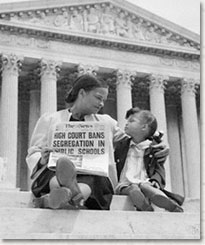
Mother (Nettie Hunt) and daughter (Nickie) sit on steps of the Supreme Court building on May 18, 1954, the day following the Court's historic decision in Brown v. Board of Education. ,Reproduction courtesy of Corbis Images,
 
 
May 17 is the 60th anniversary of Brown v. Board of Education, the U.S. Supreme Court’s 1954 decision that prohibited Southern states from segregating schools by race. The Brown decision annihilated the “separate but equal” rule, previously sanctioned by the Supreme Court in 1896, that permitted states and school districts to designate some schools “whites-only” and others “Negroes-only.” More important, by focusing the nation’s attention on subjugation of blacks, it helped fuel a wave of freedom rides, sit-ins, voter registration efforts, and other actions leading ultimately to civil rights legislation in the late 1950s and 1960s. But Brown was unsuccessful in its purported mission—to undo the school segregation that persists as a central feature of American public education today. This issue brief highlights key elements of the American education system that have evolved in the wake of Brown:

Monday, November 18, 2013

How our public schools became a threat.

How our Public Schools Became a 'Communist Threat'

By Paul Buchheit

Heartland Institute President Joseph Bast called the public school system a "socialist regime." Michelle Rhee cautions us against commending students for their 'participation' in sports and other activities.
Privatizers believe that any form of working together as a community is anti-American. To them, individual achievement is all that matters. They're now applying their winner-take-all profit motive to our children.

We're Sliding Backwards, Towards "Separate and Unequal"

In 1954, the Supreme Court decision in Brown vs. the Board of Education seemed to place our country on the right track. Chief Justice Earl Warren said that education "is a right which must be made available to all on equal terms." Thurgood Marshall insisted on "the right of every American to an equal start in life."

Sunday, October 20, 2013


The Black Parallel School Board 
Southeast Village Neighborhood Association
Presents
A Community Forum featuring
Dr. Jesus Hernandez, sociology professor at UC Davis
“Residential Segregation and School Closures”  
Free and open to the public!!!
Thursday, October 24, 2013 from 5:30pm -8:00pm
George Sim Community Center, 6207 Logan Street, Sacramento, CA  95824
Our Co-Sponsors: (partial list): Stephanie Francis, Parent, African Research Institute, Alpha Academy Program , Suzanne Brooks , Concerned African American Parents of Elk Grove, Democracy and Education Institute ,  Mexican American Digital History Project, Sacramento Progressive Alliance, DSA (Sacramento), Sac Cultural Hub, Sacramento Area Black Caucus, Order Of Olufunmi , Friends of Sabeel -- Sacramento Region, Chicano Consortium of Sacramento and Sacramento City Teachers Association, Avondale Glen Elders Neighborhood Association (AGENA), Hmong Innovating Politics (HIP), Bernard A. Goldberg, Capital Region Organizing Project (CROP), Sacramento ACLU Chapter of Northern California,  Master Barber & Beauty Shop and The Talking Drums News.

Tuesday, February 09, 2010

Charters and school segregation


New study looks at segregation in charter schools

My guest is Kevin G. Welner, professor of education policy and program evaluation in the School of Education at the University of Colorado at Boulder, and director of theEducation and the Public Interest Center. He can be reached at welner@colorado.edu.

By Kevin G. Welner
The Washington Post published an article last Wednesday about a study from UCLA’s Civil Rights Project/Proyecto Derechos Civiles which analyzed charter schools across the country and found them to be substantially more racially isolated than traditional public schools. The study has received quite a bit of attention, as well as pushback from charter school advocates.

Today, CU-Boulder’s policy center, along with its partner policy center at Arizona State University (collectively, EPIC/EPRU) is releasing a studyhttp://epicpolicy.org/publication/schools-without-diversity that, coincidentally, asks some of the same questions as the UCLA study did.
Our study provides a comprehensive examination of enrollment patterns in schools operated by private corporations and finds these schools to be segregated by race, family income, disabilities and English language learner status. As compared with their local public school districts, these schools operated by Education Management Organizations, or EMOs, are substantially more segregated, and the strong segregative pattern found in 2001 is virtually unchanged through 2007.
 
Creative Commons License
This work is licensed under a Creative Commons Attribution-NonCommercial 3.0 Unported License.