Showing posts with label students. Show all posts

Friday, September 13, 2024

Civic Education for Students


The Office of California Secretary of State Shirley N. Weber, Ph.D., would like to invite you to our upcoming 2024 California College Civic and Voter Empowerment Summit.  

We would also greatly appreciate your help with spreading the word about this important event. Please share the information below with your networks, college students and anyone who would benefit from learning about college civic and voter empowerment and the upcoming General Election on Tuesday, November 5, 2024.  


Event Details 


Join California Secretary of State Shirley N. Weber, Ph.D., and the Students Vote Project for important updates on the 2024 General Election. Learn from civic engagement leaders, enhance campus civic involvement, and participate in a virtual internship fair for college students. 


Wednesday, October 9, 2024 
10 a.m. – 12 p.m. PDT 

Topics to include: 
  • Importance of Voting Rights and Civic Engagement  
  • Civic and Voter Empowerment Coordinator “Best Practices” Panel 
  • Presentation on “What is on the Ballot?”  
  • Virtual California State Internship Fair for College Students 


View social media graphics and flyer for the virtual meeting: drive.google.com/drive/folders/14fKu4UMu9WeZTGI7tmCFAZm19i-kHlvt


Thank you for helping us spread the word! If you have any questions, feel free to reach out to us at caststudentsvote@sos.ca.gov.  


For media requests, please contact sospress@sos.ca.gov.


Saturday, May 18, 2024

Abuse of Power : Sonoma State


 A friend of mine Ed Lee.  A  colleague at Sacramento State University. Then, a college president.  Just got dismissed for talking with the students.


https://www.sacbee.com/news/politics-government/capitol-alert/article288535505.html


This act is an abuse of power. 


Here is an example of an alternative.  

https://www.insidehighered.com/opinion/views/2024/03/25/cease-fire-now-neutrality-complicity-opinion


Wednesday, January 12, 2022

15,000 Sac City Students Went Without a Regular Teacher Today. Tomorrow Will Likely Be Worse.

15,000 Sac City Students Went Without a Regular Teacher Today. Tomorrow Will Likely Be Worse.: As Superintendent Jorge Aguilar Continues to Demand $10,000 Per Year Cut in Teacher Take-Home Pay While Taking a New, Massive Increase in Total Compensation for Himself The crisis for students at Sac City continues to worsen. Since classes resumed on January 3, the number of students without a regular teacher in the classroom has skyrocketed […]

Sunday, January 03, 2021

Are Children Falling Behind?


Teresa Thayer Snyder 
December 12, 2020
I sincerely plead with my colleagues, to surrender the artificial constructs that measure achievement and greet the children where they are, not where we think they “should be.”

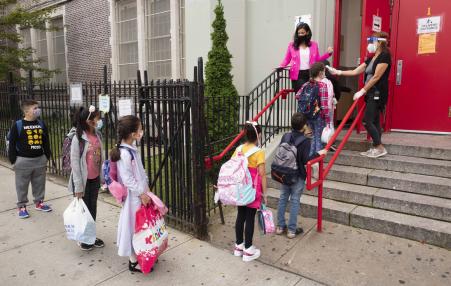
Students line up to have their temperature checked before entering PS 179 elementary school in the Kensington neighborhood, Sept. 29, 2020 in Brooklyn, AP Photo/Mark Lennihan // Politico


Dear Friends and Colleagues:

I am writing today about the children of this pandemic. After a lifetime of working among the young, I feel compelled to address the concerns that are being expressed by so many of my peers about the deficits the children will demonstrate when they finally return to school. My goodness, what a disconcerting thing to be concerned about in the face of a pandemic which is affecting millions of people around the country and the world. It speaks to one of my biggest fears for the children when they return. In our determination to “catch them up,” I fear that we will lose who they are and what they have learned during this unprecedented era. What on earth are we trying to catch them up on? The models no longer apply, the benchmarks are no longer valid, the trend analyses have been interrupted. We must not forget that those arbitrary measures were established by people, not ordained by God. We can make those invalid measures as obsolete as a crank up telephone! They simply do not apply. 

When the children return to school, they will have returned with a new history that we will need to help them identify and make sense of. When the children return to school, we will need to listen to them. Let their stories be told. They have endured a year that has no parallel in modern times. There is no assessment that applies to who they are or what they have learned. Remember, their brains did not go into hibernation during this year. Their brains may not have been focused on traditional school material, but they did not stop either. Their brains may have been focused on where their next meal is coming from, or how to care for a younger sibling, or how to deal with missing grandma, or how it feels to have to surrender a beloved pet, or how to deal with death. Our job is to welcome them back and help them write that history.

I sincerely plead with my colleagues, to surrender the artificial constructs that measure achievement and greet the children where they are, not where we think they “should be.” Greet them with art supplies and writing materials, and music and dance and so many other avenues to help them express what has happened to them in their lives during this horrific year. Greet them with stories and books that will help them make sense of an upside-down world. They missed you. They did not miss the test prep. They did not miss the worksheets. They did not miss the reading groups. They did not miss the homework. They missed you.

Resist the pressure from whatever ‘powers that be’ who are in a hurry to “fix” kids and make up for the “lost” time. The time was not lost, it was invested in surviving an historic period of time in their lives—in our lives. The children do not need to be fixed. They are not broken. They need to be heard. They need be given as many tools as we can provide to nurture resilience and help them adjust to a post pandemic world.

Being a teacher is an essential connection between what is and what can be. Please, let what can be demonstrate that our children have so much to share about the world they live in and in helping them make sense of what, for all of us has been unimaginable. This will help them– and us– achieve a lot more than can be measured by any assessment tool ever devised. Peace to all who work with the children!

[Teresa Thayer Snyder was superintendent of the Voorheesville district in upstate New York. She wrote this essay on her Facebook page.]


Tuesday, May 05, 2020

Impact of Covid on Latino Students


Town Hall for #EdJustice:
The Impact of COVID-19 on Latino Students and Educators

Video is here,


The League of United Latin American Citizens (LULAC) and the National Education Association (NEA) will be hosting the #EdJustice Town Hall tomorrow with the National Immigration Law Center and the Hope Center for Wellness for a comprehensive discussion on COVID-19 and its impact on Latino students and families. The virtual town hall will be moderated by María Peña, a journalist and digital reporter at Telemundo News.
The conversation will address virtual learning, strengthening access to school safety nets, mental health resources, and supporting and advocating for our immigrant and undocumented families.
We will also address the conditions under which schools could reopen and what they may look like once students return.
Join us as we come together to discuss ways we are responding to this crisis and working to ensure that our public schools help all students pursue their dreams regardless of where they come from, what they look like, or where they live.

Wednesday, December 12, 2018

Keeping the Dream Alive

·      Students participate in a panel discussion during the "Keeping the Dream Alive" gathering in the University Union Ballroom on Dec. 3. (Sacramento State)
Hundreds of educators and allies of so-called Dreamers filled the University Union Ballroom at Sacramento State for the third annual “Keeping the Dream Alive” conference, where personal stories of hope provided inspiration for those looking to improve the college experience for undocumented students. 
The Dec. 3-4 conference highlighted best practices to promote success, remove barriers and reduce fear for students laboring under ongoing uncertainty about the future of DACA (Deferred Action for Childhood Arrivals) and the program’s protection for Dreamers, whose status remains at risk.
“ 'Keeping the Dream Alive’ is about moving forward ... education in the K-12, community college and higher-education system (for students) who are seeking to advance their lives, become educated, and contribute to society,” said Viridiana Diaz, assistant vice president of strategic diversity initiatives.
The conference provided an opportunity to share knowledge, expertise and emerging practices on topics from supporting resource centers and safe spaces for undocumented high school students to maximizing funding for college and finding legal solutions.
This year’s theme, “Rising Beyond the Unimaginable: Visionary Approaches to Promoting Success Among Undocumented and Mixed-Status Students,” has special significance in the current national political climate, University President Robert S. Nelsen said.
“With DACA still in limbo, our students continue to face uncertainty about their future," said Nelsen, a member of the Presidents’ Alliance on Higher Education and Immigration. "Now more than ever, we have a responsibility to intensify our efforts and show them just how deeply we care and that we plan to support them despite the actions or inactions of our government.” 
Alma Valverde, a dream center coordinator at Santa Rosa Junior College, was among more than 300 participants seeking practical knowledge to share.
“I want to bring back a lot of ideas on how to increase student activism and awareness and intercampus collaboration and relations with the high schools,” said Valverde. “The variety of interests has stood out so far to me, so it’s not just supporting a section of students, it’s also how to develop allies.”
Amanda Staack, an undocumented-center advisor at Humboldt State University, also hopes to become an agent of change within the CSU.
“Scholars without Borders is a student-run center, so we’re looking to find ways to navigate and find resources on our campus, and also to institutionalize it and to make connections with other people and what they’re doing,” she said.
Attendees heard stories about personal struggles related by speakers such as Aurora Chang, assistant professor and program chair in Higher Education at Loyola University’s School of Education.
Chang, once an undocumented immigrant from Guatemala, was reared in a family of eight in Richmond. She encouraged participants to “write the text you have always dreamed of reading,” telling them “our stories are our resistance.”
Author and inspirational speaker Reyna Grande echoed that advice, telling her story of entering the United States illegally and eventually becoming the first person in her family to graduate from college.
“One of the things I thought when I succeeded crossing the border after my third attempt, I thought there would be no more borders for me to cross," she said. "And then I realized that I came to a country that loves to put up borders for its immigrant populations, so I have been crossing borders ever since.” 
In 2015, the University opened its Dreamer Resource Center that provides academic and financial guidance, access to legal immigration services, and support for 500-800 students each year. For more information, visit the Dreamer Resource Center website. - Anita Fitzhugh

-->CSU Media Services

Sunday, October 28, 2018

Teachers Respond to Hate


As I stood at a vigil at Temple Emanuel in New York City today to honor the Tree of Life synagogue victims, I couldn’t stop thinking about how hate has become a fact of life in our country.


Hateful rhetoric and words of incitement have fueled heinous acts of violence across our nation over the past week: pipe bombs mailed to elected officials and the media, a racially motivated shooting at a Kroger grocery store after a failed church attack, and, yesterday, the most deadly anti-Semitic attack in our nation’s history. Political violence that once seemed unimaginable now seems inevitable—the result of hate being normalized and divisions stoked by those in power. This is a moment of crisis for our communities that we have not experienced in decades.


We are in pain, but our pain can’t immobilize us; we must act, and that starts with voting on Nov. 6.


On Tuesday night, one week before the midterm election, we’re holding a telephone town hall, with partners including MoveOn, the NAACP and other progressive groups, about what’s happened in the last week and what we’re doing about it. Sign up here, and we’ll make sure you’re on the call.


The sad truth is that no matter how much we plead for Donald Trump to change, he won’t. He can’t. He’s so caught up in his quest for praise and power that he seems incapable of reflection on, much yet empathy for, what’s happened to America during his tenure and his role in enabling such division and polarization. Despite these three terrible acts in the last week, at the hands of assailants who self-identify as anti-immigrant, anti-Semitic, racist white supremacists who have embraced Trump’s words and deeds, the president is still using the same tactics and exacerbating the same shameful divisions.

Thursday, March 22, 2018

March for Our Lives


This weekend, students will join together at March For Our Lives in Washington, D.C., and in sibling marches across the country. It takes a lot of courage to stand up to Congress and state legislatures to demand measures that will protect them at their schools and in their communities.

Sunday, February 18, 2018

Gun Violence in Schools

I spent yesterday in Broward County, Fla., simply trying to help.
I met with educators and school staff from Stoneman Douglas High School and so many other schools—union members from Broward Teachers Union who spent hours at our afternoon meeting. They are feeling and expressing every emotion possible right now. 
Let’s take a moment to appreciate the Stoneman Douglas staff, who on 2/14 performed acts of selfless heroism to protect their kids from bullets, hiding them in closets and keeping them calm.
I met with educators who lost their colleagues and the students they loved. 
I heard from students who sheltered in closets, who lost their friends, who wrote texts to their families thinking they had one last opportunity to say they loved them, and who are now speaking out and demanding action. As Emma Gonzalez said, “We are going to be the kids you read about in textbooks. Not because we're going to be another statistic about mass shooting in America, but because, just as David said, we are going to be the last mass shooting.”

Friday, October 20, 2017

California to Become an (Almost) Sanctuary State


By Duane Campbell

 California Governor Jerry Brown signed into law SB 54 on Thursday Oct 5, the "California Values Act", which built upon the landmark Trust Act to help protect California immigrant residents from deportations. It is commonly known as the “Sanctuary State” act.

Immigrant communities around the state led the fight for the bill, which is considered a "foundation" for additional legislation. The bill was amended to include criticisms and restrictions insisted upon by Governor Brown.  This sanctuary state act contributes to building community and state-level resistance to the White House attacks against the growing "sanctuary" movement among communities, institutions and local and state governments in California.  

As signed, the bill does away with several local deportation practices, such as local police arrests for "civil immigrant warrants", and it helps to ensure that spaces like schools, health facilities, courthouses and other spaces are safe and accessible to all. 

State Senate President Kevin de Leon, the lead author of the bill said, “With today’s signing of SB 54 into law, one of the most important parts of that legal wall of protections is now in place. Donald Trump and Jeff Sessions will not be able to use California’s own law enforcement officials in an effort to round up and deport our fellow Californians.”

The law will go into effect January 1, 2018. Elements of the bill are already in place in numerous cities throughout the state.

Wednesday, September 13, 2017

A Guide for Teachers: Immigrant and Refugee Children

Now, more than ever, these vulnerable students need advocates in schools.


Teaching Tolerance, Issue 55, Spring 2017
December 8, 2016

This guide was created for educators, school support staff and service providers who teach, mentor and help open the doors of opportunity for undocumented youth and unaccompanied and refugee children currently living in the United States. Educators, school support staff and service providers are often the first individuals a student and/or family comes out to as undocumented.

Moreover, they are often the first ones to witness the impact of increased enforcement measures on students and their families.

Schools should be safe havens that embrace all students and families, regardless of citizenship and national origin, and that includes unaccompanied and refugee children. The 1982 U.S. Supreme Court case Plyler v. Doe ruled that undocumented children have a constitutional right to receive a free public K–12 education, which provides the means to becoming a “self-reliant and self-sufficient participant in society,” the court wrote, and instills the “fundamental values necessary to the maintenance of a democratic political system.” However, today’s increased enforcement measures by the Department of Homeland Security and campaign promises made by the incoming administration threaten that right for thousands of undocumented youth and the 4.1 million U.S.-born children who live in mixed-status households with at least one parent or family member who is undocumented.
Note: SCUSD has declared its school sites Safe Grounds and prohibits ICE from enforcement action at the school site.


Facts About Undocumented Students

An undocumented student is an aspiring citizen who came to the United States without legal documentation or who has overstayed his or her visa. These students:
Often don’t know they are undocumented until they begin the college application process;
Don’t qualify for federal grants or loans, even if they are in financial need and their parents pay taxes;
Are racially and ethnically diverse, from all corners of the world, and are part of the 11.5 million undocumented immigrants in the United States.


Educator's FAQ About Immigration Raids
What impact do raids have on children and youth?

Saturday, March 25, 2017

A Guide for Teachers on Immigrant Children and Trump Attacks on Immigrants

 Tools and Resources to help protect immigrant youth and their families in case of ICE, immigration, raids and enforcement efforts.
Prepared by the American Federation of Teachers.
Excellent resources.
Downloadable copy  at aflcio.org/immigrationresources

Monday, March 20, 2017

CTA: A Call to Action for the Public Education All California's Students Deserve


Public education is the foundation of our 21st-century democracy. Social justice for all begins with a quality, free public education. Our public schools are where our students come to be educated in the fullest sense of that word, including as citizens of this great country. As educators, we strive every day to make every public school and college a place where we prepare the nation's young people to contribute to our society, economy and citizenry. 
California must continue to lead the nation. The 325,000 members of CTA are committed to making sure all California's students get the public education they deserve. We ask all Californians, including elected leaders regardless of party affiliation, to join us in supporting a strong, inclusive, safe and innovative public education system that ensures all students can succeed, regardless of their zip code. Our public schools must remain centers of our communities, and not become corporate profit centers. We hold these values because all children, regardless of family circumstances, where they live, where they were born, how they look, who they love, or the language they speak have the right to a public education that helps them reach their full potential. 

Participate in May 1 actions.
Why May 1?

May 1st has been historically linked to international worker' rights. On May 1, 1886, the U.S. Federation of Organized Trade and Labor Unions (including immigrant workers) ruled that an 8-hour work day, would be a full and legal work day. NEA and the Alliance to Reclaim Our Schools (AROS) are also holding a national day of action on May 1. May 1, or May Day, continues to be a national day of action to raise awareness about immigration rights and the need to keep families together as they fight for a better life.  How can I get involved?

CTA is asking our local chapters and members to hold actions with parents and community members at their local school sites. Actions may include "walk-ins" with parents and community members, unveiling new safe zone policies and safe zone resolutions, taking the pledge, hosting community meetings, and more. Please join our Facebook group and fill out our form to let us know how you are participating.


Saturday, December 10, 2016

Los Angeles, Sacramento School Districts Declare Themselves Safe Zones for Immigrant Children

Sacramento Bee: Sacramento City Unified School District trustees voted unanimously Thursday, Dec. 8,  to declare district schools “safe havens” that protect students against deportation and hate speech.
The resolution is a response to the “intolerant rhetoric made over the course of the 2016 presidential race” and reports of increased hate speech at district schools, according to the document.
The three-page resolution specifies that immigration officials cannot enter campuses without written permission of the superintendent and that the district will restrict sharing of student files that could help determine the legal status of students. It also calls for activities on all campuses to promote tolerance and urges investments in programs to promote the “values of a multicultural society.”

Los Angeles, the nation’s second-largest school system sent a message to President-elect Donald Trump: Los Angeles’ public schools will continue to be “safe zones” for students in the U.S. illegally.
The Los Angeles Board of Education voted to approve a resolution reaffirming L.A. Unified’s current policy, which directs school staff members not to allow federal Immigration and Customs Enforcement agents onto school campuses unless their visit has been approved by the superintendent and the district’s lawyers. Board members also seconded a policy that protects the immigration information and identities of students, family members and school staff.


Creative Commons License
This work is licensed under a Creative Commons Attribution-NonCommercial 3.0 Unported License.