Showing posts with label union. Show all posts

Wednesday, March 01, 2023

Candidate for Chicago Mayor

Throughout his campaign, Johnson made fighting inequality across the city a central theme, prioritizing working-class communities while taxing Chicago’s wealthy. He received major backing from the CTU and United Working Families, a coalition of left-wing organizations and unions that has become a highly influential player in city politics over the past decade. He also received support from national groups like the Working Families Party.

Johnson’s ascent sets up a stark choice for Chicago voters, who will decide in April whether to embrace a progressive approach to urban politics or return to the neoliberal model that created many of the problems now plaguing the city. Crime, in particular, will be central to the campaign, making the runoff a test case of whether Johnson’s anti-carceral, pro–social services approach can defeat a traditional law-and-order, reactionary appeal by Vallas.

A Movement Mayor?

Johnson got his start teaching in Chicago Public Schools (CPS) in 2007, first at Jenner Elementary in the Cabrini-Green neighborhood on the Near North Side and later Westinghouse College Prep on the West Side. He then joined CTU’s staff alongside its then president Karen Lewis, who helped reshape the union into a democratic and militant force that fought austerity not only in public education but in city politics generally. In that role, Johnson helped coordinate the historic 2012 teachers strike, worked to block school privatization schemes, joined hunger strikers at the shuttered poor and working-class Dyett High School and successfully advocated for its reopening, and fought to win an elected school board (rather than one handpicked by the mayor), which finally became law in 2021.

In 2018, Johnson was elected to the Cook County Board, where he continues to serve. In office, he has sponsored the Just Housing Amendment, which ended discrimination against the formerly incarcerated, as well as the Budget for Black Lives, which helped lead to a multimillion-dollar investment in community resources and violence prevention — including affordable housing, health care, and other supports — as part of the 2021 Cook County budget. Johnson also helped to create a program aimed at canceling up to $1 billion in medical debt, secure legal representation for immigrant refugees facing deportation, and launch a guaranteed income pilot that offers $500 per month to thousands of low-income residents.

In his mayoral run, Johnson’s stated priorities include increasing funding to neighborhood schools, year-round youth employment programs, reopening the city’s public mental health clinics shuttered by former mayor Rahm Emanuel, reducing fares on public transit, investing in new affordable housing, and instituting a “Chicago Green New Deal” to boost environmental protections. To pay for this agenda, Johnson proposed a real estate transfer tax on luxury home sales, a financial transaction tax, a head tax on large, profitable companies that do business in the city, and new user fees for high-end commercial districts. According to Johnson, “The ultra-rich and large corporations continue to benefit from the subjugation and the isolation of poverty, and my budget plan speaks to these critical investments.”

When it comes to public safety, which played a central role in the mayor’s race, Johnson plans to pass the “Treatment Not Trauma” ordinance advanced by socialist city council member Rossana Rodriguez, which would create a hotline to deal with crisis response, invest in violence prevention programs, end no-knock warrants, establish a dedicated office to deal with illegal guns, and end the city’s gang database, which opponents have claimed in a class action lawsuit is racially discriminatory.

Taken together, Johnson’s agenda represents a profound break from the corporate-friendly politics that have dominated Chicago in the neoliberal era. As the leader of the third-largest city in the country, a Mayor Johnson could be positioned to usher in a new era of urban progressivism unseen in recent memory, if he and the forces supporting him can overcome the massive pushback that capital will mobilize against him.

In order to win, however, he will first have to overcome both a well-financed opponent and a political and economic establishment fully at odds with his platform, especially as it relates to the issue of policing.

Johnson made it to the runoff — even while competing for liberal votes against GarcĂ­a, who was the standard-bearer of left-wing politics in the city’s mayoral race two cycles ago — by articulating a progressive approach to crime that does not include massively expanding policing. He noted on the campaign trail that the Chicago Police Department’s budget of $1.94 billion is “bigger than it’s ever been, and we’re still not safe. 

From Jacobin. 

Tuesday, August 23, 2022

Join the March for Farm Worker Justice

 Our August 3 to 26 peregrinacion has followed the same route as our historic 1966 Cesar Chavez-led march. Our goal is to convince Governor Gavin Newsom to sign #AB2183 (Stone), the United Farm Workers’ bill making it easier for farm workers to vote in a union election free from intimidation by grower foremen, supervisors and farm labor contractors.

An incredible group of 19 permanent farm worker peregrinos have marched the entire length of the peregrinacion. They have given up wages, time with their family, and the comfort and security of their home to march in temperatures frequently exceeding 100 degrees.

The journey has been pretty incredible. Last Saturday, Martin Luther King III joined us on the march. His father, Rev. Dr. Martin Luther King Jr., stood in solidarity with Cesar Chavez during tough times in the 1960s. That afternoon, 1,000 supporters greeted us in Stockton during 104-degree heat. UFW co-founder Dolores Huerta was there inspiring the crowd.

Community enthusiasm across the state has built as hundreds greeted our marchers along the route and joined end-of-day rallies in valley farm towns. Local committees in each town which our march has passed through have provided food, water, cold drinks, shoes and other supplies, plus housing. Nurses tended to marchers. Supporters from near and far turned up to hand out water, drinks, popsicles and food as the peregrinos passed by. 

It’s been beautiful to see the youth out supporting us as our march has moved through the Central Valley. Our eyes tear up as a new generation is activated to honor the past and mobilize for the future.

CA Governor Gavin Newsom vetoed a similar measure last September. What’s different this year is increased public support, including solid backing by the California labor movement under its new leader, Lorena Gonzalez, as well as union, religious, and community leaders, activists and organizations.

Please come and be a part of this historic event. If are not able to be there in person, you can still join us virtually. Many options, including the ones above, can be found at ufw.org/camarch.

PS: Please share this event on Facebook & Twitter

Monday, April 19, 2021

FARM WORKERS NEED A UNION - AND WE DO TOO

A DEMOCRATIC FOOD SYSTEM MEANS UNIONS FOR FARMWORKERS
By David Bacon
Food First, 4/14/21
https://foodfirst.org/publication/a-democratic-food-system-means-unions-for-farmworkers/
https://davidbaconrealitycheck.blogspot.com/2021/04/a-democratic-food-system-means-unions.html


BURLINGTON, WA - Migrant indigenous farm workers on strike against Sakuma Farms, a large berry grower in northern Washington State, blocked the entrance into the labor camp where they live during the picking season.  The strikers wanted to stop the grower from bringing in contract guest workers from Mexico to do the work they usually do every year.


The people who labor in U.S. fields produce immense wealth, yet poverty among farmworkers is widespread and endemic.  It is the most undemocratic feature of the U.S. food system. Cesar Chavez called it an irony, that despite their labor at the system's base, farmworkers "don't have any money or any food left for themselves."  

Enforced poverty and the racist structure of the field labor workforce go hand in hand.  U.S. industrial agriculture has its roots in slavery and the brutal kidnapping of Africans, whose labor developed the plantation economy, and the subsequent semi-slave sharecropping system in the South.  For over a century, especially in the West and Southwest, industrial agriculture has depended on a migrant workforce, formed from waves of Chinese, Japanese, Filipino, Mexican, South Asian, Yemeni, Puerto Rican and more recently, Central American migrants.  

The dislocation of communities produces this migrant workforce, as people are forced by poverty, war and political repression to leave home to seek work and survive.  Any vision for a more democratic and sustainable system must acknowledge this historic reality of poverty, forced migration and inequality, and the efforts of workers themselves to change it.

California's Tulare County, for instance, produced $7.2 billion in fruit, nuts and vegetables in 2019, making it one of the most productive agricultural areas in the world. Yet 123,000 of Tulare's 453,000 residents live below the poverty line.  Over 32,000 county residents are farmworkers; according to the US Department of Labor the average annual income of a farmworker is between $20,000 and $24,999, less than half the median U.S. household income.  

Poverty has its price.  It has forced farmworkers to continue working during the COVID-19 pandemic, although they are well aware of the danger of illness and death.   As the gruesome year of 2020 came to an end, Tulare County, where the United Farm Workers was born in the 1965 grape strike, had 34,479 COVID-19 cases, and 406 people had died.  That gave it infection and death rates more than twice that of urban San Francisco, or Silicon Valley's Santa Clara County.  COVID rates follow income.  Median family annual income in San Francisco is $112,249 and in Santa Clara it's $124,055.  Half of Tulare County families, almost all farmworkers, earn less than its median $49,687.  

Democratizing the food system starts with acknowledging this disparity and seeking the means to end it.  And in fact, the broader working class of California has concrete reasons for supporting farmworkers.  COVID and future epidemics, for instance, do not stay neatly confined to poor rural barrios, but spread.  Pesticides that poison farmworkers remain on fruit and vegetables that show up in supermarkets and dinner tables.  Labor contractors and temporary jobs were features of farmworker life long before precarious employment spread to high tech and became the bane of UBER drivers.  


CHUALAR, CA - Members of the United Farm Workers on strike against D'Arrigo Brothers, demanding a contract. Early in the morning striking farmworkers stop a bus bringing strikebreakers into a field.


The rural legacy of economic exploitation and racial inequality was challenged most successfully in 1965, when the grape strike began first in Coachella, and then spread to Delano.  It was a product of decades of worker organizing and earlier farm worker strikes, and took place the year after civil rights and labor activists forced Congress to repeal Public Law 78 and end the bracero contract labor program.  

The grape strike was a fundamental democratic movement, started by rank-and-file Filipino and Mexican workers.  Although some couldn't read or write, they were politically sophisticated, had a good understanding of their situation, and chose their action carefully.  Growers had pitted Mexicans and Filipinos against each other for decades.  When Filipinos acted first by going on strike, and then asked the Mexican workers, a much larger part of the workforce, to join them, they believed that workers' common interest could overcome those divisions.  Their multi-racial unity was a precondition for winning democracy in the fields.

Philip Veracruz, a Filipino grape picker who became a vice-president of the UFW, wrote during the strike's fourth year:  "The Filipino decision of the great Delano grape strike delivered the initial spark to explode the most brilliant incendiary bomb for social and political changes in U.S. rural life."

The strike's impact was enormous.  Fifteen years after it started, farmworkers achieved the highest standard of living they've had in the years before or since.  In the union contracts negotiated in the late 1970s the base wage was 2.5 to 3 times the minimum wage of the time, the equivalent in California of what would be $37-45 per hour today.  The worst pesticides were banned, and for a decade union hiring halls kept labor contractors out of the fields.

By striking, farmworkers in 1965 were demanding the democratization of the food system.  Winning the first and most basic step - a union contract - required overcoming the division between rural and urban people.  Workers left the fields, traveled across the country, recruited allies, and stood in front of stores in the cities, appealing to consumers not to buy the struck grapes.  Of all the achievements of the farmworkers' movement, its most powerful and longest enduring was the boycott.  It leveled the playing field in the fight with agricultural corporations over the right to form a union, and led to the most powerful and important alliance between unions and communities in modern labor history.
    
Farm worker strikes have traditionally been broken by strikebreakers, and all too often, drowned in blood and violence.  No country has done more than the U.S. to enshrine the right of employers to break strikes.  From their first picket lines in Delano, members of the new union, the United Farm Workers, watched in anger as growers brought in crews of strikebreakers to take their jobs.  The boycott couldn't end the violence, but after farm workers crossed the enormous gulf between the fields and the big cities, they didn't have to fight by themselves.

The boycott was a participatory, democratizing strategy, and since then it has become a powerful tool for community-based union organizing.  Today alliances between unions and communities are a bedrock of progressive activism.  Farmworker strikes and boycotts helped develop this strategy, and gave the UFW its character as a social movement.  

In 2013 farmworkers used that experience when they went on strike against the Sakuma Brothers blueberry farm in Burlington, Washington.  For four years they combined strikes in the fields with a boycott of Sakuma's main client, Driscoll's, the world's largest berry distributor.  Their campaign succeeded in winning a union contract, and developed new ways to fight for rural democracy.


OXNARD, CA - The family of Lino Reyes are Mixtec migrants from San Martin Peras in Oaxaca.  He and his wife work in the strawberry fields, and live in the garage of a house on the outskirts of town.


Since the mid-1980s a growing part of the migrant flow into U.S. fields has come from the states of southern Mexico, especially the indigenous Mixtec, Triqui and other communities of Oaxaca and the most remote parts of Mexico's countryside.  Migrants speaking the languages of these towns formed a new union in the heat of the Sakuma strike, Familias Unidas por la Justicia.  Their fight for higher wages was closely bound to the right to speak Mixteco and Triqui, and to develop indigenous culture in rural Washington state towns two thousand miles from their home villages.  Their struggle for cultural rights expanded the meaning of rural democracy.

The strike at Sakuma Farms started when the company made obvious its intention to replace its existing workers with a new set of migrants, recruited in Mexico and brought to the U.S. in the H2-A visa program.  The union fought successfully for the rights and jobs of Sakuma's existing employees, the Mixteco and Triqui farmworkers already living and working in the U.S.  But in the years that followed their union also became the primary source of support for H2-A workers themselves, when they protested about abusive conditions.  

Familias Unidas organizers came to the defense of workers at one company, who were fired and forced to leave the U.S. after protesting the death of an H2-A worker, Honesto Silva.  They helped guestworkers on other farms protest exhausting production quotas.  And when H2-A workers began to get sick and die after contracting the coronavirus in their crowded living quarters, Familias Unidas por la Justicia sued the state over grower-friendly regulations that allowed the virus to spread.

Sakuma Farms workers discovered in the course of their strike that the U.S. food system is a transborder system.  In 2015 a similar strike movement began in Baja California, among the strawberry pickers at Driscoll's and other growers in the San Quintin Valley.  Workers there come from the same towns in Oaxaca, even the same families, as the strikers in Washington State.   Both groups found that challenging the big growers, and winning the right to a voice over working and living conditions, ultimately means cooperation and solidarity across the U.S./Mexico border.

The largest agricultural employers have responded to demands by workers for economic and racial democracy by proposals to expand the H2-A contract labor system, criticized for being "close to slavery."  The largest recruiters of H-2A workers have enormous influence over immigration policy. With no limits on the number of visas issued annually, their recruitment of workers has mushroomed from 10,000 in 1992 to over 250,000 in 2020 - a tenth of the U.S. agricultural workforce.

Their principal proposal in Congress today is the Farm Workforce Modernization Act.  It sets up the conditions for enormous growth in the H2-A program, and would likely lead to half the farm labor workforce in the U.S. laboring under H2-A visas within a few years. The bill will prohibit undocumented workers from working in agriculture, while implementing a restrictive and complex process in which some undocumented farmworkers could apply for legal status.

Instead of competing for domestic workers by raising wages, growers seek a supply of H2-A workers whose wages stay only slightly above the legal minimum.  This system then places workers with H-2A visas into competition with a domestic labor force, depressing the wages of all farmworkers.  As the program grows, domestic workers have to compete with growers for housing, and rents rise.  When guest workers are pressured to speed up their work, an exhausting work pace spreads to the other farmworkers around them.


MATTAWA, WA - An H2-A worker on strike at the King Fuji apple ranch.  Photo by Edgar Franks.


For farmworkers trying to organize and change conditions, the H2-A program creates enormous obstacles.  When H-2A workers themselves try to change exploitative conditions, employers can terminate their employment and end their legal visa status, in effect deporting them. Workers are then legally blacklisted, preventing their recruitment to work in future seasons.  Farmworkers living in the U.S., thinking about organizing or going on strike, have to consider the risk of being replaced.

Growers threaten that if wages rise, consumers will have to pay much higher prices for food.  Yet a woman picking strawberries in a California field gets less than 20¢ for each plastic clamshell box, which sells in the supermarket for $3-4.  Doubling her wage would hardly change the price in the store.   Yet the food system is built on her poverty, and growers' efforts to build a labor force of temporary workers cements that poverty into place.

Democracy in the fields is based on the idea that farmworkers belong to organic communities - that they are not just individuals without family or community, whose labor must be made available at a price growers want to pay.  When Familias Unidas por la Justicia set up a coop to grow blueberries, Tierra y Libertad, it sought to create instead a new basis for community,  a system in which workers could make the basic decisions as a community - about what to grow, how land should be used, and how to share the work without exploitation.

Rosalinda Guillen, the daughter of a farmworker family and founder of Communty2Community, the main support base for the strikers at Sakuma Farms, believes that a democratic system for food production can't be achieved if farmworkers continue to be landless.  "The value of what we bring to a community is blatantly waved aside," she charges.  "We're invisible.  Our contributions are invisible.  That's part of the capitalist culture in this country.  We are like the dregs of slavery in this country.  They're holding onto that slave mentality to try to get value from the cheapest labor they can get.  If they keep us landless, if we do not have the opportunity to root ourselves into the communities in the way we want, then it's easy to get more value out of us with less investment in us. It's as blunt as that."
        
Organizing a union doesn't give farmworkers land, and Guillen cautions that its goals are more immediate and limited.  " It's not enough to say we've got X number of union contracts," she say. "Those workers are still in a fight. They're fighting everyday for their existence."  

But getting land and reorganizing production requires political power, just as raising wages does.  And the food monopolies controlling land and production won't give up their power without a fight.  Unions for farmworkers, therefore, are the first, most basic step to power.  Democratizing the food system without the organized power of the workers within it will remain just a dream.


BELLINGHAM, WA - Marchers commemorate the death of H2-A guestworker Honesto Silva, and support the creation of the new farmworkers cooperative, Tierra y Libertad.


Online Interviews and Presentations
 
Exploitation or Dignity - What Future for Farmworkers
UCLA Latin American Institute
Based on a new report by the Oakland Institute, journalist and photographer David Bacon documents the systematic abuse of workers in the H-2A program and its impact on the resident farmworker communities, confronted with a race to the bottom in wages and working conditions.
https://www.youtube.com/watch?v=UXKa2lHJXMs
 
Organizing during COVID, the intrinsic value of the people who grow our food
Sylvia Richardson - Latin Waves Media
How community and union organizers came together to get rights for farm workers during COVID, and how surviving COVID has literally been an act of resistance.
https://latinwavesmedia.com/wordpress/organizing-during-covid-the-intrinsic-value-of-the-people-who-grow-our-food/


Tuesday, October 27, 2020

Teachers' Union Rejects Election Interference


PROTECTING AMERICAN DEMOCRACY

The 2020 election is a test of who we are as Americans and what we will do to preserve our democracy when it is in mortal peril.

Throughout our history, Americans have risen to the moment to extend and defend democracy. From the abolitionists and suffragists who risked their freedom in the fights against slavery and to secure the vote, to the working people who faced violence and repression when they organized unions and defended free speech, and from the armed forces who defeated fascism in a world war, to the civil rights activists who fought the Jim Crow South, Americans have made immense sacrifices and put our lives on the line to make the democratic promise of liberty and justice for all” a reality. The American Federation of Teachers—our members, our locals, our state federations and our national organization—has been part of that democratic quest: We fought against fascism here and abroad, including our participation in the great battles of all of our civil rights movements.

Today, we in the AFT face a historic challenge. Donald Trumps presidency has been marked by a series of attacks on the democratic institutions and norms of our government and civil society: assaults on the rule of law; an independent judiciary; a free press; the separation of governmental powers; the right to protest; equality under the law; the rights of people of color, believers in minority religious faiths and immigrants; the freedom of association of working people; and more. This endless barrage has taken a deep and destructive toll on our political life, our national psyche and our national identity, threatening to lay waste to our countrys motto: E pluribus unum—out of many, one.

Now, in the final week leading up to the 2020 election, in the midst of a surging coronavirus pandemic and as Americans are voting, Trump and his supporters have mounted an offensive on the very foundation of democracy—the power of the people to choose their government through free and fair elections.

The AFT is unequivocal and unwavering in our response: We stand for American democracy. Democracy is a defining principle of our work as educators, healthcare professionals and state and local government workers, and a core value of who we are as unionists and citizens. Our vote is our voice and a sacred right upon which freedom depends. We see no choice: To be true to ourselves and the values we hold dear, we must rise to the defense of democracy.

While our opposition to Trump is clear, our defense of the right to vote, the requirement to count every vote and the assurance that the will of the voters must determine who is president must not depend on a presidential preference.

In the coming days, we will do everything in our power to support our fellow citizens in the effort to exercise their democratic franchise and cast their votes. We will remain engaged with fellow democracy defenders to see that those votes are counted and that the will of the people is reflected in the peaceful transition of power to the legitimate winners of our free and fair elections.

To ensure that the will of the people is respected in the 2020 elections, we dedicate ourselves to the following four propositions:

  • Every American citizen registered to vote must be able to vote. In the context of the current pandemic, voters must have the ability to cast their ballot in ways that do not endanger their health, such as mail ballots and early voting, as well as have sufficient ways to vote on Nov. 3. There must be sufficient numbers of polling stations and election officials for all voters to vote. Intimidation of voters must not be allowed to stand.
  • Every vote must be counted. Given the unprecedented numbers of votes that have been cast early and by mail, the final tally will not be known on election night. Indeed, there may not be enough of a vote count available on Nov. 3 to project who has won. Counting must continue until all votes have been counted.
  • The electoral verdict of “we the people” must be respected. It is not the right of those in power—whether they be in the White House, Congress and the Supreme Court, or in state capitols and local governments—to decide who governs us. It is the right of the people, and the people alone. The reins (or leadership) of government must be transferred peacefully to the choice of the people.
  • We will not be intimidated. AFT members have a proud tradition of engaging in the peaceful struggle for American democracy. In the tradition of our teachers, Martin Luther King Jr. and A. Philip Randolph, we will organize and participate in peaceful, nonviolent mass protests against any efforts to thwart free and fair elections and to undermine American democracy. When democracy is in danger, we will be in the streets and in our workplaces with our colleagues in the labor movement and allies in the community, defending it against its enemies—foreign and domestic.

Make no mistake, the AFT believes that the American people should freely elect this countrys next leader, and we will accept the legitimate outcome of the election regardless of the victor. However, as a union deeply rooted in democratic principles, we will do whatever it takes to stand by our commitment to reject election interference, threats, tampering, stealing, acts of violence or other actions that undermine the will of the people in this exercise of Americans’ democracy. We, the people, must decide.

http://www.aft.org

Wednesday, September 09, 2020

Why Can't They Just Get Along ? Union Teachers v SCUSD Administration

 Many in Sacramento are frustrated and angry about the continuing conflict between the Sacramento City Teachers Assoc, and the SCUSD Superintendent and Board of Education.  Families are being disrupted and children are having their school schedules scrambled.

So, what is going on ? 

To find the District view, read the Sacramento Bee and particularly Marcos Breton.  He opines regularly.

I wanted to hear the teachers' side. So,  at a meeting of the Communities Priority Coalition, I asked David Fisher, President of SCTA to explain the issues.  I got an explanation I could understand.  Here it is.


At its heart, our dispute can be boiled down to one major difference. It's not a dispute about the length of teachers' workday, or teacher pay, it's about providing the best instruction to address student needs and foster a love of learning. In a brick and mortar setting, teachers have the ability to use their professional expertise and judgement to provide an education based on the individual needs of their students. Rather than extend that respect for the professional judgement of teachers to the distance learning setting, SCUSD administrators, with no direct experience teaching in a distance learning environment, are trying to impose a rigid, overly scripted learning model that devalues teachers' professional judgement. It's a choice of quality, rather than simply quantity.

Other districts have been more respectful to the experience of teachers. Here is what one assistant superintendent from Folsom Cordova Unified who "placed his full faith in the teachers" had to say: "Teachers are the educational experts. They went through a lot of training, a lot of college, and a lot of credentialing classes on how to engage kids and help them with their learning."

There's no reason such a respect for teachers should not apply in Sac City as well.


We are moving forward teaching every day to the best of our abilities based on the needs of our students but we want the learning experience to be much better than it was in the Spring.

Last Spring the District unilaterally implemented their proposal without any input from educators at all. It was unclear what the expectations were and was inconsistent at best. 

We want this fall to be much better with much clearer expectations based on input from those who are charged with implementing the instruction. That is why we pushed so hard for training that the District only finally agreed to a few hours before the day began.

That is also why our current proposal including our schedules were developed by hundreds of teachers from every school site and segment. We considered our experience in the Spring, expert recommendations by the American Association or Pediatricians and the W.H.O, we reviewed research on sleep patterns of teenagers, as well as looked at what other Districts were doing and what was working and what wasn't. 

The teachers on our bargaining team believe their ethical obligation requires them to teach in the manner that is in the best interest of students.  In addition we have received feedback from hundreds of parents, teachers and community members who prefer our more flexible, comprehensive proposal.

As far as the schedules, we are in agreement with our District that the total instructional minutes are the same as recommended by the CDE and the same that most districts also have. While there is some variance in other districts around required live screen time, most other districts give teachers the same discretion they have in a brick and mortar setting to divide their instructional minutes between whole group, small group and independent practice.

For example Folsom Cordova has no minimum required synchronous minutes and leaves it up to the discretion of the individual teachers based on student needs.
https://www.fcusd.org/Page/39750


San Juan requires 45-65 synchronous minutes at elementary level. 

https://www.sanjuan.edu/site/default.aspx?PageType=3&ModuleInstanceID=79679&ViewID=9fc4dc78-f943-4224-8465-6c780e58f4df&RenderLoc=0&FlexDataID=55014&PageID=50114


Our proposal requires a much higher minimum of (110 1-3) and 120 synchronous minutes at the elementary level (4-12) and gives the teachers flexibility to increase the minutes for those students who need extra support.

As far as standards and assessments, all teachers will continue to use standards to guide their instruction and will assess students appropriately just like they always have.

It's also important to emphasize that the decision to propose our schedules was not made by me or only a handful of leaders, it was a unanimous Decision of our 85 member bargaining team and by hundreds of school site representatives elected by their peers at each school. 

I could not unilaterally make that decision nor change that decision even if I wanted to. And for some additional context, after discussion with other local association leaders, they all said they would never sign on to our District's overly rigid proposal as written. Natomas even went so far as to take a strike vote to make sure they got an acceptable plan and Folsom Cordova didn't have an agreement until about two weeks into their school year.

All that being said our teachers are committed to, and will continue to teach our hearts out to the best of our abilities with or without the trust or respect of our district leadership. And instead of ignoring the disparities in the schools we proposed multiple options for meeting the needs of students that are unable to connect during the live screen time instruction. Unfortunately the District has rejected those ideas. 


David Fisher
President SCTA 
Phone: 916-452-4591
Fax: 916-452-4675

Tuesday, November 05, 2019

Chicago Teachers Didn’t Win Everything, But They’ve Transformed the City—And the Labor Movement


Rebecca Burns
November 1, 2019
Working In These Time

Chicago teachers and staff returned to the classrooms Friday after more than two weeks on strike. Their walkout lasted longer than the city’s landmark 2012 strike, as well as those in Los Angeles and Oakland earlier this year.

The Chicago Teachers Union (CTU) strike also lasted long enough for the season’s first snowstorm to blanket thousands of teachers and staff who surrounded City Hall Thursday morning to demand Mayor Lori Lightfoot agree to restore missed instructional days as a final condition of their returning to work. After a few hours, the union and the mayor arrived at a compromise of five make-up days—a move Lightfoot had resisted until the eleventh hour, despite the fact that it’s a standard conclusion to teacher strikes.

Over the course of an often-bitter battle, CTU and its sister union, SEIU 73, overcame a series of such ultimatums from the recently elected mayor. Before the strike, Lightfoot had refused to write issues such as staffing increases or class size caps into a contract at all. Following a budget address last week, Lightfoot vowed that there was no more money left for a “bailout” of the school district. But a tentative agreement approved by CTU delegates Wednesday night requires the school district to put a nurse and social worker in every school within five years and allocates $35 million more annually to reduce overcrowded classrooms. Both unions also won pay bumps for support staff who have made poverty wages.

Yet these substantial gains still fell short of what many members had hoped to achieve, given that they were fighting for basic investments already enjoyed by most suburban school districts—investments that Lightfoot herself had campaigned on this spring.

“It took our members 10 days to bring these promises home,” CTU Vice President Stacy Davis Gates told reporters after an agreement was reached over instructional days. “But I want to tell my members: They have changed Chicago.”

Monday, April 01, 2019

Sacramento Teachers Uprising ?


The #RedForEd Wave has already swept through Los Angeles and Oakland this year, with thousands of brave educators going on strike and leading massive movements to fight for the soul of public schools. Is Sacramento the next big fight of the Educator Uprising?
Frustrated and fed-up by continued deceit, disrespect and outright violation of their contract, Sacramento City Teachers Association (SCTA) voted to authorize a strike over egregious unfair labor practices and unlawful activity by Sacramento City Unified School District’s superintendent and school board. With 70 percent of SCTA members voting, 92 percent approved a strike to stop the district’s unfair practices and unlawful behavior, SCTA leaders announced Friday.
The SCTA bargaining team offered to meet with SCUSD at the end of the month to give the district an opportunity to correct its ongoing unlawful behavior. If SCUSD’s conduct and unfair practices continue, the executive board is authorized to set a strike date, likely in the next month.
“It’s truly unfortunate that teachers may be forced to strike to get Superintendent Jorge Aguilar, Board President Jessie Ryan and other district leaders to obey the law, including things as simple as agreeing to meet with us and honoring agreements they signed 15 months ago,” said Sacramento City Teachers Association President David Fisher. “What kind of example are they setting for the 40,000 students in our district?”
If 2,800 Sacramento City educators do indeed go on strike, it would be the first #RedForEd-era strike in the country over unfair labor practices and a school district reneging on a contractual agreement. SCTA says SCUSD’s continued unlawful activity is giving them no choice but to take direct action. These transgressions include:
  • Refusing to honor the collective bargaining agreement approved by both sides in December 2017, which included class-size reduction and increased numbers of school nurses and psychologists, violating the contract;
  • Refusing to meet at reasonable times and places with representatives the educators have elected to have represent them, and attempting to dictate who the teachers have represent them at the bargaining table;
  • Making unilateral and unlawful changes to the wages and working conditions of teachers without bargaining;
  • Failing to send district representatives to the bargaining table who have the authority to negotiate on behalf of the district, rendering bargaining meaningless.

Friday, February 23, 2018

Oppose the Janus Decision

As a union, we are, by nature, united. Our voice is stronger because we are together. We won’t let anyone silence our collective voice in advocating for safer, stronger schools and communities.

But that’s exactly what some greedy CEOs, special interests, and politicians are trying to do. With a Supreme Court case called Janus, they want to further rig the system so they can reap more profits — at the expense of the middle class. Their goal is to limit workers’ freedom to join strong unions — limiting the strength of our united voice.

For educators, this means they want to stop you from having a voice to advocate for students and the resources they need to learn.

This is a monumental moment in our nation’s history. The stakes are high for working people, and we need to make sure people are paying attention!

The Supreme Court is hearing the Janus case next week and people across the country are coming together this Saturday, February 24, to show that we will not be silenced.

In solidarity,
The Education Votes Team

Join the Working People's Day of Action.  See post below. 

Monday, March 07, 2016

California Educators Appeal Vergara Lawsuit


Civil Rights Icon Dolores Huerta Joins Educators and Community Supporters in Urging Court to Overturn Flawed Decision for the Sake of All Students
LOS ANGELES — Attorneys representing more than 400,000 members of the California Teachers Association and California Federation of Teachers appeared in the California Court of Appeal today in downtown Los Angeles, to ask that the June 2014 ruling in the deceptive and meritless Vergara v. State of California be overturned for the sake of California’s six million students. 
At a press conference before arguments were presented to the Court, Attorney Michael Rubin laid out the case for reversing the faulty opinion of Judge Rolf M. Treu. Appearing with Rubin were longtime union and civil rights leader Dolores Huerta, southern California elementary school teacher Gaby Ibarra, and Martha Sanchez, a concerned parent who believes current laws work best for students.
Stating that Judge Treu’s decision striking down five California Education Code provisions “is without support in law or fact,” the speakers predicted that Treu’s numerous errors will be clearly visible to the appeals court, and the earlier Superior Court judgment will be overturned. Treu’s decision was stayed pending appeal. But if upheld, it would cause great harm to public education.

Tuesday, March 19, 2013

Dolores Huerta recognized for leadership


Dolores Huerta. California Hall of Fame – 2013.
Induction will be March 20, 2013

DSA  Honorary Chair  Dolores Huerta  will be inducted into the   California Hall of Fame (2013) for her labor and community leadership.  She was awarded the Presidential Medal of Freedom in 2012.


 Huerta has contributed to movements for union rights and  social justice  since the founding along with Cesar Chaves, Philip Vera Cruz   and others  of the United Farm Workers (UFW) union and continues  through her current work in supporting union democracy,   civic engagement and empowerment of women and youth in disadvantaged communities. The creation of the UFW changed the nature of labor organizing in the Southwest and contributed significantly to the growth of Latino politics in the U.S.  In her frequent public engagements at college, universities and high schools  she presents  a Latina feminist perspective to civil rights and immigration issues.  Dolores continues active as  a supporter on union picket lines and union struggles throughout the state.

Friday, March 01, 2013

Philadelphia Teachers May Strike

 
Will Bunch
February 27, 2013
Philadelphia Daily News
 
Here come the contract demands that the Philadelphia School District would like to cram down the throat of the city's unionized school teachers. The so-called City of Brotherly Love is on the brink of setting a new standard in squeezing middle- class workers to death. It's not like we haven't seen this story before: Working men and women asked to take a sizable pay cut...and work longer hours...and pay more for shrinking benefits.


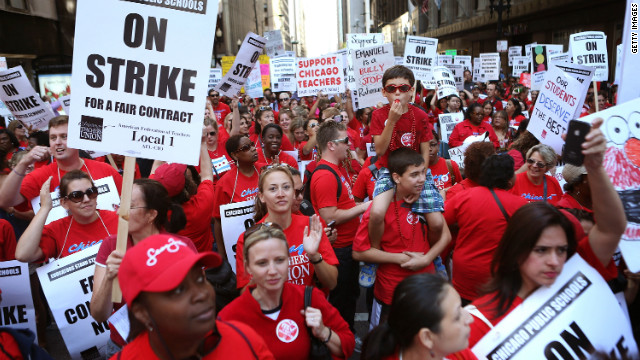
Chicago teachers on strike at the beginning of September 2012., credit - CNN,


Apparently the old saying is wrong: You can get blood from a stone after all. In a world where "the American Dream" has become a year in which your salary stays the same, the so-called City of Brotherly Love is on the brink of setting a new standard in squeezing middle- class workers to death. It's not like we haven't seen this story before: Working men and women asked to take a sizable pay cut...and work longer hours...and pay more for shrinking benefits. Usually such reports alternate with the news that the CEO of that same outfit is leaving with a golden parachute worth hundreds of thousands of dollars, maybe millions.
 
But just when you think it can't get any worse, here come the contract demands that the Philadelphia School District would like to cram down the throat of the city's unionized school teachers. The news -- first reported by Kristen Graham of the Inquirer -- is a jaw- dropper:
 
-- Large pay cuts imposed in teachers up to 13 percent for those making (a whopping) $55,000 a year or more. then frozen until 2017.
 
-- A sizable jump in out of pocket costs for health coverage.

Saturday, November 10, 2012

What was Kevin Johnson doing during the recent election ?


In this case the News and Review covers what the Sacramento Bee ignores.
Speaking of that whole Waiting for ‘Superman’ cult: What was Sacramento’s first couple doing this election season while hundreds of millions of dollars were on the line for Sacramento schools? Roving the country, trying to screw up other people’s school systems, of course.
Michelle Rhee, patron saint of the teacher-bashing movement, has been using her Sacramento-based StudentsFirst organization—a 501(c)(4) “social welfare” organization, of course—to funnel money into ballot measures in several states.
In Michigan, StudentsFirst funded anti-union groups trying to defeat a ballot measure that would put the right to organize unions for private and public employees into the state’s constitution. It’s a right that is recognized in the United Nations’ Universal Declaration of Human Rights, but apparently not one that Rhee thinks Michigan teachers (or any other workers) should have.
“I love teachers. Effective teachers,” she told members of the Michigan state Legislature while lobbying against the measure. By “effective” Rhee means teachers with high test scores: exactly the kind of evaluation system she instituted as chancellor of the Washington, D.C., schools before her boss, Mayor Adrian Fenty, was unelected and Rhee had to follow. The same kind of system that Raymond was warning about in his critique of Race to the Top.

Thursday, August 25, 2011

Make Wall Street Pay-


JOIN THE NURSES TO MAKE WALL STREET PAY TO HEAL AMERICA

Urge your legislators to support the tax on Wall Street for jobs, healthcare and education on Main Street!

Thursday, September 1st

11:00 AM - 12:00 PM
Rep. Dan Lungren’s Field Office
2339 Gold Meadow Way
Gold River, CA 95670

12:30 PM – 2:00 PM
Rep. Tom McClintock’s Field Office
8700 Auburn-Folsom Road
Granite Bay, CA 95746

On September 1st, nurses across America will lead Main Street actions to publicize support for a Financial Transaction Tax on Wall Street to repair Main Street and begin restoring economic fairness to our nation.  For more information, please visit www.mainstreetcontract.org.


Tuesday, March 29, 2011

The legacy of Cesar Chavez and the economic crisis of 2011

Cesar Chavez and Duane Campbell,1972

 CĂ©sar Chávez:
By  Duane E. Campbell

On March 31, 2011, California and ten  other states will celebrate the life and work of labor organizer Cesar Chavez.  State workers will have the day off.  Ironically, however, farm workers will not.  It is interesting that these states take a day off to recognize the contributions of a labor leader while cutting vital services for poor people.   Meanwhile the spirit of Cesar Chavez lives on in the struggle for union rights and justice in the fields of California, Ohio, and Florida as well as  in the struggles for union rights and workers dignity in Wisconsin, Ohio, Indiana and Pennsylvania.  What can we learn from the creation of the UFW that is useful today?
 Along with Dolores Huerta, Philip Vera Cruz, and others, CĂ©sar created the United Farm Workers  (UFW) the first successful union of farm workers in  U.S. history.  There had been more than ten prior attempts to build a farm workers union.
            Each of the prior attempts to organize farm worker unions were destroyed by racism and corporate power. Chávez chose to build a union that incorporated the strategies of social movements and community organizing  and allied itself  with the churches, students,  and organized labor.  The successful creation of the UFW changed the nature of labor organizing  in the Southwest  and contributed significantly to the growth  of Latino politics in the U.S. The UFW has shown unions that immigrants can  and must be organized.   
        CĂ©sar Chavez, Dolores Huerta,  Philip Vera Cruz, and others deliberately created a multiracial organization, Mexican immigrants,  Mexican American, Filipino, African-American, Dominican, Puerto Rican and Arab workers, among others, have been part of the UFW.  This cross racial organizing  was necessary in order to combat the  prior divisions and exploitations of workers based upon race and language. Dividing the workers on racial, language lines and immigration status  always left the corporations the winners.

Friday, March 11, 2011

Then they came for the trade unionists

 On this day, it behooves us to remember the words of Martin Niemoller. "First they came for the communists," he wrote, "and I didn't speak out because I wasn't a communist. Then they came for the trade unionists, and I didn't speak out because I wasn't a trade unionist. Then they came for the Jews, and I didn't speak out because I wasn't a Jew. Then they came for me and there was no one left to speak out for me." I am a trade unionist, and Wednesday in Wisconsin, they came for me. They came for you. They came for every working person in America, and their intent could not be more clear.
William Rivers Pitt

Tuesday, July 15, 2008

New view of school reform and NCLB

July 15, 2008
New Vision for Schools Proposes Broad Role

By SAM DILLON
Randi Weingarten, the New Yorker who is rising to become president of the American Federation of Teachers, says she wants to replace President Bush’s focus on standardized testing with a vision of public schools as community centers that help poor students succeed by offering not only solid classroom lessons but also medical and other services.

Ms. Weingarten, 50, was elected Monday to the presidency of the national teachers union at the union’s annual convention. In a speech minutes later to the delegates gathered in Chicago, Ms. Weingarten criticized the No Child Left Behind law, President Bush’s signature domestic initiative, as “too badly broken to be fixed,” and outlined “a new vision of schools for the 21st century.”

“Can you imagine a federal law that promoted community schools — schools that serve the neediest children by bringing together under one roof all the services and activities they and their families need?” Ms. Weingarten asked in the speech.

“Imagine schools that are open all day and offer after-school and evening recreational activities and homework assistance,” she said. “And suppose the schools included child care and dental, medical and counseling clinics.”

By laying out that expansive vision of government’s role in the public schools, Ms. Weingarten waded into a fierce debate among Democrats seeking to influence the educational program of Senator Barack Obama, their party’s presumptive presidential nominee. In an interview last week, she said the ideas in the speech amounted to “what I’d like to see in a new federal education law.”

In her 10 years of service as president of the United Federation of Teachers, which represents New York City teachers, Ms. Weingarten has defended teachers’ economic interests, raising her members’ salaries by 43 percent in the last five years. But she has also proved willing to accommodate the city’s ideas on improving schools. She has embraced charter schools, and last year — even as teachers unions elsewhere were opposing performance pay plans — negotiated an arrangement in New York that gives bonuses to teachers in schools whose poor children show broad gains in test scores.

With her move to the presidency of the national union, with 1.4 million members, Ms. Weingarten gains a broader platform from which to influence the nation’s education debates. Although the federation is smaller than the country’s other teachers union, the National Education Association, with its 3.2 million members, A.F.T. presidents have had an equal or larger political profile because presidential tenures in the bigger union are restricted by term limits.

Two previous presidents of the United Federation of Teachers, Albert Shanker and Sandra Feldman, also rose to lead the A.F.T.

“My sense is that Randi Weingarten is continuing Al Shanker’s tradition, clearly standing up for the interests of teachers but also trying to engage in thoughtful education reform that will be good for students,” said Richard D. Kahlenberg, a senior fellow at the Century Foundation whose biography of Mr. Shanker, “Tough Liberal,” was published this year.

On Sunday, Mr. Obama spoke to the convention by satellite feed from California, and he mixed criticism of the No Child law with praise for teachers’ contributions and an exhortation to Americans to meet the nation’s responsibility to educate all children. He quoted a young Chicago teacher as telling him that she had been annoyed by a tendency “to explain away the shortcomings and failures of our education system by saying, ‘These kids can’t learn.’ ”

“These children are our children,” Mr. Obama said. “It’s time we understood that their education is our responsibility.

“I am running for president to guarantee that all of our children have the best possible chance in life,” he said, “and I am tired of hearing you, the teachers who work so hard, blamed for our problems.”

Convention delegates gave Mr. Obama a standing ovation.

Ms. Weingarten takes national office with robust support of the rank and file. “The last eight years of the Republican presidency have really been a threat to the middle class and to public education,” said William Gallagher, a high school social studies teacher in Philadelphia for 33 years. Ms. Weingarten, he said, would “work hard to make sure the new president, whoever he is, puts education on the forefront of issues in this country.”

In Ms. Weingarten’s speech, she praised the ideas of a group of Democrats led by Tom Payzant, the former schools superintendent in Boston, who have argued that schools alone cannot close achievement gaps rooted in larger economic inequalities, and that “broader, bolder” measures are needed, like publicly financed early childhood education and health services for the poor.

Another group, headed by the Rev. Al Sharpton and Schools Chancellor Joel I. Klein of New York, issued a manifesto last month urging the nation to redouble its efforts to close the achievement gap separating poor students from affluent ones and blaming “teachers’ contracts” for keeping ineffective teachers in classrooms.

Ms. Weingarten said the nation needs a new vision for schools “that truly commits America to closing the achievement gap once and for all.”

“Imagine if schools had the educational resources we have long advocated, like quality pre-K, smaller classes, up-to-date materials and technology and a nurturing atmosphere, so no child feels anonymous,” she said.

Ms. Weingarten, whose mother was a teacher in Nyack, N.Y., is a lawyer who was union counsel during the 1980s and 1990s. In the last decade, Ms. Weingarten taught high school history for six years in the Crown Heights neighborhood of Brooklyn.

In the interview, she said: “We all have to work tenaciously to eliminate the achievement gap and to turn around low-performing schools. But the folks who believe that this can all be done on teachers’ shoulders, which is what No Child tries to do, are doing a huge disservice to America.”


Copyright 2008 The New York Times Company
Privacy Policy Search Corrections RSS First Look Help Contact Us Work for Us Site Map
 
Creative Commons License
This work is licensed under a Creative Commons Attribution-NonCommercial 3.0 Unported License.