Showing posts with label Strike. Show all posts

Monday, February 09, 2026

Call for NATION WIDE strike : ICE Out

https://www.laborpolitics.com/p/weve-had-a-nationwide-immigrant-strike?


We’ve Had a Nationwide Immigrant Strike Before. We Can Do It Again.

The 2006 “Day Without an Immigrant” offers urgent lessons for beating ICE today

Friday, May 02, 2025

California Teachers Coordinate Bargaining Power


After years of grinding for wage gains that were quickly wiped out by California’s soaring cost of living, unionized educators are about to make a power move. 

In the midst of President Donald Trump’s attack on the federal Department of Education and the state’s own struggle with the myriad issues facing its public school system, the teachers’ unions say they’ll coordinate strategies across multiple California districts that together serve more than 1 million students.

Whether they will win better contracts in their individual districts, many of which are fighting ongoing budget issues, is an open question. But some of those who’ve been on the front lines of the education battle in the state feel they have little to lose.

“We have a staffing crisis, and it’s worst in areas where teachers are needed the most. If we want to fully staff our schools, we need a living wage,” said Kyle Weinberg, a special education teacher and president of the 7,000-member San Diego Education Association. “This is why this statewide effort is so critical, and why we in San Diego are all in.”

Under the plan, announced this week by the California Teachers Association, roughly 77,000 educators in 32 districts – about a quarter of the union’s full membership – will bargain for contracts around a shared set of core issues: improved wages, smaller class sizes, fully-staffed schools and more resources for students. (The California Teachers Association is a donor to Capital & Main). 

The union can’t negotiate for such improvements on a large-scale basis; the individual districts have to do that for themselves. But through a carefully orchestrated series of moves over the past several years, many of the state’s largest districts have aligned their contracts to expire on the same day, June 30.

The hope is that the implications of labor strife at the same time in so many major school districts – Los Angeles, San Francisco, Oakland, San Jose, Sacramento, San Diego – will ratchet up public pressure and prompt more responsive bargaining in each area.

“I don’t say this lightly: We are facing a crisis in our public schools,” said David Goldberg, president of the California Teachers Association, which represents about 310,000 public education workers. “There are not enough educators on our school campuses.”

During a news conference, Goldberg noted that California ranks in the bottom five in the U.S. for class size ratio and sits at 48th for access to school counselors. A survey of its own members by the union, meanwhile, found that four in 10 are considering leaving the profession – in large measure, they say, because they can’t afford to live near the schools where they work.

The result of such pressures, the union says, is inadequate staffing that can erode the quality of public education. And in a job marketplace in which choosing to become a teacher may mean a struggle to pay for basic needs, California is lagging to keep up. The state has had to figure out ways to fast-track the credentialing process in order to get more teachers into the pipeline, but it still faces a significant shortage.

“The sacrifices that educators are making is significant,” said Lauren Pomrantz, a first-grade teacher and president of the Live Oak Elementary Teachers Association, a 100-member group in Santa Cruz County. “We’re often using our own funds to buy classroom supplies, and the reality is that not one school district in this county pays even the statewide average, even though studies show year after year that Santa Cruz is one of the least affordable places for teachers in the United States.”

This theme of unaffordability is not new; California teachers have been sounding the alarm for years about their incremental wage gains being quickly overwhelmed by runaway housing and living costs. But never before has the statewide union helped coordinate efforts by local districts to both time their contract bargaining and sharpen their message.

The California Teachers Association, which also counts school counselors, psychologists, librarians, support staff and other non-supervisory employees among its members, has often faced battles regarding messaging.

The state’s average salary for public school teachers in 2022-23, for example, was a seemingly robust $95,160, according to the California Department of Education. But that raw number doesn’t account for cost of living, especially housing, in the state’s largest and most expensive metropolitan areas. It also doesn’t reflect the reality that starting salaries for most teachers run in the mid-$50,000s – a tough sell in a place like L.A. or San Jose.

A recent report by the nonpartisan Center for Economic and Policy Research found that California has been falling behind for decades in teacher pay – and that average weekly salaries have remained flat since 2003, once the cost of living is taken into account.

Over the past 45 years, the inflation-adjusted average weekly wage of California teachers has risen 26.3%, while the average pay of nonteaching college graduates in the state is up 70%. Put simply, people are choosing other jobs. “Both the long-term trends and the recent trends have been troubling,” said Sylvia Allegretto, senior economist at the Center for Economic and Policy Research.

How much school districts have left to give is another question. With declining enrollment a reality, and state funding generally based on average daily attendance, many districts have found themselves strapped for cash and either considering closing schools or actively doing so. Leaders in Oakland have been considering multiple closures to trim a budget deficit estimated at between $75 million and $95 million.

But wi

After years of grinding for wage gains that were quickly wiped out by California’s soaring cost of living, unionized educators are about to make a power move. 

In the midst of President Donald Trump’s attack on the federal Department of Education and the state’s own struggle with the myriad issues facing its public school system, the teachers’ unions say they’ll coordinate strategies across multiple California districts that together serve more than 1 million students.

Whether they will win better contracts in their individual districts, many of which are fighting ongoing budget issues, is an open question. But some of those who’ve been on the front lines of the education battle in the state feel they have little to lose.

“We have a staffing crisis, and it’s worst in areas where teachers are needed the most. If we want to fully staff our schools, we need a living wage,” said Kyle Weinberg, a special education teacher and president of the 7,000-member San Diego Education Association. “This is why this statewide effort is so critical, and why we in San Diego are all in.”

Under the plan, announced this week by the California Teachers Association, roughly 77,000 educators in 32 districts – about a quarter of the union’s full membership – will bargain for contracts around a shared set of core issues: improved wages, smaller class sizes, fully-staffed schools and more resources for students. (The California Teachers Association is a donor to Capital & Main). 

The union can’t negotiate for such improvements on a large-scale basis; the individual districts have to do that for themselves. But through a carefully orchestrated series of moves over the past several years, many of the state’s largest districts have aligned their contracts to expire on the same day, June 30.

The hope is that the implications of labor strife at the same time in so many major school districts – Los Angeles, San Francisco, Oakland, San Jose, Sacramento, San Diego – will ratchet up public pressure and prompt more responsive bargaining in each area.

“I don’t say this lightly: We are facing a crisis in our public schools,” said David Goldberg, president of the California Teachers Association, which represents about 310,000 public education workers. “There are not enough educators on our school campuses.”

During a news conference, Goldberg noted that California ranks in the bottom five in the U.S. for class size ratio and sits at 48th for access to school counselors. A survey of its own members by the union, meanwhile, found that four in 10 are considering leaving the profession – in large measure, they say, because they can’t afford to live near the schools where they work.

The result of such pressures, the union says, is inadequate staffing that can erode the quality of public education. And in a job marketplace in which choosing to become a teacher may mean a struggle to pay for basic needs, California is lagging to keep up. The state has had to figure out ways to fast-track the credentialing process in order to get more teachers into the pipeline, but it still faces a significant shortage.

“The sacrifices that educators are making is significant,” said Lauren Pomrantz, a first-grade teacher and president of the Live Oak Elementary Teachers Association, a 100-member group in Santa Cruz County. “We’re often using our own funds to buy classroom supplies, and the reality is that not one school district in this county pays even the statewide average, even though studies show year after year that Santa Cruz is one of the least affordable places for teachers in the United States.”

This theme of unaffordability is not new; California teachers have been sounding the alarm for years about their incremental wage gains being quickly overwhelmed by runaway housing and living costs. But never before has the statewide union helped coordinate efforts by local districts to both time their contract bargaining and sharpen their message.

The California Teachers Association, which also counts school counselors, psychologists, librarians, support staff and other non-supervisory employees among its members, has often faced battles regarding messaging.

The state’s average salary for public school teachers in 2022-23, for example, was a seemingly robust $95,160, according to the California Department of Education. But that raw number doesn’t account for cost of living, especially housing, in the state’s largest and most expensive metropolitan areas. It also doesn’t reflect the reality that starting salaries for most teachers run in the mid-$50,000s – a tough sell in a place like L.A. or San Jose.

A recent report by the nonpartisan Center for Economic and Policy Research found that California has been falling behind for decades in teacher pay – and that average weekly salaries have remained flat since 2003, once the cost of living is taken into account.

Over the past 45 years, the inflation-adjusted average weekly wage of California teachers has risen 26.3%, while the average pay of nonteaching college graduates in the state is up 70%. Put simply, people are choosing other jobs. “Both the long-term trends and the recent trends have been troubling,” said Sylvia Allegretto, senior economist at the Center for Economic and Policy Research.

How much school districts have left to give is another question. With declining enrollment a reality, and state funding generally based on average daily attendance, many districts have found themselves strapped for cash and either considering closing schools or actively doing so. Leaders in Oakland have been considering multiple closures to trim a budget deficit estimated at between $75 million and $95 million.

But without adequate teaching staffs, simply keeping schools open won’t solve the issue. And while the California Teachers Association will continue to plead with state legislators to improve funding, Goldberg said, teachers in the local districts will ultimately be fighting many of their own battles.

They’ll now do so as part of a coordinated effort. “They’re able to learn from each other, support each other, and build broader pressure statewide,” Goldberg said. “We have to think of different ways to put students and educators first.”


Copyright 2025 Capital & Main


thout adequate teaching staffs, simply keeping schools open won’t solve the issue. And while the California Teachers Association will continue to plead with state legislators to improve funding, Goldberg said, teachers in the local districts will ultimately be fighting many of their own battles.

They’ll now do so as part of a coordinated effort. “They’re able to learn from each other, support each other, and build broader pressure statewide,” Goldberg said. “We have to think of different ways to put students and educators first.”


Copyright 2025 Capital & Main


Saturday, June 01, 2024

UC Workers on Strike

In an Historic Show of Labor Solidarity with Palestine, UAW Local 4811's Stand-up Strike Grows by 12,000. U.C. Workers. 

The academic workers at UCLA and UC Davis will join 2,000 already on strike at UC Santa Cruz.


https://inthesetimes.com/article/uaw-4811-strike-ucla-university-of-california-israel-palestine-students-rafah-gaza 


About 2,000 members of Local 4811 at UC Santa Cruz went on strike last week, the first of 10 UC campuses that may be involved in the Stand-Up Strike. UCLA and UC Davis will strike on Tuesday, May 28.PHOTO BY JUSTIN SULLIVAN/GETTY IMAGES

Tuesday, January 23, 2024

CSU Strike Settled - Pending vote

CSU Strike Settled _ Pending Vote of Members 

 The strike at the largest university system in the nation has ended ( subject to ratification vote by the faculty union.

Posted 

“The collective action of so many lecturers, professors, counselors, librarians and coaches over these last eight months forced C.S.U. management to take our demands seriously,” Charles Toombs, president of the union, said in a statement.

The deal would immediately increase salaries for all faculty members by 5 percent, retroactively to July 1, 2023, with another 5 percent raise to take effect July 1, 2024, according to union officials. It would also immediately raise the salary floor for the lowest-paid faculty members by $3,000, and increase paid parental leave to 10 weeks from six.

Mildred GarcĂ­a, the chancellor of the university system, said in a statement Monday night that she was “extremely pleased” with the deal, adding that it “enables the C.S.U. to fairly compensate its valued, world-class faculty while protecting the university system’s long-term financial sustainability.”


I participated in the creation of this union and was a local official prior to retirement.


Monday, January 22, 2024

Sac State Strike Begins _ System Wide Strike

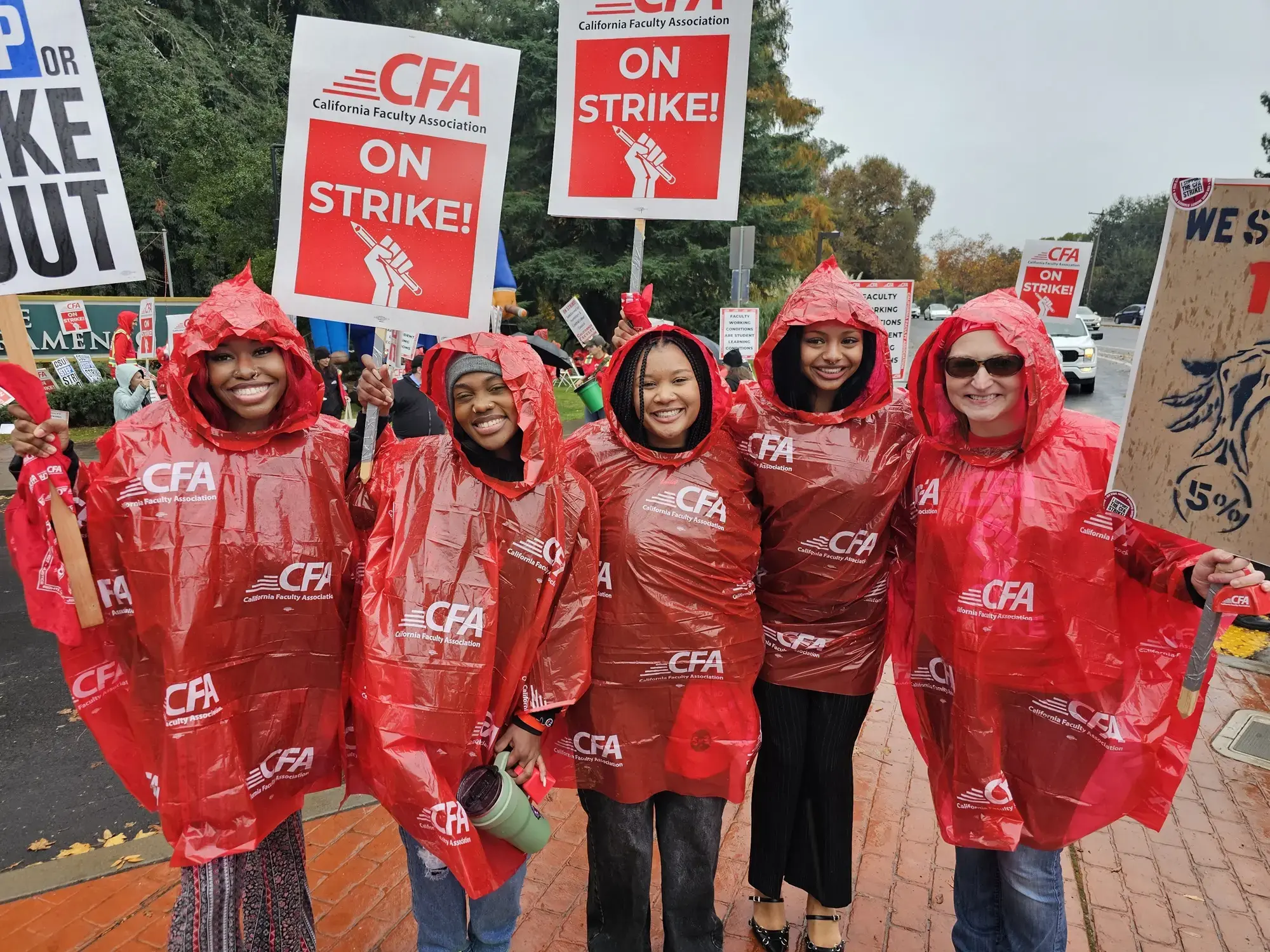
 Clouds, chills and the threat of rain didn’t dissuade Sacramento State faculty from forming the first picket line of the spring semester. Professors, lecturers, librarians, coaches and counselors shut down the California State University’s 23 campuses Monday just as many of their students returned for the spring semester. The week-long shutdown follows a series of rolling one-day strikes across four campuses in December. 

Roughly 75 people walked the picket line Monday outside Sacramento State, flanking the campus’ J Street entrance. The banners welcoming students back from break were covered with union-made signs that read, “Classes don’t start without us!” and “On strike! California Faculty Association.”

 This latest labor action at the nation’s largest university system rides the wave of union momentum in higher education created by the 2022 monthlong strike at the University of California system. Teaching assistants and graduate student workers disrupted classes across UC campuses as the fall semester concluded. 


The CFA, which represents 29,000 members, and university negotiators have spent nearly nine months haggling over salaries and other provisions as part of contract negotiation re-opener. Those non-salary demands include increased parental leave, greater access to gender-inclusive restrooms in campus buildings and more staff mental health counselors to help students. After the two sides hit an impasse in August, they engaged in mediation sessions with a third-party negotiator and then submitted to fact-finding with a neutral panelist.

the writer of this piece is under informed. 


From The Sacramento Bee.

Read more at: https://www.sacbee.com/news/local/education/article284543095.html#storylink=cpy

Sunday, January 21, 2024

Sac State Strike Begins on Monday

CSU Management Walks Out of Bargaining, Systemwide Strike Set for January 22-26 

The CFA Bargaining Team reserved four days for re-opener contract negotiations this week, making every effort to bargain in good faith and explore the space for a negotiated solution before a systemwide strike January 22 to 26. CFA members delivered four proposals Monday (January 8), but were met with disrespect from management today. After 20 minutes, the CSU management bargaining team threatened systemwide layoffs, walked out of bargaining, cancelled all remaining negotiations, then imposed a last, best and final offer on CFA members.

Rather than bargain in good faith with CFA members, CSU management expressed nothing but disdain for faculty. We know they have the money in their flush reserve accounts.

CSU management has never taken seriously our proposals for desperately needed equity transformation for CSU students, faculty, and staff, including raising base salary for our lowest-paid, struggling faculty, manageable workloads for more student engagement, more mental health services for students, limits to police power, and humane and adequate parental leave.

Instead of showing care and concern for the issues faculty have raised repeatedly at the bargaining table since last May, Chancellor Mildred GarcĂ­a and her team seem intent on a campaign of insult and intimidation.

Management’s imposition gives us no other option but to continue to move forward with our plan for a systemwide strike in coalition with Teamsters Local 2010 members. The systemwide strike on all 23 campuses over January 22 – January 26 must demonstrate to the Chancellor that she must do right by the faculty, staff, and students of the CSU.

It’s time to get involved and uplift our faculty, staff, and students. Sign up for the January strike dates and join the picket lines! If you have other questions or concerns, please reach out to us at bargainingideas@calfac.org.

Strike FAQs


Tuesday, January 16, 2024

Faculty Prepare for Strike at Sac State: the CSU


A woman dressed in a red coat and red bandanna speaking into a bullhorn in front of a group of people.
Members of the California Faculty Association rallied during a strike in December at San Francisco State University. Godofredo A. Vásquez/Associated Press

Faculty members at the California State University system, the nation’s largest four-year public university system, are planning to cancel classes and strike next week as they demand higher pay and better benefits.

The California Faculty Association, which represents 29,000 professors, lecturers, librarians, counselors and coaches, says it will begin a five-day strike on Monday, the first day of the spring semester for most students. Walkouts are planned at all 23 campuses, from Humboldt to San Diego, which together serve nearly 460,000 students.

The strike was set after university officials ended contract negotiations last week, having offered 5 percent raises; the union is seeking 12 percent pay increases. University leaders said they were grappling with a huge budget deficit and could not afford to meet the union’s demands without resorting to layoffs and other cuts.

“We have been in the bargaining process for eight months and the C.F.A. has shown no movement, leaving us no other option” but to break off the talks, Leora Freedman, the university system’s vice chancellor for human resources, said in a statement. She added that the system had recently agreed on 5 percent pay increases with five other labor unions.

The union’s president, Charles Toombs, said he hoped that the university would return to the bargaining table so the strike could be averted.

In addition to raises, the union also wants to increase the salary floor for full-time employees to $64,360 from $54,360, and is asking for other provisions, including caps on class sizes and expansion of paid parental leave.

“That is where we stand,” Toombs told me. “We know that a systemwide strike in the C.S.U. is going to be historic.”

The union’s members mounted one-day work stoppages in early December at four of the system’s largest campuses: Cal Poly Pomona, San Francisco State, Cal State Los Angeles and Sacramento State.

Hazel Kelly, a spokesperson for the system, told me that all campuses would remain open during the strike and that university leaders would try to limit disruptions to students. She said it was possible that not all classes would be canceled, because some faculty members may not participate in the strike.

The job action comes after an especially busy year for labor actions, particularly in California. Hollywood actors and writers went on strike; so did hotel and health care workers. Los Angeles schools employees staged a huge walkout in March, and Oakland educators were off the job for nearly two weeks in May.

Monday, December 04, 2023

Monday, October 30, 2023

Labor Wins The Big One - UAW


At a time of massive income and wealth inequality, when real inflation accounted for wages for the average worker are lower today than they were 50 years ago, the UAW has won an extraordinary victory not only for their own members but for all of us. They took on a particularly ugly form of corporate greed in their industry, and they won. The lesson here is clear. When we stand together there is nothing we cannot accomplish.

In a world where everything is connected to everything, it is often the struggles of the working class in one industry and community that ultimately determines the quality of wages, benefits, and the ability to retire with dignity in other seemingly unconnected industries and communities.

That is why the struggle of UAW workers standing up to corporate greed at the Big Three automakers is so important. 

Because the fight UAW workers have waged is not just about decent wages, working conditions, and pensions in the automobile industry, it is a fight against a corporate culture of arrogance, cruelty, and selfishness causing massive and unnecessary pain for the majority of working families throughout the country.

And I am pleased to tell you today — it is a fight they have won.

Just this morning, the UAW announced they have reached a tentative agreement with the third of the Big Three automakers — a historic victory that is not just a win for these autoworkers, but a victory that will resonate all across the economy, impact millions of workers from coast to coast, and help create a more just and equitable economy.

What these workers have won is historic, and all of us should take note. 

According to the UAW, their agreement with Ford is the most lucrative agreement per-member since Walter Reuther was president of the union decades ago.

Workers won a 25% wage increase over the life of the agreement, temporary workers will get raises of over 150%, there are increased retirement benefits, and they won the right to strike over future plant closures.

In other words, in addition to wage and benefit hikes, they sent a message to the Big Three that they can't keep closing plants and hurting our communities without consequences. 

I want to congratulate the UAW, its leadership, and especially its members for their historic tentative agreements with the Big Three. When workers fight back against corporate greed, they win.

In 1937, the UAW played a historic role in American history. The autoworkers of that time had the extraordinary courage to take on the greed and power of the auto industry and formed their union. Their successful sit-down strike in Flint, Michigan, ignited a grassroots movement across the country that helped create an American middle class which became the envy of the world.

Now in the year 2023 — 86 years later — the UAW, once again, is helping to lead the effort to rebuild and grow a middle class that has been beaten down by their corporate bosses for far too long.

Everyone, in every state in this country, owes them our thanks.

In solidarity,

Bernie Sanders


Thursday, September 28, 2023

Saturday, November 19, 2022

UC Strike. An Injury to one is an Injury to All


To the UC Academic Workers: Your Fight is Our Fight!

The Democratic Socialists of America (DSA) stands in unwavering solidarity with the 48,000 academic workers walking picket lines across the University of California system today as three United Auto Worker locals (UAW 2865, SRU-UAW, and UAW 5810) declare an open-ended unfair labor practice (ULP) strike. Some of our highest concentrations of DSA members in unions are in these locals. For as long as you are in the fight, we will be by your side. Strike action is never easy. It is a zero-sum game. Either the workers win and advance, or the bosses win and push us back. Knowing that all you have is the strength of your organization and your solidarity for one another, you and your coworkers jump into the fight. 

When the cost of living crisis collides with your poverty wages – when you watch your administrators live lavishly while you choose between child care and rent, when you work in overcrowded classrooms of students planning for their futures while you don’t have enough money for the bus ride home, when you find out that your coworker is sleeping in their car because their wages were not enough for that month’s rent and then the university chooses to bargain in bad faith  – then the decision to strike  becomes much easier. 

UAW members voted for this strike with 98% approval. This action is one that all working people in this country can understand. If we let the bosses have their way, unchallenged, we will be whittled away to nothing. If we want to survive, then we have to fight. The academic workers in the UC system are fighting like hell. Your common good demands of affordable housing, free public transit and serious anti-racism and anti-harassment protections show us something. When workers take on the bosses, we can build a world worth living in. Thousands of academic workers have already learned this, and we count them among our comrades in the largest socialist organization in U.S. history. Now, as you and your coworkers hit the streets, we look forward to many more young people realizing that we do not have to keep living like this. That the present is not written in stone. And that we can live in a democratic and socialist future if we’re willing to fight for it.

Through the combined donations of the DSA Labor Solidarity Fund, DSA Chapters, and DSA members, we raised more than $20,000 for the UAW-UC strike fund in one day. DSA members who are not on strike are encouraged to continue donating using this form and to use this Chapter Toolkit to learn other ways to support.  Victory to the strikers!

In Solidarity,

National Political Committee, DSA

Steering Committee, DSA National Labor Commission

Thursday, March 24, 2022

SCTA On Strike in Sacramento

 BY

PETER LUCAS

The Sacramento school district is pleading poverty in the face of demands for more student support and a pay raise to keep up with inflation. Teachers and school workers aren’t buying the district’s excuses — and now they’re on strike to change its priorities.


Teachers and school workers attend a rally in Sacramento, California. (Ian Lee / Jolie Media


Three years after a one-day strike, Sacramento teachers are back on the picket line — this time for however long it takes to win a new contract.

The 2019 demonstration was unique in that it was not over unaddressed workplace issues or to reach a deal on an upcoming contract. Instead, teachers walked out to defend their already agreed-upon contract, which the district reneged on after its signing. That one-day strike culminated in a rally at the district building where thousands of educators, school workers, and community supporters gathered to demand the district honor the contract.

Now, almost three years later, teachers have walked out again — but this time they don’t know when they’re going back. Sacramento teachers are on an open-ended strike to demand pay that reflects the cost of living under inflation, more support for students, and the preservation of their health care plan.

The Sacramento City Teachers Association (SCTA) announced the strike date at a rally last week attended by an estimated twenty-five hundred people, including teachers, school staff, and supporters. Among them was Sacramento City Council Representative and Democratic Socialists of America (DSA) member Katie Valenzuela.

“The district’s messaging — implying that teachers are putting students at risk by striking — is disgusting.” Valenzuela, who previously worked in education policy, told Jacobin. “No one cares more [about students] than the school workers.”

Roughly eighteen hundred classified school staff — including bus drivers, cafeteria workers, yard monitors, and custodians — represented by the Service Employees International Union (SEIU) Local 1021 are also striking.

Olivia Minor has worked transportation services in Sacramento City Unified School District’s (SCUSD) for ten years — nine as a bus driver before getting promoted to dispatcher last year. Her kids also attend SCUSD schools. When asked about her working conditions she told Jacobin, “Things are getting out of control. I have to call more and more parents to say their bus route is getting canceled because there isn’t enough staffing.”

According to Minor, 25 percent of the district’s drivers have left over the past eighteen months. “Given all the requirements and restrictions to be a driver — including [monitoring] the medication someone takes — it’s such a stressful job for not enough pay.”

The school workers’ contract expired in June of 2020, but the district has not responded to proposals made in bargaining back in October, according to the union. The union also claims that requests to bargain throughout the past weekend have been ignored. Instead the district offered a bargaining date of March 30 — which will be six days into the strike.

Striking teachers and school workers on the picket line in Sacramento, California. (Ian Lee / Jolie Media)

On Tuesday, the United Public Employees (UPE), representing principals, vice principals, and other administrators in Sacramento schools, sent out a letter claiming that its members have “lost confidence in the district’s ability to provide effective leadership.” The letter includes a survey that shows more than 70 percent of its members believe the union should take a vote of no confidence in the superintendent Jorge Aguilar, and that more than 40 percent of UPE members support the SCTA strike.

Aguilar recently received a raise of $34,126, earning him a total salary of $414,818 — at a time when the district is pleading poverty when teachers demand equitable pay. Since Aguilar became superintendent of SCUSD in 2017, SCTA has filed eighteen unfair labor practice charges against the district.

Nate Starace, who has been teaching at McClatchy High School for almost twenty years, says the letter bodes well for SCTA. In addition to the encouraging support from admin — which has typically sided with the district on workplace issues — Starace says the fact-finding report has bolstered their case. The report, which was conducted under the the California Public Employment Relations Board after the district declared an impasse and whose findings were unanimously endorsed by SCTA, concluded that the district ought to provide employees with a retroactive across-the-board cost-of-living increase.

Belén Moreno, who is in her first year of teaching in SCUSD, explained why she is walking off the job despite not having been in the district for long:

My students and my coworkers have inspired me. My students deserve the very best from their teachers which means their teachers have to be treated like humans. A stronger contract would provide us with enough security — a fair salary that reflects the market — to allow me to catch my breath and refocus, spend more time on teaching than figuring out how to live on month-to-month pay, and attract more qualified teachers to a district that is suffering from a shortage.


https://jacobinmag.com/2022/03/sacramento-city-teachers-association-strike-fair-pay-student-support


Wednesday, March 23, 2022

Strike FAQ for Our Community

Strike FAQ for Our Community: When will the strike begin?SCTA and SEIU 1021 are on strike beginning March 23, 2022. Why are SCTA and SEIU 1021 on strike? We are on strike because every student deserves a teacher in their classroom in a fully staffed school.  We are facing a severe staffing crisis in our district. It’s time to prioritize […]

Saturday, June 19, 2021

The Teacher Insurgency


The Teacher Insurgency. By Leo Casey. Harvard Education Press, 2020. 304 pages

Review by Paul Buhle Leo Casey, a former teacher and veteran labor strategist, has a lot to say about the accelerating crisis in American education and what teachers themselves—often without the support of politicians or the public (and sometimes against the advice of their own unions)—have done about it. His new book, The Teacher Insurgency: A Strategic and Organizing Perspective, looks at the wave of teachers’ strikes during 2018-19 that shocked nearly everyone, except perhaps teachers themselves. 

Not only were these strikes militant, but they took place in the Republican enclaves of North Carolina, Arizona, and West Virginia. Casey calls the 2018 events a “Teacher’s Spring,” a provocative phrase that brings us to 2019, because the pattern of strikes had spread to blue states as well. By then, the pattern had become a strategy. 

We met the threat of new legislation taking away fundamental rights to public unionism by a newly elected Republican governor, with a weeks-long occupation of Wisconsin’s state capitol and a more than year-long series of demonstrations. 

Teachers took action not only on the familiar issues of pay and working conditions, but also the excessive use of testing and the social and nutritional needs for chidlren—including the growing number of those that are homeless and undocumented. Teachers’ experience arguably occupied the central status of working lives, in some ways similar to the mass production workers of the 1930s-40s or skilled craftsmen in the decades after the Civil War.

As a longtime resident of Madison, Wisconsin, I cannot resist reflecting on the struggle of teachers and social workers in the Wisconsin Uprising of 2011-2012. So many crises have come (if not necessarily gone) in public life, this experience may now be remembered as life-changing, or a metaphor of our times, only by the participants and supporters. They—or, rather, we—met the threat of new legislation taking away fundamental rights to public unionism by a newly elected Republican governor, with a weeks-long occupation of Wisconsin’s state capitol and a more than year-long series of demonstrations—sometimes with hundreds of thousands of protesters. 

The numbers were stunning. And the spirit was nothing short of festival-like, featuring retired unionists from near and far, a battle of the bands, singers and newly minted songs by the dozens, and above all a raucous sense of humor at our sour reality. That President Barack Obama did not stop by to offer his support—after having promised as a candidate that “when I'm in the White House, I'll put on a comfortable pair of shoes myself. I'll walk on that picket line with you”—was a particular disappointment. 

What had once been a famous “house of the people,” setting into motion the dreams of Robert M. La Follette and the nationwide progressive movement had, at that point, become home to an anti-union legislature of racist bigots. No one was demonized as surely and completely as women in the center of the workforce.


Casey points to what the late political economist James O’Connor dubbed the “Fiscal Crisis of the State,” the recession following the boom economy of the 1960s. The decision-makers at the top—made up of neoconservatives along with the standard rightwingers—sought to squeeze out the deficits by making the poor pay. “Draconian cuts” in public education from New York to California punished minority students, just as they were intended to do. 


Casey glosses over the 1970s teacher strikes, which swelled union membership, as often to the National Education Association as the American Federation of Teachers (AFT). And then, with the election of Ronald Reagan, came the reaction.  Decades later, the recession of 2008 struck again, perhaps more cruelly.

In this light, the ongoing privatization of public education has accelerated with the rightwing-funded charter school movement and their inflated claims of voucher systems. Casey lucidly explains that early reform hopes for flexibility and experimentation fell under the spell of market-driven economies. Administrators became autocrats and unionized teachers became scapegoats, with a particularly perverse twist turning the civil rights legacy on its head, supposedly offering the Black community the educational reforms best suited for minority students. 

Charter schools, however, produced no better results for the students (or the parents). Instead, they served the needs of the think tanks and private investors. From Wall Street to Silicon Valley, praises rang out for these so-called reforms, epitomized by Betsy DeVos’s rise to Education Secretary with the vision of driving a stake into the heart of public education. The Manhattan Institute could not have dreamed of a better outcome.

Nonetheless, teachers themselves did not accept this verdict. The “Teacher’s Spring” of 2018 inspired the election of progressive city and state officials in more than a dozen states, setting the stage, according to Casey, for a new phase of educational history. But, in looking to the past movements and events for models, he sometimes skates on thin ice. 

The labor movement, marked in the later 1960s and early 1970s by a failed democratic struggle within unions against aging and recalcitrant male bureaucracies, staggered dramatically downward with de-industrialization. Discussing the rise of teacher unionism, Casey returns to a point made most forcefully by leftwing industrial unions in theSouth during the 1940s, unions raided and purged in the Red Scare: the need for community support and all-out community engagement.  

The AFL and the more conservative CIO unions disdained this kind of involvement and failed at the most important single task: organizing the South. The AFT tried in its own way to engage the community. Great efforts were made and the AFT spearheaded the rise of teacher unionization around the country at a time when public service unionism offered the one bright spot in the labor movement. 

Tragically, the 1968 teachers action in New York, which pitted the union against the Black community and put on display the worst qualities of both sides. A popular Manhattan newspaper columnist at the time quipped that the strike and its effects set back Black/Jewish relationships for a generation.

Randi Weingarten, the current AFT president who succeeded several divisive presidencies, made grand efforts to heal old wounds and move ahead. Casey makes a striking case for the ways in which today’s teachers have challenged themselves and the system to become more skillful and more democratic with each other. 

Schools are the basis of public engagement at crucial times in young people’s lives. Teacher Insurgencies not only drives home the urgency of reform, but the impossibility of complete reform under capitalism’s rigors. The voracious ruling elite’s neoliberal urge to promote a handful of minorities while sending the rest to the reserve army of labor can bring only further harm.

Casey is a well-versed, urgent advocate for teacher unionism and reform. Read this book and learn.


Creative Commons License
This work is licensed under a Creative Commons Attribution-NonCommercial 3.0 Unported License.