| The Los Angeles teachers' strike isn't all about wages. At its core, the strike is a fight against a hostile takeover of public schools by the superrich. |
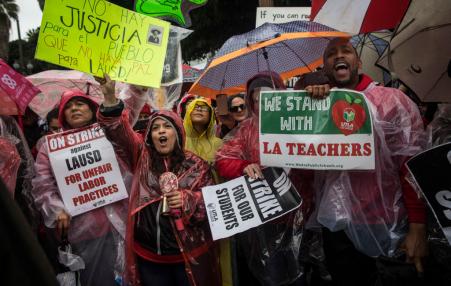
People rally in the streets of downtown in the pouring rain during a United Teachers Los Angeles strike on January 14, 2019 in Los Angeles, California. , Barbara Davidson / Getty Images
|
Unlike many labor actions, the Los Angeles teachers’ strike is not really about wages or benefits. At its core, this is a struggle to defend public schools against the privatizing drive of a small-but-powerful group of billionaires.
The plan of these business leaders is simple: break-up the school district into thirty-two competing “portfolio”networks, in order to replace public schools with privately run charters. As firm believers in the dogmas of market fundamentalism, these influential downsizers truly believe that it’s possible to improve education by running it like a private business. Not coincidentally, privatization would also open up huge avenues for profit-making — and deal a potentially fatal blow to one of the most well-organized and militant unions in the country, the United Teachers of Los Angeles (UTLA). As union leader Arlene Inouye explains, “This is a struggle to save public education; the existence of public education in our city is on the line.”
It’s always important to “know thy enemy.” But this is especially true for the educators’ movement in Los Angeles, which is directly challenging an unholy alliance of the some of richest individuals in the United States. Here’s a short primer on the corporate “who’s who” aiming to destroy public schools in LA — and across the nation.
The Walton Family
In a watershed moment for the drive to take over Los Angeles public education, pro-charter billionaires spent an unprecedented $9.7 million to buy the 2017 Los Angeles school board elections. A key funder of this campaign to elect charter school acolytes was none other than the Walton Family, best known as the founders of Walmart.
|


http://inthesetimes.com/working/entry/18830/eli-broad-los-angeles-philanthropy
February 28, 2016
2
[Reprinted with permission from In These Times [1]. All rights reserved.]
The Broad, an immaculate white postmodern structure, is the latest architectural jewel representing the revival of downtown Los Angeles.
 The self-titled museum is a “gift” from Eli Broad, the billionaire Angeleno property developer-turned-philanthropist. Broad is attempting to use his gifts to the arts and a high-profile push to shake up the city’s education system as a way to etch his name deep into the streets of Los Angeles.
But Broad’s philanthropy is two-faced. While publicly making dramatic, self-aggrandizing gestures supporting Los Angeles’ poor children and their schools, Broad’s private business practices and political machinations cripple the very communities he claims to support. The $140 million museum, meant to be a symbol of Eli Broad’s public largesse, is actually a symbol of his philanthropic hypocrisy.
The man who wants to transform public education by bringing market discipline to schools has no problem gorging at the public trough to beef up his namesake museum.
In 2011, Broad syphoned off $52 million [2] of public tax dollars meant for Los Angeles’ poor communities to subsidize his museum’s parking garage—more than all of South LA’s 800,000 mostly low-income residents received from the same public fund that year.
For Broad, it’s all about the gestures. While South LA’s schoolchildren fight for a roof over their head, at least they’ll have a nice place to park when they come to see Broad’s personal art collection.
Eli Broad, who is estimated to be worth $7.4 billion, styles himself an advocate for poor black and brown children. Urban education is his pet project. Decrying the underperformance of poor children of color, Broad points the finger at unionized public school teachers and bureaucracy, claiming educators simply aren’t working hard enough to improve academic outcomes. To save the children, Broad wants to reform education along a corporate model—privatizing schools, busting teachers’ unions and imposing punitive accountability systems. Broad is calling for—and helping fund [3]—a complete transformation of the American education system. And he wants it done in his name.
He trains school leaders to apply business practices to schools through the Broad Residency at the Broad Academy, and rewards compliant school districts with the Broad Prize, of $250,000. Broad’s latest headline-grabbing proposal is to pull 50 percent of Los Angeles’ schoolchildren (what one report refers to as “market share” [4]) into privately managed, non-union charter schools over the next eight years.
The Broad, an immaculate white postmodern structure, is the latest architectural jewel representing the revival of downtown Los Angeles.
The self-titled museum is a “gift” from Eli Broad, the billionaire Angeleno property developer-turned-philanthropist. Broad is attempting to use his gifts to the arts and a high-profile push to shake up the city’s education system as a way to etch his name deep into the streets of Los Angeles.But Broad’s philanthropy is two-faced. While publicly making dramatic, self-aggrandizing gestures supporting Los Angeles’ poor children and their schools, Broad’s private business practices and political machinations cripple the very communities he claims to support. The $140 million museum, meant to be a symbol of Eli Broad’s public largesse, is actually a symbol of his philanthropic hypocrisy.
The man who wants to transform public education by bringing market discipline to schools has no problem gorging at the public trough to beef up his namesake museum.
In 2011, Broad syphoned off $52 million [2] of public tax dollars meant for Los Angeles’ poor communities to subsidize his museum’s parking garage—more than all of South LA’s 800,000 mostly low-income residents received from the same public fund that year.
For Broad, it’s all about the gestures. While South LA’s schoolchildren fight for a roof over their head, at least they’ll have a nice place to park when they come to see Broad’s personal art collection.
Eli Broad, who is estimated to be worth $7.4 billion, styles himself an advocate for poor black and brown children. Urban education is his pet project. Decrying the underperformance of poor children of color, Broad points the finger at unionized public school teachers and bureaucracy, claiming educators simply aren’t working hard enough to improve academic outcomes. To save the children, Broad wants to reform education along a corporate model—privatizing schools, busting teachers’ unions and imposing punitive accountability systems. Broad is calling for—and helping fund [3]—a complete transformation of the American education system. And he wants it done in his name.
He trains school leaders to apply business practices to schools through the Broad Residency at the Broad Academy, and rewards compliant school districts with the Broad Prize, of $250,000. Broad’s latest headline-grabbing proposal is to pull 50 percent of Los Angeles’ schoolchildren (what one report refers to as “market share” [4]) into privately managed, non-union charter schools over the next eight years.


