|
The New York governor is replacing elected representatives with private, unaccountable monopolists, and lawmakers across the US are doing the same thing. Too many decision-makers are ceding their policy to corporate power and private sector privileg
|
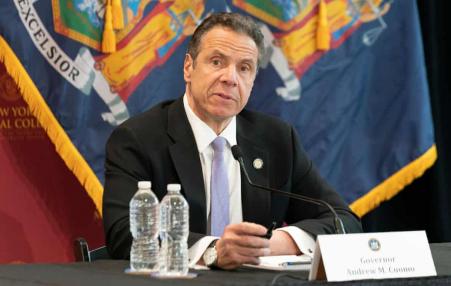
`Lawmakers are notably MIA in the middle of a pandemic - and by all accounts Cuomo likes it that way.', Photograph: Lev Radin/Pacific Press/REX/Shutterstock // The Guardian
|
Last week, New York’s governor, Andrew Cuomo, announced that Bill Gates would be responsible for “reimagining” New York’s education system. Cuomo also asked former Google chief executive Eric Schmidt to lead a panel planning New York’s post-Covid tech infrastructure.
As Naomi Klein writes, the appointments of Schmidt and Gates represent a “Pandemic Shock Doctrine … that is being rushed into being as the bodies still pile up [and] treats our past weeks of physical isolation not as a painful necessity to save lives, but as a living laboratory for a permanent – and highly profitable – no-touch future”.
As she points out, the two billionaires have disastrous records in the precise areas of public policy they are charged with leading. The Gates Foundation was the driving force behind high-stakes testing regimes and the Common Core fiasco. And Schmidt’s vision of the future is Black Mirror with a bow on it: mass surveillance plus public investment in companies in which he has a stake.
Even if Schmidt and Gates had good policies, Cuomo’s knighting of them is offensive to American self-government. Nobody voted for them and they are accountable to no one. Cuomo, often accused of being too close to big campaign donors, is tripling down: he is simply allowing billionaires to plan our future directly, taking out the middlemen.
In case you had any doubt that this is a new form of government worming its way into our old democratic ways, Cuomo anointed these tsars at the exact same time that he took vast new powers away from the state legislature, which has not been holding regular legislative hearings since 1 April. Lawmakers are notably MIA in the middle of a pandemic – and by all accounts Cuomo likes it that way.
Turning away from locally-elected representatives, and towards billionaires with no accountability, represents a terrible erosion of democratic decision-making: Cuomo is quite literally replacing elected representatives with private, unaccountable monopolists. And too many other lawmakers across the US are doing the same thing.
From California to Florida, states are turning to big corporations, CEOs and trade associations to not only decide when and how these states should “reopen”, but also what the post-virus economy should look like. The various taskforces and panels states have convened to chart a way forward are populated by executives from Pepsi, Dell, Disney and other corporations.
The White House has trotted out a steady stream of Wall Street bankers, pharma executives, and big-box store CEOs to make promises about pandemic recovery measures. (Which haven’t been kept – for instance, weeks later, the promised Target and Walmart parking lot testing sites hadn’t materialized.)
Meanwhile, the Cares Act, Congress’ coronavirus rescue package, is an authoritarian, top-down, big business restructuring of the already monopolized American economy. It gives extraordinary powers to the treasury secretary to reshape manufacturing, retail and banking in America, with almost no oversight, via easy access to trillions of dollars from the Federal Reserve.
Too many decision-makers are ceding their policy to corporate power and private sector privilege.
Even before this pandemic, turning to big businesses and their wealthy owners was a common condition of policymaking
Even before this terrible pandemic, turning first to big businesses and their wealthy owners was a common condition of American policymaking. When federal lawmakers want to juice the economy, they pass tax cuts for big corporations and the wealthy. When state and city lawmakers want to promote economic development, they dole out giveaways to big companies, providing them a leg up over smaller, more local competitors, often without letting constituents know until the contracts have all been signed.
|
Showing posts with label Billionaires. Show all posts
Showing posts with label Billionaires. Show all posts
Friday, May 22, 2020
Should Billionaires Plan Education's Future?


Thursday, February 27, 2020
How Bloomberg Trashed Public Education in New York
How Bloomberg Trashed Public Education in New York
Jake Jacobs
February 24, 2020
The Progressive
I’m an art teacher. Mike’s policies gutted my school. During those years, I was lucky to have enough copy paper for my students to draw on. Bloomberg’s harmful education policies are today being papered over as his money cascades through the media.

Former Mayor Michael Bloomberg at a campaign event in Phoenix, Arizona., Photo by Gage Skidmore, courtesy of Flickr // The Progressive
Mike Bloomberg, the former mayor of New York City now running for President, often brags about being one of the most prolific charter school creators in the United States. Bloomberg says he “absolutely” intends to expand charters in his federal education plan. This is a serious threat to public education, especially given Bloomberg’s history of using his fortune to shape policy.
Since 2013, Bloomberg has been one of the nation’s biggest donors to candidates and ballot initiatives promoting charters and vouchers, giving more than $4 million to candidates in New Jersey, Colorado, Minnesota, and Louisiana, often through “dark money” PACs. In California, Bloomberg spent a whopping $39 million, backing both Democrats and Republicans who support charters. In Pennsylvania, he gave $6 million to pro-charter incumbent Republican Sen. Pat Toomey, who won re-election with a narrow 1.5 percent edge, and ended up casting a critical vote for Supreme Court nominee Brett Kavanaugh.
New York City teachers are vocal critics of Bloomberg, who not only used public money for school privatization but usurped the power of elected community school boards as the state granted Bloomberg “mayoral control” of New York City schools in 2002.
Bloomberg proceeded to appoint corporate attorney Joel Klein as head of New York City’s education department. Klein began a "test-and-punish" regime, which led to the closure of 150 schools and earned him an 80 percent disapproval rating with teachers
Thursday, January 17, 2019
Solidarity With Striking Teachers - Sanders

Today, for the first time in 30 years, more than 30,000 Los Angeles public school teachers are on strike fighting for smaller class sizes and decent wages, for nurses, counselors and librarians in their schools, and against a coordinated effort from billionaires on the right to make money privatizing public education.
Public education is fundamental to any functioning democracy, and teaching is one of its most valuable and indispensable professions.
So how is it that the top 25 hedge fund managers in this country make more money than the combined salaries of every kindergarten teacher?
How is it that the billionaires of this country get huge tax breaks, but our teachers and children get broken chairs, flooded classrooms and inadequate support staff in their schools?
That is what a rigged economy looks like.
In the richest country in the history of the world, our teachers should be the best-paid in the developed world, not among the worst-paid.
So I stand in solidarity with the United Teachers of Los Angeles. Because a nation that does not educate its children properly will fail, and I applaud these teachers for leading this country in the fight to change our national priorities. Today, I am asking you to do the same:
But what we really need in this country is a revolution in public education.
Tuesday, January 15, 2019
Billionaires Vs. Teachers in Los Angeles
| The Los Angeles teachers' strike isn't all about wages. At its core, the strike is a fight against a hostile takeover of public schools by the superrich. |
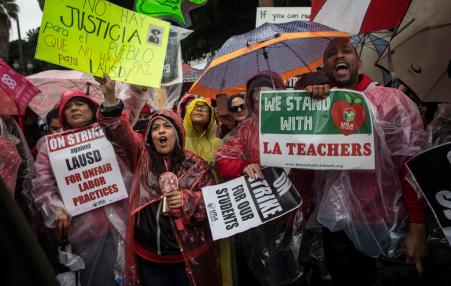
People rally in the streets of downtown in the pouring rain during a United Teachers Los Angeles strike on January 14, 2019 in Los Angeles, California. , Barbara Davidson / Getty Images
|
Unlike many labor actions, the Los Angeles teachers’ strike is not really about wages or benefits. At its core, this is a struggle to defend public schools against the privatizing drive of a small-but-powerful group of billionaires.
The plan of these business leaders is simple: break-up the school district into thirty-two competing “portfolio”networks, in order to replace public schools with privately run charters. As firm believers in the dogmas of market fundamentalism, these influential downsizers truly believe that it’s possible to improve education by running it like a private business. Not coincidentally, privatization would also open up huge avenues for profit-making — and deal a potentially fatal blow to one of the most well-organized and militant unions in the country, the United Teachers of Los Angeles (UTLA). As union leader Arlene Inouye explains, “This is a struggle to save public education; the existence of public education in our city is on the line.”
It’s always important to “know thy enemy.” But this is especially true for the educators’ movement in Los Angeles, which is directly challenging an unholy alliance of the some of richest individuals in the United States. Here’s a short primer on the corporate “who’s who” aiming to destroy public schools in LA — and across the nation.
The Walton Family
In a watershed moment for the drive to take over Los Angeles public education, pro-charter billionaires spent an unprecedented $9.7 million to buy the 2017 Los Angeles school board elections. A key funder of this campaign to elect charter school acolytes was none other than the Walton Family, best known as the founders of Walmart.
|
Thursday, November 01, 2018
NPE Action Endorses Tony Thurmond for Superintendent of Public Instruction in California!

The Network for Public Education Action Fund endorses Tony Thurmond for Superintendent of Public Institution in California!
California is a mess because of the intrusion of billionaires into education, billionaires who do not send their own children to public schools but want to control and privatize them. They pour millions into school board races, and they are now pouring millions into the state superintendent race, in hopes of capturing that important position.
Tony Thurmond’s opponent, Marshall Tuck, has a long history in the charter industry. Although he claims to be a Democrat (as in DFER), Tuck was endorsed by the California Republican party. Thurmond won the support of 95% of the delegates to the California Democratic party convention. Tuck was also endorsed by Arne Duncan, and Duncan’s endorsement means support of charter schools, high-stakes testing, and misuse of test scores to evaluate teachers.
California desperately needs accountability and transparency for its unregulated charter sector, not a fox in charge of the henhouse.
, Broad, and the other billionaires, should spend their money to improve schools rather than to attack teachers. https://capitalandmain.com/charter-school-donors
,
From the Sacramento Bee
Fresh off a Supreme Court loss that stripped them of millions of dollars in an annual revenue, California public employee unions are finding that they still have the big money they need to run statewide political campaigns.
It just might not be enough cash to keep up with their opponents.
The first test of California public-sector union spending after labor’s June defeat at the Supreme Court in Janus vs. AFSCME is unfolding in the race for state superintendent, a contest that typically attracts intense interest from education unions and groups that want to embrace charter schools.
Saturday, October 06, 2018
Corporate Money, Charters and the Schools
Hijacked By Billionaires: How The Super Rich Buy Elections To Undermine Public SchoolsAn NPE Action Investigative Report www.npeaction.org


Friday, May 26, 2017
Why Do Billionaires Want Charter Schools ?
 |
| Eli Broad and Edyth |
Harold Meyerson:
The billionaires, apparently, we shall always have with us — even when we decide how to run the state-funded schools where they rarely send their own kids.
In the Los Angeles school board elections earlier this month, a number of billionaires, including Eli Broad, Netflix founder Reed Hastings and two Walton family siblings, poured millions into the campaigns of two charter-school advocates. These billionaire-sponsored candidates defeated two badly outspent opponents who took a more cautionary stance on expanding charters, lest they decimate the school district’s budget. In total, pro-charter groups outspent teacher unions, $9.7 million to $5.2 million. (In the 2016 state legislative campaigns, the charterizers outspent the unions by a far larger margin, $20.5 million to $1.2 million.)
ADVERTISING
Though a number of the billionaires who’ve involved themselves in the charter cause are conservatives and Republicans, the actual election battles they join almost always pit Democrat against Democrat — in part because nearly all big cities are now overwhelmingly Democratic. In California, where Republicans’ numbers have ebbed past the point of power, the lion’s share of billionaires’ legislative campaign contributions have gone to more centrist Democrats, who not only are reliable votes on charter issues but also often oppose environmental and other measures advanced by their more progressive colleagues.
Charter billionaires have settled on a diagnosis, and a cure, that focuses on the deficiencies of the system’s victims, not the system itself.
Of all the issues billionaires could choose, why charters, and why now? One reason commonly adduced is that they’ve noticed something troubling: Public school graduates lack the skills necessary for employment. Many of those needed skills, however, are the kind that students acquire in vocational educational programs, not at charter schools.
That there are huge problems in the education of low-income students is beyond dispute — but this is hardly a recent development. The real recent development is the rising share of such students as the middle class has waned.
If the Waltons, say, decided to redirect more of their fortune to raising Wal-Mart workers’ wages, that in turn might enable hundreds of thousands of families to have more economically secure and stable lives, which could have a greater effect on student performance than charterization.
Thursday, May 18, 2017
More on LA School Board Take Over by Corporate Billionaires
| A Big Win for Corporate Advocates of Charters. Mike McPhate School board campaigns are often sleepy affairs, not the sort of electoral battle that generates widespread attention and outside donations. But this week’s election for the Los Angeles Unified school board was something of an epic proxy fight. Some saw it as a battle over the influence of the teachers’ union. Others cast it as a fight against the education agenda of President Trump and Betsy DeVos and the expansion of charter schools. |
| After Tuesday’s results, the seven-member school board that governs the nation’s second largest public school system will be dominated by supporters of charter schools who may move to increase the number of publicly funded but privately run schools across the city. |
| The election drew in some $14 million — making it among the most expensive school board races in the country’s history — and a host of high-profile endorsements. In the end, the candidates who portrayed themselves as supporters of dramatic changes won out, leaving the teachers’ union and its supporters angered and worried about the future. Steve Zimmer, the school board president who lost to the challenger Nick Melvoin, was so angered by the defeat that he refused to make the customary congratulatory call. Mr. Zimmer called the results “devastating” and said he would never run for office again. |
Thursday, October 30, 2014
Big Money Taking Over Education Politics
By Jeff
Bryant, Education Opportunity Network.
Big Money
Floods A California Superintendent Race
Education
historian and public school activist Diane Ravitch recently called our attention to
the race for state superintendent of school in California where Marshall Tuck,
running against educator Tom Torlakson, got a late infusion of huge campaign
contributions” from many of the same entities influencing the Minneapolis
school board race – Michael Bloomberg, the Waltons, and other heavy weight
private foundations.
As Poltico’s
Stephanie Simon explained, the contest is
between two Democrats – incumbent, Tom Torlakson, a former teacher and veteran
legislator, and a former Wall Street and charter school executive Marshall
Tuck.
Ed.note. The Torlakson –Tuck campaign has been much better
covered on this blog.
The
Torlakson campaign is “backed by all the traditional constituencies of a mainline
Democratic campaign, Simon explained, “including public sector unions,
environmentalists, reproductive rights groups and even the party apparatus
itself
Tuck, on the
other hand, “has been endorsed by every major newspaper in the state – and by a
bipartisan array of wealthy donors,” including the above mentioned Bloomberg
and Walton as well as mega-wealthy Los Angeles philanthropist Eli Broad and
numerous Silicon Valley entrepreneurs, all of whom register their political
leanings to the Democratic Party.
For that
reason Simon claimed, “The race has become a highly symbolic fight for the
heart and soul of the Democratic Party – and is shaping up to be major test of
waning teachers union power.”
Calling it,
“a campaign that echoes the same ‘Main Street vs. Wall Street’ divide that has
roiled the Democratic Party in recent years,” Simon noted Tuck’s negative
stance on teacher tenure and his strong support for charter schools compared to
Torlakson’s opposition to unfair teacher evaluations and over-emphasis on
testing that have been imposed by the Obama administration.
An analysis
of the two candidates at Education Week highlighted the divergence in
their assessments of what current school policies are achieving. Whereas Tuck
prefers the language of failure – saying, “We have a status quo that has been
broken for kids for a long time, that’s failing kids” – Torlakson talks about
recent accomplishments, including “California 8th graders’ significantly higher scores on the NAEP
reading test in 2013, a record-high graduation rate of 80 percent
for the class of 2013, and a new funding formula intended to provide more
resources and power to school districts.”
Simon noted
that Tuck is particularly eager to take on the California Teachers’
Association, the state teachers’ union, calling it too influential, while
Torlakson has defended hard won union contractual agreements with the state.
As the
education news outlet EdSource noted, both candidates have raised
about the same amount of money, $2.5 million for Torlakson and $2.4 million for
Tuck. But with total spending likely to hit $25 million, according to Simon’s
report, most of the money is coming from outside the candidates’ efforts.
As the
EdSource report explained, “There are no limits on donors to outside groups,
identified on campaign disclosure reports as ‘independent expenditure
committees.’ These committees have intensified their efforts in the past few
weeks,” mostly in a rush of support to Tuck.
Democracy
Gets Lost
What’s
getting lost in the flood of money into both these and other similarly
afflicted races is the integrity of the democratic process.
When a small
group of private individuals get such an out-sized ability to control the
conversation, the voices of the electorate are drowned out.
Those who
welcome the big money coming into these contests from corporate and private
interests are quick to note that labor organizations have long used their money
to influence education-related elections.
They are
quick to cast these contests as being referendums on the power of unions, as
Politico’s Simon did, and argue that these are merely two equivalent interests
duking it out on a level playing field.
But that in
fact is a false equivalency, as Simon herself seemed to admit in a recent Twitter exchange with me.
Teachers
unions are fundamentally democratic organizations, as Matt Di Carlo
has explained on his blog at the Albert Shanker Institute. “Teachers’ unions
are comprised of members who are teachers, they’re led by teachers (many still
in the classroom) who are elected by teachers, and union policy positions and
collective bargaining agreements are voted on and approved by teachers,” he
wrote. “When you hear ‘teachers’ unions,’ at least some part of you
should think ‘teachers.’”
Furthermore,
union influence can’t hide behind the secrecy that outside PACs and independent
expenditure committees enjoy.
That’s
different from what you should think when you hear about organizations working
to undermine the interests of teachers – like 50CAN and Students for Education
Reform – whose sole constituency is comprised of a few very wealthy people.
What you
should think instead, at least if you are a Democrat, is Citizens United and
Koch brothers.
By Jeff Bryant
Most folks
in the Democratic Party have a problem with the Citizens United ruling by the
U.S. Supreme Court that permitted goo-gobs of corporate and private interest
cash to be dumped onto our elections. The party’s platform supports amending
the Constitution to reverse the decision. President Obama has also called for
such an amendment, and Hillary Clinton has said she would consider supporting
it.
Most
Democrats are also alarmed by the enormous amounts of cash funneled into the
electoral process by folks like Karl Rove and the Koch brothers who use
corporate and private interest money to overwhelm citizen voice in elections
and usurp democracy.
But if
you’re a Democrat, you should know the influence buying unleashed by Citizens
United and perpetrated by people like the Koch brothers are at work – with the
blessing and participation of fellow Democrats – in education politics.
Historically,
elections that determine public education governance – from local school bard
races to contests determining state administrative leadership – have been
fairly subdued affairs in comparison to mayoral and legislative races.
That’s not
necessarily a good thing, because education has long been America’s most
collaborative public enterprise, affecting virtually everyone and determining
how we nurture the next generation of citizens, workers, and leaders.
But lately,
these contests have grown more animated as a new element –money from big
business and private individuals and foundations – is now altering the
electoral process in new and fundamental ways.
Examples of
this new dynamic have surfaced in the upcoming 2014 elections at both the local
school district level and at state level contests, and in each example, the big
money often coming from people who associate with the Democratic Party.
Further, these wealthy Democrats often collude with conservative Republicans in
these school-related elections in ways they never would in other contests.
This
confluence of big money is often called “bipartisanship.” But the results are
apt to be the same we’ve seen in more popular elections – a distortion of
democracy that leads to governance that is less progressive.
Big Money
Goes After School Boards
As Valerie
Strauss pointed on her blog at The Washington Post recently, “For several
years now local school board races around the country have attracted big money
from outside the state — and sometimes from across the country — as school
reformers and their supporters seek to elect like-minded public officials. In
2013, for example, millions of dollars were spent on school board
races in Los Angeles and in 2012, outsiders poured money into a New Orleans school board
race.”
In that
post, Strauss pointed to an article by Minneapolis-based writer and former
teacher Sarah Lahm, published by In These Times, describing how big money is
arm twisting the democratic process in her local school board election.
Lahm
explained how one of the candidates, Don Samuels, is benefiting from “extensive
financing and canvassing support … from several well-heeled national
organizations, such as the Washington, D.C.-based 50CAN,
an offshoot of Education Reform Now called Students
for Education Reform (SFER).”
Samuels has
out-raised his main competitor, incumbent Rebecca Gagnon, by almost 4 to 1
including “tremendous support from outside of Minnesota. The D.C.-based 50CAN
Action Fund filed a campaign finance report in Minnesota showing that it was
devoting $14,350 in financial resources to the Minneapolis school board race,
as well as in-kind donations valued in the thousands of dollars.”
Another
report on who is influencing the Minneapolis school board race, from Beth
Hawkins on the MinnPost website, described big donations
coming into the race from former New York City Mayor Michael Bloomberg and,
again, 50CAN and Students for Education Reform. That report also mentioned
another recipient to the largesse, candidate Iris Altamirano.
50CAN, a nonprofit organization with a stated mission to
“advocate for a high-quality education for all kids,” was founded and is led by
Marc Porter Magee, a former employee of the
Democratic Leadership Council’s think tank, a centrist-minded Beltway group
carrying a Democratic Party label but supportive of many policies favored by
Republicans.
The DLC, as
my college a the Campaign for America’s Future Robert
Borosage described, “led the Wall Street-funded, corporate wing of
the Party. The New Dems scorned the base of the Democratic Party – labor,
feminists, environmentalists, minorities, peace activists. Rather than resist
conservative headwinds, they argued vociferously that Democrats should tack to
them, adopting a muscular foreign policy, trimming social liberalism, posturing
tough on crime and the poor.”
According to
Wikipedia, early funding for the DLC came from
big corporations including “ARCO, Chevron, Merck, Du Pont, Microsoft, Philip
Morris and Koch Industries.” A more recent report, from The
American Prospect, adds a whole slew of corporate money and
influence into the DLC make-up.
So now 50CAN
– with funding from the likes of Google and lots of rich private foundations
including those of Bill and Melinda Gates and the Walton family of Walmart fame
– has emerged as a DLC clone with a mission to determine the results of local
school board elections.
Despite what
50CAN states as its mission, the organization seems clearly more geared to a
political strategy than it is on developing high quality schools.
In an
interview featured on the website of a conservative D.C.-based think tank,
Magee has stated his intentions of “breaking up the old ways of thinking in the
Democratic Party … by asking: How could we solve conservative problems with
liberal means, and liberal problems with conservative means?”
Apparently,
that recipe includes using the “conservative means” of big money to influence
the “liberal problem” of education policy.
Students for
Education Reform is a similarly minded group loosely linked to the Democratic
Party label but more often at odds with progressive causes. As a recent article
in The Nation described, “SFER has received $1.6 million from Education Reform
Now, whose PAC, Democrats for Education Reform (DFER), shelled out $1 million
to attack the Chicago Teachers Union. DFER worked with the Koch brothers and
ALEC to push Proposition 32, which if passed, would have blocked labor unions from using automatic payroll
deductions for political purposes. Though SFER claims neutral territory, its
motives are laid bare by its rallying around the funding of charter schools,
the issue of limiting tenure, and its strict focus on testing.”
In
Minnesota, as Lahm reported, the state branch of SFER “received $26,000 in
outside money, some of which it spent on such things as paid canvassers and
campaign infrastructure, and $4,350 of which it passed along to the 50CAN
Action Fund for ‘walk literature.” These effort by 50CAN and SFER on behalf of
two candidates in the race have been bolstered with more money coming from
Republican donors and charter school advocates, Lahm explained.
But to what
ends, Lahm asked? Minneapolis is being “primed” Lahm contended for charter
schools expansions.
Samuels’
campaign in particular, Lahm found, “appears to support the proliferation of
charter schools in Minneapolis.” Altamirano, the other candidate benefiting
from the outside money, supports charters as well.
As Lahm
noted, “the outside money flowing to the Samuels campaign follows a relatively
recent national pattern that’s played out in places such as Texas, Oregon, Colorado and New Jersey, where local school board races
have been heavily influenced by the political and financial heft of outside
groups.” In the 2014 election, you can add Indiana to that list.
But big
money coming from Democratic Party advocates for “education reform” is
targeting state elections as well.
What you
should think instead, at least if you are a Democrat, is Citizens United and
Koch brothers.
By Jeff Bryant
Saturday, September 06, 2014
Corporate educational "reformers"
Corporate “
Reformers” Andrew Ross Sorkin. NYTimes.
Beginning with
the Carnegies and the Rockefellers, billionaires have long seen the nation’s
education as a willing cause for their philanthropy — and, with it, their own
ideas about how students should learn. The latest crop of billionaires,
however, has tended to take the line that fixing our broken educational system
is the key to unlocking our stagnant economy. Whether it’s hedge-fund managers
like Paul Tudor Jones (who has given tens of millions to support charter
schools) or industrialists like Eli Broad (who has backed “blended learning”
programs that feature enhanced technology), these philanthropists have
generally espoused the idea that education should operate more like a business.
(The Walton Foundation, backed by the family that founded Walmart, has taken
this idea to new heights: It has spent more than $1 billion supporting various
charter schools and voucher programs that seek to establish alternatives to the
current public-school system.) Often these patrons want to restructure the
system to make it more efficient, utilizing the latest technology and
management philosophies to turn out a new generation of employable students.
Tuesday, February 26, 2013

Wednesday, January 23, 2013
Why do many reporters miss the story on the realities of school change ?
How the media distorts the
issues in the public school debates.
Reporters who are not experts on schools too often rely upon the wisdom of selected
“spokespersons” and other elites.
They have been sold a
framework of a corporate view of
accountability. Corporate sponsored networks and think tanks such as the the Thomas
B. Fordham Institute, the Broad Foundation, the Bradley Foundation, the Pacific Research Institute, and the Olin Foundation provide
“experts” prepared to give an opinion on short notice to meet a reporters
deadline. Most reporters assume
that these notables are telling the truth when in fact they are promoting a
particular propaganda such as in the film “Waiting for Superman”. Who do they not talk with? They fail to interview experienced
teachers and professionals who have worked for decades to improve the quality
of inner city schools.
The Obama Administration’s
appointment of Arne Duncan was symptomatic of the problem. He represents the kind of corporate/media approach to
reform. So, reporters can go
to the corporate funded foundations and provide “balance” by asking the
appointees of the government- they get the same story. In particular recently they have been
turning to the Gates and Broad Foundations or the conservative Democrats for Education Reform and
Michelle Rhee.
What the foundations and the Billionaires Boy’s Clubs are
saying is fundamentally misleading.
They are deliberately distorting the story. However reporters think that these foundations have smart
people so they must know what they are talking about. See Diane Ravitch. The Death and Life of the Great
American School System: How Testing and Choice Are Undermining Education.
2010.
Subscribe to:
Posts (Atom)


