Tuesday, September 16, 2014

California Children Living Below the Poverty line

New Census Data Show That More Than One in Seven Californians -- One-Third of Them Children -- Lived in Poverty in 2013

STATE'S OVERALL POVERTY RATE AND CHILD POVERTY RATE REMAIN HIGH DESPITE DECLINES SINCE 2011, HIGHLIGHTING NEED FOR POLICIES THAT BOOST WORKERS' EARNINGS 
SACRAMENTO -- Census Bureau data released today show that the share of all Californians with incomes below the federal poverty line in 2013 remained significantly higher than in 2006, the year before the Great Recession began. More than 5.6 million Californians -- over one in seven -- had incomes below the poverty line in 2013. California's overall poverty rate of 14.9 percent in 2013 is down significantly from 16.9 percent in 2011, but is still much higher than the pre-recession level of 12.2 percent in 2006.

Nearly 2 million California children were living in poverty in 2013, accounting for one in five children in the state (20.3 percent). Although this child poverty rate is down significantly from that in 2011 (24.3 percent), children still account for an outsize share of Californians living in poverty. Californians under age 18 were less than one-quarter of the total state population (23.9 percent) in 2013, but they accounted for nearly one-third of those living in poverty (32.5 percent). 


"The new Census poverty figures highlight the fact that many Californians are being left behind by our economy, even several years after the Great Recession ended," said Alissa Anderson, senior policy analyst with the CBP. "The child poverty rate is especially troubling, since children who grow up in poverty are more likely to remain in poverty as adults."

Saturday, September 13, 2014

The Story on SCUSD Superintendent that the Bee will not tell you.

Thank you Cosmo Garvin for writing what the Bee will not report on.
Cosmo Garvin. Sacramento News and Review. 9/11/2014. Page 15.
The Bee is clearly still sore about the loss of the previous superintendent, Jonathan Raymond. Raymond seemed to enjoy sticking it to teachers (and the occasional principal) and generally followed the playbook for corporate-ed reform.
He left quite suddenly during the last school year. The public reason was that he wanted his kids to be closer to their grandparents back in Boston. Surely a tough decision, to leave what he described as his “dream job.” But family comes first.
This summer, Raymond took a job as president of an education nonprofit called the Stuart Foundation—in San Francisco.
The Stuart Foundation is a major funder of something called the California Office to Reform Education. You may recall that Raymond committed Sac City schools to participate in the CORE, to help fund it, and to tie teacher evaluations to student test scores as part of the deal.
This was intensely controversial—and done without public input or any vote of the Sac City school board. The board only reversed Raymond’s decision after he had bailed, and after protests from teachers, parents and community groups.
It’s not so surprising that a plum job for Raymond was waiting on the other side of the revolving door. But what about the family thing?
Carol Ting, the Stuart Foundation’s chief operating officer, told Bites, “That was his plan. But then the recruiter came along and offered him his dream job.”
Dream job, huh? Anyway, Raymond slipped out the back door in a hurry, to take a dreamier job, or to escape whatever nightmares had cropped up here in Sacramento. Either way, even in his absence he was an important presence at the school-board-candidates forum held in Oak Park last Sunday.

Wednesday, September 10, 2014

U.S. Teachers Work Really Hard

American teachers work hard. Like, really hard.
Rebecca Klein
This year's education report from the Organisation for Economic Co-operation and Development outlines the state of education in the world's most developed countries. It finds that American elementary school teachers spend more hours actually teaching students than peers in any other surveyed country.
The graph below details how much time elementary school teachers spend in front of the classroom:

American middle school and high school teachers spend more time educating students than peers in every OECD country except Chile, according to the report. In addition to classroom time, U.S. teachers are required to be at school for more hours than most of their international peers.
Despite the long hours, American teachers aren't well compensated, Andreas Schleicher, OECD director of education and skills, explained in a call with reporters Monday. While U.S. raw teacher salaries are high compared with the rest of the world, the pay lags behind that of similarly educated American workers.
“Teacher pay relative to other countries, in absolute terms, is quite competitive in the United States," said Schleicher. "But when you look at this relative to the earnings of other people with college degrees, actually the United States is pretty much at the end of the scale."
The OECD graphic below shows how teachers' salaries compare with other college-educated workers in each country. The report found that teachers are paid more than comparably educated workers in only seven countries.

Sunday, September 07, 2014

November elections: high stakes for teachers and students

  • November elections: High stakes for students, parents, education voters
California;
A vital election between Tom Torlakson, Superintendent of Public Instruction-  a teacher himself who has opposed the Vergara decision.  And, Marshall Tuck, a Wall Street banker who has been hired as CEO of a charter school company.  He took no position on Proposition 30 which has now restored funding to California schools. 
    In the nation. 
    by Amanda Litvinov and Colleen Flaherty/image courtesy of Stu Spivack
    A relatively small group of elected officials at the local, state and federal levels determines what educators are expected to accomplish in the classroom each year and the resources they’ll have to pull it off. This November, most of those offices are up for election, including the seats of 36 governors, 6,048 state legislators, 31 state attorneys general, and 468 members of the U.S. Congress.
    TAKE ACTION ›
    Education voters got low marks in the 2010 midterm elections. Our presence at the polls was dismal, which opened the door to scores of candidates who put the desires of wealthy corporations and CEOs before the needs of the 80 million students who attend America’s public schools and universities. The results proved devastating.
    It’s not just who we elect for president — local elections like school board seats and state elections have the most direct effect on education funding, says Beary Clark, a high school custodial worker from Erie, Penn.
    “Governor [Tom] Corbett cut a whole lot from our budget since he came into office in 2011, which left us short on resources as basic as the books we need, and it directly affects kids,” Clark says. “Our district alone closed two elementary schools to make up for an $8.8 million deficit and a lot of people lost their jobs — all because voters weren’t paying attention to who was getting into office.”
    Similar scenarios played out across the country after the 2010 elections.
    Since then, billions of dollars have been cut from state education budgets; federal education funding is lower than it was three years ago, despite the fact that public schools now serve a million more students; and educators’ ability to advocate for their students through bargaining has been severely diminished in some states and is under constant threat in others.
    Education voters are getting ready for one of the high stakes tests of their voting-eligible lives. If you’re not convinced that elections matter—or you need to convince those around you that they do—borrow our notes to review how the roles of elected officials determine what happens in your district, school, and classroom.

    Saturday, September 06, 2014

    Corporate educational "reformers"

    Corporate “ Reformers” Andrew Ross Sorkin. NYTimes.  
    Beginning with the Carnegies and the Rockefellers, billionaires have long seen the nation’s education as a willing cause for their philanthropy — and, with it, their own ideas about how students should learn. The latest crop of billionaires, however, has tended to take the line that fixing our broken educational system is the key to unlocking our stagnant economy. Whether it’s hedge-fund managers like Paul Tudor Jones (who has given tens of millions to support charter schools) or industrialists like Eli Broad (who has backed “blended learning” programs that feature enhanced technology), these philanthropists have generally espoused the idea that education should operate more like a business. (The Walton Foundation, backed by the family that founded Walmart, has taken this idea to new heights: It has spent more than $1 billion supporting various charter schools and voucher programs that seek to establish alternatives to the current public-school system.) Often these patrons want to restructure the system to make it more efficient, utilizing the latest technology and management philosophies to turn out a new generation of employable students.

    Tuesday, September 02, 2014

    Teacher Unions appeal Vergara decision on teacher tenure

    Contrary to the advocacy of the Sacramento Bee:
    Governor Jerry Brown, Attorney General Kamala D. Harris file to appeal  court decision.

    LOS ANGELES — The final decision rendered by Los Angeles Superior Court judge Rolf Treu today in the Vergara v. California case offered no new reasoning or information as to how stripping teachers of their workplace professional rights will help students gain a better education.  In rolling back the protections that allow teachers to educate their students and advocate for them without fear of arbitrary and capricious retaliation, the judge has set back a century of well-reasoned law.
    “This decision fails to recognize the benefits to students and society provided by the challenged statutes, including the ability to recruit and retain educators and promoting teaching as a life-long career,” said CTA President Dean E. Vogel. “These statues provide educators with basic due process rights that allow teachers to speak up on behalf of their students and provide transparency in district employment and layoff decisions.”
    Evidence during the trial showed no link between the statutes and the retention of ineffective teachers or in the assignment of teachers to particular schools. On the contrary, the evidence showed that school districts have tremendous latitude in hiring, in assignment and in dismissal. In fact, according to testimony by several districts, underperforming teachers are remediated or removed from their positions frequently using the existing statutes.

    Monday, September 01, 2014

    Bee Editorial Board throws more bricks at Banda

    The Bee Editorial Board on Sunday continued its impolite, nasty, commentary on the new Superintendent of  Schools in Sacramento- Jose Banda. http://www.sacbee.com/2014/08/31/6665241/editorial-banda-needs-to-hit-ground.html
    First, they continue with their whining that when asked why he was returning to California he mentioned the pension advantages.  He said much more, but the Bee editors are fixated on this.  They can’t keep themselves from throwing stones.
    Then we learn that the Bee’s editorial board “ sat down with Banda last week to give him an opportunity to disabuse us of the notion.” Well, isn’t that nice . The royalty offered the commoner a chance to talk.
    Next they offer their own suggestions.
    1.     “Meet with the mayor right away.”  They go on to discuss Johnson’s role and that of his wife- Michelle Rhee from the perspective of the Editorial Board – none of whom work in schools.
    Why should he start here?  Banda has met with the Bee, one of the Johnson’s chief cheerleaders.
    It is far more important that he meet with teachers, students and administrators, which he is doing.

    Yes, he needs a strong start. 
    And the Bee editorial board keeps throwing bricks.  I wonder what their motives are?

    Saturday, August 30, 2014

    Tom Torlakson supports teachers rights to teach

    SACRAMENTO—State Superintendent of Public Instruction Tom Torlakson today released the following statement regarding theVergara, et al. vs. State of California, et al. lawsuit:
    "The people who dedicate their lives to the teaching profession deserve our admiration and support. Instead, this ruling lays the failings of our education system at their feet.
    "We do not fault doctors when the emergency room is full. We do not criticize the firefighter whose supply of water runs dry. Yet while we crowd our classrooms and fail to properly equip them with adequate resources, those who filed and support this case shamelessly seek to blame teachers who step forward every day to make a difference for our children.
    "No teacher is perfect. A very few are not worthy of the job. School districts have always had the power to dismiss those who do not measure up, and this year I helped pass a new law that streamlined the dismissal process, while protecting the rights of both teachers and students. It is disappointing that the Court refused to even consider this important reform.
    "In a cruel irony, this final ruling comes as many California teachers spend countless unpaid hours preparing to start the new school year in hopes of better serving the very students this case purportedly seeks to help.
    "While the statutes in this case are not under my jurisdiction as state Superintendent, it is clear that the Court's ruling is not supported by the facts or the law. Its vagueness provides no guidance about how the Legislature could successfully alter the challenged statutes to satisfy the Court. Accordingly, I will ask the Attorney General to seek appellate review."

    Thursday, August 28, 2014

    Rethinking Schools- Teaching Ferguson

    RS Logo
    Teaching Ferguson
    Compilation of blog posts and resources from Rethinking Schools,
    Teaching for Change, and Zinn Education Project 

    Teaching About Ferguson
    by Julian Hipkins III

    Credit: Reuters

    As the new school year begins, first and foremost on our minds and in our hearts will be the killing of Michael Brown in Ferguson, Missouri. Teachers may be faced with students' anger, frustration, sadness, confusion, and questions.  Some students will wonder how this could happen in the United States. For others, unfortunately, police brutality and intimidation are all too familiar.

    Here are a few ideas and resources for the classroom to help students think critically about the events in Ferguson and ways they can be proactive in their own communities.


    Teach About Mike Brown. But Don't Stop There.
    By Rethinking Schools magazine contributor Renée Watson
    Credit: flickr user no scream @ the end
    This time last summer, I researched articles and collected poems about police brutality, racial profiling, and the murders of black men in the United States. The George Zimmerman verdict was fresh on my mind and I wanted to talk about it with my students once school was back in session. I revised a lesson I had taught six years prior on the murder of Sean Bell that asked young people to turn their pain into poetry. And now, here I am again, swapping out the articles I used last year on Trayvon Martin with articles about Mike Brown. I have accepted that I may have to teach this lesson every school year.

    Back to School, and to Widening Inequality

     Robert Reich
     American kids are getting ready to head back to school. But the schools they’re heading back to differ dramatically by family income. Which helps explain the growing achievement gap between lower and higher-income children. Thirty years ago, the average gap on SAT-type tests between children of families in the richest 10 percent and bottom 10 percent was about 90 points on an 800-point scale. Today it’s 125 points. The gap in the mathematical abilities of American kids, by income, is one of widest among the 65 countries participating in the Program for International Student Achievement.
    On their reading skills, children from high-income families score 110 points higher, on average, than those from poor families. This is about the same disparity that exists between average test scores in the United States as a whole and Tunisia.
    The achievement gap between poor kids and wealthy kids isn’t mainly about race. In fact, the racial achievement gap has been narrowing.
    It’s a reflection of the nation’s widening gulf between poor and wealthy families. And also about how schools in poor and rich communities are financed, and the nation’s increasing residential segregation by income.

    Wednesday, August 27, 2014

    Groups protest Pro-corporate policies of Mexican G...

    antiracismdsa: Groups protest Pro-corporate policies of Mexican G...: SACRAMENTO, Calif. — Mexican President Enrique Pena Nieto praised Gov. Jerry Brown and state lawmakers Tuesday for approving a series ...

    Thursday, August 21, 2014

    The U.S.'s Classist Educational System - And California's

    by Peter Dreier.
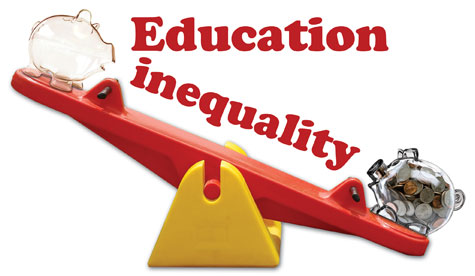
    America's education system is unequal and unfair. Students who live in wealthy communities have huge advantages that rig the system in their favor. They have more experienced teachers and a much lower student-teacher ratio. They have more modern facilities, more up-to-date computer and science equipment, and more up-to-date textbooks. They have more elective courses, more music and art offerings, and more extracurricular programs. They have better libraries, more guidance counselors and superior athletic facilities.
    2014-07-25-EducationalInequalityposter.jpg
    Not surprisingly, affluent students in well-off school districts have higher rates of high school graduation, college attendance and entry to the more selective colleges. This has little to do with intelligence or ability. For example, 82 percent of affluent students who had SAT scores over 1200 graduate from college. In contrast, only 44 percent of low-income students with the same high SAT scores graduate from college. This wide gap can't be explained by differences in motivation or smarts. It can, however, be explained by differences in money.

    Wednesday, August 13, 2014

    Another Opportunity Missed - Civic Education Policy Proposals in California

    California education policy makers have once again written and published a nice looking report on school curriculum – this one on the need for improved civic education.  As is the norm for these tasks, a group of “well respected” civic leaders have participated.
    They have written a report, Revitalizing K-12 Civic Learning in California, and they call it a Blue Print for Action. http://www.powerofdemocracy.org/wp-content/uploads/2014/02/CLTF-Final-Report.pdf
    They call for a major revision of civic education.  That is fine. They also call for discussion of their proposals on social media.( p 42)   Well, here is some of the needed discussion. 

    They even recognize the diversity of California students.  They say,
    “Civic learning is also vital for our increasingly diverse California society. In 2012-
    2013, our 6.2 million K-12 students were 53 percent Latino, 26 percent white,
    9 percent Asian and 6 percent African American, with the remaining 6 percent
    comprised of other ethnicities. In addition, an increasing number of our students
    are not native speakers of English. Almost 4 in 10 kindergarteners are English
    language learners. This diversity, and the attention it requires, is now acknowledged
    in our school funding model. The Local Control Funding Formula (LCFF) recognizes
    the necessity of investing in the reduction and ultimate removal of inequitable
    outcomes in California public schools. Revitalizing civic learning opportunities, in
    an equitable manner, can contribute to meeting these goals.”

    While it is accurate that we have a general problem of civic engagement of the young,  it is also true that we have a very specific problem with the rate of Latino and Asian voter participation and  civic engagement.
     Rates of voting and voter registration provide a window into civic engagement.  The proportion of state voter  registration that is Latino and Asian has remained far below the proportions of these groups in the state’s overall population. In 2010, Latinos in the state made up 37.6% of the general population while they were on 21.2 % of the registered voters. The Asian population was 13.1 % of the state but  only 8.1 % of the registered voters.

    Monday, August 11, 2014

    Civil Rights and Civil Wrongs in Public Schooling

    By Anthony Cody and Alan Aja.
    From the very beginnings of No Child Left Behind, the strongest argument for attaching stakes to tests has been Civil Rights. This phrase is shorthand for equity in education, an end to the systemic neglect of children of color. And proponents of corporate reform have become adept at wrapping themselves in these concerns, while promoting policies that have devastating effects on students and their communities. Common Core is no exception to this.
    From Politico last week came word that Common Core proponents have realized that they are losing the battle.
    We’re so good at all our statistics and data and rational arguments . [but] emotion is what gets people feeling passionate,” Oldham said. “It may not be the most comfortable place for the business community . [but] we need to get better at doing it.
    This message seems to connect with Mike Petrilli of the Thomas B. Fordham Institute, which has received Gates Foundation funding to evaluate the Common Core, as well as general operating grants. Petrilli said:
    “We’ve been fighting emotion with talking points, and it doesn’t work,” said Mike Petrilli, executive vice president of the Fordham Institute, a leading supporter of the standards. “There’s got to be a way to get more emotional with our arguments if we want to win this thing. That means we have a lot more work to do.”
    Step one: Get Americans angry about the current state of public education.
    To that end, expect to start hearing from frustrated college students who ended up in remedial classes even though they passed all their state tests and earned good grades in high school. “These kids should be as mad as hell” that the system failed them, Petrilli said.

    Saturday, August 09, 2014

    Release of DC-CAS Proficiency Scores Affirms Need for Transparency, Change of Policy Strategy | Economic Policy Institute

    Release of DC-CAS Proficiency Scores Affirms Need for Transparency, Change of Policy Strategy | Economic Policy Institute


    Clearly Michelle Rhee's leadership of D.C. schools did not improve student achievement.

    "Better than the Republicans", Not Good Enough

    by Jeff Bryant,
    A common admonition progressives have gotten used to hearing over the years is to support more conservative Democratic candidates because “Republicans are worse.”
    This admonition makes some sense in electoral politics, when, in most cases, progressives face a ballot box decision where they have to choose the “lesser evil” instead of someone who wants to do something really horrible like roll back government policies to what was in favor a hundred years ago. Elections, after all, are societal constructions where you’re forced to make a choice between only two candidates, usually. To not vote at all forfeits your right to have a say-so in the matter. And few Americans get the opportunity to vote for third party candidates who have viable shots at winning.
    But “better than the other side” loses any legitimacy in the policy arena, or at least it should. For sure, there are often trade-offs between adversaries in the legislative process. But when there’s not an actual bill facing an up-or-down vote, there’s simply no reason for progressives to accept policy positions from office holders on the basis of those positions being better than what the other side wants.
    Yet progressives who push for polices reflecting their values are constantly scolded for exhibiting a “have it all fantasy.” They’re told to give centrist Democrats “credit” for positions where there is some agreement – such as marriage equality or climate change – and understand when those officials have to make deals with the other side. “That’s how the game is played,” goes the refrain.
    When it comes to the education policy arena, “the game” has played into a disaster for the nation’s schoolteachers, parents, and students.

    Thursday, August 07, 2014

    The Myth of Teacher Tenure


    by Diana D'Amico — July 23, 2014

    In the stories of exorbitant costs and incompetence, teacher tenure laws have achieved mythic proportions. Judge Rolf Treu’s tentative decision in Vergara v. California may be the death knell for teacher tenure. But what will change as a result? A look to the past reveals that teacher tenure never really protected teachers and nor was it supposed to. Using history as a lens, this commentary explores the origination of tenure policies and the debates that surrounded them. This commentary argues that embedded in the tenure debates is a much larger problem that should concern us all.

    In 1917, the president of New York City’s Board of Education told a reporter that the schools are “burdened and clogged with many teachers who are unfit” because of their “permanent tenure.”1 For nearly a century, critics have blasted tenure for putting the needs of adults above those of children. In the stories of exorbitant costs and incompetence, teacher tenure laws have achieved mythic proportions. Judge Rolf Treu’s tentative decision in Vergara v. Californiamay be the death knell for teacher tenure. But what will change as a result? A look to the past reveals that teacher tenure never really protected teachers and nor was it supposed to.  

    Monday, August 04, 2014

    Welcome to Sacramento Superintendent José Banda

    Welcome to Sacramento.  We hope that you can establish a positive working relationship with the Board, the community, and the teachers.  Developing a positive relationship and sustained, consistent leadership is required for school improvement.

    We regret the prompt attacks on your character and your contract by the Sacramento Bee editorial board.  You see they were staunch advocates for the prior Superintendent Jonathan Raymond, a Broad Foundation assisted superintendent.  He left promptly without an explanation. It is unusual for the Bee to attack a new superintendent before he has an opportunity to make some decisions. 
    Duane Campbell, Director.
    Democracy and Education Institute

    Friday, August 01, 2014

    New President of NEA and Arne Duncan

    Jeff Bryant:
    For years, politicians and policy leaders have been running the nation’s public education system basically by the seat of the pants, drafting and passing legislative doctrine that mostly ignores the input from classroom teachers, research experts and public school parents.
    What’s got teachers stirred up? How real and potent is this upsurge of their activism? Why should people who identify with progressive causes care? Salon recently posed those questions, and others, to Lily Eskelsen García, the new president-elect of the National Education Association, the nation’s largest teachers’ union, at the recent Netroots Nation conference in Detroit.
    First of all, congratulations on becoming the new NEA president.
    Still president-elect. I take office Sept. 1. We have an incredible president, Dennis Van Roekel, who basically said a transition period should be a transition period, not go stand in the corner. So he gave me the president-elect title and told me I would take the press calls, go to Netroots, meet with Arne Duncan, start establishing where you want to go and be as vocal and as visible as you can possibly be. Our members have asked NEA to step up and take things to another level. There’s too much at stake for us. There are policies that need addressing and we have some of the best policy expertise in the nation, but those ideas need a face to the NEA, a face for the American teacher that is channeling the voices of these 3 million educators, and when you hear the words come out of her mouth it’s not just her opinion — it’s a whole lot of teachers and support staff who are saying here’s an important thing for the American people to hear and an important thing for Arne Duncan and President Obama to hear. So he told me to start being that voice today.
    The voices of these teachers are important, aren’t they? And too often we don’t really hear their stories about what it’s really like to teach in American schools, do we? For instance, I was just at a meeting of the American Federation of Teachers, where a teacher told us about showing up to school one morning and finding a man had been shot to death in front of the building the night before. The body was still on the sidewalk as the kids were coming to school, and the teachers had to decide how they were going to handle this with the children. So many of our teachers are really serving as first responders for kids, aren’t they?
     
    Creative Commons License
    This work is licensed under a Creative Commons Attribution-NonCommercial 3.0 Unported License.