Showing posts with label history. Show all posts

Friday, July 03, 2026

Trump /Maga Viewpoints

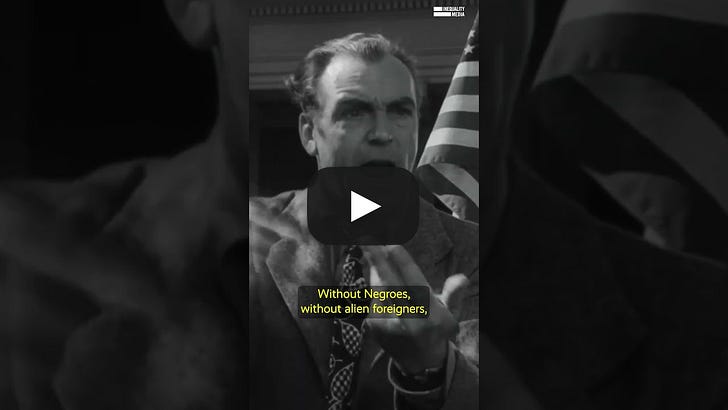
 I came across this Public Service Announcement produced by the U.S. government in 1945. It seems apt today, on the eve of the nation’s 250th anniversary, when bigotry and hate are being stoked by a neofascist president. Please take a look:

Actually, it was Robert Reich who came across this video.  On his substack.

This is a clip from the original, which runs 23 minutes. It was called “Don’t Be a Sucker.”

Saturday, April 18, 2026

May Day and A Day Without Immigrants


May Day and No Kings 2026

A Day Without Immigrants 


by Harry Targ


This year May Day will continue the historic mass mobilizations for social and economic justice of recent historic No Kings rallies. The original May Day was designed to remember the May 1, 1886 rally in Chicago for the 8-hour day. At that rally more than 300,000 workers from 13,000 businesses walked off their jobs to demand justice for workers. 


At a subsequent rally two days later at another rally an unknown person threw a bomb, violence broke out, police and others were killed. Anarchist leaders of the rallies, the Haymarket Martyrs, were charged with the violence, which they had nothing to do with. Subsequently eight martyrs were convicted, four of whom were executed for crimes they did not commit. Three years later, a federation of socialists workers, the Second International, declared May 1 an International Workers Day to remember the Haymarket Martyrs and at the same time to continue to rally for worker rights, from social and economic justice to ending war. Almost 70 countries around the world honor May Day as an official holiday today, and workers in many more countries celebrate the day and workers’ rights even though it is not an “official” holiday.


Today working people, most of the population of the United States, still need social and economic rights, labor rights, and would benefit from dramatic cuts in military spending and increases in social spending. As a result, millions of people in the United States have marched and rallied for social and economic justice, defending democratic institutions, and against wars in recent No Kings rallies, the most recent being March 28. Given the threats of fascism at home and world war overseas, activists are asking “What do we do now?’ One answer is to step up the militancy while honoring May Day, the International Workers Day.


​“Coming off the heels of the massive energy from the No Kings mobilizations, people are ready to take action and keep fighting for a democracy of, by, and for the people,” says Indivisible Co-Founder Leah Greenberg, whose organization started the No Kings protest. 


On May 1, Indivisibles will be joining people across the country with a clear message: we demand a government that invests in our communities, not one that enriches billionaires, fuels endless war, or deploys masked agents to intimidate our neighbors.” 


https://paydayreport.com/no-kings-organizers-pivot-to-may-day-general-strike/


As Ralph Chapin. the lyricist of the industrial Workers of the World wrote in 1915 in the workers' anthem, “Solidarity Forever”:


“In our hands is placed a power greater than their hoarded gold,

Greater than the might of armies, magnified a thousand-fold.

We can bring to birth a new world from the ashes of the old.

For the union makes us strong”

Friday, October 31, 2025

How Politics is Changing / Corrupting the Way History is Taught

 California, the nation’s largest Democratic-led state, has passed a law restricting what teachers can say in the classroom, and has walked back an effort to require high school students to take classes in ethnic studies.


To supporters of these changes, they are a necessary corrective to what they see as a leftward tilt in the education establishment. But these developments have also set off alarms among free speech advocates, as the Trump administration pushes to punish speech it dislikes and to impose its patriotic vision of American history on schools.


How Politics is Changing the Way History is Taught.

https://www.nytimes.com/2025/10/27/us/history-lessons-ethnic-studies-retreat.html


To win, they will have to come through us. 


Wednesday, May 03, 2023

National History Scores Decline


It’s Not Just Math and Reading: U.S. History Scores for 8th Graders Plunge 

The latest test results continue a nearly decade-long decline. Try a sample quiz to test your knowledge.

and Civics.
The dip in civics performance was the first decline since the test began being administered in the late 1990s.Credit...Joseph Rushmore for The New York Times
An empty classroom with an America flag in the corner.

National test scores released on Wednesday showed a marked drop in students’ knowledge of U.S. history and a modest decline in civics, a sign of the pandemic’s alarming reach, damaging student performance in nearly every academic area.

The pandemic plunge in U.S. history accelerated a downward trend that began nearly a decade ago, hitting this recent low at a time when the subject itself has become increasingly politically divisive.

A growing number of students are falling below even the basic standards set out on the National Assessment of Educational Progress, a rigorous national exam administered by the Department of Education. About 40 percent of eighth graders scored “below basic” in U.S. history last year, compared with 34 percent in 2018 and 29 percent in 2014.

Just 13 percent of eighth graders were considered proficient — demonstrating competency over challenging subject matter — down from 18 percent nearly a decade ago


this is not an endorsement of so called national standards. 


Friday, April 14, 2023

US Fascism Is Spreading Under the Guise of “Patriotic Education” Henry A. Giroux ,


The relentless state-based attacks on Black people in the U.S. and the war being waged against public and higher education are not unrelated.

In the present political and ideological climate, far right political leaders, such as Florida Gov. Ron DeSantis, Texas Lt. Gov. Dan Patrick and Sen. J.D. Vance (R-Ohio) have declared a war on institutions of public and higher education, which they’ve identified as centers of “unpatriotic education.” Most far right Republicans fear higher education as a bulwark against their authoritarianism and hence see students as a threat to their propaganda machines and fascist politics. As a result, the right wing has kicked into overdrive in an attempt to target educational institutions as a site for policing dissent, eliminating unions, indoctrinating faculty and students, and for normalizing white Christian nationalism, white supremacy and pedagogies of repression.

We have seen this in Ron DeSantis’s efforts to take over the progressive New College of Florida and turn it into a haven for white Christian education. DeSantis wants to remodel New College after the reactionary Hillsdale College, a private Christian liberal arts college that Kathryn Joyce states has played a “far-reaching role in shaping and disseminating the ideas and strategies that power the right.”

It’s clear that the far right GOP has deemed education to be the most powerful tool for creating a public that is neither informed nor willing to struggle to keep a democracy alive. This is particularly evident in the right-wing war on education, which aims at replacing public education with charter schools, fashioning public and higher education into centers of far right indoctrination, and destroying higher education as a democratic public good. Central to such an attack is a war on critical thinking, troubling knowledge, historical memory and any form of education that address social problems. Extremists in the GOP fully embrace both white nationalism and white supremacy while simultaneously supporting a culture and society in which the distinction between lies and the truth disappear. What they would also like to see disappear in their reign of domestic terrorism are the educators, institutions, and other public spaces that resist this ongoing tsunami of authoritarian ideas, acts of repression, and war on critical intellectuals, dissidents and educators.

What the far right GOP politicians fear about education is that it is the one site where young people learn the responsibilities of being critical and engaged citizens. As Moira Donegan argues, education at all levels “are foundational to democracy and this is the reason why DeSantis and the far right are attacking education.” She writes:


https://portside.org/2023-04-12/us-fascism-spreading-under-guise-patriotic-education?


Wednesday, February 08, 2023

You have got to be carefully taught !


Stephen Rohde 
January 25, 2023
Truthdig
How U.S. history textbooks and prominent American universities justified slavery, perpetuated racial stereotypes and promoted white supremacy.

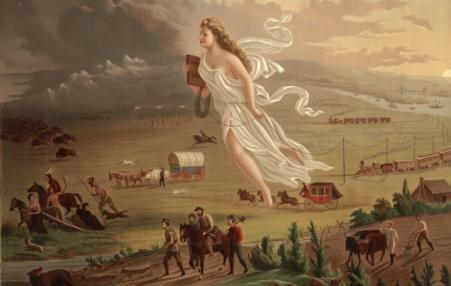
John Gast's 1872 painting "American Progress," seen as an allegory for Manifest Destiny and American westward expansion. The painting serves as the cover for Donald Yacovone's “Teaching White Supremacy: America’s Democratic Ordeal and the Forging of Our N, 


You’ve got to be taught to hate and fear

You’ve got to be taught from year to year

It’s got to be drummed in your dear little ear

You’ve got to be carefully taught

You’ve got to be taught to be afraid

Of people whose eyes are oddly made

And people whose skin is a diff’rent shade

You’ve got to be carefully taught

You’ve got to be taught before it’s too late

Before you are six or seven or eight

To hate all the people your relatives hate

You’ve got to be carefully taught

With these haunting words from the 1949 Broadway musical “South Pacific” by Richard Rodgers and Oscar Hammerstein II, Donald Yacovone opens his startling new book “Teaching White Supremacy: America’s Democratic Ordeal and the Forging of Our National Identity” (Pantheon). Equally revealing, and an important partner to Yacovone’s book, is Jessica Blatt’s “Race and the Making of American Political Science” (University of Pennsylvania). These impressive books describe how the institution of American education trained its teachers and taught its students to believe slavery was good for the enslaved, that Reconstruction was a disaster, that African Americans were innately inferior and that the destiny of the United States was to be ruled by the descendants of White Europeans.

These books would have been welcome whenever they appeared, but they take on added urgency today as Republicans in Congress and several state legislatures across the country actively seek to turn back the clock by passing new laws to erase history and reimpose  a white supremacist narrative in American education and by banning certain books and curriculums because they offer a thorough account of the ongoing struggle throughout American history to overcome racism, sexism, homophobia and bigotry.

On January 12,  the Florida Department of Education informed the College Board, which administers Advanced Placement exams, that Florida would not allow a new A. P. course on African American studies to be offered in its high schools, claiming the course is not “historically accurate,” “significantly lacks educational value” and violates state law.  Last year, Gov. Ron DeSantis, a Republican, signed legislation that restricted how racism and other aspects of history can be taught in schools and workplaces. The law’s sponsors called it the Stop WOKE Act. Among other things, the act prohibits instruction that could make students feel responsibility for or guilt about the past actions of other members of their race. The College Board said the course, a multiyear pilot program that has been used in 60 high schools across the country, including at least one in Florida, is multidisciplinary and addresses not just history but civil rights, politics, literature, the arts and geography.

Florida law prohibits schools from teaching “critical race theory,” an academic framework for understanding racism in the United States, and does not allow educators to teach The 1619 Project, a classroom program developed by The New York Times that seeks to reframe the country’s history by putting the consequences of slavery and the contributions of Black Americans at the center of the national narrative.  Henry Louis Gates Jr., a former chair of Harvard’s Department of African and African American Studies and director of the Hutchins Center for African & African American Research, who was a consultant to the College Board as it developed the A.P. course, said last year that he hoped the curriculum would not shy away from such topics that spur debate, not as a framework, but as a way of studying different theories of the African American experience.

Tuesday, September 15, 2015

Trump and Immigration - A Time to Fight Back

Bernard Weisberger
September 14, 2015
Moyers & Company
 
Trump’s announced intention to deport 11 million “illegals” while building a wall from the Pacific to the Gulf of Mexico at no cost — details conveniently not provided — is simultaneously savage and ludicrous. Even more disturbing is the sluggishness of the response from Republican and Democratic opinion makers. Where is the outrage? Why is the counterattack left largely to Hispanic organizations? 


A Know-Nothing cartoon depicting stereotypes about whiskey drinking Irish and beer drinking Germans as they steal the ballot box while Americans fight at the polls., 
 
 
It has so far annoyed but not really surprised me that Donald Trump, despite being an obnoxious bully, has defied expectations with a steady rise in the public opinion polls. It may be that his buffoonery and megalomania are simply more attractive to some early voters than rival candidates, with their solemn professions that what pushes them into the grind of campaigning is their dedication to promoting the public welfare.
But I am considerably more than annoyed when Trump puts himself at the head of the armies of the new nativism by using his bullhorn to echo the warnings of the movement’s Cassandras against the supposed “hordes” of undocumented immigrants pouring through our “open southern border.” His point of attack is the so-called “anchor babies” — children of pregnant mothers who supposedly sneak into the United States so that their children will be born here and automatically become citizens.

Tuesday, March 17, 2015

Teach The Students Well- Their Own History !

Write Chicano/Mexican American History into California State Textbooks

By Duane Campbell
Mexican American/Chicano history is substantially absent from public school textbooks and curriculum in California- and it has been since  1986.  This year we have an opportunity to change that. 
California has the largest student  population of any state, with more than 6,236,000 students  in school in 2013.  Students who are Mexican American of Latino heritage make up over 53% of the total school population. 
Latino student political non participation  and disconnectedness is significantly caused by Latino absence from the K-12 textbooks and curriculum. 
Children and young adults need to see themselves in the curriculum.  Students, have low levels of attachment to California and U.S.  civics engagement in significant part because the government institution they encounter the most- the schools-  ignore the students’ own history, cultures and experiences.

California state textbooks currently largely ignore the roles of Mexican Americans and Latinos in building this state.  Students need to learn civic engagement – it is not automatic.  Students need to learn that they belong , that they are a part of the community and its history.

Monday, February 02, 2015

Sen.Rand Paul Criticizes Common Core History Standards- duh There aren't any

However, Common Core only sets standards in english language arts/literacy and math, as ThinkProgress pointed out.
Critics of Common Core take issue with its alleged required reading list, which Bill Bennett, former Secretary of Education for President Ronald Reagan, described as a "myth" in a September op-ed.
The only texts Common Core requires students to read are the Declaration of Independence, the Preamble to the Constitution, the Bill of Rights, and President Lincoln's second inaugural address, according to NPR.

Monday, July 29, 2013

Why California textbooks ignore Chicano/ Mexican American history


 And what you can do about it.
Textbooks for  California schools are selected by the State Board of Education based upon recommendations of their Curriculum Committees and the state frameworks and standards.   The current Framework was written in 1987 – before the fall of the Soviet Union. It is urgent that the History-Social Science Framework be revised to provide an accurate history of the contributions of Mexicans, Mexican Americans, Latinos and Asians to the history of the state and of the nation. The current Framework reflects the historiography of the 1950’s. It was written in 1986 by senior scholars, they in turn were educated in the early 1970’s or before. It is substantially out of date. For a more detailed description of this issue see https://sites.google.com/site/chicanodigital/home/why-california-students-do-not-know-chicano-history
Unfortunately this existing, outdated, biased  document could well become the template for schools throughout the nation as a part of the Common Core Standards efforts.
Here is the problem. The  Democracy and Education Institute and the Mexican American Digital History Project  has  been working for the last  three  years to change the California History/Social Science Framework for California Public Schools to include the significant contributions of Mexicans and Chicanos to the history of the state. 
At the same time, the U.S. is moving toward Common Core standards for all schools in the nation.   The Common Core is well along its way in math and English (reading).  History, Civics and Social Studies will follow soon. The development of a common core  usually proceeds from a state’s existing standards.  The existing California standards are based upon the existing biased and insufficient  1987 History Social Science Framework.  Unless there is change, California will be advocating for a set of Common Core standards that ignore Chicano ( and Asian) history.  Other states including Texas and Arizona have similarly biased and insufficient standards.  Thus, unless there is a change in the California standards, the Common Core effort  could well lock in the 1987 standards for another decade.  An unnecessary shame.

Tuesday, May 28, 2013

How History is Socially Controlled in k-12 - Rodolfo Acuña


How History is Socially Controlled in K-12
Setting Standards :Serfs and Lords
By
Rodolfo F. Acuña

People ask me if the banning of books is actually a blessing in disguise because it calls attention to the banned books. I respond, “Hell No!” Censorship threatens our freedom of speech, and it is the final step toward a totalitarian state. 

In the guise of security, our emails and our phones are tapped. Anyone using a Wi-Fi can be spied on at will. What is happening today pales George Orwell’s 1984; it is as insidious as the methods used by the Nazis, the Stasi and the Russians.

The fallout of the banning of books affects all of us. In the future, it will negatively affect the publication of Latino books. What makes it so dangerous is that most of us are oblivious to this threat to our liberties. We are like the serfs in the Middle-Ages who were willing surrender their freedoms and their properties to the feudal lords in return for protection.

The first fatality of censorship is the truth. In the case of the censorship of books by the Tucson Unified School District, it was not just the books that were banned, it is also what will be published in the future. The banning of books did not affect the sales of Occupied America or the other banned books – the banning certainly did not hurt Shakespeare’s The Tempest

Thursday, January 03, 2013

Mexican American History Again Left Out


Mexican Americans will be left out – again.  When the  teachers and the profession gets around to writing Common Core Standards in History and Social Studies we can anticipate that they will again fail to include Mexican American history.  How do we know this?
 Major discussions in education circles now focus on Common Core Standards which are an attempt to get some agreements on what level of achievement all states can expect from their students.  Until now, all such standards were in the states.  There was no national common core. ( See ASCD)
Common core standards  have been established in Math and Literacy and are producing major changes in curriculum across the nation.  There are no Common Core standards in History or Social Studies. In these disciplines we continue to have state standards only.
History standards in Texas, Arizona, and California, among others, lack the inclusion of even the most minimal history of Mexican American people.  In California the state standards are based upon the state History/Social Science Framework which was drafted in 1986 and is nearly totally devoid of Mexican American History.  (Campbell ,2012)

Mexican American have been left out up to this date (2013), and the history profession has less diversity and less inclusion in their course work than they did in the 1990s.  Ethnic studies and Mexican American history has less influence.  We can therefore predict that when committees get together they will continue the practices of the past- that is exclusion.
  Lets look at California.   California has the largest population of any state, with more than 6,191,000  students  in school in 2009. 

Wednesday, October 03, 2012

Youth civic engagement - when Chicano History is ignored


    An interesting  and valuable publication was released today, “Opportunities and Challenges for Youth Civic Engagement”, by the  California Civic Engagement Project of the Center for Regional Change at U.C. Davis and funded by the California Endowment, among others.  The Civic Engagement Project describes itself as  a “new, nonpartisan data repository  and research initiative for the State of California.
Thanks for the good work.  If these organizations are indeed interested in improving youth engagement, they should look at the 48% of  public school youth who are Latino or descendents of Latinos.   As CCEP Policy Brief #1 says,  “ the proportion of state registration that is Latino and Asian has remained far below the proportions of these groups in the state’s overall population. “  Now, that is not new news.  
 Public schools, more than any other institution, reach these students.  Unfortunately due to past decisions and current budget restraints, the public schools are not usually  promoting civic engagement.   How does that happen?
 When the 48.72 % of students who are Latino , and the 11.5 % who are Asian do not see themselves as part of history,  for many their sense of self is  marginalized.   Marginalization negatively impacts their connections with school and their success at school. School marginalization contributes directly to low level civic engagement.   It contributes to an nearly 50% drop out rate for Latinos and some Asian students.  An accurate history  would provide some students with a  a sense of self, of direction,  of purpose. History and social science  classes  should help young people acquire and learn to use the skills, knowledge, and attitudes that will prepare them to be competent and responsible citizens throughout their lives.   Instead, the current history textbooks tell a fairy tale of what happened here in the Southwest.

Wednesday, March 14, 2012

The Irish Famine in history textbooks


by Bill Bigelow 
 So go ahead: Have a Guinness, wear a bit of green, and put on the Chieftains. But let's honor the Irish with our curiosity. Let's make sure that our schools show some respect, by studying the social forces that starved and uprooted over a million Irish -- and that are starving and uprooting people today.
"Wear green on St. Patrick's Day or get pinched." That pretty much sums up the Irish American "curriculum" that I learned when I was in school. Yes, I recall a nod to the so-called Potato Famine, but it was mentioned only in passing.
Sadly, today's high school textbooks continue to largely ignore the famine, despite the fact that it was responsible for unimaginable suffering and the deaths of more than a million Irish peasants, and that it triggered the greatest wave of Irish immigration in U.S. history. Nor do textbooks make any attempt to help students link famines past and present.
Yet there is no shortage of material that can bring these dramatic events to life in the classroom. In my own high school social studies classes, I begin with Sinead O'Connor's haunting rendition of "Skibbereen," which includes the verse:

Sunday, October 30, 2011

Why California students ( and most teachers) do not know Chicano History


Workshop: Teaching Chicano/ Latino History in Grades 8-12.  Curriculum ideas for teaching about César Chávez, Dolores Huerta, Civil Rights Movement, and economic justice.  With Duane Campbell, Director of the Education and Democracy Institute., Sacramento.   Dolores Delgado Campbell.  Professor. American River College. 
Presented  as a part of the  annual conference of The Bilingual Multicultural Education Department (BMED)  Sat . Nov. 5, 2011.  10;35  Am. In the University Union, at  Sacramento State.
 California has the largest population of any state, with more than 6,252,000 students  in school in 2008.   California students make up more than 11 percent of the United States total. California, along with some 16 other states, adopts textbooks for the entire state instead of district by district purchasing.  This makes the California adoption the largest single textbook sale in the nation.
California has failed to revise its k-12 history curriculum since 1987.  Since 2008, the failure was caused by the way the legislature and the governor responded to  the state’s budget crisis.

Friday, May 20, 2011

State history textbooks ignore Mexican American/Latino history


Why California students do not understand Chicano/Latino history. 1987- 2011. By Duane Campbell
The morning paper includes an article by Jim Sanders entitled in the print edition, Schools’ history books are so 1998.  Good article. Actually, the books are more like 1986. Assembly bill 1033 by Feuer (D- Los Angeles) encourages a small modification.http://www.sacbee.com/2011/05/20/3640800/assemblyman-mike-feuer-urges-upgrading.html  According to the testimony, his position was opposed by some Elk Grove teachers of Science. That is not even a start of the problem.
Textbooks for  California schools are selected by the State Board of Education based upon recommendations of their Curriculum Committees and the state frameworks and standards.  It is urgent that the History-Social Science Framework be revised to provide an accurate history of the contributions of Mexicans, Mexican Americans, Latinos and Asians to the history of the state and of the nation. The current Framework reflects the historiography of the 1950’s. It was written in 1986 by senior scholars, they in turn were educated in the early 1970’s or before. It is substantially out of date.  Because the Framework is out of date- the text books are out of date.  And, Mexican American/Latino history is not being taught.
 Standards and frameworks are products of the people who make the decisions. Frameworks like  standards pick winners and losers;  the choices which committees make favor one group over another group- choices are based upon the political power of those represented on the committees.  The Framework is  supposed to be revised each 7 years but it has not been revised.  The current Framework reflects the historiography  of the 1970’s  and the political balance of power of the 1980’s.

Monday, November 23, 2009

Why California Students Do Not Understand Chicano/Latino History


  Why California Students Do Not Understand Chicano/Latino History.
Dr. Duane Campbell, BMED (emeritus) has been organizing testimony to change the History/Social Science Framework for California Schools.  The current Framework was written in 1987 and ignores Chicano/Latino history and Asian history. State Frameworks control the writing and the  selection of textbooks in California.  The Framework was scheduled to be revised in 1994, 2000, and 2007, but it was not.
This story is told in Choosing Democracy: a practical guide to multicultural education, 2010,(Allyn And Bacon)   now in its 4th. edition by Duane Campbell with co-authored sections by a number of  faculty in BMED.  This  willful refusal to include Chicano/Latino and Asian history is a continuing  example of cultural imperialism.
Dr. Campbell will speak on the current status of the Framework, on California  textbook adoption , curriculum development, on multicultural education and the role of the university in challenging ideological hegemony.  Co authors of the book will be present to respond to questions. 
Monday, Nov. 30.  4 PM.  Hinde Auditorium,
CSU-Sacramento.
Sponsored by the Joe and Isabel Hernandez-Serna Center.

Light refreshments will be served.
 
Creative Commons License
This work is licensed under a Creative Commons Attribution-NonCommercial 3.0 Unported License.