Showing posts with label politics. Show all posts

Monday, December 11, 2023

Wealthy Donors and Universities


When wealthy donors oust university presidents over how they answer congressional questions

A frighteningly dangerous precedent

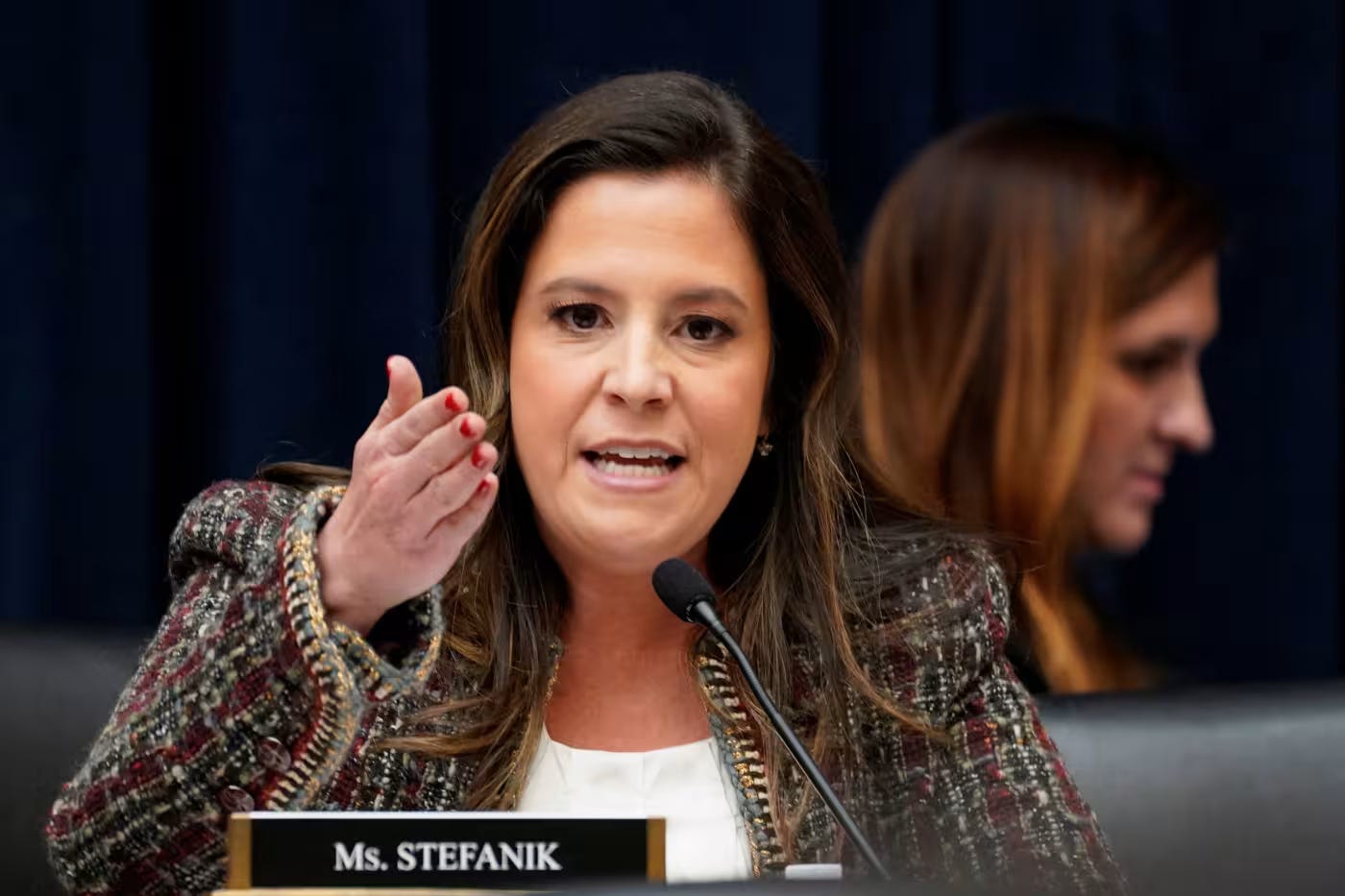
[Rep. Elise Stefanik]

Friends,

America’s prestigious universities play a big role in determining who gets into America’s wealthy elite. 

A degree from Harvard, Penn, or M.I.T., to take three examples, is a meal ticket to a lucrative job on Wall Street or a corporate law firm and to the richest and most influential people in the land. 

But as America becomes increasingly stratified by wealth, those tickets are easily abused. 

Universities that give preference in admissions to the children or grandchildren of major donors serve to widen inequality even further. 

Universities that allow major donors to influence what is taught or expressed on campus could be seen to suppress ideas that threaten the wealthy — which could chill freedom of expression and fuel social resentment.

Which brings us to the latest imbroglio. 

Last Tuesday, the presidents of the University of Pennsylvania, Harvard, and M.I.T. tried to give precise answers to questions from members of Congress about whether their university cultures had encouraged hostility towards Jews — hostility that has surged since Hamas’s October 7 attack on Israel and Israel’s attack on Gaza in response. 

In their opening remarks, all three denied it, and repeatedly condemned antisemitism. 

Then Elise Stefanik, a Republican representative from New York (and herself a Harvard graduate) asked a yes or no question: would calls for genocide of Jews on campus violate their codes of conduct or harassment policies? 

The presidents hedged. “If the speech turns into conduct, yes, it can be harassment,” Penn’s president, M. Elizabeth Magill, a former dean of Stanford Law School, replied in lawyer-like fashion. 

“I’m asking if specifically calling for the genocide of Jews — does that constitute bullying or harassment?” Stefanik pressed her point. 

“If it is directed and severe or pervasive, it is harassment,” said Magill.

“So the answer is yes?” 

“It is a context-dependent decision, congresswoman,” Magill said.

Faced with the same question, Harvard’s president, Claudine Gay, also temporized. “It can be,” she said, “depending on the context.” 

The university presidents should have answered unambiguously and unequivocally that calls for genocide of any group are intolerable. 

Their failure to do so has fueled a firestorm. 

Ross Stevens, a hedge fund manager, said he would withdraw a $100 million gift to Penn. Other wealthy Penn donors called for Magill to resign. 

Even prior to the hearing, a campaign had been launched by some of Wall Street’s most powerful figures to oust all three university presidents for failing to adequately condemn Hamas’s October 7 attack on Israel.

The influential board of advisers of Penn’s Wharton School’s, chaired by Marc Rowan of Apollo Global Management, one of the world’s largest private equity firms, called on alumni to withhold donations to Penn. 

The billionaire investor Bill Ackman, Harvard alumnus and head of New York hedge fund Pershing Square Capital Management, called for the three university presidents to be fired. 

The day after their testimony, Magill and Gay issued statements in efforts to contain the damage. 

But on Saturday evening, after an emergency meeting of Penn’s board of trustees, Magill resigned under pressure. 

Over the weekend, calls from donors for Harvard’s Claudine Gay to resign grew louder, as prominent donors demanded her ouster, too. 

I can well understand the anger and frustration of these donors. In their congressional testimony, the university presidents should have been clearer that their institutions do not tolerate calls for genocide. Period. 

But to use their power as major donors to force or seek the ouster of these presidents is almost as repugnant as the failures of these presidents to unambiguously condemn calls for genocide. It endangers the autonomy of America’s universities. 

Who’s kidding whom? Those of us who have spent our lifetimes teaching in prestigious universities are well aware of the influence of big donors. The major job of today’s university presidents is to solicit money, and their largest targets are typically denizens of Wall Street. 

For the same reason, boards of trustees are packed with wealthy alumni, often from the Street, who routinely veto candidates for university presidentships harboring views they find offensive. 

But not until now have major donors so brazenly used their financial influence to hound presidents out of office for failing to come out as clearly as the donors would like on an issue of campus speech or expression. 

As a Jew, I cannot help but worry, too, that the actions of these donors will fuel the very antisemitism they claim to oppose — based on the perilous stereotype of wealthy Jewish bankers controlling the world.

...
Editorial note. This is as good of a reason as possible to support public funded universities.

Saturday, April 01, 2023

The Need to Defend Public Education

Randi Weingarten 
March 28, 2023
Common Dreams
Our public schools shouldn't be pawns for politicians' ambitions. Or defunded and destroyed by ideologues. We are at a crossroads: Fear and division, or hope and opportunity. A great nation does not fear people being educated.

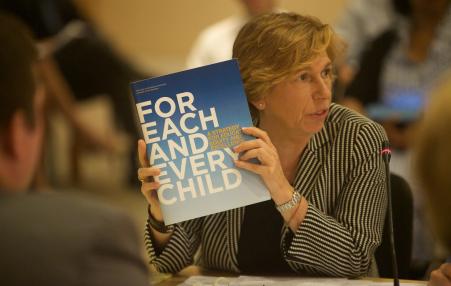
Randi Weingarten at 50 State Equity Strategy Rollout in 2014, US Department of Education


The following are the prepared remarks by American Federation of Teachers president Randi Weingarten delivered on Tuesday, March 28, 2023 at the National Press Club.

I. THE PROMISE AND PURPOSE OF PUBLIC EDUCATION

Today, we once again grieve for families shattered by senseless gun violence. Please join me in a moment of silence for the lives lost at the Covenant School in Nashville, and for all victims of gun violence.

Today we renew our call for commonsense gun safety legislation including a ban on assault weapons. This is an epidemic that our great nation must solve.

There's a saying: You don't have to love everything about someone to love them. I'm sure my wife doesn't love everything about me, but she loves me. (I, on the other hand, love everything about her.) Nothing is perfect. Banks aren't. Congress isn't. And neither are our public schools—not even our most well-resourced and highest-performing schools. Those of us involved in public schools work hard to strengthen them to be the best they can be. But only public schools have as their mission providing opportunity for all students. And by virtually any measure—conversations, polls, studies and elections—parents and the public overwhelmingly like public schools, value them, need them, support them—and countless Americans love them.

Public schools are more than physical structures. They are the manifestation of our civic values and ideals: The ideal that education is so important for individuals and for society that a free education must be available to all. That all young people should have opportunities to prepare for life, college, career and citizenship. That, in a pluralistic society such as the United States, people with different beliefs and backgrounds must learn to bridge differences. And that, as the founders believed, an educated citizenry is essential to protect our democracy from demagogues.

Thomas Jefferson argued general education was necessary to "enable every man to judge for himself what will secure or endanger his freedom." Franklin D. Roosevelt said: "The real safeguard of democracy … is education." And Martin Luther King Jr., in accepting the United Federation of Teachers' John Dewey Award, made clear, "Education is the road to equality and citizenship."

When kids go to school together, they become part of a community; their families become part of a community. That community comes together at school concerts, basketball games and science fairs, and for shelter and comfort, when people are displaced by natural disasters or, far too often, at vigils for victims of gun violence. In good times and bad, public schools are cornerstones of community, of our democracy, our economy and our nation.

But some people want that cornerstone to crumble—and they're wielding the sledgehammers.

II. ATTACKS ON PUBLIC EDUCATION AND DEMOCRACY

Attacks on public education are not new. The difference today is that the attacks are intended to destroy it. To make it a battlefield, a political cudgel. After former President Trump lost re-election, Steve Bannon, his key ally, declared that their fight goes through school boards. In a speech last year, culture war operative and Governor Ron DeSantis' appointee Christopher Rufo put it bluntly, "To get to universal school choice, you really need to operate from a premise of universal public school distrust." To this end, he says, his side has "to be ruthless and brutal."

And, I would add, well-funded, which it is. The DeVos, Bradley, Koch, Uihlein and Walton family foundations and others have poured many millions of dollars into anti-public education, pro-privatization groups like the American Federation for Children and EdChoice.

The Betsy DeVos wing of the school privatization movement is methodically working its plan: Starve public schools of the funds they need to succeed. Criticize them for their shortcomings. Erode trust in public schools by stoking fear and division, including attempting to pit parents against teachers. Replace them with private, religious, online and home schools. All toward their end goal of destroying public education as we know it, atomizing and balkanizing education in America, bullying the most vulnerable among us and leaving the students with the greatest needs in public schools with the most meager resources.

It's an extremist scheme by a very vocal minority of Americans. It's hurting our efforts to do the work we need to do, which is educating the nearly 50 million kids who attend America's public schools. And the urgent work of helping kids recover from learning loss, sadness, depression and other effects of the pandemic.

And it's not what parents or the public want.

Let's start with defunding: This year alone, 29 state legislatures are considering bills to either create or expand existing voucher programs.[i] This is on top of the 72 voucher and tax credit programs in 33 states already subsidizing private and home schooling, costing billions every year.[ii] Voucher programs are proliferating even though research shows that, on average, vouchers negatively affect achievement—the declines are worse than pandemic learning loss. In fact, vouchers have caused "some of the largest academic drops ever measured in the research record."

Proponents of vouchers used to argue that they were a way for low-income and minority families to transfer out of low-performing schools. No longer. Today most vouchers go to families who already send their kids to private schools. And private schools are not required to follow most federal civil rights laws protecting students, so they can—and many do—discriminate, especially against LGBTQ students and students with special needs.

The universal voucher program signed by Florida Gov. DeSantis yesterday will divert $4 billion from the state's public schools. Florida ranks 44th in the nation in per pupil spending, and 48th in average teacher salaries. DeSantis is sending taxpayers' dollars in the wrong direction.

And then there are the culture wars. What started as fights over pandemic-era safety measures has morphed into fearmongering: False claims that elementary and secondary schools are teaching critical race theory; disgusting, unfounded claims that teachers are grooming and indoctrinating students; and pronouncements that public schools push a "woke" agenda, even though they can't or won't define what they mean. Banning books and bullying vulnerable children. School board meetings descending into screaming matches. This is an organized and dangerous effort to undermine public schools.

Over the last three years, legislators in 45 states proposed hundreds of laws placing public schools at the center of culture wars: laws seeking to ban books from school libraries—even books about Ruby Bridges and Anne Frank and Roberto Clemente; laws restricting what teachers can teach and students can learn—particularly about about race, gender, LGBTQ issues, current events and American history; and laws attacking kids who are transgender. Students and staff should feel welcome, safe and respected in school—but the culture wars are fueling hostility and fear.

Tuesday, November 13, 2018

Politics is About Power

These notes were the basis for a presentation to the San Francisco Bay Area Chapter of the National Lawyers Guild on November 8, 2018.
Max Elbaum 
Politics is about Power. One of positive things this moment is that the question of power has moved central to discussion on the left. Not just how to speak truth to power, or how to protest those in power, or pressure those in power. Rather, how to take chunks of power from those who have it now and get it for exploited and oppressed. I haven't seen that on the scale of today since 1960s, when the question of a path to power was put before the left in a different way. The differences are important, but the main thing is that radical discussion is again focused on finding a path to power. That's the context of our discussion tonight.
Elections are also about power. They are a barometer of relative stre3ngth of different social and political forces; and within certain constraints, they can shift that power. Those constraints vary, sometimes outcome of elections can shift things only in tiniest of ways, other times they have big consequences. This just-completed election, and likely even more the one in 2020, the stakes are quite high. There are three inter-related reasons for this.
SPECIAL DANGER OF TRUMPISM
First is the special danger posed by Trump and the GOP which under him has been captured by white nationalism and is permeated by the politics of racial and imperial revenge. Of course, Trumpism is not some fluke; reactionary anti-democratic blocs driven anchored in white supremacy have been common in U.S. society because of deep structural factors - a country founded on the genocide of the indigenous people and the enslavement of people of African descent. But if Trumpism represents pattern in US life, it is also something new.  In context of demographic change, decline of US global hegemony and failure of economic model dominated US since Regan, it is turn from dog-whistles to bullhorns and an attempt to put in place a semi-apartheid authoritarian system. There's debate on the left of what Trumpism does and does not have in common with classical fascism, but little debate that this is something different and extremely dangerous.
The second reason, flowing from the first, is that the country is polarized to a degree not seen at least since early 1960s and more likely since the Civil War. White nationalism's capture of the GOP has meant that racial polarization in country and partisan political polarization all but totally overlap and reinforce each other. Add in geographic polarization, and the way media has evolved means different sectors of society have nearly completely different sources of not just analysis but basic facts, and the chasm is even more severe. These and other factors rooted in political economy and the shifting power relations in global politics also means that the ruling class itself is more divided than its been in decades. That means the battle between the Trump and anti-Trump camps has squeezed out middle ground and past patterns of so-called bipartisan cooperation. It is now take-no-prisoners trench warfare.
The third factor, especially important for us in this room, is that within the anti-Trump camp there is a surging social justice motion rooted especially in communities of color, and among youth, women and the LGBTQ community. And host of progressive organizations of different types threw themselves into the electoral fray in ways not seen in decades or longer. More on this later if I have time, but for a quick sampling:

Monday, February 13, 2012

What is happening in Greece: Financial Crisis ?


Financial Crisis, Markets and Democracy, Climate Justice: SI Council in Costa Rica


23-24 JANUARY 2012


Speech by George Papandreou, President of PASOK and President of the Socialist International
at the Council meeting of the Socialist International, San José, 23 January 2012


It is a great pleasure for me to be here with you today, in San Jose, Costa Rica. It is a special honor for the Socialist International to have with us her Excellency the President of Costa Rica Ms. Laura Chinchilla. As Costa Rica's first woman President she is a symbol of women empowerment in Central America and beyond. We are looking forward to her remarks. 

Dear friends, dear comrades,

I often hear a question, even a complaint: Is our movement relevant to today's problems? Here in Central and Latin America you know very well we are relevant. It is not only the fact that we have become a strong political force for change and progress but we have shown that progressive governance does matter.

This region has experienced - as we in Greece are experiencing - deep economic crises. The rule of the IMF, the mistrust of the financial system, the austerity of the measures. Yet you know. You know more than anyone else that both Latin and Central America are rich areas. Rich with resources, rich with human capital. But these resources have often been mismanaged, squandered, usurped by the few and powerful, by dependencies and interventions.

That is why these crises are not primarily financial but they are political. They are crises because of the lack of democratic governance, because of the inequalities, because of the lack of opportunities, the lack of transparency, corruption, the clientilist and authoritarian regimes. Regimes under which our citizens were marginalized or even oppressed.

Thursday, August 18, 2011

The President proposes more jobs - its about time


The President’s Bold Jobs Bill (Maybe)The President is sounding like a fighter these days. He even says he’ll be proposing a jobs bill in September – and if Republicans don’t go along he’ll fight for it through Election Day (or beyond).That’s a start. But read the small print and all he’s talked about so far is extending the payroll tax cut and unemployment benefits (good, but small potatoes), ratifying the Columbia and South Korea free trade agreements (not necessarily a job-creating move), and creating an infrastructure bank.
An infrastructure bank might be helpful, depending on its size. Which is the real question hovering over the entire putative jobs bill – its size.
Some of the President’s political advisors have been pushing for small-bore initiatives that they believe might have a chance of getting through the Republican just-say-no House. They also figure policy miniatures won’t give aspiring GOP candidates more ammunition to tar Obama as a big-government liberal.
But the President is sounding as if he’s rejected their advice.
That’s good policy and good politics.

Sunday, July 17, 2011

The Federal Deficit Crisis


Fact Sheet
Questions and Answers on the Federal Budget


Q: Why do we now have such a large federal budget deficit?

A:    1. Ten years of the Bush tax cuts enacted in 2001 and 2003 have accumulatively cost $2.5 trillion dollars in federal revenues.  The tax cuts primarily benefited wealthy individuals and corporations, turned the modest budget surpluses under the Clinton administration into growing deficits, but failed to promote economic growth. Tax revenues remain depressed as even fewer workers are employed at decent wages following the onset of the Great Recession.

2. The costs of the lengthy wars in Afghanistan and Iraq are being paid for by borrowed money rather than taxes.   See also; http://www.commondreams.org/view/2011/07/12-3 by James Gailbraith. 

3. When the great recession broke out following the financial collapse caused by reckless speculation on the housing derivative markets, the federal government borrowed more money to bail out banks and other financial institutions.  The Obama Administration also administered a modest but costly economic stimulus program that alleviated the worst consequences of the crisis, especially for state and local governments and for the unemployed.  However that stimulus funding has lapsed, threatening millions of vital jobs in education and other public services at the state and local levels.

Q: What is really at stake in the Budget Debate in DC?

A: A manufactured crisis over raising the debt ceiling is being used by Republicans and conservative Democrats to attack Social Security and Medicare, which are highly popular, cost efficient and vitally needed government “entitlement” programs. Our values as a nation are expressed in the national budget, in how we raise our national revenues and prioritize our spending. 

Q: What are Republicans Up To in DC?

A:  Republicans are holding the country hostage by refusing to raise the debt ceiling; they will only do so if the federal government caps domestic spending at a fixed percentage of GDP and passes a balanced budget amendment. Both of these policies would have disastrous long-term results for the U.S. economy.  The Republicans also refuse to raise taxes, even by permitting the last set of “temporary” Bush-era tax cuts to lapse.  Their real aim is to hamstring government from having any positive role in society.

The Republicans’ concern for the “deficit crisis” is hypocritical. Conservative policies of tax cuts for the rich and deficit-financed military expenditure are the real causes of our deficit problem, not excessive government spending on health, education, and child care. Nearly half of the total $14.2 trillion total debt owed by the United States government derive from loss in government revenue due to the Reagan and Bush tax cuts for the wealthy and corporations and by their administration’s huge increases in military spending.

Tuesday, June 28, 2011

The Republicans won the California Budget battle today


The Republican minority won the California budget battle.
California is a Democratic controlled state; in the Senate there are 25 Democrats and 15 Republicans, in the Assembly there are 52 Democrats and 28 Republicans, the Governor and most state offices are Democrats.
In spite of these majorities, the Republicans won the budget battle of 2011.  They got a cut in the sales tax by 1 %, and a cut in the vehicle license fee.  The result will be further cuts in the Univ. of California, further cuts in the California State University system, and further cuts ( called deferrals) in the K-12 schools.
California is presently 47th. out of the 50 states in per pupil expenditures, we are among the very poor in funding our schools.  In prior years, as described by the California Budget project, “Lawmakers cut the overall annual funding level for K-12 public schools by $6.3 billion, from $50.3 billion in 2007-08 to $44.1 billion in 2009-10.3 Lawmakers cut schools’ general purpose dollars as well as funds earmarked for specific school programs, often referred to as categoricals.”
What remains?  The proposed budget uses overly generous estimates of future tax incomes.  If the projects fall short, there will be mandated further cuts to the universities and to k-12 education.
By imposing this mostly cuts budgets, the economic crisis flows down to produce cuts in police, fire protection and local budgets.
The Democratic leadership will not admit the truth.  They lost.  Jerry Brown claimed he could negotiate with reasonable Republicans.  He failed.
The school budget crisis was not caused by the Democrats.  

Wednesday, May 25, 2011

Quiz Time- Republican corporate greed

Pop Quiz: What would CA look like under Rep. Ryan's (R-Wis.) radical, Tea Party-inspired budget? 

A. A typical 65-year-old in CA would spend $6,057.09 more per year out of pocket for health care by 2022 because Medicare's promise would be replaced with underfunded vouchers. (The national average is a $6,359 increase.)

B. At least 2,008,796 CA residents would lose Medicaid health care (at least 15 million nationally).

C. $4.2 trillion in new tax cuts would be handed out mostly to corporations and the rich.

D. All of the above. 

If you answered D, all of the above, you're right. This Tea Party-inspired budget would do all of those things. 

All but four House Republicans voted for this radical proposal. The Senate will consider it this week. How many Senate Republicans will vote to give even more tax cuts to Wall Street and the wealthy and pay for them by cutting deeply into services for seniors, children and low- and middle-income working families?

Let's make sure every U.S. senator knows this "right-wing social engineering" bill--which is what former GOP House Speaker Newt Gingrich recently called Rep. Ryan's budget--is not a starting point for a debate over America's future.

Monday, May 23, 2011

Economic Balance of Power


Sacramento United Nations Assoc-USA Presents
DUANE E. CAMPBELL
CSUS Professor Emeritus
"Trade Agreements: Changing
The Economic Balance of Power"
Monday, May 23, 7 p.m.
SMUD Headquarters Bldg.,
6201 S Street, Main Floor
Sacramento
Professor Campbell, currently Director of the Institute for Democ-racy and Education, will bring considerable knowledge of the impact of trade agreements on workers here and abroad. He is Chair of the Sacramento Chapter of the Democratic Socialists of America and serves on the Editorial Board of Democratic Left. He received his doctorate from Carnegie-Mellon University and at CSUS was Founding Chair of the Peace and Conflict Resolution Studies Pro-gram from 1972-1994.
Anna 

Saturday, January 22, 2011

Senator Steinberg and the California Budget Crisis

 I just returned fro a Town Hall with Senator Darrell Steinberg  about the state budget crisis at the Belle Cooledge library in Sacramento.  As you know, Senator Steinberg in the Senate Pro Tem ( Democratic Leader) of the Senate, thus he has one of the major inputs on the budget.
Senator Steinberg started with a general view of the budget and the political situation of the coming votes.   Essentially Governor Brown and the Democrats are proposing 12.5 Billion in budget cuts and proposing passing a special initiative to extend the current ( temporary ) tax increases for 5 more years to recover 12.5 billion in revenue.
The room was packed to overflow with persons some of whom agreed with the Senators argument that these cuts were necessary and others who disagreed and argued that these cuts were destructive to life and opportunity.   Advocates for the disabled, for child care workers, teachers, and others made their case.
California can continue the current process of cuts and reductions.  The fiscal crises of the states – all the states- has caused major cut backs and retrenchment and made the economic crisis approach a depression.  The state cut backs are greater than the federal stimulus producing a prolonging of the crisis for working people.   The proposed state cuts will make the recession longer and deeper than is necessary.  Continuing on the present direction produces protection of  obscene profits for billionaires along with growing poverty and hardships for the majority.
The Brown- Democrats approach  would  follow the process of Ireland and Greece and dramatically cut services and impoverish the economy.  Then, since the state  is poorer and has less income you will need to raise more taxes and cut more services all in an effort to protect the excessive profits of bankers and bond holders.  This produces a race to the bottom.

Thursday, January 20, 2011

Possible tax vote in California

An important piece from Dan Walters.
Prop.25 may actually help.


Dan Walters: Vote margin on taxes key factor
PUBLISHED WEDNESDAY, JAN. 12, 2011 in Sacramento Bee.
A key factor in Gov. Jerry Brown's plan to balance the state budget is whether he and fellow Democrats could do it by themselves, or whether the votes of at least a few Republican legislators would be required.
Politicians and stakeholders are consulting attorneys, but at the moment, no one appears to know for certain – in part because the sections of the state constitution involved have never been legally tested.
….Republicans who voted for the temporary taxes two years ago were hammered by anti-tax groups and radio talkers. So far, GOP leaders have shunned an election to extend them.

Monday, January 10, 2011

The End of the New Deal Liberalism- Greider

The End of New Deal Liberalism

Friday, November 19, 2010

What is next ? A progressive agenda. Richard Flacks


What is next? Richard Flacks.
Are you as tired as I am with never-ending critiques of Barack Obama coming from the left as well as the right? Mainstream punditry has decided that he is largely a failed president (never forget that the MSM thought he was a failed candidate before he wasn't). Everyone on the left thinks, as one friend (a committed feminist) said the other night, ‘he has no balls.' The current rage is focused on apparent White House support for some sort of compromise on extending those Bush tax cuts. And there's plenty of other betrayals over which to wring hands and gnash teeth.
Handwringing and teeth gnashing don't bring the needed change, however. Why do we keep playing this blame game?
Let's stipulate, the administration needs to be criticized and pressed to correct course. There's no doubt that the president needs to figure out how to explain his key policies to those whose disapproval seems based on misunderstanding. This seems especially true for health care reform, the complexity of which has been key to its apparent unpopularity (I say this in light of the fact that large majorities approve of most of the specific provisions of the act when these are described). But the demand that Obama become more confrontational in order to challenge the fatuous and foolish GOP in congress isn't good strategic advice for him. The country sees him as trying to solve problems and govern, and sees the GOP already as obstructionist. A significant number of people who once identified as Republican now declare as independents. Here's some recent polling evidence. For us on the left, Obama's reasonableness is frustrating. But it could be his best chance to prevail in terms of policy as well as politics.
But...
As I keep saying in this space, if progressives want to promote real change we can't be waiting for Barry, it's up to us. We should be asking each other, not what should he be doing, but what should we do. Of course it's fine to mobilize for a progressive/populist tax measure in the lame duck congress and to defend social security in the face of the Bowles-Simpson initiative. These very focused issues lend themselves well to on-line actions that will give counter-weight to the rightwing onslaught.
But there are more far-reaching measures we should be figuring out how to mobilize for-measures that might really help the people:
       A new WPA?
In a recent web posting, Jeanne Mirer and Marjorie Cohen, argued that Obama could do what FDR did-create a lot of jobs by executive order:
"Can the President directly create jobs by executive order? The answer is a resounding yes. Remember when the Emergency Economic Stabilization Act of 2008, which created the $700 billion Troubled Assets Relief Program (TARP) was passed, one of the purposes was to preserve homeownership, and promote jobs and economic growth.
Much of the TARP money has been repaid and the administration refers to the profit on the payments. If one assumes an average cost of one job is $50,000, 6 million jobs could be immediately created for $300 billion. 12 million jobs could be created for $600 billion. Because this is already appropriated money, Congressional Republicans could not block it""
Such funding could also be used to support state budgets to protect education and public safety, and to promote weatherization and other green economy job creation.

Sunday, October 10, 2010

Fact based and perspective challenges to Waiting for Superman


I have posted here several critiques of  the film, “Waiting for Superman,” so I do not need to repeat these criticisms.  The most fact based criticism is here What Superman got wrong. http://voices.washingtonpost.com/answer-sheet/guest-bloggers/what-superman-got-wrong-point.html
My goal in the following is to share my own reaction to the film. First, it is an important film and I encourage people to see it.  It illustrates to a rather uninformed public and an often poorly informed press   several of the important issues including the budget crisis in schools and the importance of having quality teachers. 
Second. The film makes two glaring claims that were assertions by anti union advocates  when the film was made and now are wrong.  The film claims that the teachers union leadership in Washington D.C. would not allow the Michele Rhee offered contract to come to a vote.  In fact, since the film was made, the contract was submitted to a vote and it passed.  That is Rhee got the contract she wanted- which the film claims was made impossible by union obstruction.  Also, the film supports its claim that incompetent teachers are difficult to remove by citing the extreme case of the New York City room, called by the press the “rubber room.”  It is a compelling story.  However, the so called “rubber room was eliminated last year by the very union contract which the film makers claim was protecting incompetent teachers.

Friday, October 08, 2010

The California budget crisis


What caused this  budget crisis?
The proposed state budget takes 3.1 billion from k-12 schools, closes parks, forces state worker furlough’s and more.  County and city budget cuts reduce our police protection, cause limits on fire protection, and close mental health facilities pushing some of the mentally ill into jails and prisoners out of our jails early  on to the streets.
While  state budget reforms are needed, the basic cause of this crisis is the economic crisis in the nation.
 Crisis in the states.
The current  economic crisis has forced the cutting of higher education, of k-12 education, and of social welfare systems.  This crisis was caused by the greed and avarice of the financial class and aided by the politicians of both major political parties.
First came the housing bubble and the selling of near fraudulent home mortgages.  To make a profit m ajor banks and corporations looted the economy creating an international meltdown.  Now, they have been rewarded with bail out money.  The crisis was not caused by students, teachers, public employees  nor recipients of social security.   Now we have cuts in parks,  in universities, in nurses, libraries.  School children did not create this crisis.

Tuesday, October 05, 2010

Bill Gates et al and Waiting for Superman


            When Generosity Hurts: Bill Gates, Public School Teachers and the Politics of Humiliation
Tuesday 05 October 2010
by: Henry A. Giroux, t r u t h o u t | Op-Ed
So-called reformers such as Michelle Rhee, who took over the District of Columbia public schools three years ago, have become iconic symbols for enacting educational policies based on a mix of market incentives such as paying students for good grades, merit pay for teachers and firing teachers en masse who do not measure up to narrow and often discredited empirically based performance measures.(18) Reform in this case is driven by a slash-and-burn management system that relies more on punishment than critical analysis, teacher and student support and social development. The hedge fund managers, billionaire industrialists and corporate vultures backing such policies appear to view teachers, unions and public schools as an unfortunate, if not threatening remnant, of the social state, and days long past when social investments in the public good and young people actually mattered and public values were the defining feature of the educational system, however flawed. This hatred of public values, public services, public schools and teachers is only intensified by a wider culture of cruelty that has gripped American society.
Read the entire post here:

Thursday, September 23, 2010

The continuing economic crisis


The financial crisis is not over although it has been moved off of the front pages of many papers.  On Thursday, September 23, 2010, the Financial Crisis Inquiry Commission came to Sacramento chaired by Phil Angelides.  In his opening statement Angelides noted that there were 26 million out of work, over 2 million have lost their homes, over $12 trillion in wealth has been wiped out, and California has an official 12.8 % unemployment.
The crisis started in the housing markets, particularly  in places like Sacramento. The economic problems were accelerated by the near larceny of business practices by corporations including Washington Mutual and Long Beach Savings.  Sub prime and Alter A mortgages were promoted and sold to make outlandish profits even though it was clear that many home buyers could not pay for their mortgages.
The  current Great Recession was accelerated far beyond  Sacramento and the Central Valley by finance capital and banking, mostly on Wall Street, ie. Chase Banks, Bank of America, Goldman Sachs,  AIG, and others.  Finance capital owned the banks, and they robbed the banks through investment and trading  schemes including investments in mortgage backed derivatives. Wall Street’s actions plunged the U.S. into the worst financial crisis since the Great Depression, destroying jobs and lives, and triggering a recession in much of  the developed world.

Saturday, September 18, 2010

California Schools- not in compliance????


Update on Education Jobs Money
Education Secretary Arne Duncan is urging governors to act quickly and submit their state applications for their share of the $10 billion education jobs funding as soon possible so that the emergency aid can begin flowing to districts. So far, 17 states have had their funding requests approved:
Funds
         Estimated Number of
           Teaching Positions
             Created/Saved*
Alabama
$149.5 million
2,250
California
$1.2 billion
13,318
Colorado
$159.5 million
2,393
Connecticut
$110.5 million
1,251
Georgia
$322.3 million
4,397
Illinois
$415.4 million
5,118
Iowa
$96.5 million
1,503
Kansas
$92.5 million
1,572
Maine
$39 million
614
Massachusetts
$204 million
2,083
Nebraska
$58.9 million
966
Nevada
$83.1 million
1,184
New Mexico
$64.9 million
1,077
New York
$607.6 million
6,263
South Dakota
$26.3 million
574
Tennessee
$195.9 million
3,279
Wisconsin
$179.7 million
2,329

The $10 billion education fund was created to support education jobs in the 2010–11 school year and will be distributed to states by a formula based on population figures. States can then distribute their funding to school districts using their funding formulas or districts' relative share of federal Title I funds.
However, a provision in the bill requires states to have maintained their level of higher education spending this year, something many of the states have not been able to do. And the bill does not offer waivers for states to opt out of this requirement, which means that those states that have made drastic cuts to higher education could miss out on the windfall. Some states—such as California, Michigan, Pennsylvania, and Rhode Island—are believed to be caught in this noncompliance situation.

Only Congress can rectify this issue by repealing this provision.
 
Creative Commons License
This work is licensed under a Creative Commons Attribution-NonCommercial 3.0 Unported License.