Showing posts with label capitalism. Show all posts

Friday, May 01, 2026

Why MayDay : Robert Reich

 Friends,

Warner Bros. Discovery shareholders voted last Thursday on the Ellison family’s purchase of the company. Some 1.743 billion shares were cast in favor of the sale; 16.3 million were cast against it, a ratio of roughly 99 to 1.

1. Great for a Handful of Super-Wealthy, but Bad for Workers and Bad for America

This vote came soon after more than 4,000 workers in the media industry — directors, screenwriters, producers, actors, editors, cinematographers, musicians, and composers — signed a letter predicting an industry disaster if the sale went through.

That’s because, as my friend Harold Meyerson from The American Prospect has noted, such deals typically saddle the purchased companies with gigantic debts that buyers incur to make the deal — in the case of Warner Bros. Discovery, $79 billion — and this debt, in turn, requires that buyers slash costs (especially payrolls) to pay off some of it. 

More than 70 percent of all the shares in Warner Bros. Discovery are held by institutional investors — including the Vanguard Group, BlackRock, and State Street. These institutions voted for the sale because they believe it will make their shares more valuable. 

The sale will also make certain individuals a lot of money. David Zaslav, the CEO of Warner Bros. Discovery, stands to collect some $886 million for shepherding it, in addition to his regular pay package (which was $51 million in 2024). Oracle’s Larry Ellison and his son, David, the new owners of Warner Bros. Discovery, are already among the richest people in the world. 

But what about the workers in the industry who’ll lose their jobs as a result of the sale? What about all the people whose wages will be slashed? What about Los Angeles, which may lose a sizable portion of its major industry? 

And what about the concentration of so much of the news business — so much of what Americans learn about what’s happening — under these two Trump suck-ups? 

If Trump’s Justice Department approves the deal (do birds fly?), CBS News and CNN — along with CBS entertainment (home to Stephen Colbert, whose contract is about to run out and who will be taken off the air because of his criticisms of Trump) and Comedy Central (home to Jon Stewart) and HBO (John Oliver) and TikTok (where 1 out of 5 Americans now get their news) — are all about to become one giant mega-media monopoly under the control of Trump allies, the Ellisons.

2. The Moral Bankruptcy of Shareholder Capitalism 

At the heart of modern American capitalism is the assumption that a corporation exists for only one purpose: to make its shares more valuable. 

That goal trumps (excuse me) all other goals — such as raising workers’ wages, improving workers’ job security, creating more jobs, enhancing the quality of life for the community where a company is headquartered or does business, making life better for the inhabitants of the nation and the world, even protecting democracy. 

In fact, if shareholders can make more money by shafting these other “stakeholders” and destroying these other values, that’s thought to be perfectly fine. It’s simply the way “impersonal market forces” work. It’s “efficient.”

Before the 1980s, American capitalism ran on a very different principle: that large corporations had responsibilities to all their stakeholders. “The job of management,” proclaimed Frank Abrams, chairman of Standard Oil of New Jersey, in a 1951 address, “is to maintain an equitable and working balance among the claims of the various directly affected interest groups … stockholders, employees, customers, and the public at large.” 

The sentiment may seem quaint or inauthentic today, but in the three decades after World War II, it laid the basis for rapid economic growth and, with strong unions, an equally rapid expansion of the American middle class. 

It reflected the sincere views of corporate executives. Many had endured the Great Depression and the war and felt some responsibility for America’s future well-being. These views helped legitimize the role of the large corporation in the public’s mind.

Today, shareholder capitalism has replaced stakeholder capitalism — and most Americans are excluded from its benefits. 

Over 92 percent of the value of all the shares of stock owned by Americans is owned by the richest 10 percent. More than half is owned by the richest 1 percent. And even they have turned over their votes to giant institutions like Vanguard, BlackRock, and State Street, which have no concern for the well-being of anyone or anything other than the short-term value of the shares they buy or sell.

We are witnessing the logical ending point of shareholder capitalism. 

As the share values of America’s biggest corporations continue to soar — even as (and in many cases, because) they eliminate tens of thousands of jobs — the goal of “maximizing shareholder returns” is revealing itself to be morally bankrupt and economically rotten. 

And as Artificial Intelligence takes over a growing amount of the work Americans do, the gap between share values (including the wealth of top investors and executives) and the incomes of most Americans will widen into a chasm. 
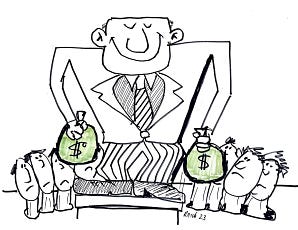
3. Toward a New Stakeholder Capitalism

But here’s the good news: We don’t have to stick with shareholder capitalism. We don’t have to be victims of “impersonal market forces” over which we supposedly have no control. 

We can have control. The market is a human creation. It is based on laws that humans devise. We can make laws that alter market forces to serve the interests of the vast majority instead of mainly the oligarchs at the top. 

Over the last four decades, corporate laws have been shaped by wealthy individuals to channel a large portion of the nation’s total income and wealth to themselves. 

If America’s super-wealthy continue to have unbridled influence over laws and gain control over the assets at the core of Artificial Intelligence, they will end up with almost all the wealth, all the income, and all the political power. Under such conditions, our economy and society simply cannot endure. 

Laws can and should be changed to produce a new version of stakeholder capitalism that shares the wealth more widely. 

How? For example, corporations could be required to provide long-term employees with the same number of shares as are held by investors. Profitable corporations could be required to provide their workers a portion (a quarter?) of their profits. 

Corporations whose highest-paid executives earn more than 100 times their lowest-paid employees should have to pay a surtax. Corporations over a certain size (worth, say, $1 trillion or more) or having more than a certain share of their markets (say, 25 percent) should be broken up. Unfriendly (hostile) takeovers should be banned (as they were, in effect, before 1980).

The “stepped-up basis” rule that allows the wealthy to pass assets to their heirs without ever paying capital gains taxes on them should be eliminated. Vast accumulations of private wealth (say, in excess of a billion dollars) should, after a certain number of years, automatically be turned over to a fund providing subsistence incomes — a universal basic income. 

State corporate laws shouldn’t empower corporations to make any campaign donations (effectively reversing Citizens United). 

Sound radical? Maybe it is. But shareholder capitalism doesn’t work — as illustrated by the Warner Bros. Discovery fiasco. Unless radical changes are made, that fiasco is just a taste of what’s to come. If Artificial Intelligence isn’t to destroy capitalism and obliterate democracy, we’re going to have to come up with something that does work, and soon. 

Happy May Day, 2026. 

Robert Reich, 

Monday, December 04, 2023

Sen. Chris Murphy: ‘This Party Has Not Made a Firm Break From Neoliberalism’

Sen. Chris Murphy: ‘This Party Has Not Made a Firm Break From Neoliberalism’: Connecticut’s junior senator launches a new interview series focused on monopoly power, part of his quest to understand American unhappiness.

Sunday, November 20, 2016

Rethinking Globalization, Or Trumpism Prevails


Democracy, Trade, Globalization and Trump


https://www.theguardian.com/commentisfree/2016/nov/16/globalization-trump-inequality-thomas-piketty


 By Thomas Piketty
November 16, 2016
Let it be said at once: Trump's victory is primarily due to the explosion in economic and geographic inequality in the United States over several decades and the inability of successive governments to deal with this.
Both the Clinton and the Obama administrations frequently went along with the market liberalization launched under Reagan and both Bush presidencies. At times they even outdid them: the financial and commercial deregulation carried out under Clinton is an example. What sealed the deal, though, was the suspicion that the Democrats were too close to Wall Street - and the inability of the Democratic media elite to learn the lessons from the Sanders vote.
Hillary won the popular vote by a whisker (60.1 million votes as against 59.8 million for Trump, out of a total adult population of 240 million), but the participation of the youngest and the lowest income groups was much too low to enable key states to be won.
The tragedy is that Trump's program will only strengthen the trend towards inequality. He intends to abolish the health insurance laboriously granted to low-paid workers under Obama and to set the country on a headlong course into fiscal dumping, with a reduction from 35% to 15% in the rate of federal tax on corporation profits, whereas to date the United States had resisted this trend, already witnessed in Europe.
In addition, the increasing role of ethnicity in American politics does not bode well for the future if new compromises are not found. In the United States, 60% of the white majority votes for one party while over 70% of the minorities vote for the other. In addition to this, the majority is on the verge of losing its numerical advantage (70% of the votes cast in 2016, as compared with 80% in 2000 and 50% forecast in 2040).
The main lesson for Europe and the world is clear: as a matter of urgency, globalization must be fundamentally re-oriented. The main challenges of our times are the rise in inequality and global warming. We must therefore implement international treaties enabling us to respond to these challenges and to promote a model for fair and sustainable development.
Agreements of a new type can, if necessary, include measures aimed at facilitating these exchanges. But the question of liberalizing trade should no longer be the main focus. Trade must once again become a means in the service of higher ends. It never should have become anything other than that.
There should be no more signing of international agreements that reduce customs duties and other commercial barriers without including quantified and binding measures to combat fiscal and climate dumping in those same treaties. For example, there could be common minimum rates of corporation tax and targets for carbon emissions which can be verified and sanctioned. It is no longer possible to negotiate trade treaties for free trade with nothing in exchange.
From this point of view, Ceta, the EU-Canada free trade deal, should be rejected. It is a treaty which belongs to another age. This strictly commercial treaty contains absolutely no restrictive measures concerning fiscal or climate issues. It does, however, contain a considerable reference to the "protection of investors". This enables multinationals to sue states under private arbitration courts, bypassing the public tribunals available to one and all.
The legal supervision proposed is clearly inadequate, in particular concerning the key question of the remuneration of the arbitrators-cum-referees and will lead to all sorts of abuses. At the very time when American legal imperialism is gaining in strength and imposing its rules and its dues on our companies, this decline in public justice is an aberration. The priority, on the contrary, should be the construction of strong public authorities, with the creation of a prosecutor, including a European state prosecutor, capable of enforcing their decisions.
The Paris Accords had a purely theoretical aim of limiting global warming to 1.5 degrees. This would, for example, require the oil found in the tar sands in Alberta to be left in the ground. But Canada has just started mining there again. So what sense is there in signing this agreement and then, only a few months later, signing a highly restrictive commercial treaty without a single mention of this question?
A balanced treaty between Canada and Europe, aimed at promoting a partnership for fair and sustainable development, should begin by specifying the emission targets of each signatory and the practical commitments to achieve these.
In matters of fiscal dumping and minimum rates of taxation on corporation profits, this would obviously mean a complete paradigm change for Europe, which was constructed as a free trade area with no common fiscal policy. This change is essential. What sense is there in agreeing on a common fiscal policy (which is the one area in which Europe has achieved some progress for the moment) if each country can then fix a near-zero rate and attract all the major company headquarters?
It is time to change the political discourse on globalization: trade is a good thing, but fair and sustainable development also demands public services, infrastructure, health and education systems. In turn, these themselves demand fair taxation systems. If we fail to deliver these, Trumpism will prevail.
[Thomas Piketty is professor of economics at the Paris School of Economics. He is the author of numerous articles and books, including Capital in the Twenty-First Century.]
This piece was first published in Le Monde on 12 November 2016

Thursday, September 01, 2016

To Fight the Right, We need to Understand It Better


To Fight the Right, We Need to Understand It Better

At a Donald Trump rally, Dallas, Texas, September 14, 2015 (Jamelle Bouie) 

It crystallized for me the other day when I was listening to a radio interview with Glenn Beck. With complete disgust and surprising nuance, Beck attacked Donald Trump and, in so doing, demonstrated the very real differences that exist within the right, differences that many of us on the left all but ignore. Beck called Trump a fake conservative; instead, he insisted, the Republican nominee is a populist, a socialist, and a nationalist. The “socialist” charge was surprising, but the others were predictable. What I found most intriguing, however, was Beck’s critique of Trump as a man who allegedly doesn’t believe in adhering to the Constitution. 
Too many of us on the left treat the right as a monolith. We spend little time trying to distinguish various right-wing currents, let alone disentangling the differences between neoliberalism and right-wing populism. And our failure to do so is hampering our efforts to fight back.
Over the last half-century there has been a demonstrable shift to the right among the political establishments of the global Northern capitalist states. With the global restructuring of capitalism, beginning in the late 1960s, and the rise of what has come to be known as neoliberal globalization, there came an assault on progressive movements and their gains over the preceding decades. Privatization, casualization, tax cuts for the rich, anti-worker offensives, and an increasing restriction on democratic liberties have added up to a slow-moving strategic defeat for the global Northern working class. The blunting of social movements, including but not limited to the women’s movement and the black freedom movement, has gone hand in hand with an increase in a polarization of wealth not only between the global North and the global South, but also within each.
To defeat the working classes of the global North, there had to be a combination of active repression and active disorganization. The active disorganization involved the promotion and toleration of various right-wing social movements that aggressively revolted against the gains of their progressive counterparts. The active repression included military and paramilitary-style repression of the left (varying from country to country), the militarization of law enforcement, and the rise of various forms of preventive detention and extra-constitutional imprisonment, along with mounting, if subtle, restrictions on the parameters for “acceptable” discourse under democratic capitalism (for example, in mainstream television debate). As a result, what was considered “left” kept moving rightward. That conservatives can get away with describing former President Bill Clinton as a leftist shows just how far we’ve come.

Tuesday, March 29, 2016

Moneyed class proposes new ways to steal from working people

The excellent blog Capital & Main has an important piece up about the proposal to create a new retirement system in the state for workers who do not have a pension system.

As the writer Judith Lewis Mernit well describes, California ( and the nation) is facing a growing retirement crisis and more and more jobs no longer have pensions.  This is an emerging crisis.

For comparison, here is the Sacramento Bee version of the same story. http://www.sacbee.com/news/politics-government/article68342897.html


The Capital and Main piece is a good piece on important issues. But, do we really only want to consider the neoliberal finance approach?  For example, the proposal calls for employers to insist on participation, but apparently does not require employers to contribute- as does social security.
Then, the advocates claim it is progressive because of the pooled IRA project.  But, IRA's are still invested in the markets. This is like the Peterson Institute arguing for the privatization of social security.

Thursday, January 01, 2015

The Start of the Chinese Century

Without fanfare—indeed, with some misgivings about its new status—China has just overtaken the United States as the world’s largest economy. This is, and should be, a wake-up call—but not the kind most Americans might imagine.
By Joseph E. Stiglitz

SOFT POWER For America, the best response to China is to put our own house in order.

When the history of 2014 is written, it will take note of a large fact that has received little attention: 2014 was the last year in which the United States could claim to be the world’s largest economic power. China enters 2015 in the top position, where it will likely remain for a very long time, if not forever. In doing so, it returns to the position it held through most of human history...

The United States then made two critical mistakes. First, it inferred that its triumph meant a triumph for everything it stood for. But in much of the Third World, concerns about poverty—and the economic rights that had long been advocated by the left—remained paramount. The second mistake was to use the short period of its unilateral dominance, between the fall of the Berlin Wall and the fall of Lehman Brothers, to pursue its own narrow economic interests—or, more accurately, the economic interests of its multi-nationals, including its big banks—rather than to create a new, stable world order. The trade regime the U.S. pushed through in 1994, creating the World Trade Organization, was so unbalanced that, five years later, when another trade agreement was in the offing, the prospect led to riots in Seattle. Talking about free and fair trade, while insisting (for instance) on subsidies for its rich farmers, has cast the U.S. as hypocritical and self-serving.

Thursday, December 04, 2014

How the Koch Brothers Are Sneaking Their Way Into Public Schools

In November  in Boston, thousands of teachers will gather for the annual National Council for the Social Studies (NCSS) conference.
Two non-teachers will be there, too: Charles and David Koch, the notorious right-wing billionaires.
Well, the Kochs won’t be there in person, but they will be represented by a Koch-funded and controlled organization: the Arlington, Virginia-based Bill of Rights Institute. For years, the Bill of Rights Institute has shown up at NCSS conferences to offer curriculum workshops, distribute teaching materials, and collect the names of interested educators. What the Bill of Rights Institute representatives fail to mention when they speak with teachers is that they have been the conduit for millions of dollars from Charles and David Koch, as the brothers seek to influence the country’s social studies curriculum. (When I attended a Bill of Rights Institute workshop at an NCSS conference, I asked the presenter who funds their organization. “Donations,” she replied.)
With assets of more than $80 billion, the Koch brothers, who control Koch Industries, are together richer than Bill Gates. As a recent Rolling Stone exposé (“Inside the Koch Brothers’ Toxic Empire”) by investigative reporter Tim Dickinson details, the Kochs made that money largely by polluting the Earth and heating up the climate, with massive oil and gas holdings. And through their network of far right foundations and front groups, they lobby for policies and fund politicians in line with their free market, fossil fuel interests.

Wednesday, March 13, 2013

This is about digital capitalism, not digital democracy


This is not about digital democracy. It is about digital capitalism.  I woke up this morning to my usual New York Times and was astounded to read that my state senator, Darrell Steinberg, is proposing a bill to require the CSU, UC, and community colleges to grand credit to massive on-line courses, known as MOOCs.  Senator Steinberg is working with former Senator Dean Florez who is financed to promote such arrangements ( usually known as lobbying).
They claim that this is a response to lack of courses in the universities.   Note. This is not about offering more educational opportunities.  It is about making money for private corporations.
There is much to be said about this direction.  Future posts will develop several ideas in detail.  But, let us begin.
This move is a part of a much larger assault on public education including the massive expansion of Charter Schools.  See the post below by Stan Karp.  The state- ie. Senator Steinberg, creates a problem by underfunding the universities and colleges, and then offers a technological alternative-  one that will make certain corporations such as Pearson’s  very wealthy at state tax payers  expense.
This run at public education by offering what claims to be open education is primarily a corporate run for public funds- similar to the mass expansion of the Univ. of Phoenix and other for profit schools that get up to 80% of their funds from taxpayers while giving great profits to their owners and poor service to their students.  (See the Harkin committee report of the U.S. Senate). http://www.gpo.gov/fdsys/browse/committeecong.action?collection=CPRT&committee=health&chamber=senate&congressplus=112&ycord=0
Steinberg’s proposal will enrich the well connected with state funds while not adequately funding the state universities and colleges.

Sunday, November 13, 2011

The need for public investment in public schools

Important report: Public education faces two significant challenges. The population of students that schools have traditionally underserved is growing rapidly at the same time there is greater pressure for improving outcomes for all students and for equipping them with the knowledge and skills for success in the 21st century. Meeting these challenges will require a redoubling of the civic investment, the authors write. Around the country, community members have formed organizations to channel their support for public schools. A recent report identified public education funds (PEFs) -- twice the number from a decade before -- that provided $1.2 billion in funds to support public schools in 2007, serving more than 20 million children. These organizations can only function effectively, however, if they meet high standards for efficiency, effectiveness, and ethics. The National Commission on Civic Investment in Education therefore created a set of standards specifically for PEFs in five areas: mission and policies; evaluation and transparency; responsible stewardship; legal compliance; and personal and professional integrity. PEFs can lead the advocacy efforts necessary to set policymakers' priorities straight, but can only do so effectively if they have the strong support of the public they represent and who work as part of these organizations.
Read more: http://www.publiceducation.org/pubs_20111108_VUE.asp
See the standards: http://publiceducation.org/pdf/2011_National_Conference/Conference_Standards.pdf
From PEN.

Wednesday, November 09, 2011

The Story of Broke (2011)


And they want us to believe the problem is public pensions.

Wednesday, August 31, 2011

The Godfather of Microcredit

The Godfather of Microcredit
An excellent analysis of the Micro credit effort of Muhammad Yunus. Yunus describes his own remarkable efforts in Building Social Business- a New Kind of Capitalism that Serves Humanity's Most Pressing Needs.

Sunday, July 10, 2011

The Ideological Crisis of Western Capitalism. Joseph Stiglitz.


Sunday 10 July 2011
by: Joseph E. Stiglitz, Project Syndicate | Op-Ed

Just a few years ago, a powerful ideology – the belief in free and unfettered markets – brought the world to the brink of ruin. Even in its hey-day, from the early 1980’s until 2007, American-style deregulated capitalism brought greater material well-being only to the very richest in the richest country of the world. Indeed, over the course of this ideology’s 30-year ascendance, most Americans saw their incomes decline or stagnate year after year.
Moreover, output growth in the United States was not economically sustainable. With so much of US national income going to so few, growth could continue only through consumption financed by a mounting pile of debt.
I was among those who hoped that, somehow, the financial crisis would teach Americans (and others) a lesson about the need for greater equality, stronger regulation, and a better balance between the market and government. Alas, that has not been the case. On the contrary, a resurgence of right-wing economics, driven, as always, by ideology and special interests, once again threatens the global economy – or at least the economies of Europe and America, where these ideas continue to flourish.
 
Creative Commons License
This work is licensed under a Creative Commons Attribution-NonCommercial 3.0 Unported License.