How to Fight against Right Wing Culture War on ‘Critical Race Theory’ – And Win
The latest culture war of the American right is an all-out assault on ‘critical race theory.’ Like all culture wars mounted by the right, it has two fronts – first, a discursive battle to define public perceptions of ‘critical race theory’ in ways that facilitate attacks on efforts to address racism in education, and second, a political battle to issue gubernatorial executive orders and pass state legislation that severely restrict how K-12 teachers in public schools and faculty in post-secondary public institutions can discuss and work on issues of racism in their classes and schools. Part of that second front is an effort to mobilize voters on the right with an appeal to white racial resentment. The two fronts work in tandem, feeding off each other; consequently, they must be addressed together.
To counter the attacks on critical race theory, we need to understand the discursive strategies that are being employed. I find the following image useful to describe how this discursive approach works: the right treats critical race theory as something akin to a public bulletin board on which it can post all manner of leaflets, flyers and manifestos with negative associations.[1] In the absence of a contrary discourse, these negative associations then define the public understanding of critical race theory.
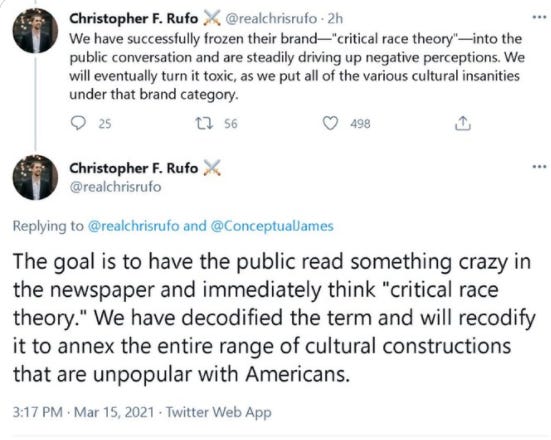
Here’s Christopher Rufo, perhaps the leading figure in the attacks on critical race theory[2], explaining this discursive strategy in a couple of tweets:
We have successfully frozen their brand – critical race theory – into the public conversation and are steadily driving up negative perceptions. We will eventually turn it toxic, as we put all of the various cultural insanities under that brand category. The goal is to have the public read something crazy in the newspaper and immediately think “critical race theory.” We have decodified the term and will recodify to annex the entire range of cultural constructions that are unpopular with Americans.
And here is Rufo’s discursive approach in practice, in a New York Post piece which is typical of this culture war approach. With rapid fire assertion after assertion and extraordinary leaps of logic, it links critical race theory to a veritable pot pourri of associations that most people – but especially white conservatives – would find negative: Marxism, Stalin’s gulags, Mao’s Cultural Revolution, the Khmer Rouge’s ‘killing fields,’ ‘identity politics,’ ‘Black Communism,’ ‘anti-Americanism,’ ‘intersectionality,’ ‘suspension of property rights,’ ‘omnipotent bureaucracy,’ ‘reeducation camps,’ and ‘race-based redistribution of wealth.’ There are more, but the point has been made. The targeted reader does not even have to know all of the associated phenomena – few who consume the New York Post will know what ‘intersectionality’ refers to – because there are so many negative associations that he will recognize. Nor does he have to have the same intensity of reaction of to all of the associations, since there will be a sufficient number that he finds abhorrent. The reader concludes, therefore, that critical race theory must be a political evil.
With this foundation, the piece then adds into the mix terms that are employed in actual efforts to address racism in education: “equity,” “social justice,” “diversity and inclusion” and “culturally responsive teaching.” On their own, these terms would appear innocuous, even positive in many respects, but identified with a critical race theory already cast in the most negative terms, they become guilty by association. To strengthen this fabric of guilt by association, these terms are sutured into a now familiar appeals to white racial resentment that has been the stock in trade of Trumpism, with claims of ‘discrimination’ against white people and attacks on the ‘free speech’ of white people deemed ‘insufficiently anti-racist.’
This discourse concludes with a call to culture war arms: “This ideology will not stop until it has devoured all of our institutions… Critical race theorists must be confronted.”
What is an effective response?
Let’s start with what NOT to do.
1. Ignore the attacks.
Yes, culture war attacks on critical race theory are unsupported by logical argument and convincing evidence. Within a scholarly community, attacks like Rufo’s New York Post piece will garner no serious attention: their sheer intellectual dishonesty alone is disqualifying. But these attacks are not part of academic colloquia. If we have learned nothing else from the last decade, we should know that propaganda of this sort does not have to be logical or supported with evidence to be effective. It must be actively countered.[3]
2. Think that the attacks can be finessed with terminological shifts.
If the right makes a term toxic, why can’t we just shift to a different term? A variant of this thinking is now at work in education, where it has been suggested that we use the term ‘racially literate’ education, rather than ‘anti-racist’ education, to evade the attacks on Kendi’s ‘anti-racist’ book. Methods which propose a simple side-stepping of unfounded attacks have an obvious appeal, but by themselves they are ultimately ineffectual. If the larger discourse is left intact, it is a relatively simply matter to add any new term to it, and even to place that new term at its center. If terms with positive connotations like ‘equity,’ ‘diversity’ and ‘inclusion’ can be sullied through association with the parade of politically negative terminology patched together by Rufo and others, any term can meet a similar fate. New nomenclature will only have efficacy if it is part of an overall approach which counters the discourse itself.
3. Respond with ‘corrections of the record.’
An understandable reaction to a complete misrepresentation of a body of scholarship like critical race theory is to seek to ‘correct the record.’ While it is important to clearly state that the portrait of critical race theory drawn in these attacks is without foundation, it is a mistake to think that it is desirable or even possible to respond effectively to this sort of attack with corrections of the misrepresentations and distortions. The lies are legion, and while you are at work correcting the first, ten more will have been added to the list.
In this regard, it is worthwhile to put the attacks on critical race theory in political context. Over the last two years, there have been two dry runs for mounting a right wing culture war on the front of race and education: the attacks on the 1619 Project curated by Nikole Hannah-Jones and published by the New York Times and on Ibram Kendi’s book How to be an Anti-Racist. Neither of those attacks has been abandoned (witness the recent denial of tenure to Hannah-Jones, and the ban on teaching 1619 in proposed laws and executive actions), but instead rolled into the culture war on critical race theory. This shift in focus is because for this discursive strategy, critical race theory makes a much more inviting target. Both the 1619 Project and Kendi’s book are discrete texts, with actual arguments that can’t be entirely ignored and with authors who can speak authoritatively for what was written and what it means. By contrast, critical race theory is a body of scholarship on questions of race that can be found in dozens of fields of research, and in thousands of texts by hundreds of authors. (The closest analogue would be feminist theory.) If the object is to create a vast field of negative associations around a term which is unfamiliar to the target lay audience, it is far easier to do with critical race theory, because it covers a much broader intellectual terrain, and does not have a single, coherent argument or authors that can speak for it an authoritative way. That is why it is now the preferred target of the right wing culture war.
It is essential to keep foremost in mind what is really at stake in these attacks. It is not the reputation of actual critical race theory (or the 1619 Project or Kendi’s book.) Rather, the objectives of the right are twofold: First, there are political initiatives – the legislation and the executive orders – that seek to drastically limit teaching and learning about racism in public K-12 and higher education. Second and related, there are efforts to mobilize voters – especially conservative, white male voters – around a political project of racial resentment and antagonism. To the extent that a response is entirely defensive, seeking to restore the ‘good name’ of the targets of the discursive strategy, it is a losing stratagem that fails to engage on these key objectives.
What to Do:
1. Go on the offense.
The most effective response quickly and concisely states that the attacks on critical race theory are without foundation, based on misrepresentations and out of context citations, and then quickly turns to counter the political objectives of the attacks on critical race theory – especially the attempts to restrict teaching and learning on issues of race. This discursive battle is not won on the defense; defensive interventions should be short, declarative and to the point, and followed by extensive offensive counter-attacks.
2. Focus on what is really at stake.
Talk about the proposed laws and executive orders, and what they do. Demonstrate how they would directly impact what can be discussed in schools, colleges and universities.
Examine how they would impede and inhibit efforts to make public schools, colleges and universities into welcoming and nurturing places for students of all races by addressing the obstacles which students of color face. Explain why, for example, these actions undermine a culturally responsive pedagogy which is so vital for students of color to see themselves, their experiences and their heritage culture in their education, as white students already do.
Discuss how these laws and executive orders seek to prevent a full study of American history by preventing the free and unimpeded investigation of the impact of racism on American government and society, starting with enslavement itself. Bring up concrete examples of what would be prohibited, such as the consideration of how slavery shaped the U.S. constitution with the ‘three-fifths clause,’ the ‘fugitive slave clause,’ and the design of counter-majoritarian institutions such as the Senate to give southern ‘slave’ states an effective veto over government policy, as well as the role of the Supreme Court in defending systemic racism for much of its history, such as in its Dred Scott and Plessy v. Ferguson decisions.[4] Make the connections between that history and attacks on the right to vote and democracy today.
Describe how topics such as the finally acknowledged Tulsa Massacre of 1921 and other acts of government-sanctioned violence against African Americans, including the lynching and rape that were pervasive under the Jim Crow regime, could be called into question. Explain how debates on the role of systemic racism and racial segregation in the economic subjugation of African Americans and other people of color – through job discrimination, restrictive housing covenants, redlining and the shaping of government programs – would be prohibited.[5] Make the connections between those practices and the vast racial wealth gap of today.
Talk about how consideration of the deep impact of systemic racism on criminal justice, education and health care would be restricted.[6] Make the connections between that history and the disparities we find in the COVID pandemic, policing and mass incarceration today.
Explain how the proscriptions written into these laws and executive orders could extend beyond the history of racism toward African Americans to include such matters as the Trail of Tears and campaigns of extermination against indigenous people; the Mexican-American war and forced deportations of the 1920s and 1930s; and the Chinese American Exclusion Act of 1882 and the internment of Japanese Americans during World War II.
3. Remember who are trusted to make decisions about education, and why.
Right wing culture wars seek to mobilize populist resentment against intellectual and cultural elites. (Insofar as the right can bring it itself to criticize economic elites, it is only when ‘woke capital’ aligns itself with a position in defense of racial diversity or against voting rights restrictions.[7]) That is why academics and institutions like the New York Times have been selected as targets in the attacks on critical race theory. The resentment against cosmopolitan elites has been an enduring presence in American history, finding expression in such forms as the ‘Know Nothing’ movement; it resonates among parts of the American public who feel ‘left behind.’ But it is far from the totality of our history and the current moment.
Who do most Americans trust and have confidence in? In public opinion polling on the most trusted and distrusted professions, K-12 teachers continually rank at the top as most trusted, together with nurses and doctors – despite having borne the brunt of many right wing attacks, including during the COVID pandemic. College faculty do not rank as high, but still far outweigh groups at the bottom – elected officials in Washington DC and state capitols are among the lowest. This ranking reflects the fact that like health care, education is seen as ‘caring’ work that a person enters to help others.
So the question that needs to be posed is this: Who do we want making decisions about how public schools, colleges and universities address issues of racism – educators or elected officials? Would we rather that those who have studied how to educate our children and are experienced in that work, those who have the closest relationship with our children and care about them as individuals, make these decisions? Or would we rather that elected officials looking to gain political advantage and increase their power by stoking racial resentment and antagonism make those decisions?
4. Make the argument for the freedom to teach and engage in scholarship as essential to democracy.
Most Americans accept that there will always be controversies about how to understand our history and society. The question then is: How do we want those controversies and disagreements to be addressed in our nation’s schools, colleges and universities? Do we want them to be freely debated and deliberated, with all ideas subject to criticism and made better by that process? Or do we want the government to be able to preempt that debate, deciding which interpretations should be taught and learned by prohibiting and censoring other interpretations?
Disagreements over such matters are how our knowledge and understanding develops and grows. By contrast, the crass politicization of history and social science, with the use of propaganda to misrepresent and distort scholarship and learning such as we see in the attacks on critical race theory, is what authoritarian movements do. And state mandates on which topics and schools of thought can and cannot be discussed in schools are what authoritarian governments do.
At the core of this question is the ability of educators to educate their students into democratic citizenship. The mandate in the Texas law that a current controversy can only be taught "without giving deference to any one perspective" was manifestly written to hinder the ability of teachers to provide a factual basis and encourage critical thinking in discussions of who won the 2020 election and what happened on the January 6. Our political freedom and our democracy are inextricably intertwined with our freedom to teach and to engage in scholarship without being subjected to the political whims of would-be authoritarians in government.
5. Make the connection between the struggle for freedom and democracy.
The story of the forward progress of American democracy cannot be told without according a central role of the Black freedom struggle. When that struggle moved forward – with the end of slavery, the Civil War amendments and Reconstruction, and again with the civil rights movement and the 1964 Civil Rights Act and 1965 Voting Rights Act – so did American democracy. When that struggle suffered defeats – with the end of Reconstruction and the imposition of Jim Crow and de jure racial segregation – so did American democracy. We rise – and fall – together. To realize the democratic promises of its founding documents, of liberty and justice for all, the United States must embrace that freedom struggle.
Leo Casey,
Albert Shanker Institute
An update of this piece is in process.
[1] There is a body of linguistic theory that explains this discursive process, one which makes “critical race theory” into an ‘empty signifier’ which can be ‘filled’ with a vast array of negative meanings in a chain of equivalences. But one does not have to delve into that theory to grasp the fundamentals of the discursive strategy being employed.
[2] Rufo is a senior fellow of the Manhattan Institute. He is partisan of Donald Trump, and was hired as part of the Institute’s conversion to full bore Trumpism. On that conversion, see Sol Stern, “Think Tank in the Tank.”
[3] I will not consider suggestions that the way to respond to right wing culture war is to join in it in some way, such as advocated by Ruy Teixeira for the Democratic Party in this New York Times article. I imagine that there is some theory of political triangulation lurking beyond such ideas, but in my view, such an approach is tantamount to surrender to this propaganda.
[4] These themes were addressed in the essays of Jamelle Bouie and Nikole Hannah-Jones in the 1619 project. The Texas law prohibits instruction in history that requires “an understanding of The 1619 Project." Moreover, it prohibits teaching that “slavery and racism are anything other than...betrayals of...the authentic founding principles.”
[5] These themes were discussed in the essays of Kevin Kruse and Trymaine Lee in the 1619 project.
[6] These themes were discussed in the essays of Bryan Stevenson and Linda Villarosa in the 1619 project.
[7] See, for example, Marco Rubio’s New York Post op-ed, “Corporations that undermine American values don’t deserve GOP support.”