Thursday, August 21, 2014

The U.S.'s Classist Educational System - And California's

by Peter Dreier.
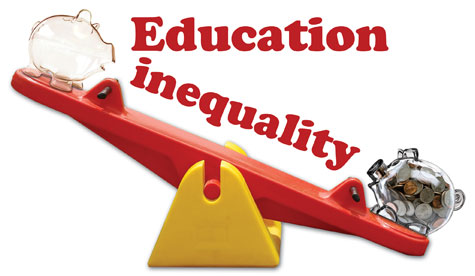
America's education system is unequal and unfair. Students who live in wealthy communities have huge advantages that rig the system in their favor. They have more experienced teachers and a much lower student-teacher ratio. They have more modern facilities, more up-to-date computer and science equipment, and more up-to-date textbooks. They have more elective courses, more music and art offerings, and more extracurricular programs. They have better libraries, more guidance counselors and superior athletic facilities.
2014-07-25-EducationalInequalityposter.jpg
Not surprisingly, affluent students in well-off school districts have higher rates of high school graduation, college attendance and entry to the more selective colleges. This has little to do with intelligence or ability. For example, 82 percent of affluent students who had SAT scores over 1200 graduate from college. In contrast, only 44 percent of low-income students with the same high SAT scores graduate from college. This wide gap can't be explained by differences in motivation or smarts. It can, however, be explained by differences in money.

Wednesday, August 13, 2014

Another Opportunity Missed - Civic Education Policy Proposals in California

California education policy makers have once again written and published a nice looking report on school curriculum – this one on the need for improved civic education.  As is the norm for these tasks, a group of “well respected” civic leaders have participated.
They have written a report, Revitalizing K-12 Civic Learning in California, and they call it a Blue Print for Action. http://www.powerofdemocracy.org/wp-content/uploads/2014/02/CLTF-Final-Report.pdf
They call for a major revision of civic education.  That is fine. They also call for discussion of their proposals on social media.( p 42)   Well, here is some of the needed discussion. 

They even recognize the diversity of California students.  They say,
“Civic learning is also vital for our increasingly diverse California society. In 2012-
2013, our 6.2 million K-12 students were 53 percent Latino, 26 percent white,
9 percent Asian and 6 percent African American, with the remaining 6 percent
comprised of other ethnicities. In addition, an increasing number of our students
are not native speakers of English. Almost 4 in 10 kindergarteners are English
language learners. This diversity, and the attention it requires, is now acknowledged
in our school funding model. The Local Control Funding Formula (LCFF) recognizes
the necessity of investing in the reduction and ultimate removal of inequitable
outcomes in California public schools. Revitalizing civic learning opportunities, in
an equitable manner, can contribute to meeting these goals.”

While it is accurate that we have a general problem of civic engagement of the young,  it is also true that we have a very specific problem with the rate of Latino and Asian voter participation and  civic engagement.
 Rates of voting and voter registration provide a window into civic engagement.  The proportion of state voter  registration that is Latino and Asian has remained far below the proportions of these groups in the state’s overall population. In 2010, Latinos in the state made up 37.6% of the general population while they were on 21.2 % of the registered voters. The Asian population was 13.1 % of the state but  only 8.1 % of the registered voters.

Monday, August 11, 2014

Civil Rights and Civil Wrongs in Public Schooling

By Anthony Cody and Alan Aja.
From the very beginnings of No Child Left Behind, the strongest argument for attaching stakes to tests has been Civil Rights. This phrase is shorthand for equity in education, an end to the systemic neglect of children of color. And proponents of corporate reform have become adept at wrapping themselves in these concerns, while promoting policies that have devastating effects on students and their communities. Common Core is no exception to this.
From Politico last week came word that Common Core proponents have realized that they are losing the battle.
We’re so good at all our statistics and data and rational arguments . [but] emotion is what gets people feeling passionate,” Oldham said. “It may not be the most comfortable place for the business community . [but] we need to get better at doing it.
This message seems to connect with Mike Petrilli of the Thomas B. Fordham Institute, which has received Gates Foundation funding to evaluate the Common Core, as well as general operating grants. Petrilli said:
“We’ve been fighting emotion with talking points, and it doesn’t work,” said Mike Petrilli, executive vice president of the Fordham Institute, a leading supporter of the standards. “There’s got to be a way to get more emotional with our arguments if we want to win this thing. That means we have a lot more work to do.”
Step one: Get Americans angry about the current state of public education.
To that end, expect to start hearing from frustrated college students who ended up in remedial classes even though they passed all their state tests and earned good grades in high school. “These kids should be as mad as hell” that the system failed them, Petrilli said.

Saturday, August 09, 2014

Release of DC-CAS Proficiency Scores Affirms Need for Transparency, Change of Policy Strategy | Economic Policy Institute

Release of DC-CAS Proficiency Scores Affirms Need for Transparency, Change of Policy Strategy | Economic Policy Institute


Clearly Michelle Rhee's leadership of D.C. schools did not improve student achievement.

"Better than the Republicans", Not Good Enough

by Jeff Bryant,
A common admonition progressives have gotten used to hearing over the years is to support more conservative Democratic candidates because “Republicans are worse.”
This admonition makes some sense in electoral politics, when, in most cases, progressives face a ballot box decision where they have to choose the “lesser evil” instead of someone who wants to do something really horrible like roll back government policies to what was in favor a hundred years ago. Elections, after all, are societal constructions where you’re forced to make a choice between only two candidates, usually. To not vote at all forfeits your right to have a say-so in the matter. And few Americans get the opportunity to vote for third party candidates who have viable shots at winning.
But “better than the other side” loses any legitimacy in the policy arena, or at least it should. For sure, there are often trade-offs between adversaries in the legislative process. But when there’s not an actual bill facing an up-or-down vote, there’s simply no reason for progressives to accept policy positions from office holders on the basis of those positions being better than what the other side wants.
Yet progressives who push for polices reflecting their values are constantly scolded for exhibiting a “have it all fantasy.” They’re told to give centrist Democrats “credit” for positions where there is some agreement – such as marriage equality or climate change – and understand when those officials have to make deals with the other side. “That’s how the game is played,” goes the refrain.
When it comes to the education policy arena, “the game” has played into a disaster for the nation’s schoolteachers, parents, and students.

Thursday, August 07, 2014

The Myth of Teacher Tenure


by Diana D'Amico — July 23, 2014

In the stories of exorbitant costs and incompetence, teacher tenure laws have achieved mythic proportions. Judge Rolf Treu’s tentative decision in Vergara v. California may be the death knell for teacher tenure. But what will change as a result? A look to the past reveals that teacher tenure never really protected teachers and nor was it supposed to. Using history as a lens, this commentary explores the origination of tenure policies and the debates that surrounded them. This commentary argues that embedded in the tenure debates is a much larger problem that should concern us all.

In 1917, the president of New York City’s Board of Education told a reporter that the schools are “burdened and clogged with many teachers who are unfit” because of their “permanent tenure.”1 For nearly a century, critics have blasted tenure for putting the needs of adults above those of children. In the stories of exorbitant costs and incompetence, teacher tenure laws have achieved mythic proportions. Judge Rolf Treu’s tentative decision in Vergara v. Californiamay be the death knell for teacher tenure. But what will change as a result? A look to the past reveals that teacher tenure never really protected teachers and nor was it supposed to.  

Monday, August 04, 2014

Welcome to Sacramento Superintendent José Banda

Welcome to Sacramento.  We hope that you can establish a positive working relationship with the Board, the community, and the teachers.  Developing a positive relationship and sustained, consistent leadership is required for school improvement.

We regret the prompt attacks on your character and your contract by the Sacramento Bee editorial board.  You see they were staunch advocates for the prior Superintendent Jonathan Raymond, a Broad Foundation assisted superintendent.  He left promptly without an explanation. It is unusual for the Bee to attack a new superintendent before he has an opportunity to make some decisions. 
Duane Campbell, Director.
Democracy and Education Institute

Friday, August 01, 2014

New President of NEA and Arne Duncan

Jeff Bryant:
For years, politicians and policy leaders have been running the nation’s public education system basically by the seat of the pants, drafting and passing legislative doctrine that mostly ignores the input from classroom teachers, research experts and public school parents.
What’s got teachers stirred up? How real and potent is this upsurge of their activism? Why should people who identify with progressive causes care? Salon recently posed those questions, and others, to Lily Eskelsen García, the new president-elect of the National Education Association, the nation’s largest teachers’ union, at the recent Netroots Nation conference in Detroit.
First of all, congratulations on becoming the new NEA president.
Still president-elect. I take office Sept. 1. We have an incredible president, Dennis Van Roekel, who basically said a transition period should be a transition period, not go stand in the corner. So he gave me the president-elect title and told me I would take the press calls, go to Netroots, meet with Arne Duncan, start establishing where you want to go and be as vocal and as visible as you can possibly be. Our members have asked NEA to step up and take things to another level. There’s too much at stake for us. There are policies that need addressing and we have some of the best policy expertise in the nation, but those ideas need a face to the NEA, a face for the American teacher that is channeling the voices of these 3 million educators, and when you hear the words come out of her mouth it’s not just her opinion — it’s a whole lot of teachers and support staff who are saying here’s an important thing for the American people to hear and an important thing for Arne Duncan and President Obama to hear. So he told me to start being that voice today.
The voices of these teachers are important, aren’t they? And too often we don’t really hear their stories about what it’s really like to teach in American schools, do we? For instance, I was just at a meeting of the American Federation of Teachers, where a teacher told us about showing up to school one morning and finding a man had been shot to death in front of the building the night before. The body was still on the sidewalk as the kids were coming to school, and the teachers had to decide how they were going to handle this with the children. So many of our teachers are really serving as first responders for kids, aren’t they?

Wednesday, July 30, 2014

New Senate Bill Fails To Address Root Causes of Central America refugees...

antiracismdsa: New Senate Bill Fails To Address Root Causes of Ce...: The Republican bill in the House is far worse. http://noticias.univision.com/video/488477/2014-07-29/noticiero-univision/videos/duras-co...

Thursday, July 17, 2014

The Democratic Party's Divide on Education - Teachers Unions

Democratic Party’s Divide on Education Policy gets Worse
Jeff Bryant
Political pundits who try to tamp down talk of divisions within the Democratic Party must not be paying any attention to education policy.
For quite some time, close observers of the nation’s education policy have been calling attention to the fault lines between education progressives in the Democratic Party and Third Way-style centrists, such as Secretary of Education Arne Duncan and Democrats for Education Reform, who lean toward a market-based, econometric philosophy for public education governance.
As Furman University education professor Paul Thomas recently wrote for Alternet, “While the Obama administration has cultivated the appearance of hope and change, its education policies are essentially slightly revised or greatly intensified versions of accountability reform begun under Ronald Reagan.”
But the Democratic Party’s divergence from real progressive values for governing our schools mostly went unnoticed in major media outlets until recently when a few light bulbs went off among political observers. Writing for Slate, Matt Yglesias noticed, “Education reform, not ‘populism’ divides Democrats.” Then, Connor Williams of the New America Foundation saw the light and explained for The New Republic, “In 2016, Democrats have good reason to run against Obama’s education record.”
Now, Jonathan Chait has penned a piece for New York Magazine, “Teachers Unions Turn Against Democrats,” in which he postulates that a “backlash” to President Obama’s education policies, energized by education historian Diane Ravitch, could lead to an alliance between teachers unions and, gulp, Republicans.

Wednesday, July 09, 2014

NEA Delegates call for resignation of Arne Duncan


by Motoko Rich

The long partnership between Democrats and teachers’ unions has frayed in recent years as the Obama administration has pursued policies that many teachers oppose, including performance ratings that link student test scores to evaluations and decisions about promotion or firing.

But the dissatisfaction hit a new level late last week when the National Education Association, the nation’s largest teachers’ union, with almost three million members, passed a resolution at its convention in Denver calling for the resignation of the secretary of education, Arne Duncan.

Why Does the Obama Administration Keep Getting It Wrong on Education Policy?

Tuesday, July 08, 2014

Child refugees on our border

antiracismdsa: Child refugees on our border: Dear President Obama:  July 3, 2014 We, the undersigned immigration, civil and human rights, faith, labor, anti-viole...

Over 200 groups sign letter to Obama about refugee children.

Sunday, July 06, 2014

Breton repeats deeply flawed Vergara claims

Sacramento Bee opinion columnist Marco Breton published a piece on Sunday,  July 6, noting that Progress ( on race relations) has been slow since the 1994 campaign of California  Proposition 187. The first half of the article where he recounts the history of the Prop. 187 effort is reasonably  well done.  The second half, where he uses Prop. 187 as a means to blame teachers for low school performance does not have evidence to support it.  He takes up the Vergara case, a topic of several posts here.  Breton cites the opinion of Judge Rolf M True. 
 Here is a response to Breton’s assertions by Jeff Bryant.
The campaign against public school teachers and their unions has evolved from casting insults to inflicting real injury. The recent ruling by a California judge in the Vergara v. California case made it a legal precedent to equate teachers’ employment security to an affront to students’ rights to a quality education.

Saturday, July 05, 2014

Let Teachers Teach, Stop Toxic Testing

by Félix Pérez
By one estimate, nearly one-third of school time is now spent preparing students to take standardized tests, administering the tests and reviewing the test results. Educators increasingly are saying, “Enough is enough!”
TAKE ACTION ›
Join the national campaign to put the focus of public education back on student learning. 
The national rising tide against over testing is about to enter a new phase if 9,000 educators gathering the next four days in Denver approve the “National Education Association Campaign Against Toxic Testing.”
An open letter  from NEA and the “educators of America” states, “It is time to end this toxic testing and implement real accountability in our public education system. As educators who have dedicated our careers and lives to our students and their success, we will not stand silent while commercial standardized testing is used to reduce our public education system to wreckage.”

Wednesday, July 02, 2014

When Teachers are left out of Common Core

by Jeff Bryant
This act is wearing thin.
As implementations of Common Core State Standards falter around the country, supporters of the new academic benchmarks continue a sort of dog and pony show to reinforce the message to “stay the course.”
The latest such example came from the Center for American Progress who staged a panel recently on “A Roadmap for a Successful Transition to the Common Core in States and Districts.” Typical of these sorts of affairs, the panel consisted of two Beltway think tank execs and two former pols now firmly ensconced in the private sector. There wasn’t an actual practicing educator in sight.
The report bears out the superficial substance of the PR event, a view from 30,000 feet up with seemingly no input from practicing teachers and principals on the ground.

Tuesday, July 01, 2014

Do Teachers' Unions Have Any Friends in the Obama Administration?

by Diane Ravitch
We are living in an era when the very idea of public education is under attack, as are teachers' unions and the teaching profession. Let's be clear: these attacks and the power amassed behind them are unprecedented in American history. Sure, there have always been critics of public schools, of teachers, and of unions. But never before has there been a serious and sustained effort to defund public education, to turn public money over to unaccountable private hands, and to weaken and eliminate collective bargaining wherever it still exists. And this effort is not only well-coordinated but funded by billionaires who have grown wealthy in a free market and can't see any need for regulation or unions or public schools.
In the past, Democratic administrations and Democratic members of Congress could be counted on to support public education and to fight privatization. In the past, Democrats supported unions, which they saw as a dependable and significant part of their base.
This is no longer the case. Congress is about to pass legislation to expand funding of charter schools, despite the fact that they get no better results than public schools and despite the scandalous misuse of public funds by charter operators in many states.
 
Creative Commons License
This work is licensed under a Creative Commons Attribution-NonCommercial 3.0 Unported License.