| ||
| ||
| ||
| ||
| ||
| ||
| ||
| ||
| ||
| ||

Issues
Fighting for Everyone to Have a Successful Future
Eric is running for Assembly to deliver for our neighborhoods and all of California — so that everyone has a chance to succeed. He will work on issues that matter most to our community, including:
Ensuring that our children get a top-level education from pre-k through college and that college is affordable for all families
Tackling the housing crisis by addressing housing affordability, including investments in permanent housing, rental assistance, and first-time homebuyer loans
Helping our economy and workforce by supporting small and mid-size businesses — during and after the pandemic
For details: Go to
https://www.electericguerra.com/issues
Our classrooms are not sites of demoralized children who hate themselves and their country. Students are hungry for explanations — real explanations — for the world they have inherited. |
The wave of state legislation and school board policies restricting what educators can and can’t teach shows no signs of slowing. These efforts rely on a narrative that learning about the history of racism and white supremacy harms students — particularly white students, leaving them feeling guilty and ashamed. We emphatically reject this narrative; it in no way matches our combined 30-plus years of experience as public school teachers. It is not teaching about racism that endangers our students, but the curricular gag-rules that seek to perpetuate their miseducation. Our use of the term “miseducation” comes from the 1933 Carter G. Woodson text, “The Mis-education of the Negro.” Woodson argued that the struggle for education was not just about access, but also curricula. How could formal education be liberatory for a child if “the inferiority of the Negro is drilled into him in almost every class he enters and in almost every book he studies?” Woodson was also clear that racist curricula affect Black and white children. To those who claimed children were too young to confront the history of racism in the classroom, Woodson replied: These misguided teachers ignore the fact that the race question is being brought before Black and white children daily in their homes, in the streets, through the press and on the rostrum. How, then, can the school ignore the duty of teaching the truth while these other agencies are playing up falsehood? We are white women, who teach mostly white kids, in two of the whitest states — Oregon and Vermont — in the country. Woodson’s argument — that all children deserve a curriculum that challenges the lie of white supremacy — has deeply shaped how we view our role as educators. Our identities and educational genealogies have made us particularly alert to the way white children have become props in the recent onslaught of miseducation policies. Woodson asserted that the prevailing narratives in too many U.S. schools harmed Black and white children, albeit differently. Both groups were inculcated with scripts of Black racial inferiority and white racial superiority. Two sides of the same old and ugly lie. To avoid confronting this lie, the narrative of history lessons making white kids feel guilty has taken hold. Many of the recent “anti-CRT” bills ban any curricula that could lead an individual to “feel discomfort, guilt, anguish or another form of psychological distress solely because of the individual’s race or sex.” A Heritage Foundation commentary endorsing the laws asked, “How would you feel if your child came home from school and said her teacher had told her that everything that happens in the world is ‘racist’ and that she’s part of the problem because of the color of her skin?” The universal language here only thinly veils the assumed white subject for whom this concern is whipped up. Former Secretary of State Condoleezza Rice was more explicit in an appearance last fall on ABC’s “The View”: "One of the worries that I have about the way that we’re talking about race is that it . . . seems so big that somehow white people now have to feel guilty for everything that happened in the past. . . . What we don’t do is make seven- and 10-year-olds feel that they are somehow bad people because of the color of their skin." We have been among those amplifying the now-common retort: “If kids of color are old enough to experience racism, white kids are old enough to learn about it.” But this formulation has limitations. Early in their encounters with the history of systemic oppression, white students sometimes express denial, disbelief, anger and yes, guilt. But the right would have you believe that those feelings are the end of the story rather than its beginning. We are lucky to work with students over the course of a school year or longer. Our lessons are not one-offs. There is space and time for students’ initial reactions to be named, understood and analyzed — and often transformed. In our experience, for many white students, learning about systemic racism is in fact not harmful, but generative. When students express denial or disbelief, we assist them in finding the resources they need to verify facts. We might ask, “I wonder why some of us struggled to believe this was true? Any ideas?” Through discussion, it is possible for students to understand that what they have been taught — and not taught — shapes their feelings about what they are learning now. We can also introduce a key idea for all critical consumers of information: Knowledge is contested. There are dominant narratives and counternarratives, state-sanctioned history (i.e., textbooks) and marginalized histories. When students understand that there is a struggle to define the past, they are less likely to deny history and more likely to investigate with curiosity why they know what they know and how they came to know it. When students respond with anger — “How could this have happened?” “Why did I never know about this before now?” — we again lean on questions. We might ask, “How would the world be different if more children were learning this history earlier and more fully?” and “So now that you know this history, what do you want to do with it?” When young white people display signs of guilt or shame — we have had students say things like “white people suck” or “I am embarrassed to be white” — our job is to help them process those feelings and foster a healthier sense of self and identity. In a recent podcast, the writer Clint Smith suggested that it is possible to reckon with the truth without allowing it to define your present beliefs. “You are not defined by the decisions that your great-great-grandfather made,” he said. “What would it look like to say, ‘My great-great-grandfather fought in this [Civil] War for a cause that runs counter to everything that I believe in today. And my family is not defined by that’?” Not only can this create a healthy separation between the actions of our ancestors and ourselves, but it also invites us to look for models of white people throughout history who acted for justice. These examples help students imagine and build an identity untethered from the perpetuation of racism. If one were to believe Fox News, a curriculum like ours — one that regularly and explicitly examines white supremacy’s manifestations, past and present — is a recipe for demoralized children who hate themselves and their country. But our classrooms are not sites of doom and gloom. Students are hungry for explanations — real explanations — for the world they have inherited, and in our experience, they often feel relieved to gain insight into why things are the way they are. Moreover, our curriculum emphasizes the varied, powerful and creative ways that people have resisted oppression and built justice. We are careful to offer students models of action, examples of people just like them who have tried to change the world and sometimes succeeded. No, our classrooms are not incubators of cynicism. They are brimming with curiosity, conversation and, yes, joy. To defeat the efforts to miseducate our children, we will all need to do our part: teachers, school administrators, school boards, labor unions, professional and community organizations, elected officials, parents, caregivers and students. We need to testify at school board meetings and state department of education hearings, write letters to the editor and op-eds and advocate to unseat the elected officials who are the architects of these attacks. And for those of us who are white, we need to know that when we emphatically reject the narrative of the guilty white child by telling our stories, the right’s lie will be obvious: Their concern is not that children will feel bad when learning about the fight for racial justice, but that children will feel good. Young white people with the capacity to act in solidarity with movements for justice are dangerous to white supremacy and its guardians. Those are the real stakes — not white children feeling guilty, but white children armed with truth, history and a righteous desire to work with others to change the world. Christie Nold (she/her) has been teaching in Vermont public schools for eight years. Prior to her experience in public education she worked at Shelburne Farms, an organization dedicated to education for sustainability, and taught in a village school in Nedryhailiv, Ukraine. Ursula Wolfe-Rocca (she/her) taught high school in a suburb of Portland, Oregon for 20 years. She is an organizer and writer with the Zinn Education Project and on the editorial board of “Rethinking Schools” magazine. This story about critical race theory was produced by The Hechinger Report, a nonprofit, independent news organization focused on inequality and innovation in education. Sign up for Hechinger’s newsletter. |
RACIAL VOLCANO EXPLODES IN LOS ANGELES.
BILL FLETCHER AND BILL GALLEGOS.
LOS ANGELES—The site of huge urban uprisings in 1965 and 1992 is once again a city on fire. The current blaze was ignited by revelations about an October 2021 meeting between three Chican@ members of the Los Angeles City Council and the Chican@ head of the Los Angeles County Federation of Labor regarding the redistricting of LA’s council districts. In a now-infamous conversation, as reported by the Los Angeles Times, racist remarks were directed against Blacks, Indigenous Oaxacans who live in the city’s Koreatown, Jews, and Armenians.
One of the most outrageous utterances was council president Nury Martinez’s reference to the Black child of white LA councilor Mike Bonin as a “changuito” (monkey) who needed a “beat down.” The political thrust of the discussion was creating new Latin@ council districts—largely at the expense of existing districts that have Black representation.
The three city council members, Martinez, Kevin de Léon, and Gil Cedillo have issued public apologies—and Martinez resigned from the city council on Wednesday. Ron Herrera, the fourth participant in the racist exchange, has resigned as head of the LA Federation of Labor.
Read more.
https://www.thenation.com/article/politics/racism-los-angeles-city-council/
|
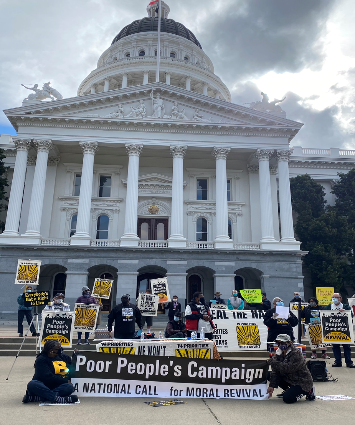
Join Sacramento rally for National Day of Action
|
On Immigration

A Race-Class Narrative About Immigration
Regardless of where we come from, what our color is, or how
we worship, every family wants the best for their children. But
today, certain politicians and their greedy lobbyists are putting
all of our families at risk. They rig the rules to enrich themselves
and avoid paying their fair share of taxes, while they
defund our schools and threaten seniors with cuts to Medicare
and Social Security. Then they turn around and point the finger
for our hard times at new immigrants—even tearing families
apart and losing children. When we reject their scapegoating
and come together across racial differences, we can make this a
nation we’re proud to leave all of our kids—whether we’re white,
Black, or brown, from down the street or across the globe.
From Ian Haney Lopez; Merge Left.
Fusing Race and Class, Winning Elections, and Saving America
A response to Ron DeSantis
As I contemplate the significance of Hispanic Heritage Month, which began September 15, I can’t help but recall Fredrick Douglass' seminal 1869 speech, “Composite Nation.” In this speech, delivered four years after the Civil War, Douglass outlined a bold vision of a pluralistic America that remains profoundly prescient:
“If we would reach a degree of civilization higher and grander than any yet attained, we should welcome to our ample continent all nations, kindreds and tongues and peoples; and as fast as they learn our language and comprehend the duties of citizenship, we should incorporate them into the American body politic.”
As posted by Congressman Ro Khan
09/18/22
Back to school
Share on Facebook Share on TwitterShare with Email
by Randi Weingarten
President, American Federation of Teachers
I have been crisscrossing the country lately, as students and staff start the new school year. For the first time since March 2020, school feels familiar. There are challenges, of course, including staff shortages and worries about gun violence. But scientific advances and funding from the federal government have given us the tools to address COVID-19. Educators didn’t need to see declines in test scores to know what to do right now: Focus like a laser on helping our kids recover and thrive. Teach them core skills and knowledge, and to think critically. Teachers will need all the support we can give them.
This is the unheralded work that happens in public schools every day, in every community across America. But, too often, ideologues’ scaremongering and sensational headlines divert attention from educators’ dedication and from what is needed to support high-quality teaching and learning for all children.
As extremists are trying to ban books, the AFT is well on our way to giving away 1 million books this year—and we will give another million books to kids and families next year. From Scranton to Socorro, from Nashua to Neshaminy, children are delighting in picking out books of their own. As critics complain about student debt forgiveness, the AFT is working to make higher education accessible without a “debt sentence,” by offering student debt clinics, suing fraudulent loan servicers, and promoting public service loan forgiveness so people can choose professions like teaching without being forever buried in debt. And as extremist politicians like Florida Gov. Ron DeSantis make baseless, politically motivated claims that there is “woke indoctrination in our schools” around race and sexuality, educators are doing everything they can to create safe and welcoming environments for students and to help them recover and thrive—academically, socially and emotionally. The AFT’s What Kids and Communities Need campaign is grounded in a simple premise: Teachers want what students need. Those needs are great due to the systemic inequities that have always existed in our schools and society, the trauma and disruption caused by the COVID-19 pandemic, the strain of teacher and school staff shortages, and the cynical attacks on educators and schools by extremists.
The message from parents is equally clear: They don’t want culture wars infiltrating our schools. They support honest, age-appropriate teaching of history. Polling shows that parents like their public schools and appreciate educators’ herculean efforts to support students during the pandemic.
This is the time to bring joy and support into our schools, not politics and hate. This is the time to support America’s largest civic institution—our public schools—to bring our divided country together and nurture our children’s and our nation’s healing. Educators and families are leading the way.
Download the Column (788.83 KB)
Robert Reich wondered out loud what many people including me have been saying. He posed it as a question. Is Ron DeSantis a fascist? He didn’t even get into the damage that DeSantis has done to teachers, driving them out with low pay, gag orders, censorship, and replacing them with veterans and first responders without experience or knowledge of teaching. He also fired five elected officials and replaced them with cronies. Four were Broward County school board members who were criticized in a state report for the Parkland school shootings, the fifth was a county prosecutor who said he would not prosecute women who sought an abortion. He is on a roll, attacking teachers and anyone he considers WOKE (i.e., concerned about racism, injustice, etc.). He is rising by making hatred his brand.
Robert Reich writes:
I like to tweet. Not as much as I like to write here on Substack where I get to share my thoughts at some length. On Twitter it’s a different kind of conversation, and pace — like speed chess.
Last Tuesday I tweeted:
Robert Reich @RBReichJust wondering if “DeSantis” is now officially a synonym for “fascist.”August 23rd 20221,626 Retweets10,490 Likes
I was surprised at the outrage my little tweet provoked.
The Washington Examiner, for example:
Ultra left-wing elitist and former secretary of labor during the Clinton administration Robert Reich tweetedearlier this week, “Just wondering if ‘DeSantis’ is now officially a synonym for ‘fascist.’” This insulting slur has no basis, of course. This is just what left-wing ideologues do when they discuss Republican politicians who pose any threat to the existence of their political ideology. It’s not grounded in any reality and is a sham. Yet, it never stops any of them from repeating the lie. Anyone the Democrats don’t like or disagree with is a fascist…. Any person using such hyperbolic, unhinged name-calling is not a serious person, and anything they say should not be deemed credible.
Fox News’s digital outlet took umbrage as did many others, with rightwing rage at my tweet ricocheting through the echo-chambers of Republican social media.
Don’t worry about me. After a half-century in and around politics, I’ve got a thick skin. But the size of the blowback on my little tweet makes me think I struck a nerve.
DeSantis has become a favorite of the GOP’s Fox News-viewing base, and the most likely rival to Trump for the Republican nomination in 2024. The Harvard and Yale educated DeSantis (what dothey teach at Harvard and Yale?) has been called “Trump with a brain.” Lately DeSantis has been campaigning on behalf of Republican election-deniers around the country, including gubernatorial candidate Doug Mastriano in Pennsylvania and US Senate candidate JD Vance in Ohio.
DeSantis is the nation’s consummate culture warrior. Consider what he has wrought in Florida:
How much of a reactionary bully is DeSantis? Don’t take my word for it. Here’s a smattering of some of his pearls of (dare I say, fascist) rhetoric: “We are not going to surrender to woke,” DeSantis said last Tuesday. “Florida is the state where woke goes to die.” He has describedan America under assault by left-wing elites, who “want to delegitimize our founding institutions.” DeSantis envisions his job as governor as fighting critical race theory, “Faucian dystopia,” uncontrolled immigration, Big Tech, “left-wing oligarchs,” “Soros-funded prosecutors,” transgender athletes, and the “corporate media.” The state of Florida, DeSantis says, has become a “citadel of freedom.” He charges — using a standard racist dog whistle — that “We’re not letting Florida cities burn down … In Florida, you’re not going to get a slap on the wrist. You are getting the inside of a jail cell.”
So, back to my tweet: Is it useful to characterize DeSantis’s combination of homophobia, transphobia, racism, and misogyny, along with his efforts to control the public schools and universities and to intimidate the private sector (e.g., Disney), as redolent of fascism?
America’s mainstream media is by now comfortable talking and writing about “authoritarianism.” Maybe it should also begin using the term “fascism,” where appropriate. (Even Joe Biden, who has never been known as a rhetorical bomb-thrower, last Thursday accused the GOP of “semi-fascism.” A spokesperson for the Republican National Committee called Biden’s comment “despicable.”)
Authoritarianism implies the absence of democracy, a dictatorship. Fascism (the word comes from the Latin fasces, denoting a tightly-bound bundle of wooden rods that typically included a protruding axe blade, adopted by Benito Mussolini in the 1930s to symbolize his total power) is different from mere authoritarianism. Fascism also includes hatred of “them” (people considered different by race or religion, or outside the mainstream, or who were born abroad), control over what people learn and what books they are allowed to read, control over what had been independent government units (school boards, medical boards, universities, and so on), control over women and the most intimate and difficult decisions they’ll ever make, and demands that the private sector support the regime.
Perhaps my “just wondering” tweet about DeSantis hit the nerve of the fascism now taking root in the Republican Party?
Or is DeSantis’s own nascent presidential campaign behind the outsized reaction to my tweet? After all, if you’re seeking a presidential nomination in today’s GOP, there’s nothing like an accusation of fascism to rally Trump supporters. It might be a particularly useful strategy if your primary opponent in 2024 will be Trump.
What do you think?