Tuesday, January 12, 2021

Response to the Proposed Ethnic Studies Model Curriculum for California

 This is in response to the  Ethnic Studies model curriculum draft posted for public review by the California State Board of Education. 


Response by Sacramento League of United Latin American Citizens, Lorenzo Patiño Council, 2862. Sacramento, California.


We offer the following critiques. 


Chapter 4. Bibliography


The proposed bibliography primarily includes theoretical pedagogical publications while lacking content specific materials.   While advocacy pedagogical literature certainly has value, teachers also  need background content.  The bibliography should be expanded to include some content specific recommendations on the history, sociology, and culture of  each of the major groups.  For example, for Mexican American/Latino readings should include Occupied America:  A History of Chicanos, 8th edition or later by Rodolfo  F. Acuña,  From Out of the Shadows: Mexican Women in the Twentieth-century America, by Dr. Vicki Ruiz,   and Carlos Muñoz, Youth, Identity, Power: The Chicano Movement .  Sources providing basic historical background are missing from the bibliography.   Similar suggestions would improve the usefulness of the bibliography  as teachers cover several of the other  major ethnic  groups. 


Appendix A.  Sample lessons and topics


The first model lesson recommends  a lesson on immigration in current Los Angeles.  While this lesson has merit, the sample model lessons should begin with the  forced incorporation of the Mexican people living in the Southwest into the United States  via the Mexican American War of 1846-1848  and the Treaty of Guadalupe Hidalgo and the Gadsden Purchase. 


Respectfully submitted by the Education Committee of Sacramento LULAC , Lorenzo Patiño Council.  2862.

Adopted by the Council on  Jan. 7,2021


Manuel Lares, President of LULAC 2862,


Dolores Delgado Campbell. Professor Emeritus. History, American River College, Sacramento, California.


Dr. Duane E. Campbell.  Professor Emeritus. Bilingual/Multicultural Education, California State University- Sacramento.  Education and Democracy Institute. 


Dr. Susan Nakaoka,  Professor, Division of Social Work,  California State University -Sacramento. 


Monday, January 11, 2021

How Fascism Works: A Warning for the U.S. | Amanpour and Company

Trump, the Big Lie, and Fascism

  Post-truth is pre-fascism, and Trump has been our post-truth president. When we give up on truth, we concede power to those with the wealth and charisma to create spectacle in its place. Without agreement about some basic facts, citizens cannot form the civil society that would allow them to defend themselves. If we lose the institutions that produce facts that are pertinent to us, then we tend to wallow in attractive abstractions and fictions.


The American Abyss

A historian of fascism and political atrocity on Trump, the mob and what comes next.

By Timothy Snyder

  • Jan. 9, 2021  New York Times. 


Thursday, January 07, 2021

The Attempted Coup Against Democratic Elections


On Wednesday afternoon, a rally of Trump supporters — after being whipped up by Trump, repeating myths of a stolen election — stormed the Capitol building and stopped the electoral vote certification. Yes, it's an attempted coup.


Let's take a moment to acknowledge the emotional weight of this moment. This is awful and another line crossed by Trump's behavior. He called for the protest, spoke at it, and told his supporters to march to the Capitol. It is outrageous — broken windows, shots fired, explosive devices planted, 13 arrested with weapons confiscated inside the Capitol and one person shot under unclear circumstances. As members of the public, we're feeling angry and disheartened. 

We always said a coup needs legitimacy to be successful. If the goal of today's seizure of the Capitol was to gain legitimacy, the action has backfired spectacularly. 

The pillars of our democratic society are largely standing and supporting our democracy. This coup is not gaining traction or convincing the majority of lawmakers, particularly those required to certify election results. Police have successfully regained control of the Capitol (though questions will need to be answered about their taking selfies with occupiers inside the Capitol and the obvious disparate treatment of black protestors previously and the armed white protestors who just invaded the Capitol).

And it's not playing well in the public arena. In fact, the seizing of the Capitol is being decried widely by the right (some calling it domestic terrorism) — and even by politicians who supported stymying the election. This is a fluid situation.

Some other happenings of note:

You can be sure we are monitoring this situation. We are in discussion with allies around what development might call for a national mobilization. But strategically we think this is a last gasp and the risks are huge if we simply tell people to rush into the streets.

At this moment, we are not calling for mass protest. We think one of the most dangerous cocktails would be violent clashes between civilians. Tonight, we encourage people in the DC area to honor the curfew and stay home. Everyone at the Capitol should go home. 

This violent coup attempt appears to be backfiring on its perpetrators, and they seem to be losing both in the electoral process and in the sphere of public opinion. They look out of control.

Tonight, the most effective action is to let the coup plotters expose how isolated and unsupported they are. Their actions are doing that.

We think it is strategic to get on with certification and finish it. Contact your Representatives to urge them to certify the results of the election ASAP. It's time to end this. 

We are keeping a close eye to see if things change course. Some indications we're looking for are leaders of societal pillars — other than politicians or the Stop the Steal protestors — encouraging taking to the streets to support the coup OR, people successfully occupying the Capitol building and again delaying the vote certification. 

Violence could escalate overnight, so it may be helpful to mentally prepare for that possibility. We think that behavior would only further isolate and discredit their effort to overturn the election.

We don't believe this coup attempt has the support necessary to overturn the election result. We believe we will see a democratic — if not peaceful — transfer of power on the 20th. And we return to the collective feeling: this is bad. This President's lies, urges to violence, and support of a coup attempt have done damage to our democracy that will take all of us to heal.

With gratitude, 

The Choose Democracy Team 

Also see

Also see:
The Insurrection Was Predictable
by 
DAVID SIROTA
Yesterday’s events were the expression of a dangerous authoritarian movement that has been long in the making. 
 
On Jacobin.
 
https://jacobinmag.com/2021/01/capitol-building-storming-far-right-election

Do these attempts constitute a coup? New York Times

Amanda Taub, Jan.7, 2021.

Do the actions of President Trump and some of his supporters — including Mr. Trump’s effort on Saturday to bully Georgia’s secretary of state into overturning the results of the state’s vote in the presidential election, and then yesterday openly inciting a mobthat then attacked the United States Capitol — constitute a coup attempt?

If the question is whether those actions are as gravely serious as a coup, the answer is yes, said Erica de Bruin, a political scientist at Hamilton College who has researched coups for more than a decade.

But the violent, anti-democratic attack on the Capitol doesn’t fit the technical definition of a coup even though the president incited and encouraged it. That matters, experts say, because different actions are required to prevent this type of attack from harming democracy.

A coup is an illegal attempt to take power through force or the threat of force, usually involving at least a faction of the military or formal security forces, though sometimes they are backed by paramilitaries or other armed groups.

That’s not what happened in Washington yesterday.

Although some of the people that stormed the Capitol were armed, they do not appear to be part of any organized military or rebel organization. And while Mr. Trump encouraged his loyalists in his capacity as a leader of their movement, he did not try to call the military to their aid, or otherwise use the formal powers of the presidency to help them, said Naunihal Singh, a professor at the Naval War College whose research focuses on coups.


Image

A member of the mob inside the Capitol on Wednesday.Credit...Erin Schaff/The New York Times

But that is not the end of the story.

These days, democracies tend to collapse from piecemeal backsliding that falls short of the technical definition of a coup, but is often ultimately more damaging. A clear pattern has played out in countries around the world, including Turkey, Russia, Hungary, and Venezuela, in which leaders come to office through elections but then undermine norms, gut institutions and change laws to dismantle any restraints on their power. Eventually, their countries become dictatorships in all but name.

Yesterday’s attack, and Mr. Trump’s encouragement of it, fit well within that category. And to combat that kind of anti-democratic backsliding requires different tactics than would be used against a coup.

“We know how to prevent coups,” said Dr. de Bruin, who literally wrote the book on how to do so. “We have a whole set of actions that international organizations, military officers, individuals can use. But we know far less about how to prevent anti-democratic actions.”

A coup either succeeds or fails, usually within a few hours. Stopping anti-democratic actions like Wednesday’s attack on the Capitol requires political engagement over time. Legal remedies like arrests and impeachment can help. So can political remedies, like political parties cutting off money to those who participate in anti-democratic actions, and party elites speaking out against it.

Subtler responses are also important.

“Authoritarian leaders are desperately afraid of ridicule because so much of their power comes from social connectedness,” Dr. Singh said, and treating them as if they are respectable reinforces that power.

But, he said, treating Wednesday’s attack, and Mr. Trump’s support of it, with the “ridicule and umbrage it deserves” is a way to undermine any suggestion of legitimacy or authority.

Some senior Republican officials did that yesterday. For weeks after the election, Senator Mitch McConnell, the Republican from Kentucky who is majority leader, had remained silent about Mr. Trump’s spurious claims of electoral fraud. On Wednesday, he said on the Senate floor that overruling the voters would “damage our republic forever.”

Senator Mitt Romney, Republican of Utah and a former presidential candidate, was even more outspoken.

“We gather due to a selfish man’s injured pride,” he said when the chamber reconvened after the attack, “and the outrage of supporters who he has deliberately misinformed for the past two months and stirred to action this very morning. What happened here today was an insurrection incited by the president of the United States.”


Sunday, January 03, 2021

Are Children Falling Behind?


Teresa Thayer Snyder 
December 12, 2020
I sincerely plead with my colleagues, to surrender the artificial constructs that measure achievement and greet the children where they are, not where we think they “should be.”

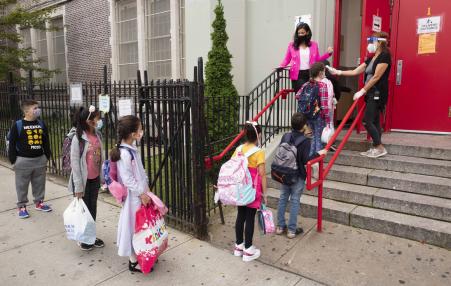
Students line up to have their temperature checked before entering PS 179 elementary school in the Kensington neighborhood, Sept. 29, 2020 in Brooklyn, AP Photo/Mark Lennihan // Politico


Dear Friends and Colleagues:

I am writing today about the children of this pandemic. After a lifetime of working among the young, I feel compelled to address the concerns that are being expressed by so many of my peers about the deficits the children will demonstrate when they finally return to school. My goodness, what a disconcerting thing to be concerned about in the face of a pandemic which is affecting millions of people around the country and the world. It speaks to one of my biggest fears for the children when they return. In our determination to “catch them up,” I fear that we will lose who they are and what they have learned during this unprecedented era. What on earth are we trying to catch them up on? The models no longer apply, the benchmarks are no longer valid, the trend analyses have been interrupted. We must not forget that those arbitrary measures were established by people, not ordained by God. We can make those invalid measures as obsolete as a crank up telephone! They simply do not apply. 

When the children return to school, they will have returned with a new history that we will need to help them identify and make sense of. When the children return to school, we will need to listen to them. Let their stories be told. They have endured a year that has no parallel in modern times. There is no assessment that applies to who they are or what they have learned. Remember, their brains did not go into hibernation during this year. Their brains may not have been focused on traditional school material, but they did not stop either. Their brains may have been focused on where their next meal is coming from, or how to care for a younger sibling, or how to deal with missing grandma, or how it feels to have to surrender a beloved pet, or how to deal with death. Our job is to welcome them back and help them write that history.

I sincerely plead with my colleagues, to surrender the artificial constructs that measure achievement and greet the children where they are, not where we think they “should be.” Greet them with art supplies and writing materials, and music and dance and so many other avenues to help them express what has happened to them in their lives during this horrific year. Greet them with stories and books that will help them make sense of an upside-down world. They missed you. They did not miss the test prep. They did not miss the worksheets. They did not miss the reading groups. They did not miss the homework. They missed you.

Resist the pressure from whatever ‘powers that be’ who are in a hurry to “fix” kids and make up for the “lost” time. The time was not lost, it was invested in surviving an historic period of time in their lives—in our lives. The children do not need to be fixed. They are not broken. They need to be heard. They need be given as many tools as we can provide to nurture resilience and help them adjust to a post pandemic world.

Being a teacher is an essential connection between what is and what can be. Please, let what can be demonstrate that our children have so much to share about the world they live in and in helping them make sense of what, for all of us has been unimaginable. This will help them– and us– achieve a lot more than can be measured by any assessment tool ever devised. Peace to all who work with the children!

[Teresa Thayer Snyder was superintendent of the Voorheesville district in upstate New York. She wrote this essay on her Facebook page.]


Wednesday, December 30, 2020

Governor Newsom California COVID-19 Update: Schools- December 30, 2020

Ethnic Studies Model Curriculum

 Ethnic Studies Curriculum SBE

At its November 18–19, 2020, meeting, the Instructional Quality Commission (IQC) recommended the revised draft Ethnic Studies Model Curriculum to the State Board of Education (SBE) following a 45-day public comment period. The IQC incorporated edits, including those recommended by the California Department of Education (CDE), that strengthen the content and honor the four traditional disciplines of African American, Native American, Asian American, and Chicana/o/x and Latina/o/x studies and better reflect the diversity of experiences and contributions of groups that have been marginalized and understudied. Additionally, the IQC updated and expanded an existing set of resources—where all sample lessons are housed—to further explore communities and raise the voices of identities whose experiences intersect with the core disciplines of ethnic studies, such as Arab Americans, Armenian Americans, Jewish Americans, and Sikh Americans.

This revised draft of the Ethnic Studies Model Curriculum is in alignment with state law (Education Code Section 51226.7) and the State Board of Education-adopted guidelines, which can be found on the CDE’s Ethnic Studies Model Curriculum Guidelines web page.

The model curriculum draft has been posted for a final 45-day public review period. State law requires the SBE to take final action on the model curriculum by March 31, 2021.

More information on the Ethnic Studies Model Curriculum can be found on the CDE Model Curriculum Projects web page. Individuals or groups may submit public comment on the Ethnic Studies Model Curriculum 

Tuesday, December 29, 2020

10 Things You Should Know About Socialism | Yes! Magazine

10 Things You Should Know About Socialism | Yes! Magazine: What do we mean when we talk about “socialism”? Here are ten things about its theory, practice, and potential that you need to know.

Sanders Objects !


Last night, the House of Representatives, with a two-thirds majority of 275 to 134, voted in a bi-partisan way to increase the direct payments going to working families from $600 per adult to $2,000 per adult. 

The House did the right thing. I congratulate them. Now it is time for the Senate to step up to the plate and do what the American people overwhelmingly want us to do. 

Earlier today, I spoke on the Senate floor urging Majority Leader Mitch McConnell to bring this bill to a vote. Now I am asking you to join me: 

Please add your name to tell Mitch McConnell to let the Senate vote on increasing direct payments to $2,000 for working people across the country. This is important. 

As a result of the pandemic, tens of millions of Americans have lost their jobs and their incomes. In the middle of the winter, families now face the threat of eviction and the possibility of being thrown out in the streets. 

Hunger in America is at the highest level that it has been for decades with moms and dads struggling to feed their kids, and working families lining up mile after mile to get emergency food packages. 

We are even seeing an increase in grocery store shoplifting as desperate Americans try to keep their families from going hungry — all of this taking place in the wealthiest country in the history of the world. 

In the last number of years, as people know, Congress has provided massive tax breaks for the wealthiest people in this country. That is one of the reasons why we currently have higher income and wealth inequality than any time since the 1920s. 

Inequality has grown worse during this pandemic, with many in the billionaire class seeing their wealth increase by hundreds of billions of dollars while Americans struggle to put food on the table.

Congress has also given enormous tax breaks to large corporations so the biggest companies in this country pay zero dollars in federal income taxes.

We have also passed the largest military budget in the history of our country at $740 billion, more than the military budgets of the next ten nations combined. 

Meanwhile, half a million Americans are homeless, and half of working families are struggling to survive paycheck to paycheck.

In the middle of a horrific pandemic, over 90 million Americans are uninsured or underinsured and not sure whether they can afford to go to a doctor. 

We are coming to the close of one of the most terrible and painful years in American history. That is a tragic fact. More than 330,000 people have died from COVID-19 and record-breaking new cases have left hospitals overwhelmed with new admissions.

The House has done the right thing by an overwhelming vote. Democrats and Republicans in the House voted to increase that $600 direct payment to a $2,000 payment, and 78% of Americans believe that is the right decision. 

If Mitch McConnell refuses to bring this legislation to a vote in the Senate, I will delay the Senate vote on the National Defense Authorization Act and keep the Senate in session through the New Year. Working families need help now. 

In this historic moment, that is where we are right now. Do we turn our backs on struggling working families, or do we respond to their pain? 

Please sign my petition — tell Mitch McConnell to bring $2,000 payments to a vote in the Senate.

In the richest country in the history of the world, we cannot allow the working class to get left behind. Thank you for adding your name to join me in calling on Mitch McConnell to let the Senate vote on this important legislation. 

In solidarity, 

Bernie Sanders

ADD YOUR NAME


Monday, December 28, 2020

Tuesday, December 08, 2020

Teachers’ Strikes -Conditions for Success

 Teachers’ Strikes -Conditions for Success


At the center of the recent teacher insurgency is one particular form of direct action—the strike. The strike occupies a distinctive place in the popular consciousness of teachers and working people more generally, primarily because of its extraordinary visibility, leverage, and power as a tactic but also because of the mythology and romance that is often associated with it. Despite their success in establishing public-sector unionism and collective bargaining (including teacher unionism) in the 1960s, teacher strikes became increasingly ineffective by the mid-1970s and 1980s and had dwindled to a mere handful by the start of the twenty-first century. The success of the teacher insurgency in reestablishing the strike as a powerful tactic is a welcome development, but to maintain and build on that success, we need to be acutely aware of the approaches that best situate teacher strikes to win.


Far too much of what passes for thinking about strikes in the United States— including teacher strikes—rests on a “field of dreams” theory: Call it, and they will come. We must go beyond such romantic notions, which are recipes for disaster, and consider the different conditions and approaches that have led teacher strikes to victory and defeat, to find a way forward that will continue the success of the strikes of the teacher insurgency.

Complete chapter at 

https://www.dissentmagazine.org/online_articles/the-teacher-strike-conditions-for-success


Leo Casey is Executive Director of the Albert Shanker Institute, a think talk affiliated with the American Federation of Teachers. Over the course of a forty-year career, he has been a rank and file public school teacher, the leader of the union at his school and a Vice President of New York City’s United Federation of Teachers.

This text was adapted from Leo Casey’s book The Teacher Insurgency: A Strategic and Organizing Perspectiveout now from Harvard Education Press. 


Monday, December 07, 2020

No More Children Locked in Cages- Separated from Their Families


 WASHINGTON (AP)  President-elect Joe Biden has picked California Attorney General Xavier Becerra to be his health secretary, putting a defender of the Affordable Care Act in a leading role to oversee his administration’s coronavirus response.

Separately, Biden picked a Harvard infectious disease expert, Dr. Rochelle Walensky, to head the Centers for Disease Control and Prevention. And he announced a new role for Dr. Anthony Fauci, the government’s top infectious disease expert.

If confirmed by the Senate, Becerra, will be the first Latino to head the Department of Health and Human Services, a $1 trillion-plus agency with 80,000 employees and a portfolio that includes drugs and vaccines, leading-edge medical research and health insurance programs covering more than 130 million Americans.

Biden’s selection of Becerra and Walensky was announced early Monday in a press release from the transition office. People familiar with the decision had confirmed the picks to The Associated Press on Sunday night. Biden also announced other top members of his health care team, though some posts remain unfilled.

Becerra, as the state of California’s top lawyer, has led the coalition of Democratic states defending “Obamacare” from the Trump administration’s latest effort to overturn it, a legal case awaiting a Supreme Court decision next year.

A former senior House Democrat, Becerra was involved in steering the Obama health law through Congress in 2009 and 2010. At the time he would tell reporters that one of his primary motivations was having tens of thousands of uninsured people in his Southern California district.

Becerra has a lawyer’s precise approach to analyzing problems and a calm demeanor.

But overseeing the coronavirus response will be the most complicated task he has ever contemplated. By next year, the U.S. will be engaged in a mass vaccination campaign, the groundwork for which has been laid under the Trump administration. Although the vaccines appear very promising, and no effort has been spared to plan for their distribution, it’s impossible to tell yet how well things will go when it’s time to get shots in the arms of millions of Americans.

Becerra won’t be going it alone. Biden is expected to stress a coordinated response to the virus when he publicly introduces his team this week.

Businessman Jeff Zients was named as Biden’s White House coronavirus coordinator. An economic adviser to former President Barack Obama, Zients also led the rescue of the HealthCare.gov website after its disastrous launch in 2013. Former Surgeon General Vivek Murthy, a co-chair of Biden’s coronavirus task force, is returning to his post as the nation’s doctor, with broader responsibilities.

Biden announced Fauci will be the president’s chief medical adviser, while continuing as director of the National Institute of Allergy and Infectious Diseases.

Adding to the group are national security expert Natalie Quillian as co-director of the coronavirus response and Yale public health specialist Dr. Marcella Nunez-Smith, who will head a new working group to reduce health disparities in COVID-19, a disease that has taken a deeper toll among minorities.

The core components of HHS are the boots on the ground of the government’s coronavirus response. The Food and Drug Administration oversees vaccines and treatments, while much of the underlying scientific and medical research comes from NIH. The Centers for Disease Control and Prevention takes the lead in detecting and containing the spread of diseases. The Centers for Medicare and Medicaid Services, or CMS, provides insurance coverage for more than 1 in 3 Americans, including vulnerable seniors, as well as many children and low-income people.

Biden still has not picked the heads of FDA and CMS.

Under President Donald Trump, CDC was relegated to a lesser role after agency scientists issued a stark early warning that contradicted Trump’s assurances the virus was under control, rattling financial markets. The FDA was the target of repeated attacks from a president who suspected its scientists were politically motivated and who also wanted them to rubber-stamp unproven treatments.

As CDC director, Walensky would replace Dr. Robert Redfield, who accurately told the public coronavirus vaccines would not be available for most people until next year, only to be disparaged by Trump as “confused.” Walensky is a leading infectious disease specialist at Massachusetts General Hospital, and has devoted her career to combatting HIV/AIDS.

Becerra’s experience running the bureaucratic apparatus of the California attorney general’s office, as well as his success working with Republicans, helped seal the pick for Biden, said a person familiar with the process but not authorized to comment publicly. Becerra had worked with Louisiana’s Republican attorney general to increase the availability of the COVID-19 drug treatment Remdesivir in their states. He’s also worked closely with other Republican attorneys general on legal challenges against opioid manufacturers.

Early in California’s coronavirus response, Becerra defended broad shutdowns Gov. Gavin Newsom had put in place to curtail the pandemic, including limits on religious gatherings. Three churches in Southern California had sued Newsom, Becerra and other state officials because in-person church services had been halted.

Biden’s offer was extended to Becerra on Friday. The president-elect has been under pressure from the Congressional Hispanic Caucus to appoint Latinos to the Cabinet.

Previously Becerra had served for more than a decade in Congress, representing parts of Los Angeles County. He had also served in the California state assembly after attending law school at Stanford.

His mother was born in Jalisco, Mexico, and emigrated to the U.S. after marrying his father, a native of Sacramento, California, who had grown up in Mexico.

Becerra often cites his parents as his inspiration, saying they instilled in him a strong work ethic and a desire for advancement. His father worked road construction jobs, while his mother was a clerical employee. Becerra is married to Dr. Carolina Reyes, a physician who specializes in maternal and fetal health.

In an AP profile published last year, a lifelong friend of Becerra’s said he learned to stay calm and self-controlled in high school as a varsity golfer and an exceptional poker player. Becerra studied the advice of famous golfers while practicing with a set of used clubs costing less than $100.

***


Saturday, December 05, 2020

New NEA Leader Fighting Trump


Nicole Gaudiano 
October 21, 2020
Politico
As president, Becky Pringle said her mission is to “lead a movement to reclaim public education as a common good.” She wants to transform the system into one that is racially and socially just and equitable.

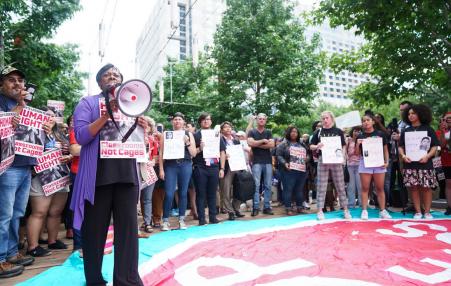
Becky Pringle, who became president of the National Education Association in September, speaks at a human rights rally during NEA’s Conference on Racial and Social Justice in Houston in 2019., (Photo: NEA)


Becky Pringle was among the many Black mothers in the mid-1990s having “that conversation” with her teenage son about getting stopped by police: what to say, where to keep his hands, how to stand up for his rights.

Pringle had seen how Black school-age males were disproportionately subjected to suspensions or expulsions while teaching science at Susquehanna Township Middle School in a suburb of Harrisburg, Pa. As her son prepared to get his driver’s license, she knew she had to talk to him “so that he could come home safely,” she said.

“Much of the country is just now paying attention to George Floyd and so many others,” she said during an interview. “But as a Black mother, I've always been paying attention. This is not new. This has been happening forever.”

As newly elected president of the 3-million-member National Education Association, the nation’s largest union, Pringle, 65, is now the highest-ranking Black female labor leader in the country. Only two other Black women have held the job before her, in the late 1960s and 1980s. Personal experience drives her work leading a national rebellion against President Donald Trump’s education policies and systems, which she says continue to marginalize students of color.

Pringle stepped into her role in September amid deep divisions nationwide about whether to reopen schools, pitting teachers afraid of returning to the classroom against the Trump administration and some governors and local officials calling for in-person classes. The crisis has led to budget cuts that have cost some teachers their jobs, has robbed others of their lives and has shined a spotlight on educational inequities across the country.

Pringle said a second Trump term wouldn’t stop the union’s work in states that are supportive of public education or its fight, for example, for the inclusion of ethnic studies in schools. And the union will keep pushing aggressively for safety and equity in schools during the pandemic through strikes, protests and sickouts — or by backing lawsuits, as it has in Florida, Iowa and Georgia, she said.

If Trump wins and Education Secretary Betsy DeVos continues in her role, Pringle said, “we will lift up all of the things that they are doing to destroy public education, to dismantle it, to hurt our educators’ rights to organize and have a voice to advocate at work for our students and for their community.”

DeVos, who has been pushing for reopening schools for in-person classes, took her own swipe at teachers unions at a recent forum, saying they are focused on “protecting adult positions, adult power” rather than “doing what’s right for students.”

The union, perhaps unsurprisingly, endorsed Democratic presidential nominee Joe Biden, whose wife, Jill, is a career educator and an NEA member. Pringle has said that Biden will listen to scientists and doctors when making public health decisions and educators and parents on how to support students during the pandemic.

The labor group is running a massive member campaign for Biden with digital organizing, phone banking, texting, virtual rallies and car caravans, said Kim A. Anderson, NEA’s executive director. More than 225,000 members are participating in 2020 election activities so far, almost doubling their numbers from 2016.

Pringle “reminds us every day that we need a new president and we need a pro-public-education United States Senate,” Anderson said.

She has also been speaking out against the Trump administration. Last month, Pringle called for the resignation of DeVos and HHS Secretary Alex Azar over reports of political meddling in school reopening guidance. She is also fighting the Supreme Court nomination of Judge Amy Coney Barrett.

Pringle argues that students’ rights, which have been “dismantled” under DeVos — such as protections for transgender students — are at stake, along with collective bargaining rights and health care.

The disdain is apparently mutual. Responding to Pringle, Education Department spokesperson Angela Morabito stated: “What dismantles students’ rights is denying them the opportunity to effectively learn this school year and instead playing politics. Those are the policies of the union bosses.”

Conservatives question whether teachers unions are exploiting this moment with demands for reopening schools that are unrelated to ensuring safety during the pandemic. During the summer, a coalition including some local unions laid out demands such as police-free schools, a cancellation of rents and mortgages and moratoriums on both new charter programs and standardized testing.

Contracts that give teachers more flexibility or allow remote work are “defensible,” but provisions that sharply reduce the expected workday seem “much harder to justify,” said Rick Hess, director of Education Policy Studies at the conservative American Enterprise Institute. “I’ve got to ask, are these contracts really about protecting staff or are there other demands ... for the convenience or preferences of members?” he asked.

But Pringle argued that local unions are seeking the safe and equitable reopening of schools. “I've seen no instances where they have gone too far,” she said. “Is it too far … to demand that all students have digital tools to learn remotely or in person? Is that going too far? Is it going too far to have class sizes at a level that allows individual attention?”

Pringle’s tenure begins during a national moment of reckoning on racial justice, which is the very reason she became involved in unions.

Lily Eskelsen García, who headed the union before Pringle, said her successor “changed the conversation” within NEA around racial justice issues in education and led that work as the union's vice president.

“As we talked about, ‘How do we get test scores up?’ And she’d say, ‘Shut up about the test scores. Why don't these kids have the resources, the staff, the class size?’” Eskelsen García recalled.

As president, Pringle said her mission is to “lead a movement to reclaim public education as a common good.” She wants to transform the system into one that is racially and socially just and equitable, ensuring teachers and students have the resources they need. The union is offering training on virtual learning but also on practices that focus on conflict resolution and improving school climate and culture so that students — particularly those of color — can feel safe and valued, she said.

Children are seeing and participating in protests for racial justice, and many expect schools to step up and work with them, Pringle said. “We're looking at ourselves first, and we're saying: ‘What do we need to do to build our racial justice muscle?’”

Derrick Johnson, president and CEO of the NAACP, said Pringle “walked in the door with a level of empathy that's needed, while at the exact same time she's respected among her peers, both in rural and urban school districts.”

Eskelsen García said she and Pringle grew close during times that had “nothing to do with running a board meeting.” The two women cried together over losing husbands. And both have had similar experiences as parents of gay children. Eskelsen García’s son was interviewed on television when he and his husband were among the first gay couples to marry in Utah, and Pringle’s daughter and her wife were the first Black lesbian couple to appear on TLC’s “Say Yes to the Dress.”

Eskelsen García mentioned at the end of her term that she wanted a mariachi band at some point when the pandemic ends. Pringle made it happen, even with the crisis in full swing, surprising Eskelsen García and her second husband with the band playing in Pringle’s garage as it rained.

“One by one, her neighbors came out with their umbrellas,” Eskelsen García said. “We all danced, 6 feet apart, with umbrellas.

“You have to love this woman, because she is all business right until the minute that she’s not, and then it is all love and friendship,” she said.

Pringle’s all-business side was what caught the attention early on of Kelly Berry, who served as president of the Susquehanna Township Education Association in the 1980s. She remembers Pringle, back then, pushing for fewer students in her son’s kindergarten class during a school board meeting with her new boss, the superintendent. Pringle was a new teacher at the middle school after teaching for a short period in Philadelphia. Berry said she was both concerned and “in awe” of Pringle “because she was not mincing any words.”

After that meeting, Berry told Pringle she had a “big mouth” — in a good way — and then recruited her.

“We needed people who were going to speak truth to power, which she has been doing her whole life,” Berry said.

Racial justice issues also have been a part of Pringle’s life, even before she could understand them as a child growing up in Philadelphia.

She recalled how her class at Kinsey Elementary School “overnight was almost all Black” in the 1960s, when desegregation orders finally took effect in the city, spurring white flight.

Pringle qualified for admission to Philadelphia High School for Girls, a college preparatory school, “and even there, I felt I experienced the racism of a system that did not see my potential. And my dad had to fight for me to major in math and science,” she said.

Pringle’s great grandfather was enslaved, a fact that influenced her father, Haywood Board, who taught high school history and made sure his students — and daughters — knew what the Civil War was “actually” about, as well as the Reconstruction period, the Harlem Renaissance and the civil rights movement.

Despite his own career, Pringle’s father was initially “really disappointed” by her aspirations to become a teacher. It was a traditional career for a Black woman, she said, and he wanted her to be a scientist. “He already saw the lack of respect that he, as a teacher, was experiencing, and he wanted more for me,” she said.

But when she was elected secretary-treasurer of the NEA in 2008, he told her he had been wrong. “You have a chance to actually lead an organization that can make a difference in the lives of every student,” he told her.

“And I will never forget those words,” she said. “And I get up every day ... thinking about my dad and that responsibility.”

Nicole Gaudiano covers national K-12 education policy for POLITICO. She spent 13 years covering Congress and politics for the USA Today/Gannett Washington Bureau, moving from regional to national beats. 

 
Creative Commons License
This work is licensed under a Creative Commons Attribution-NonCommercial 3.0 Unported License.