Sunday, March 01, 2020

South Carolina and California - Sanders


The vote for Biden was impressive,

The last time South Carolina voted for a Democrat in the Presidential election ( not primary) was 1976. I expect  Biden or others to win in Alabama and Mississippi also,

We should watch North Carolina. ( and others like California) on Super Tuesday.  


Democratic presidential candidate Senator Bernie Sanders waves to guests after being interviewed by Rev. Jesse Jackson at Operation Rainbow Push on Mar 12, 2016 in Chicago, Ill. Illinois residents go to the polls on Mar 15, 2020 for their state's primary., Photo: Scott Olson/Getty Images // Common Dreams


The Important Word in ‘Democratic Socialism’ is ‘Democratic’

Jesse Jackson
February 24, 2020
Chicago Sun-Times


Sen. Bernie Sanders isn’t talking about making America into Cuba or Venezuela. He’s talking about extending social guarantees like those offered in other advanced countries, such as Denmark and Sweden.


After the Nevada caucuses, Bernie Sanders is now the front-runner in the Democratic presidential race.

After the Nevada caucuses, Bernie Sanders is now the front-runner in the Democratic presidential race.

In South Carolina, the next primary, former Vice President Joe Biden is the favorite, buoyed by his support among African American voters. But Sanders will come into the state with real momentum, having won the popular vote in each of the first three contests

More importantly, in Nevada, Sanders revealed the breadth of his growing coalition: he led the field among men and women, among whites and Latinos, among union households and non-union households, among voters of all ages, except those over 65, among Democrats who called themselves liberals, moderates and conservatives.

"Call it capitalism with a conscience, democratic socialism, call it lemonade. It’s the substance, not the label that counts."

Equally important, Sanders and Elizabeth Warren have offered Americans a new direction, not simply another candidate. Both have called for a modern version of what Franklin D. Roosevelt called the Economic Bill of Rights: Medicare for all, tuition-free public education, universal day care, a Green New Deal to generate jobs while addressing climate change. Both would tax the wealthy and corporations to make vital public investments in the common good.

The other candidates—particularly Biden, Amy Klobuchar, Pete Buttigieg and Mike Bloomberg—have scoffed at these ideas as too radical, too bold, too costly, too ambitious. They offer mostly a continuation of the politics that existed before Donald Trump disrupted the country. The problem with that, of course, is that it doesn’t offer much hope for most Americans.

Sanders calls himself a “democratic socialist.” Warren objects to that label and says she’s for making markets work. But this is a difference in labels, not in substance. Their agendas are remarkably similar. The direction they would set is the same.

Some already have started to frighten people about the label “democratic socialist.” Trump paints it as Venezuela or Cuba. Mike Bloomberg has called Sanders (and presumably Warren’s) views on taxing wealth “communist.” Voters are going to hear a lot more of this nonsense, if Sanders continues to build momentum or Warren catches fire.

Here’s the reality. The important word in “democratic socialism” isn’t socialism, it’s democratic. Sanders isn’t talking about making America into Cuba or Venezuela; he’s talking about extending social guarantees like those offered in most other advanced industrial states, invoking Denmark or Sweden. These countries have universal health care at lower cost, paid family leave, guaranteed paid vacations, higher minimum wages, more generous public retirement programs. They also have vibrant and competitive economies, lower inequality, less poverty, and higher life expectancies.

Sanders is seeking a popular mandate from voters to move in this direction.

When you think of democratic socialism, remember the programs that Republicans and conservatives and the corporate lobbies denounced as socialistic when they were first considered: Social Security, Medicare, Medicaid, environmental and consumer protection, banking regulation to protect consumers.

The Federal Aviation Administration, which manages our nation’s civil aviation and international waters, is a state program. The Food and Drug Administration, which ensures that drugs are safe is a state program. The minimum wage, food stamps, public housing could all be considered democratic socialist programs.

Our problem has been that we have too much socialism for the rich and the powerful—subsidies for corporations, get out of jail free cards for crooked bankers, tax breaks for the rich that leaves them paying a lower tax rate than their secretaries, monopoly power for corporations that allows them to gouge customers and more.

And we have too little shared security—democratic socialism—for working people: affordable health care, a living wage, guaranteed paid vacation and family leave, universal childcare, affordable college, public mobilization to deal with the threat of climate change.

Friday, February 28, 2020

Sidelining Scientists Can Only Make COVID-19 Worse


Sidelining Scientists Can Only Make COVID-19 Worse

Michael Halpern
February 28, 2020
Scientific American


We need to hear about the risks directly from the experts, not through the filter of politicians


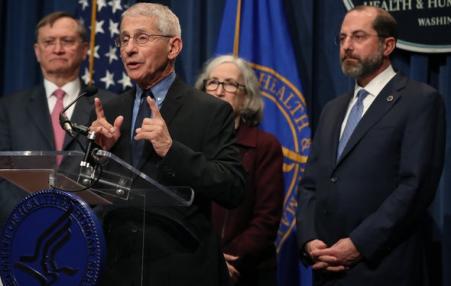
Anthony Fauci, Director of the National Institute of Allergy and Infectious Diseases, Mark Wilson Getty Images

In 1918, World War I was raging, and the Spanish flu arrived on American shores. But the Sedition Act banned communications that might undermine the war effort, including information that might slow down the movement of people or goods.

In that political climate, “public health officials, determined to keep morale up, began to lie,” wrote John Barry in Smithsonian magazine. “Each day the disease accelerated. Each day newspapers assured readers that influenza posed no danger.” Congress repealed the Sedition Act in 1920, but the damage was done. Hundreds of thousands of people in the United States would eventually die from the disease.

Over the next century, we developed complex disease monitoring systems. We created best practices for communicating disease risk. And we invested in the independence of government agencies, empowering government experts to openly share information about public health dangers.

The Centers for Disease Control and Prevention are now well practiced at risk communication. A 65-page manual details how the agency should communicate during a health crisis like the one we currently face. That’s why it’s so troubling that the White House has taken over communication around the coronavirus COVID-19.

While this move would be worrisome under any president, this administration creates unique challenges. Under this president, global disease surveillance systems were weakened, research programs were abandoned, and senior global health experts left the government. The president’s budget requests routinely seek extreme cuts at federal health agencies, including CDC. In the midst of this leadership vacuum, the president will say whatever he wants about virtually any topic without evidence, sometimes even contradicting the experts standing at his side.

There are echoes of 1918. The Washington Post reported that a government employee faced retaliation for raising concerns about unsafe assessment of potentially-infected individuals. The New York Times reported that public communications about the virus from CDC scientists will need “clearance.”

Senior NIH official and physician-scientist Anthony Fauci had to cancel several television appearances after the vice president took over the response effort. Fauci has said that he was not gagged, and we should take him at his word. But let me be clear: under no circumstances should the distribution of public health information be subject to White House or any other political clearance.

Open communication is not just good practice; it’s also policy. CDC’s (now archived) media policy puts the agency’s scientific staff in control of clearance of information. The CDC’s scientific integrity policy promotes sharing scientific information “in an open, timely, and appropriate way.”The coronavirus is moving rapidly across the globe. Our response must be focused and clear, prioritizing public health rather than fluctuations in financial markets or political advantage. We should hear directly from the experts, not just from political appointees with a political axe to grind.

Sadly, high-ranking officials continue to confuse the public. On February 28, White House Chief of Staff Mick Mulvaney suggested the media has an agenda. “The reason you’re seeing so much attention to it today is that they think this is what’s going to bring down the president,” he told a conference audience. “That’s what this is all about.” If millions of Americans are misled about the seriousness of this threat, we’re in real trouble. 


The Reality Check: THE SLOW TRAIN WRECK OF CALIFORNIA'S ONLINE COMMUN...

The Reality Check: THE SLOW TRAIN WRECK OF CALIFORNIA'S ONLINE COMMUN...: THE SLOW TRAIN WRECK OF CALIFORNIA'S ONLINE COMMUNITY COLLEGE By David Bacon CFT United, 2/17/20 https://www.cft.org/article/has-calbrig...

Thursday, February 27, 2020

How Bloomberg Trashed Public Education in New York


How Bloomberg Trashed Public Education in New York


Jake Jacobs
February 24, 2020
The Progressive

I’m an art teacher. Mike’s policies gutted my school. During those years, I was lucky to have enough copy paper for my students to draw on. Bloomberg’s harmful education policies are today being papered over as his money cascades through the media.


Former Mayor Michael Bloomberg at a campaign event in Phoenix, Arizona., Photo by Gage Skidmore, courtesy of Flickr // The Progressive


Mike Bloomberg, the former mayor of New York City now running for President, often brags about being one of the most prolific charter school creators in the United States. Bloomberg says he “absolutely” intends to expand charters in his federal education plan. This is a serious threat to public education, especially given Bloomberg’s history of using his fortune to shape policy.

Since 2013, Bloomberg has been one of the nation’s biggest donors to candidates and ballot initiatives promoting charters and vouchers, giving more than $4 million to candidates in New Jersey, Colorado, Minnesota, and Louisiana, often through “dark money” PACs. In California, Bloomberg spent a whopping $39 million, backing both Democrats and Republicans who support charters. In Pennsylvania, he gave $6 million to pro-charter incumbent Republican Sen. Pat Toomey, who won re-election with a narrow 1.5 percent edge, and ended up casting a critical vote for Supreme Court nominee Brett Kavanaugh.

New York City teachers are vocal critics of Bloomberg, who not only used public money for school privatization but usurped the power of elected community school boards as the state granted Bloomberg “mayoral control” of New York City schools in 2002.

Bloomberg proceeded to appoint corporate attorney Joel Klein as head of New York City’s education department. Klein began a "test-and-punish" regime, which led to the closure of 150 schools and earned him an 80 percent disapproval rating with teachers


Saturday, February 22, 2020

SCUSD Not Insolvent- It Just Can't Count


Sacramento City Unified says  due to its own financial crisis it will need to lay off about 50 certificated employees ( teachers, counselors, etc). for 2020/2021.  The district predicts a shortfall of  $ 28 million dollars for next year.   This is their fiscal recovery plan. 
Recall that the district predicted a similar emergency short fall for 2019/2020.  It never happened.  At the end of the year, the district had a deficit of some $100,000.  And, a budget surplus of $ 31,000,000.

The district projects that it will have a deficit of some 28,707, 835 for 20/21.  The projection of the Community Priorities Coalition is that the district will have a deficit of some $ 7,221,409.  A deficit of this size can be easily dealt with while the district has a budget surplus of $31 million.  

It is clear that the district can not count. Their  failure has been well documented in the FCMAT report(Fiscal Crisis Management and Assistance Team) in 2018.   It is the job of the Board to require clear and open accounting. Instead of balancing the budget, they implement a public relations strategy.  They have failed. And, today, they continue to fail. 

In addition to the continuing claims and campaigns of insolvency of the district by the Board,  the local LULAC ( League of United Latin American Citizens) has notified the Board and the Superintendent in 2017, 2018, and 2019, that we are concerned about the misuse of funds provided to the district for assistance for English Language Learners.  The district receives some $ 6 million per year from the Local Control Funding Formula (LCFF) directed to improve the educational opportunities of English learners. The district budget is difficult to read. However as best we can read it, the district spends some $1.6 million per year for instruction of English learners.

We have been unable to trace where the remaining money goes.  However, in other districts with this similar pattern, the money is not spent it the year allocated on English learners.  Then, it is transferred to the general fund in the following year for any use that the district chooses. https://edsource.org/2020/new-efforts-to-make-school-spending-in-california-more-transparent/621871
Until demonstrated otherwise, we must assume that Sacramento City Unified is making similar transfers since they decline, or are unable to describe where the English learners money goes. Such funding transfers would become illegal under new pending legislation AB 1835 and AB 1834 by Assemblywoman Shirley Weber. 

Though Feb. 2020, the board of SCUSD has consistently failed or refused to respond to our proposed  changes in the budget of SCUSD in the LCAP plan to expand services for English learners.   Our proposal continues to be that the district use the funds received from LCFF for improved services to English learners be used  for improving the services to English learners. 

Dr. Duane E. Campbell
Education and Democracy Institute.
Education Committee , Sacramento LULAC.#2862.


Wednesday, February 19, 2020

Bloomberg's Education Reforms Would be a Disaster for Public Schoos


Mike Bloomberg's Education 'Reforms' Would be a Disaster for Public Schools

Dr Heather Gautney and Eric Blanc
February 17, 2020  The Guardian

Like Trump, Bloomberg is a fervent backer of privatizing and dismantling public schools across the country


Democratic presidential candidate Michael Bloomberg attends a campaign event at Buffalo Soldiers national museum in Houston, Texas, on 13 February., Photograph: Go Nakamura/Reuters

Nominating Michael Bloomberg would be a disaster for public schools – and for the Democrats’ chances at beating Donald Trump in 2020. Because when it comes to education policy, it is virtually impossible to tell the two billionaire politicians apart.

Like Trump and his inept secretary of education, Betsy Devos, Bloomberg is a fervent backer of privatizing and dismantling public schools across the country. Education, in their view, should be run like a business.

While other establishment Democrats have begun changing their tune in response to the “Red for Ed” movement, Bloomberg’s campaign spokesman has made it clear that privatization will be a core message of his 2020 presidential run: “Mike has always supported charter schools, he opened a record number of charter schools as mayor of New York City, and he will champion the issue as president.”

Indeed, Bloomberg succeeded in massively expanding privately run but publicly funded charter schools during his term as mayor, increasing their number from 18 to 183. His controversial push to “increase school choice” closed over 100 schools in low-income communities and entrenched New York City’s education system as the most racially segregated in the country.

In contrast with Bloomberg’s too-little-too-late apology for imposing racist stop-and-frisk policies upon New York City – and its overwhelmingly non-white student body – the former mayor has doubled down on his rightwing education approach in recent years.

If anything, the main difference between Bloomberg and Trump is that the former has spent far more of his immense personal fortune to boost corporate “education reform” and local candidates driving this agenda. The New York Times reported last week that Bloomberg has spent millions to promote charters in the state of Louisiana alone. And this is just the tip of the iceberg: Bloomberg’s foundation in 2018 announced its plan to spend $375m to promote charters, merit pay and the sacking of “failing” teachers, among other reforms.

Monday, February 17, 2020

Who Controls Our Schools? How Billionaire-Sponsored Privatization Is Destroying Democracy and Enriching the Charter School Industry

YDS Organizes for Green New Deal

Emma Edmund, City Editor
CHICAGO — Organizers from across the country came together to strategize and discuss advocating for and implementing a Green New Deal during the Young Democratic Socialists of America 2020 Winter Conference. 
The conference, which spanned the entire weekend, drew students from around the country and featured workshops to help attendees build skills in areas such as grassroots fundraising and creating a multiracial working class movement. 
On Saturday morning, attendees gathered for a panel about the Green New Deal with prominent members from Democratic Socialists of America, YDSA and Warehouse Workers for Justice, an organization that fights for labor rights in warehouse in distribution centers. 
The Green New Deal is an ambitious congressional resolution aimed at reducing the negative consequences of climate change. Among other objectives, the plan calls for the United States to source 100 percent of its power demand from renewable sources, and for the government to provide job training to communities who currently rely on jobs in the fossil fuel industry. 

Trump's Greatest Vulnerability is the Economy- Just Ask the Poor

RS Seminar- Economic Crisis: Trump's Greatest Vulnerability is the Economy- Jus...: Rev. William Barber Yes, the Dow is at a record high and unemployment rates are lower than they have been in decades – but 140 million pe...

Tuesday, February 11, 2020

Bloomberg + Stop and Frisk

Let me plant the stake now: No black person — or Hispanic person or ally of people of color — should ever even consider voting for Michael Bloomberg in the primary. His expansion of the notoriously racist stop-and-frisk program in New York, which swept up millions of innocent New Yorkers, primarily young black and Hispanic men, is a complete and nonnegotiable deal killer.
Stop-and-frisk, pushed as a way to get guns and other contraband off the streets, became nothing short of a massive, enduring, city-sanctioned system of racial terror…
In 2002, the first year Bloomberg was mayor, 97,296 of these stops were recorded. They surged during Bloomberg’s tenure to a peak of 685,724 stops in 2011, near the end of his third term. Nearly 90 percent of the people who were stopped and frisked were innocent of any wrongdoing.
A New York Times analysis of stops on “eight odd blocks” in the overwhelmingly black neighborhood of Brownsville in Brooklyn found close to 52,000 stops over four years, which averaged out to “nearly one stop a year for every one of the 14,000 residents of these blocks.”
In 2009, there were more than 580,000 stop-and-frisks, a record at the time. Of those stopped, 55 percent were black, 32 percent Hispanic and only 10 percent white. Most were young, and almost all were male. Eighty-eight percent were innocent. For reference, according to the Census Bureau, there were about 300,000 black men between the ages of 13 and 34 living in the city that year.
Not only that, but those who were stopped had their names entered into a comprehensive police database, even if they were never accused of committing a crime. As Donna Lieberman, then the executive director of the New York Civil Liberties Union, said in 2010, the database became a place “where millions of completely innocent, predominantly black and Latinos have been turned into permanent police suspects.”
The state outlawed the keeping of these electronic records on the innocent, over the strong objections of Bloomberg and his police chief…
Bloomberg’s crime argument was dubious. The Columbia Law School professor Jeffrey Fagan produced a report that became part of a class-action lawsuit against the city in 2010. It found that: “[s]eizures of weapons or contraband are extremely rare. Overall, guns are seized in less than 1 percent of all stops: 0.15 percent … Contraband, which may include weapons but also includes drugs or stolen property, is seized in 1.75 percent of all stops.”

Monday, February 03, 2020

CA's Fair Funding Formula Makes More Possible for Schools


Note; LCFF is not currently serving Sacramento City Unified students well.


Here is the LULAC (Sacramento)  demand.


Legal Services Department,
Sacramento City Unified School District                        Jan. 29, 2020

We are submitting this request pursuant to the California Public Records Act (Govt. Code
§§ 6250 et seq.) for copies of certain records in the possession, custody, or control of SCUSD. Our request encompasses the documents falling within the specific categories set forth below.

Specifically, we request copies of the following documents:


1.     Documents showing the actual amount of funds received by SCUSD from LCFF funds, including supplemental and concentration funds designated for support of English Learners for 2016, 2017, 2018. Please disaggregate the indicated funding between LCFF support for base activities and LCFF funding for supplemental and concentration efforts.

2.    A list of the SCUSD budget categories (i.e. teacher salaries, teacher assistants, consultants, teaching materials and other services) that reveal the amount of dollars from the LCFF funds, including supplemental and concentration funds allocated and spent for services to English Language learners in the district. Include a document showing how the district decides on expenditures from supplemental and concentration funds. How does the district distribute the funds between designated target groups (i.e. English learners, Foster Children, Special education, low income students)?

3.    A listing of budget allocations and expenditures for each of the categories listed above (teachers, teacher assistants, administrators. consultants, as well as copies of the pages of documents where these allocations and expenditures are described.

More information to follow. 

Thursday, January 30, 2020

Latino Voter Outreach in Iowa

antiracismdsa: Latino Voter Outreach in Iowa: Nation’s Oldest & Largest Latino Civil Rights Organization to Discuss Successful Voter Outreach Campaign; 70% of Adult Lati...

Wednesday, January 29, 2020

Diane Ravitch on Disruption’s Educational Carnage


No Child Left Behind was a disaster and school choice has failed. A new book points the way forward from the wreckage.
 January 29, 2020
By

Photo: Jack Miller

It’s been 10 years since education historian and former U.S. Assistant Secretary of Education Diane Ravitch became the school choice movement’s most vocal apostate by detailing its fallacies in her book The Death and Life of the Great American School System.
Her tale of how a onetime charter school true believer from within the corporate-reform think-tank establishment could no longer ignore the contrary evidence of her own eyes came as a wake-up call. It gave authoritative voice to the anger and frustration of the over 3 million public school classroom teachers whose hands had been tied by the country’s destructive disinvestment in its children. And it contained Ravitch’s own vow to devote the rest of her life to trying to make up for her error.
That mea culpa thrust the New York University research professor into the center of the national public education debate and elevated her to a role as a revered leader of the groundswell of political resistance that followed. With 2013’s Reign of Error: The Hoax of the Privatization Movement and the Danger to America’s Public Schools, she further documented the failure of charters and the carnage wreaked by high-stakes testing, while inventorying evidence-supported and cost-effective reforms that had been sidetracked by the school-privatization movement.
Now, Ravitch completes the arc with Slaying Goliath: The Passionate Resistance to Privatization and the Fight to Save America’s Public Schools, which was published last week.
The completed trilogy bears all the Ravitch signatures: her mastery of the rapier epithet and incisive metaphor; her lucid and authoritative marshaling of the evidence; and, most of all, the page-turning, first-person power of her own dramatic conversion that formed the heart of Death and Life.
Slaying Goliath charges that, after 20 years of having wholly hijacked education reform with destructive high-stakes testing and standardized test scores, and by demonizing teachers, the school choice movement — whose members Ravitch pejoratively redubs “the Disrupters” — has not only failed at reform, it has awakened a sleeping giant. Ravitch identifies and deconstructs the aims and the rhetoric of the Disrupters, along with their manifold scandal-tainted failures. But Slaying Goliath is primarily the story of the anti-privatization resistance and its culmination in the 2018-19 Red for Ed teachers’ strikes, and in this year’s 12-person field of 2020 Democratic presidential primary candidates, of whom only one (neoliberal billionaire Michael Bloomberg) is running as a charter school booster.
Capital & Main spoke to Ravitch by phone as she prepared for a cross-country book promotion tour that will bring her to California with a stop in Menlo Park on February 6 and in Los Angeles February 9.


Capital & Main: Why Slaying Goliath, why now?
Diane Ravitch: I started writing the book in February of 2018, inspired by the West Virginia teachers’ strike. West Virginia changed the national narrative, which was a huge accomplishment, because we’ve had at least 20 years of teacher-bashing, and public school bashing and appeals funded by billionaires for privatization, making outlandish promises about how if the schools were in private hands, they would accomplish X, Y and Z. And it took time to figure out that they hadn’t fulfilled any of their promises.
No Child Left Behind has required that we would have 100 percent [grade level] proficiency [in reading and math], and nobody made that goal. The things funded by Bill Gates and Eli Broad and all the other [billionaire charter promoters] had made outlandish claims about closing the achievement gap. And as I point out in the book, it’s literally impossible to close the achievement gap because if you’re using the standardized test as your measure, the gap is structured into it. So that’s really the focus, which is to say this behemoth, this Goliath, has not succeeded. And I boldly predict that the resistance will ultimately prevail because the billionaires have nothing to offer but disruption, and disruption is very bad for children.

Sunday, January 26, 2020

Not Me; Us - the Sanders Campaign

 Not Me; Us - the Sanders Campaign: Naomi Klein, IT MADE FOR  a tough juxtaposition. Late Monday night, CBS News  reported  that Bernie Sanders had just done exactly wha...

Friday, January 24, 2020

Update: Ethnic Studies Model Curriculum

REL#20-06
CONTACT: Kindra Britt
FOR IMMEDIATE RELEASE
PHONE: 916-319-0818
January 24, 2020

Ethnic Studies Model Curriculum Update

The Instructional Quality Commission (IQC) was charged with developing an Ethnic Studies Model Curriculum that shall be a guide to allow school districts to adapt their courses to better reflect the pupil demographics in their communities. Last week at the IQC meeting, California Department of Education (CDE) staff presented a brief update on the status of the Ethnic Studies Model Curriculum. CDE recommended that revisions to the draft follow the State Board of Education guidelines and follow Assembly Bill 2016, the legislation that directed the state to create a model curriculum. This will ensure that the curriculum is written to encourage cultural understanding of how different groups have struggled and worked together, as well as highlight core ethnic studies concepts such as equality, justice, race, ethnicity, and indigeneity. CDE also recommended that it be written in language that is inclusive and supportive of multiple users.
Since the last IQC meeting in November, much work and outreach has been done by CDE after receiving thousands of public comments about the draft released in summer 2019. In October, State Superintendent of Public Instruction Tony Thurmond hosted a panel discussion that included subject matter experts as well as legislators. The panel provided different perspectives on ethnic studies implementation at the K–12 level. CDE staff have also used this time to review, analyze, and synthesize the more than 20,000 public comments to make recommendations to the IQC in spring 2020. WestEd is currently conducting focus groups for CDE that are comprised of teachers with ethnic studies experience as well as teachers who have not taught ethnic studies but may in the future. CDE is also working with districts that have implemented ethnic studies to utilize their learnings in our recommendations.
Keeping in mind that ethnic studies has traditionally been a higher education course, the model curriculum that the IQC is charged with developing will serve as a guidance document to schools that choose to implement ethnic studies in the K–12 system. Over the course of history, both in our state and nationally, specific ethnic groups have had unjust treatment even from respected institutions of authority. The curriculum taught in our schools has not done enough to highlight and preserve the contributions of people of color and has actually minimized the importance of their role. A movement to create a better model of inclusion to be taught in our K–12 system was established in the hopes of teaching a history that is more representative of what actually occurred. Ethnic studies as a whole should represent a broad range of topics, but it must devote a special emphasis to people of color, including their experiences and their important role in our state and national history. 
Therefore, our recommendations will acknowledge and honor the four foundational groups: African American, Asian American, Chicana/o/x and Latina/o/x, and Native American. By providing guidance to teachers on how to make connections to student population demographics utilizing various resources, including the History and Social Science Framework, we must also honor the human experience and the intersectionality of all students that we serve.
We are proud of the efforts that have been made since our last update, and we look forward to providing our recommended revisions to the IQC in spring 2020. As of now, the legislation allows that a final draft will go to the State Board of Education for adoption in March 2021.
#####
The California Department of Education is a state agency led by State Superintendent of Public Instruction Tony Thurmond. For more information, please visit the California Department of Education’s website. You may also follow Superintendent Thurmond on TwitterFacebook, and YouTube
PASSWORD:CDEducation1430

Thursday, January 23, 2020

Not Me; Us - the Sanders Campaign

SACRAMENTO PROGRESSIVE ALLIANCE: Not Me; Us - the Sanders Campaign: Naomi Klein, IT MADE FOR  a tough juxtaposition. Late Monday night, CBS News  reported  that Bernie Sanders had just done exactly wha...

Sunday, January 19, 2020

March With Poor People's Campaign


MARCH WITH THE POOR PEOPLE’S CAMPAIGN
AT THE MARTIN LUTHER KING DAY MARCH
IN SACRAMENTO 

Join Us!

Monday January 20, 2020 
7:30 AM Leaving 
Oak Park Community Center
Martin Luther King Blvd And Eighth Ave
At 8:00 AM

Bring Your Banners
Bring Your Flyers
Build Your Organization

March Against Poverty, Environmental Devastation, War
and Institutional Racism and Reawaken Dr. Martin Luther King’s Poor People’s Campaign

The March will start at the Oak Park Community Center and Join Other Marchers at the Sacramento City College at 9:15 AM
Program and Tabling at Sac City College

Wednesday, January 15, 2020

Help Qualify Schools Initiative

Collect Signatures Now.  mlares1972@gmail.com

Monday, January 13, 2020

How to Win the Latino Vote- and the Election


THE DEMOCRATIC CANDIDATES NEED TO STOP MAKING EXCUSES AND AVOID OBAMA’S MISTAKES. THE HISPANIC POPULATION IS MUCH MORE THAN AN ELECTORAL FAD.  Jorge Ramos

MIAMI : I am dreading the 2020 presidential race, which I think will be the most brutal Americans have ever witnessed. Irrespective of who the Democratic nominee is, President Trump will use all the power and dirty tricks at his disposal to remain in power for another four years.
As was the case in 2016, if Democrats want to have any chance of defeating Mr. Trump they will need the strong support of Latino voters. This time, however, they will have to work extra hard to get it.
The truth is that no candidate will be able to win the White House without Latino votes. Not even Mr. Trump, who got 29 percent of the Hispanic vote in 2016. A higher Latino turnout in states like Florida and Arizona could have produced a completely different outcome that year. Mr. Trump would never have won the presidency without Florida’s 29 electoral votes and Arizona’s 11.
The number of eligible voters of Hispanic background who did not cast a ballot in 2016 was heartbreakingly high. Over half of the 27 million eligible Hispanic voters stayed home. Why? Although many of them didn’t want to vote for Mr. Trump, in part because he had made racist remarks about Mexican immigrants, they weren’t at all enthusiastic about Hillary Clinton.
This year, for the first time in history, Hispanics will be the largest minority group of potential voters in the United States. According to the Pew Research Center, 32 million Latinos will be eligible to vote in 2020, compared with 30 million African-Americans.
If Hispanics shake off their apathy and turn out in record-high numbers in crucial states, a Democrat may well defeat President Trump. But for this to happen, the Democrats must be honest with the Latino community: They must vow not to fall into the same traps they have in the past.

Saturday, January 11, 2020

War is a Racket !

The last week has been a roller coaster.
Many of us have breathed a slight sigh of relief as things deescalate a bit around Iran. But this doesn’t mean it’s over. Far from it. The need for a broad based, working-class anti-war movement, led by the communities most affected, has become yet more clear. The bipartisan drumbeat for war in Washington and in the capitalist media, the surveillance rhetoric coming from Democratic mayors, and the way Republicans labeled any debate as traitorous, were immediate and could be revived at any time. And the silent war against civilians, of sanctions, will continue and will disproportionately hurt the poor. We have seen that civilians always suffer in the war zone.
Besides the catastrophic results of even a proxy war in the Middle East for Iranians, Iraqis and others in the region, including undocumented, displaced Afghans in Iran, the domestic impact here can’t be overstated. Medicare for All would be off the table. Abolishing student debt would be off the table. Disaster response for Puerto Rico, rocked by their worst earthquakes in a century, would be off the table. A Green New Deal, our only hope for stopping the kind of climate change induced extreme weather that has led to massive fires in Australia and massive floods in Indonesia (mirroring our own fires and floods in 2019), would be off the table. A federal housing guarantee, which would directly benefit the tens of thousands of homeless veterans that the U.S. capitalist class has discarded after using their bodies for war, would be off the table.
Investment in public programs that benefit us all would be cut so that poor and working class people could be sent abroad to kill other poor and working class people.
And, those that would see us divided would continue to drive deeper wedges. Here in New York, there has been a string of violent antisemitic attacks. Many of us responded with solidarity. But the media and the politicians are using the opportunity to call for repeal of a hard-fought bail reform law which took effect January 1st. Internet trolls pit black people and Jews against each other, a project which would only be strengthened by war, along with Islamophobia and xenophobia.
Yet, as always, I have hope.
Prior to Trump’s assassination play, Iran was rocked by working class protests against the rising cost of fuel. 
India’s Hindu nationalist prime minister Narendra Modi faces widespread protests over draconian measures targeting India’s Muslim minority, the latest a mass strike of 250 million people just yesterday.
And here in the U.S., DSA and our allies in struggle are in the streets and building our power.

Wednesday, January 08, 2020

Public Advocates Endorses Schools & Communities First Initiative


PUBLIC ADVOCATES ENDORSES THE SCHOOLS & COMMUNITIES FIRST BALLOT INITIATIVE

Today, Public Advocates Inc. announces its endorsement of the Schools & Communities First ballot initiative and pledges to support the effort to place it before California’s voters on the November 2020 ballot and secure its passage. Below is a statement from our President and CEO Guillermo Mayer:

For nearly 50 years, Public Advocates has joined parents, students, teachers and community partners throughout California in working to create a public school system that serves all students. For far too long, our public schools have been woefully underfunded, leaving students of color and low-income students behind. Since the 1970s, as our public schools increasingly served more diverse students, our investment as a state in public education has plummeted, leaving us bouncing around the bottom third to, at times, near last place nationally for school funding and near dead last in school student-to-staff ratios. This year voters have an opportunity to right this wrong and turn the page on the racist underfunding of our public schools by supporting Schools & Communities First. 

Schools & Communities First is an important step towards California reclaiming its place as the Golden State when it comes to investing in young people. The initiative will close loopholes in the state’s tax system by requiring large corporations to pay their fair share of property taxes, while protecting homeowners and small businesses. This initiative would significantly boost equitable school funding through the Local Control Funding Formula (LCFF) while supporting local governments to expand services to the same communities where schools with high-need students – English language learners, low-income, foster youth—are located. While LCFF was a significant community victory by providing the framework for more just school funding, equity for our kids and communities cannot be realized without adequate school funding. Most importantly, this measure comes authentically from, and has the growing support of the communities most impacted by our multi-decade disinvestment in public education and local government. We wholeheartedly support this grassroots movement to build racial and economic justice in California schools and communities. 

Supporting Schools & Communities First is consistent with Public Advocates’ nearly five decades of leadership in advocacy on school funding equity in California, from our role as a lead counsel in Serrano v. Priest (equalizing school funding statewide), Williams v. CA (requiring equal access to basic educational necessities), and the Campaign for Quality Education v. CA (seeking adequate school funding statewide) as well as our central role in helping to shape and implement the Local Control Funding Formula.

The Schools & Communities First initiative is a smart and just way to begin to address the adverse effects of our inequitable tax system under Prop 13. We are honored to join in this movement, which will take us that much closer to the day when all schools will be beacons of hope and places of infinite possibility and opportunity for every public school student in California.

Monday, January 06, 2020

CURMUDGUCATION: Michelle Rhee Has Been Robbed

CURMUDGUCATION: Michelle Rhee Has Been Robbed: As the various lists of faces, names, moments that defined the education policy debates of the last decade have been tallied up, one name ha...

Friday, January 03, 2020

Trump, Troll-in-Chief, Wags the Impeachment Dog By Going to War With Iran

Trump, Troll-in-Chief, Wags the Impeachment Dog By Going to War With Iran

Best Year Ever- Can You Believe It ?

Best Year Ever.  Can you believe it?
https://www.nytimes.com/2019/12/28/opinion/sunday/2019-best-year-poverty.html?

Nicholas Kristof

SCUSD and Black Parallel School Board Seek Settlement

Sacramento City Unified School District and Advocacy Groups Pursue Settlement of Lawsuit Alleging Disability and Race Discrimination


SACRAMENTO, CA - The Sacramento City Unified School District (District) and plaintiffs suing the District for alleged discrimination against students based on race and disability asked the federal court to pause litigation so the parties may seek potential resolution through settlement.   

The lawsuit, alleged as a class-action, was filed by a coalition of nonprofit advocacy groups on behalf of the Black Parallel School Board (BPSB) and three students in the District. The suit alleges that the District’s policies and practices in the areas of special education and student discipline harm students with disabilities, and in particular, Black students with disabilities. 

While the District does not agree with the allegations in the lawsuit, “we appreciate plaintiffs’ willingness to work with us,” said District Superintendent Jorge A. Aguilar. “The District believes that we should work cooperatively with the plaintiffs to identify potential policies and practices that may not serve the best interests of the District’s students with disabilities, and to jointly find solutions to those issues, which would include addressing factors which limit service options or strategies for serving District students,” said Superintendent Aguilar. 

The parties have asked the Court to grant a seven-month stay of the litigation. During the stay, and by early February, the District has offered and agreed to implement several measures intended to benefit students with disabilities, including Black students with disabilities. These measures include:
  • Halting all District suspensions based on “willful defiance” not only for students in kindergarten through third grade, but up and through eighth grade;
  • Offering students a special education assessment plan within 15 days of a request for such assessment; and
  • Directing school administrators and staff not to ask or require students to leave school as an informal response to concerns with student behavior.
  •  
“These measures are significant to students with disabilities and their parents and guardians whom we and other advocates in our community fight for and support,” said BPSB Chairperson Darryl White. “The District’s willingness to implement these interim measures has encouraged BPSB to engage in cooperative discussions with the District about potential broader and more permanent reforms and protections for our students.” 

Also, during the stay, an agreed-upon set of experts will review the District’s data and practices in the areas of special education, student discipline, and implicit bias.  That review will include expert interviews of students, parents, District staff, and other stakeholders. After the assessment and study of the information gathered, the experts will issue recommendations that the parties will consider as part of a possible settlement to create positive, lasting change for students and their families. 
The Court granted the requested stay of litigation today, December 20, 2019. 


Creative Commons License
This work is licensed under a Creative Commons Attribution-NonCommercial 3.0 Unported License.