Showing posts with label Lula. Show all posts

Monday, January 09, 2023

The Crisis in Brazil


Omar Ocampo 
January 9, 2023
Inequality.org
Having fought for labor rights under a dictatorship, the Brazilian president once again faces a violent far-right movement bent on blocking his pro-worker, pro-democracy agenda.


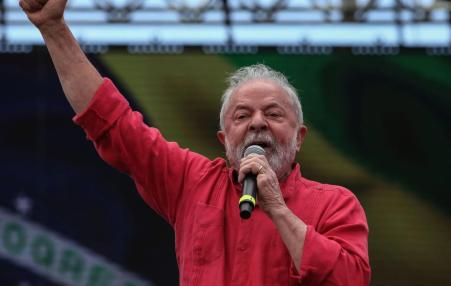
Far-right election deniers cut short the celebration of Brazilian President Luiz Inácio Lula da Silva’s remarkable political comeback with violent attacks in the country’s capital yesterday. Echoing the assault on the U.S. Capitol two years ago, supporters of defeated ex-President Jair Bolsonaro stormed the Brazilian Congress, Supreme Court, and presidential palace.

While security forces have now regained control, Brazil’s insurrectionists rattled the foundation of the world’s fifth-largest democracy. Coming just a week after Lula’s inauguration, these attacks make chillingly clear the enormous hurdles he’ll need to overcome to achieve the pro-democracy, pro-worker agenda he’s been pursuing for nearly half a century.

A former metalworker, Lula rose up the ranks of the labor movement and helped launch the Workers’ Party in 1980 as an opposition force against the country’s military dictatorship. During his first two terms as Brazil’s president, which ran from 2003 to 2010, he had enormous success in reducing the economic gaps that had widened under military rule. In this, his third term, Lula intends once again to prioritize the poor and the working-class.

Just hours after his inauguration on January 1, he signed a provisional measure expanding the flagship anti-poverty program he introduced in his previous stint in office. Between 2003 and 2011, the Bolsa Família – roughly translated as the Family Grant – distributed monthly benefits that lifted 25 million people out of poverty. This program, combined with a minimum wage increase, expanded public investment in health care and education and other progressive reforms, reduced the country’s income inequality for the first time in four decades.

Bolsonaro replaced the Bolsa Família a little over a year ago with a much less effective program – called Auxílio Brasil (Brazil Aid) – that was purely a Trojan horse intended to reduce social spending by eliminating access to other welfare programs. Thanks to Lula’s immediate action, the government will deliver 600 Brazilian reais a month – approximately $112 US dollars – to 21 million families.

In another immediate action, Lula reversed Bolsonaro’s plans to sell off eight state-run institutions, including the Petrobras oil company and the public postal service. In scrapping his predecessor’s privatization plans, he aims to ensure these entities serve the public good rather than lining the pockets of corporate executives.

LEARN MORE
Colombia's wealth tax

Lula has not yet submitted legislative proposals to Congress, but the Workers’ Party published a 90-point manifesto this past summer that gives us a glimpse of their other core priorities. Near the top is a commitment to revoking a federal spending cap to allow increased investments in fighting poverty and strengthening infrastructure. Lula has also vowed to strengthen trade unions and repeal a 2017 labor reform that exacerbated the growth in precarious work while failing to boost job creation.

Lula has also appointed a special secretary for tax reform to develop a proposal for a more efficient and equitable tax code. Brazil’s current system is notoriously complex and regressive as it places a heavier tax burden on the middle-class than those who sit at the top of the income distribution. Hopefully, Brazil will follow Colombia’s recent move and adopt a wealth tax as a central pillar of a more equitable tax code. An upcoming report co-authored by the Institute for Policy Studies estimates that a progressive tax on the assets of the richest 0.03 percent of Brazilians would generate $26.8 billion USD in 2023.

Before the attacks of January 8, the headlines about Lula’s challenges were focused on financial market jitters and worn-out conservative critiques related to his public expenditure plans. The Financial Times editorial board, for example, urged him to pursue “better, not bigger” government if he wants a strong and stable economy. Similar “fiscal responsibility” arguments thrown at Lula in his previous terms proved spectacularly wrong. But such arguments are usually driven less by sound economic analysis than by the interests of the rich and powerful.

With the headlines now fixated on the insurrectionist mob, Bolsonaro is reportedly in Florida. No doubt he was glued to the TV yesterday, watching the violence he had sparked by relentlessly questioning his country’s electoral process — just as Trump did two years ago.

What will happen now to Lula’s presidential dreams? At 77 years old, he is a man who lived through Brazil’s 1964-1985 military dictatorship and was even jailed in the 1970s for leading labor strikes. And so Lula knows better than most how to fight for the interconnected goals of democracy and economic justice.

“Join us in a great collective effort against inequality,” he told the massive crowd on inauguration day, before asking everyone to help ensure that “the hope of today ferments the bread that is to be shared among all, and that we are always ready to react in peace and order to any attacks from extremists who want to sabotage and destroy our democracy.”

Little did Lula know how soon those attacks would come.

Omar Ocampo is a researcher for the Program on Inequality and the Common Good at the Institute for Policy Studies.

Inequality.org is your portal into the world of inequality  — and ongoing efforts to leave our planet a more equal place

Sunday, March 15, 2009

Lula: The Future of Human Beings is What Matters


Lula: The Future of Human Beings is What Matters

By Luiz Inacio Lula da Silva
President of Brazil.

Financial Times
March 9, 2009

http://www.ft.com/cms/s/0/4623a78e-0ce2-11de-a555-0000779fd2ac.html

For me, capitalism has never been an abstract concept.
It is a real, concrete part of everyday life. When I
was a boy, my family left the rural misery of Brazil's
north-east and set off for Sao Paulo. My mother, an
extraordinary woman of great courage, uprooted herself
and her children and moved to the industrial centre of
Brazil in search of a better life. My childhood was no
different from that of many boys from poor families:
informal jobs; very little formal education. My only
diploma was as a machine lathe operator, from a course
at the National Service for Industry.

I began to experience the reality of factory life,
which awoke in me my vocation as a union leader. I
became a member of the Metalworkers'

Union of Sao Bernardo, in the outskirts of Sao Paulo. I
became the union's president and, as such, led the
strikes of 1978-1980 that changed the face of the
Brazilian labour movement and played a big role in
returning democracy to the country, then under military
dictatorship.

The impact of the union movement on Brazilian society
led us to create the Workers' party, which brought
together urban and rural workers, intellectuals and
militants from civil society. Brazilian capitalism, at
that time, was not only a matter of low salaries,
insalubrious working conditions and repression of the
union movement. It was also expressed in economic
policy and in the whole set of the government's public
policies, as well as in the restrictions it placed on
civil liberties. Together with millions of other
workers, I discovered it was not enough merely to
demand better salaries and working conditions. It was
fundamental that we should fight for citizenship and
for a profound reorganisation of economic and social
life.

I fought and lost four elections before being elected
president of the republic in 2002. In opposition, I
came to know my country intimately. In discussions with
intellectuals I thrashed out the alternatives for our
society, living out on the periphery of the world a
drama of stagnation and profound social inequality. But
my greatest understanding of Brazil came from direct
contact with its people through the 'caravans of
citizenship' that took me across tens of thousands of
kilometres.

When I arrived in the presidency, I found myself faced
not only by serious structural problems but, above all,
by an inheritance of ingrained inequalities. Most of
our governors, even those that enacted reforms in the
past, had governed for the few. They concerned
themselves with a Brazil in which only a third of the
population mattered.

The situation I inherited was one not only of material
difficulties but also of deep-rooted prejudices that
threatened to paralyse our government and lead us into
stagnation. We could not grow, it was said, without
threatening economic stability - much less grow and
distribute wealth. We would have to choose between the
internal market and the external. Either we accepted
the unforgiving imperatives of the globalised economy
or we would be condemned to fatal isolation.

Over the past six years, we have destroyed those myths.
We have grown and enjoyed economic stability. Our
growth has been accompanied by the inclusion of tens
of millions of Brazilian people in the consumer market.
We have distributed wealth to more than 40m who lived
below the poverty line. We have ensured that the
national minimum wage has risen always above the rate
of inflation. We have democratised access to credit. We
have created more than 10m jobs. We have pushed forward
with land reform. The expansion of our domestic market
has not happened at the expense of exports - they have
tripled in six years. We have attracted enormous
volumes of foreign investment with no loss of
sovereignty.

All this has enabled us to accumulate $207bn in foreign
reserves and thereby protect ourselves from the worst
effects of a financial crisis that, born at the centre
of capitalism, threatens the entire structure of the
global economy.

Nobody dares to predict today what will be the future
of capitalism.

As the governor of a great economy described as
'emerging', what I can say is what sort of society I
hope will emerge from this crisis. It will reward
production and not speculation. The function of the
financial sector will be to stimulate productive
activity - and it will be the object of rigorous
controls, both national and international, by means of
serious and representative organisations. International
trade will be free of the protectionism that shows
dangerous signs of intensifying. The reformed
multilateral organisations will operate programmes to
support poor and emerging economies with the aim of
reducing the imbalances that scar the world today.
There will be a new and democratic system of global
governance. New energy policies, reform of systems of
production and of patterns of consumption will ensure
the survival of a planet threatened today by global
warming.

But, above all, I hope for a world free of the economic
dogmas that invaded the thinking of many and were
presented as absolute truths. Anti-cyclical policies
must not be adopted only when a crisis is under way.
Applied in advance - as they have been in Brazil - they
can be the guarantors of a more just and democratic
society.

As I said at the outset, I do not give much importance
to abstract concepts.

I am not worried about the name to be given to the
economic and social order that will come after the
crisis, so long as its central concern is with human
beings.

__________________
 
Creative Commons License
This work is licensed under a Creative Commons Attribution-NonCommercial 3.0 Unported License.