Showing posts with label Diane Ravitch. Show all posts

Wednesday, December 12, 2018

Diane Ravitch On Gavin Newsom's Three Educational Challenges

Diane Ravitch

As Gavin Newsom prepares to take office, education looms large on the list of California’s top priorities. The nation’s most populous state faces major questions on everything from the cost of higher education to growing demands for increased oversight of charter schools. Capital & Main asked education scholar Diane Ravitch what advice she would give Newsom. Here is her response.
--------------------------------------------------------------------
The incoming administration of Governor-elect Gavin Newsom will not be cleaning up a mess. Governor Jerry Brown has been a good steward of the state during his time in office.

But Newsom faces three distinct challenges in the field of education. Although Governor Brown significantly increased spending for education, California has large unmet needs and much catching-up to do to maintain its edge as an incubator of talent and innovation, and of equal opportunity for all.

First, the state must substantially increase funding for K-12 education, which would enable districts to pay teachers better salaries, reduce class sizes and assure that all children, regardless of where they live, have access to a well-equipped, well-staffed school. The latest federal data (2016) show that California spends somewhat less than the national average per pupil. California’s per-pupil spending is $11,420, compared to a national average of $11,841. California is one of the richest states in the nation but spends far less than states such as New York, New Jersey, Connecticut, Massachusetts, Maryland, Wyoming and North Dakota. California spends about the same on its students as states like Iowa, Kansas, Louisiana and South Carolina, where the cost of living is far less than in California.

Second, California must recommit to the long established tradition that tuition for higher education must be free to all residents of the state. This principle was reiterated in the state’s Master Plan in 1960, but ended by Governor Ronald Reagan. The low-cost availability of higher education and the large pool of educated talent it created were the principle drivers of the state’s economic development and success. The primary reason that students drop out of college is cost, not ability. The state should recommit to provide higher education to all who wish to pursue it, by removing cost as a barrier to their opportunity and ambition.

Third, California must regulate the charter school industry, whose lobbyists have defeated all efforts to hold charter schools accountable and transparent. Where public money goes, public accountability must follow.

Charter schools now enroll 10 percent of the children in the state, and their representatives should have no more than 10 percent of the seats on the state board. Charters should be made subject to open-meetings laws and laws prohibiting conflicts of interest and nepotism. The law governing charters should be revised so that they are authorized solely by the district in which they are physically located, with no appeals to the county or state board. If there is no need for them, they should not exist.

Before any charter is authorized, there must be a determination of its fiscal impact on the host district. The host district should supervise the charter to assure that it is operating in accordance with state laws and serving the needs of students in the district. Every charter should enroll at least the same proportion of students with disabilities and English language learners as the district in which it is located.

Charters should be as accountable for their enrollment, discipline policies, finances and academic performance as district public schools. Charters should complement, not compete with, district public schools. They are all working towards the same goals, which is the development of every child’s abilities, equal opportunity and preparation for citizenship.

Diane Ravitch

Copyright Capital & Main

CAPITAL & MAIN NEWSLETTER

Sunday, November 27, 2016

Trump and School Privatization

Diane Ravitch. NY Review of Books. Nov.27,2016.
In early September, Donald Trump declared his commitment to privatization of the nation’s public schools. He held a press conference at a low-performing charter school in Cleveland run by a for-profit entrepreneur. He announced that if elected president, he would turn $20 billion in existing federal education expenditures into a block grant to states, which they could use for vouchers for religious schools, charter schools, private schools, or public schools. These are funds that currently subsidize public schools that enroll large numbers of poor students. Like most Republicans, Trump believes that “school choice” and competition produce better education, even though there is no evidence for this belief. As president, Trump will encourage competition among public and private providers of education, which will reduce funding for public schools. No high-performing nation in the world has privatized its schools.
The motives for the privatization movement are various. Some privatizers have an ideological commitment to free-market capitalism; they decry public schools as “government schools,” hobbled by unions and bureaucracy. Some are certain that schools need to be run like businesses, and that people with business experience can manage schools far better than educators. Others have a profit motive, and they hope to make money in the burgeoning “education industry.” The adherents of the business approach oppose unions and tenure, preferring employees without any adequate job protection and merit pay tied to test scores. They never say, “We want to privatize public schools.” They say, “We want to save poor children from failing schools.” Therefore, “We must open privately managed charter schools to give children a choice,” and “We must provide vouchers so that poor families can escape the public schools.”
The privatization movement has a powerful lobby to advance its cause. Most of those who support privatization are political conservatives. Right-wing think tanks regularly produce glowing accounts of charter schools and vouchers along with glowing reports about their success. The American Legislative Exchange Council (ALEC), a right-wing organization funded by major corporations and composed of two thousand or so state legislators, drafts model charter school legislation, which its members introduce in their state legislatures. Every Republican governor and legislature has passed legislation for charters and vouchers. About half the states have enacted voucher legislation or tax credits for nonpublic schools, even though in some of those states, like Indiana and Nevada, the state constitution explicitly forbids spending state funds on religious schools or anything other than public schools.
More: Read it on line. 

Monday, June 09, 2014

Did Bill Gates fund an "educational coup?"

Valerie Straus,   The Answer Sheet.
 The Washington Post.
Education historian and activist Diane Ravitch, in a post on her blog about Layton’s story, called the Gates involvement an “educational coup.”
This is the closest thing to an educational coup in the history of the United States. Our education system is made up of about 14,000 local school districts; most education policy is set at the state level. But Bill Gates was able to underwrite a swift revolution. It happened so quickly that there was very little debate or discussion. Almost every consequential education group was funded by the Gates Foundation to study or promote the Common Core standards. Whereas most businesses would conduct pilot testing of a major new product, there was no pilot testing of the Common Core. These national standards were written with minimal public awareness or participation, and at least one state — Kentucky — adopted them before the final draft was finished.
Read the entire column. Fascinating.

Sunday, May 11, 2014

More on Common Core

by Diane Ravitch

...Alexander ( a writer at Newsweek)  also seems never to have read the joint report by the American Educational Research Association and the National Academy of Education, which spelled out why it is wrong to judge teachers by student test scores because of the many factors affecting test scores that are beyond their control.
Newsweek writer Alexander says that some critics of Common Core are “conspiracy theorists who deem the whole project a massive payout to test maker Pearson.” That may or may not be true, but Common Core is certainly creating a huge national marketplace for Pearson and McGraw-Hill, as well as vendors of software and hardware (all Common Core testing is done online, which is diverting billions of dollars from school budgets). Perhaps Alexander has heard of the regular conferences for entrepreneurs devoted to the subject of monetizing the education industry and cashing in on the opportunities presented by Common Core.

Friday, September 20, 2013

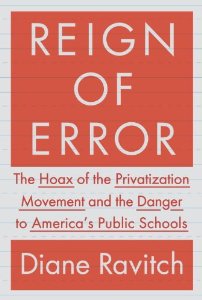
Reign of Error- Ravitch 2


reign of errorDefinitely go out and buy Reign of Error: The Hoax of the Privatization Movement and the Danger to Americas Public Schools by Diane Ravitch, which just been launched with proper publicity. She is a phenomenal woman—sending out a half-dozen e-mails a day, two books in the last decade, and traveling to speak throughout the USA. And…while she’s younger than me, she’s old enough to have rested on her laurels. Maybe it helps to change your mind, because my exhaustion comes (in part) from feeling it’s all been said before (including by me).
Reign of Error lays out step by step the relentless thirty year drive to either centralize the education of the young—on one hand—or divest it entirely into privatized hands on the other. Finally, the two sides have joined forces on a strategy that simultaneously does both. While this coalition has many old roots, in its current form it began with the fanfare around the publication of A Nation at Risk (1983). Ravitch was, at that time, a supporter of this bold statement that more or less accused America’s teachers and school boards of a plot to undermine American health and welfare of the international scene. We were, said the signers, at risk of becoming a second rate nation if we didn’t take this crisis seriously. I asked my colleague on the NBPTS, AFT leader Al Shanker, why he had signed on. He said it was a good strategy because only in a crisis is the nation willing to put the money into schooling needed to make it really first-rate. He said—as I recall (paraphrased), ‘It’s true our schools are not as bad as the report suggests, but we are entering a new period and they either have to change dramatically or what the report accuses them of will become true. We need a smarter citizenry.’
The trouble is that crying “wolf” has never been a great way to make sensible policy. Sometimes there is no choice (like Pearl Harbor). But the continuous claims that our public education system is destroying our nation has almost entirely led to bad policy.

Wednesday, September 18, 2013

Reign of Error _ Ravitch


An Evening with Diane Ravitch, educational blogger and author
Memorial Auditorium
1515 J Street, Sacamento, CA  95814
Friday, Sept. 27, 2013
6:30-8:30 pm.
Tickets are $5.
For additional information, contact Sacramento City Teachers Association – 916 452-4591.
About Diane:
My website is dianeravitch.com.
I am a historian of education and Research Professor of Education at New York University.

Tuesday, September 17, 2013

Education Spring - rebellions


by Jeff Bryant, 
Earlier this year, spontaneous rebellions against top-down mandates and budget cuts inflicted on public schools erupted around the nation.
In a months-long Education Spring, students, parents, teachers and community activists staged boisterous rallies, street demonstrations, school walkouts, test boycotts, and other actions to protest government austerity and top-down “accountability” mandates that damage community schools and diminish students’ opportunities to learn.
The protests spanned the nation and generated national media attention, resulting in a policy impasse in Washington D.C. and many state capitals, as government leaders and politicians scrambled to pause the rollouts of new heavy-handed school punishments.
Prominent pundits began to openly question the intention of a self-defined “reform” movement that has reigned for years but failed to produce any direct benefits to school children. And prominent educators, economists, parent advocates, labor and religious leaders, and community organizers called for a new policy agenda focused on ensuring students have the opportunities and resources they need to learn as much as they can.
Showdown In California
In California, a confrontation between the state’s schools chief Tom Torlakson and U.S. Secretary of Education Arne Duncan is emblematic of growing resentment toward the education reform movement’s overreliance on testing.

Sunday, September 15, 2013

Diane Ravitch: School privatization is a hoax, “reformers” aim to destroy public schools

Diane Ravitch: School privatization is a hoax, “reformers” aim to destroy public schools
Excerpt

They assert that the best way to save education is to hand it over to private management and let the market sort out the winners and the losers. They wish to substitute private choices for the public’s responsibility to provide good schools for all children. They lack any understanding of the crucial role of public schools in a democracy.
The central premise of this movement is that our public schools are in decline. But this is not true. The public schools are working very well for most students. Contrary to popular myth, the scores on the no-stakes federal tests— the National Assessment of Educational Progress (NAEP) — are at an all-time high for students who are white, black, Hispanic, and Asian. Graduation rates are also at an all-time high.
More young people than ever are entering college. Even more would go to college if the costs were not so high.
Of course some schools and districts have very low test scores and low graduation rates, and this has always been true. Most of these schools and districts have two features in common: poverty and high concentrations of racial minorities. The combination of these two factors is associated with low test scores. Children whose parents are poor and have low educational attainment tend to have lower test scores.
Children who are poor receive less medical attention and less nutrition and experience more stress, disruption, and crises in their lives. These factors have an ongoing and profound effect on academic performance.
That is why poor children need even more stability, more support, smaller class sizes, and more attention from their teachers and others in their schools, but often receive far less, due to underfunding.
Unfortunately, many people are unwilling to address the root causes of poor school outcomes, because doing so is either too politically difficult or too costly.

Sunday, April 07, 2013

Educators Occupy the Dept. of Education

Washington Post. The Answer Sheet.  Valerie Strauss.


By Amy Rothschild
From today through Sunday, education activists, including Diane Ravitch, will “occupy” the Department of Education.
Ravitch, of course, has occupied the Department of Education before, but in a different sense: From 1991 to 1993, she served as Assistant Secretary of Education under George H.W. Bush. She is standing outside the building gates as part of “Occupy 2.0, a Battle for the Public Schools.”
In 1991, her years of scholarship on school reform made her an attractive choice for the role of Assistant Secretary for Education Research and Improvement. Fast-forward two decades. She is leading the fight against corporate-based reform after the evidence persuaded her that it didn’t work. And now, the person serving in an analogous role at the department has experience not in the classroom or in public school leadership or in scholarship on school transformation, but, rather, from McKinsey & Company, and as founder of a for-profit school management company.

Sunday, November 25, 2012

Obama Administration and Republican Right on school "reform", Vouchers, etc.


by Diane Ravitch,
If ever evidence was needed about the bizarre mind meld between the Obama administration and the far-right of the Republican party, here it is.
Secretary Arne Duncan is giving the keynote to Jeb Bush’s Excellence in Education summit in Washington, D.C. on November 28. Another keynote will be delivered to the same gathering of the leaders of the privatization movement by John Podesta of the Center for American Progress, who headed the Obama transition team in 2008. This is sickening.
Jeb Bush’s organization supports vouchers, charters, online virtual charters, and for-profit organizations that run schools. It also supports evaluating teachers by student test scores and eliminating collective bargaining. Jeb Bush believes in grading schools, grading teachers, grading students, closing schools, and letting everyone “escape” from public schools to privately-run establishments. The free market is his ideal of excellence, not public responsibility, not the public school as the anchor of the community, but privatization.
Here is the press release (Podesta’s keynote was announced earlier):


Arne Duncan to Give Keynote at the
2012 National Summit on Education ReformWASHINGTON – The Foundation for Excellence in Education today announced U.S. Secretary of Education Arne Duncan will deliver a breakfast keynote address for the fifth annual Excellence in Action National Summit on Education Reform. This keynote will take place at the JW Marriott in Washington, DC, Nov. 28.
Prior to becoming the U.S. Secretary of Education, Arne Duncan served as the chief executive officer of  Chicago Public Schools (CPS), the longest-serving big-city education superintendent in the country. Among his most significant accomplishments during his tenure as CEO, an all-time high of the district’s elementary school students met or exceeded state reading standards, and their math scores also reached a record high. At high schools, Chicago Public Schools students posted gains on the ACT at three times the rate of national gains and nearly twice that of the state’s. Also, the number of CPS high school students taking Advanced Placement courses tripled, and the number of students passing AP classes more than doubled.
Unfortunately, we have reached maximum capacity for the Summit, and registration is closed. However, you can enjoy this exciting event from the comfort of your own computer. All keynote speeches and general sessions will be streamed live at www.ExcelinEd.org/Everywhere, and all strategy sessions will be filmed and available after the event. Click here to view this year’s agenda.

Wednesday, November 14, 2012

Teachers' Unions and School Reform - Diane Ravitch


How Teachers Unions Lead the Way to Better Schools

    Diane Ravitch upends the "bad teachers" narrative.

By Amy Dean

I have a concern: Teachers are getting pummeled. Too often,
they are being demonized in the media and blamed by
politicians for being the cause of bad schools. Right-wing
governors, power-hungry mayors and corporate "reformers" -
all ignoring root issues such as poverty and inequality -
have scapegoated the people who have devoted their lives to
educating our children. Moreover, these forces are seeking
to destroy the collective organizations formed by educators:
teachers unions.

The stakes for our country could not be more profound. The
labor movement and the public education system are two
critical institutions of American democracy. And they are
two that go hand in hand. Teachers unions have played a
critical role in advocating for public education, but you'd
never know it from mainstream media coverage. Therefore,
there is a great need to lift up this tradition and
highlight the efforts of teachers to collectively push for
top-notch public schools.

To figure out how we can push forward on this issue, I
talked with Diane Ravitch, one of the country's leading
education historians and public school advocates. A
professor at New York University, Ravitch is a former
Assistant Secretary of Education and the author of several
books, including 2010's The Death and Life of the Great
American School System: How Testing and Choice Are
Undermining Education.

Monday, October 01, 2012

Diane Ravitch Talks School Reform, the Chicago Strike, and the

Diane Ravitch Talks School Reform, the Chicago Strike, and the
http://prospect.org/article/diane-ravitch-talks-school-reform-chicago-strike-and-testing-vampire


Diane Ravitch.
Do you think there is a crisis in American education?
No. I think the crisis in American education is that there is a concerted effort to destroy it. That is a crisis—that’s a genuine crisis. Is there a crisis of academic achievement? No.
First of all, the test scores are the highest they’ve ever been in history on the National Assessment of Educational Progress, which is a no-stakes test. The scores of white kids, black kids, Hispanic kids, and Asian kids are the highest ever in history. What you hear from Bill Gates and [former chancellor of Washington, D.C., public schools] Michelle Rhee and all the others is we’re in a period of decline, all the schools are obsolete, the test scores are flat. Nonsense. They have been going up steadily for 40 years and they are the highest they’ve been in history.
Number two, the graduation rates today are the highest in history. Number three, the dropout rates are the lowest in history.
Is there a crisis in American education? Yes: We have all these Wall Street-funded foundation people running around saying we have to get rid of public education and saying all these phony things about our schools.

Sunday, June 17, 2012

Are Charter Schools Public? Diane Ravitch


Are charter schools public?
by Diane Ravitch 
I noted in my blog last week that the visionaries of the charter school idea—Raymond Budde of the University of Massachusetts and Albert Shanker of the American Federation of Teachers—never intended that charter schools would compete with public schools.
Budde saw charters as a way to reorganize public school districts and to provide more freedom for teachers. He envisioned teams of teachers asking for a charter for three to five years, during which time they would operate with full autonomy over curriculum and instruction, with no interference from the superintendent or the principal.
Shanker thought that charter schools should be created by teams of teachers who would explore new ways to reach unmotivated students. He envisioned charter schools as self-governing, as schools that encouraged faculty decisionmaking and participatory governance. He imagined schools that taught by coaching rather than lecturing, that strived for creativity and problem-solving rather than mastery of standardized tests or regurgitation of facts. He never thought of charters as non-union schools where teachers would work 70-hour weeks and be subject to dismissal based on the scores of their students.
Today, charter schools are very far from the original visions of Budde and Shanker. Few are run by teams of teachers. Most are managed by for-profit corporations or by nonprofit corporations with private boards of directors. The charter reflects the aims of the corporation, not the aims of its teachers. Most charters are non-union and rely on young teachers who work long hours and leave after a few years, thus keeping costs low. Many have high executive compensation. Charters have a high rate of teacher and principal turnover. Clearly, charters do not "belong" to the professionals who work in them, but to the corporation and its directors, who hold the charter.
Which raises the question of this blog: Are charter schools public schools? They say they are. But what we now see is that they are public when it comes to collecting tax money, but not in most other respects.

Wednesday, May 09, 2012

What you need to know about ALEC

by Diane Ravitch


Since the 2010 elections, when Republicans took control of many states, there has been an explosion of legislation advancing privatization of public schools and stripping teachers of job protections and collective bargaining rights. Even some Democratic governors, seeing the strong rightward drift of our politics, have jumped on the right-wing bandwagon, seeking to remove any protection for academic freedom from public school teachers.
This outburst of anti-public school, anti-teacher legislation is no accident. It is the work of a shadowy group called the American Legislative Exchange Council, or ALEC. Founded in 1973, ALEC is an organization of nearly 2,000 conservative state legislators. Its hallmark is promotion of privatization and corporate interests in every sphere, not only education, but healthcare, the environment, the economy, voting laws, public safety, etc. It drafts model legislation that conservative legislators take back to their states and introduce as their own "reform" ideas. ALEC is the guiding force behind state-level efforts to privatize public education and to turn teachers into at-will employees who may be fired for any reason. The ALEC agenda is today the "reform" agenda for education.
ALEC operated largely in the dark for years, but gained notoriety because of the Trayvon Martin case in Florida. It turns out that ALEC crafted the "Stand Your Ground" legislation that empowered George Zimmerman to kill an unarmed teenager with the defense that he (the shooter) felt threatened. When the bright light of publicity was shone on ALEC, a number of corporate sponsors dropped out, including McDonald's, Kraft, Coca-Cola, Mars, Wendy's, Intuit, Kaplan, and PepsiCo. The Bill & Melinda Gates Foundation said that it would not halt its current grant to ALEC, but pledged not to provide new funding. ALEC has some 300 corporate sponsors, including Walmart, the Koch Brothers, and AT&T, so there's still quite a lot of corporate support for its free-market policies. ALEC claimed that it is the victim of a campaign of intimidation.

Thursday, February 23, 2012

Ravitch: Teachers Should be Evaluated


Excerpt:
 
Of course, teachers should be evaluated. They should be evaluated by experienced principals and peers. No incompetent teacher should be allowed to remain in the classroom. Those who can’t teach and can’t improve should be fired. But the current frenzy of blaming teachers for low scores smacks of a witch-hunt, the search for a scapegoat, someone to blame for a faltering economy, for the growing levels of poverty, for widening income inequality.
 
 The New York Review of Books
No Student Left Untested
February 21, 2012
 

Thursday, February 02, 2012

Charter Schools Grow


Charter Schools Grow Amid Questions
By Seth Sandronsky
Traditional public school students and their teachers are facing a
shortfall of tax support across the US. But things are brighter for
tuition-free public charter schools, which operate with a contract
(charter) from a public entity.

There were over 2 million students enrolled in about 5,600 public
charter schools around the US in 2011, according to the National
Alliance for Public Charter Schools, a Washington, DC-based,
non-profit advocacy group. A recent NAPCS statement said that total
student enrollment represents a 13% increase in one year.

According to the federal Department of Education, 4% of US public
school students, pre-kindergarten through grade 12, attend public
charter schools. In 2010, California led the nation in public charter
schools with 983, according to the NAPCS, serving over 412,000
students (7% of the over-all enrollment of 6 million pupils
statewide).

Saturday, January 28, 2012

Bee editor Pia Lopez gets it wrong about schools -again


Associate Editor Pia Lopez wrote an interesting essay, “Can we find common ground on schools?”  on the ideas of Diane Ravitch in the Bee this morning- except for one paragraph where Lopez is substantially wrong.   She says,  “ In the 1980’s she (Ravitch) helped write a history curriculum framework for California that still today is considered among the best in the country.”
Lets see.  She must mean the California History Social Science Framework of 1987 – still in use today- that almost completely ignores Mexican American History.
From my essay , “Why California Students Do not know Chicano/ Mexican American History.  
The 1987 Framework still in use today  expanded African American, Native American, and women’s history coverage but remains totally inadequate in the coverage of Latinos and Asians. The only significant change between the 1985 and the 2005 adopted Framework was the addition of a new cover, a cover letter, and additions of photos such as of Cesar Chavez . Latinos currently make up 48.1 percent of California’s student population and Asians make up 8.1 %. 
The dominant neo conservative view  of history argues that textbooks and a common history should provide the glue that unites our society.(Ravitch's view at the time)  Historical themes and interpretations are selected in books to create unity in a diverse and divided society, a unity from the point of view of the dominant class.  This viewpoint assigns to schools the task of creating a common culture. In reality, television and military service may do more to create a common culture than do schools and books.
Conservatives assign the task of cultural assimilation to schools, with particular emphasis on the history, social science, and literature curricula. Historians advocating consensus write textbooks that downplay the roles of slavery, class, racism, genocide, and imperialism in our history. They focus on ethnicity and assimilation rather than race, on the success of achieving political reform, representative government, and economic opportunity for European American workers and immigrants. They decline to notice the high poverty rate of U.S. children, the crisis of urban schooling, and the continuation of racial divisions in housing and the labor force. In California they decline to notice that Mexicans, Mexican-Americans and Latinos as well as Asians contributed to the development of this society.
         At present California students are about 48% descendents of Mexican and other Latino cultures yet they are not in the textbooks as a consequence of the Ravitch History/Social Science Framework. 
         That is not “still considered among the best in the country,” except perhaps by persons who know little about the issue,  or care little about  Mexican American students, their history and their success in schools.
         See more on the Institute for Democracy and Education web site
Duane Campbell,
Professor Emeritus, Bilingual Multicultural Education.
Author, Choosing Democracy: a practical guide to multicultural education.  2010.  

Monday, January 23, 2012

Kevin Johnson and Students First ?

English: Michelle Rhee speaking to a NOAA stud...
Image via Wikipedia
“We need to say it's wrong, and if that doesn't work, engage in direct action, it's time to organize, demonstrate, and agitate…”  ~  Diane Ravitch, in Sacramento 1/20/12


Diane Ravitch’s extraordinary visit to Sacramento on Friday, Jan. 20,  left the 3000 people in attendance with a clear message of what those of us who care deeply about public education must do to stand up to and reject the privatization of our schools and the treatment of our children as commodities whose value is measured by “bubble tests.”   Michelle Rhee, disgraced former-chancellor of the Washington D.C. public schools and wife of Sacramento mayor Kevin Johnson, is the standard-bearer of the privateers, raising millions of dollars through her organization, StudentsFirst, from the likes of the Koch Bros and Rupert Murdoch to advance an agenda of  union-busting, school vouchers and public school give-aways to private interests.   The national headquarters of StudentsFirst happens to be located right here in Sacramento. 
See prior posts on Ravitch.
Enhanced by Zemanta

Friday, January 20, 2012

Diane Ravitch - NCLB

 Diane Ravitch is speaking in Sacramento this evening.
I know you are touring schools in Japan and soaking up lessons for us as you travel. Since you have Internet access, I'd like to share some thoughts about a momentous occasion: the 10th anniversary of No Child Left Behind, which occurred on January 8.
After 10 years of NCLB, we should have seen dramatic progress on the National Assessment of Educational Progress, but we have not. By now, we should be able to point to sharp reductions of the achievement gaps between children of different racial and ethnic groups and children from different income groups, but we cannot. As I said in a recent speech, many children continue to be left behind, and we know who those children are: They are the same children who were left behind 10 years ago.
In my travels over the past two years, I have seen the wreckage caused by NCLB. It has become the Death Star of American education. It is a law that inflicts damage on students, teachers, schools, and communities.
When I spoke at Stanford University, a teacher stood up in the question period and said: "I teach the lettuce-pickers' children in Salinas. They are closing our school because our scores are too low." She couldn't finish her question because she started crying.
When I spoke at UCLA, a group of about 20 young teachers approached me afterwards and told me that their school, Fremont High School, was slated for closure. They asked me to tell Ray Cortines, who was then chancellor of the Los Angeles Unified School District, not to close their school because they were working together as a community to improve it. I took their message to Ray, who is a good friend, but the school was closed anyway. The dispersed teachers of Fremont are still communicating with one another, still mourning the loss of their school.
When I spoke to Citizens for Public Schools in Boston, a young man who works as a chef at a local hotel got up to ask what he could do to stop "them" from closing his children's school. It was the neighborhood school, he said. It was the school he wanted his children to attend. And they were closing it.
In city after city, across the nation, I have heard similar stories from teachers and parents. Why are they closing our school? What can we do about it? How can we stop them? I wish I had better answers. I know that as long as NCLB stays on the books, there is no stopping the destruction of local community institutions. And now with the active support of the Obama administration, the NCLB wrecking ball has become a means of promoting privatization and community fragmentation.
I have often wondered whether there is any other national legislature that has passed a law that had the effect of stigmatizing the nation's public education system. Last year, Secretary of Education Arne Duncan said that 82 percent of our nation's schools would fail to make "adequate yearly progress." A few weeks ago, the Center for Education Policy reported that the secretary's estimate was overstated, and that it was "only" half the nation's schools that would be considered failing as of this year. Secretary Duncan's judgment may have been off the mark this year, but NCLB guarantees that the number of failing schools will grow every year. If the law remains intact, we can reasonably expect that nearly every public school in the United States will be labeled as a failing school by 2014.
If you take a closer look at the CEP study, you can see how absurd the law is. In Massachusetts, the nation's highest-performing state by far on NAEP, 81 percent of the schools failed to make AYP. But in lower-performing Louisiana, only 22 percent of the schools did not make AYP. Yet, when you compare the same two states on NAEP, 51 percent of 4th graders in Massachusetts are rated proficient, compared with 23 percent in Louisiana. In 8th grade, again, twice as many students in Massachusetts are proficient compared with Louisiana, yet Massachusetts has nearly four times as many allegedly "failing" schools! This is crazy.
More evidence of the invalidity of NCLB. The top-rated high school in the state of Illinois, New Trier High School, failed to make AYP. Its special education students did not make enough progress. When outstanding schools fail, you have to conclude that something is wrong with the measure.
The best round-up to date of the catastrophe that we call NCLB was published by FairTest in its report, "The Lost Decade." I know you have read it, as this is an organization dear to your heart. I recommend this report to our readers. It shows in clear detail that progress on NAEP was far more significant before the passage of NCLB.
Congress, in its wisdom, will eventually reauthorize the Elementary and Secondary Education Act. I hope that in doing so, they recognize the negative consequences of NCLB and abandon the strategies that have borne such bitter fruit for our nation's education system. NCLB cannot be fixed. It has failed. It has imposed a sterile and mean-spirited regime on the schools. It represents the dead hand of conformity and regulation from afar. It is time to abandon the status quo of test-based accountability and seek fresh and innovative thinking to support and strengthen our nation's schools.
Diane
- Diane Ravitch
 
Creative Commons License
This work is licensed under a Creative Commons Attribution-NonCommercial 3.0 Unported License.