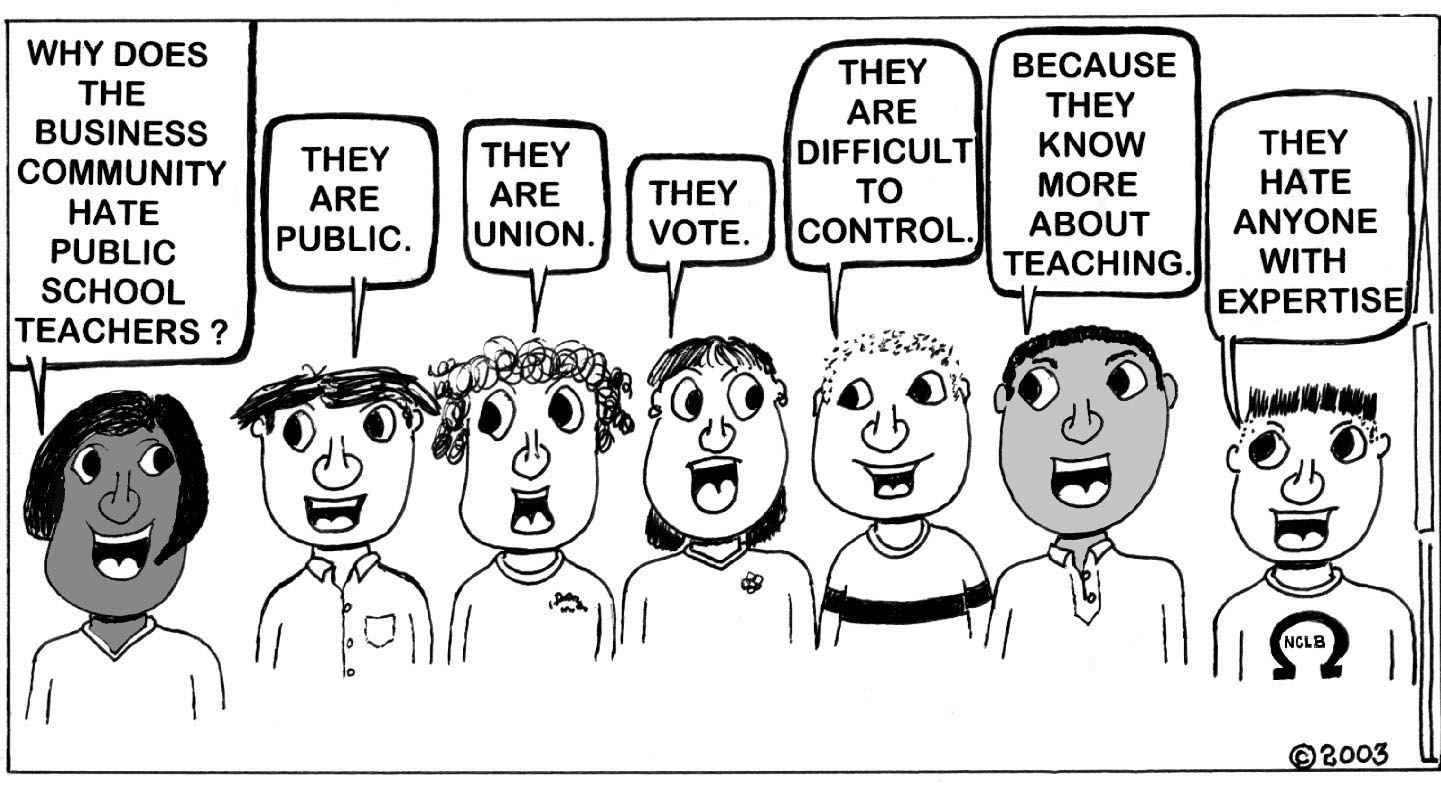
Showing posts with label corporate agenda. Show all posts

Wednesday, May 31, 2017

DeVos, Charters, and Corporate Theft

by Jeff Bryan, 
Betsy DeVos wants to give your tax dollars to private schools and businesses and tell you it’s an education “transformation.”
That’s the main theme of an address she gave this week to a conference held by the organization she helped found and lead, the American Federation for Children.
Declaring “the time has expired for ‘reform,'” she called instead for a “transformation… that will open up America’s closed and antiquated education system.” Her plan also opens your wallet to new moochers of taxpayer dollars.
By the way, AFC, according to SourceWatch, is a “conservative 501(c)(4) dark money group that promotes the school privatization agenda via the American Legislative Exchange Council (ALEC) and other avenues.” It also grew out of a defunct PAC connected to DeVos called “All Children Matter” that ran afoul legally in Ohio and Wisconsin and still owes Ohio $5.3 million for breaking election laws.
So DeVos had a supportive crowd for her speech, but what should the rest of us think of it?
The transformation she calls for seems to rest on the premise that, “It shouldn’t matter where a student learns so long as they are actually learning.” But what does she mean by “learning”? And what should the public expect about how its funds are being spent?

Thursday, May 18, 2017

More on LA School Board Take Over by Corporate Billionaires

A Big Win for Corporate Advocates of Charters.
Mike McPhate
School board campaigns are often sleepy affairs, not the sort of electoral battle that generates widespread attention and outside donations. But this week’s election for the Los Angeles Unified school board was something of an epic proxy fight. Some saw it as a battle over the influence of the teachers’ union. Others cast it as a fight against the education agenda of President Trump and Betsy DeVos and the expansion of charter schools. 
After Tuesday’s results, the seven-member school board that governs the nation’s second largest public school system will be dominated by supporters of charter schools who may move to increase the number of publicly funded but privately run schools across the city. 
The election drew in some $14 million — making it among the most expensive school board races in the country’s history — and a host of high-profile endorsements. In the end, the candidates who portrayed themselves as supporters of dramatic changes won out, leaving the teachers’ union and its supporters angered and worried about the future. Steve Zimmer, the school board president who lost to the challenger Nick Melvoin, was so angered by the defeat that he refused to make the customary congratulatory call. Mr. Zimmer called the results “devastating” and said he would never run for office again.

Monday, April 11, 2016

The Common Core

The Rotten Core

By SETH SANDRONSKY

Spring is time for high-stakes tests under the Common Core State Standards for public K-12 school students in the United States. This leaves teachers with scant time to impart critical thinking to students, a harm to democracy, or rule of the people.
We can thank a “teach to the test” approach to learning and teaching for this attack on democracy. The assault has a history.
On that note, teachers played no part in establishing the CCSS. These circumstances speaks volumes about democracy and public K-12 school education.
The origin of the CCSS points to the Council of Chief State Officers (CCSO) and the National Governors Association (NGA). These entities hold the copyright for the CCSS, and are subject to zero public accountability.
“The national command center of this corporate-based education reform movement is located in the quasi-governmental agencies of the CCSO and the NGA,” according to an editorial in the March edition of Monthly Review, “both consisting of governmental officials but functioning outside political jurisdictions as private, non-governmental organizations.”

Sunday, March 27, 2016

Why I Am Pessimistic About the Future of Public Education

Mark Naison
March 11, 2016
The Washington Post - The Answer Sheet
 
Public schools in recent years have sustained assaults from believers in the privatization of the public education system. The powers that be plan a data-based reinvention of teacher education that will require the closing, or reinvention of colleges of teacher education. If these plans go through, a majority of the nation's teachers and teacher educators could lose their jobs in the next 10 years, replaced by people who will largely be temp workers-making minimum wages


As a student of history who has watched how the financialization of capital and the expansion of technology has affected labor markets, housing markets and the political process, I am incredibly pessimistic about the future of public education.
 
After the 2007-2008 financial crisis in the United States, a growing number of those with investment capital seeking profitable outlets are seeing education - and educational technology - as growth areas. Resistance by students, parents and educators to high-stakes standardized testing and the Common Core State Standards confronted them with a temporary setback, but now they are poised to make an end run around the Opt Out movement by concentrating on "personalized learning" which requires a huge investment in computerization of classrooms as well as software.

Sunday, November 15, 2015

Dan Walters Argues for More Testing - Again and Again


Dan Walters continues to use his position as a major editorial writer in the Bee in support of corporate style school control in support of the fake school reform industry and consultants.  (Sac Bee, Nov. 15, page A3) He does this by regularly describing neoliberal charter advocates such as Gloria Romero and Michelle Rhee  and others as advocates of “school reform”.

In reality they are advocates of more testing and test driven change.

High-stakes standardized tests, and the new curriculum they have spawned, require  teachers to avoid thinking deeply about the information  we’re sending to students.  The aim of testing is to provide demonstrable, measurable evidence that work is being produced — that teachers and students are not thinking creatively  when they should be lecturing, memorizing, studying. The idea is that a teacher’s job is to get information into the heads of students, and a student’s job is to write it out, unchanged, on a test.

Saturday, September 26, 2015

Broad Plan : How to Take Over Public Schools in Los Angeles


Deirdre Fulton
September 23, 2015
Common Dreams
 
Last week the Los Angeles Times obtained a secret 44-page proposal drafted by the Eli and Edythe Broad Foundation and other charter advocates, that according to one critic would "do away with democratically controlled, publicly accountable education in LA." With the aid of a billionaires’ club of supporters, the plan is designed to charterize 50% of LA public schools. 


More than 1,000 teachers, students, parents, and community members protested at the opening of the Broad museum in downtown Los Angeles Sunday. , Mayra Gomez/UTLA Facebook photo
 
 
A California billionaire is enlisting other wealthy backers in a $490 million scheme to place half of the students in the Los Angeles Unified School District into charter schools over the next eight years—a plan at least one critic says would "do away with democratically controlled, publicly accountable education in LA."
The Los Angeles Times obtained a confidential 44-page proposal, "The Great Public Schools Now Initiative," drafted by the Eli and Edythe Broad Foundation and other charter advocates.
"Los Angeles is uniquely positioned to create the largest, highest-performing charter sector in the nation," the executive summary reads. "Such an exemplar would serve as a model for all large cities to follow."

Tuesday, August 25, 2015

The Teacher Shortage is No Accident

In These Times · http://www.inthesetimes.com

BY Kevin Prosen


Like much else in the national education debate, panics about teacher shortages seem to be a perennial event. In a widely discussed article for the New York Times earlier this month, Motoko Rich called attention to sharp drops in enrollment in teacher training programs in California and documented that many districts are relaxing licensure requirements as a result, pushing more and more people into the classroom without full certification or proper training.

“It’s a sad, alarming state of affairs, and it proves that for all our lip service about improving the education of America’s children, we’ve failed to make teaching the draw that it should be, the honor that it must be,” mused Times columnist Frank Bruni.

That Bruni would bemoan such a state of affairs is ironic, as he has used his column over the years to repeatedly argue that teaching is too easy a profession to enter and too easy to keep, and amplified the voice of reformers who want to want to make the profession more precarious. But the reality is that speaking of a “shortage” at all is a kind of ideological dodge; the word calls to mind some accident of nature or the market, when what is actually happening is the logical (if not necessarily intended) result of education reform policies.

Monday, October 13, 2014

Corporate Titans throw Millions into Tuck Campaign

Corporate school  “reformers” have raised over $4 million from the very rich during the last week to contribute to the campaign to elect Marshall Tuck as Superintendent of Public Instruction.  According the Sacramento Bee The fund includes $1 million each from Los Angeles businessmen Bill Bloomfield and Eli Broad, a major financier of efforts to overhaul public education. The Gap co-founder Doris Fisher and Laurene Powell Jobs, philanthropist and widow of Steve Jobs, have each contributed $500,000.

This anti union efforts raised in just one week  dwarfs the $2 million raised by teachers’ unions in favor of Torlakson.
Corporate advocates want Tuck in office to  support the anti tenure decisions and anti teacher due process  procedures of the Vergara case.


A handful of ultra-wealthy donors who support school privatization and cutting public pension systems are behind a flood of spending supporting former Wall Street Banker Marshall Tuck's campaign for state schools superintendent, campaign disclosure records show.
Far from "Parents and Teachers for Tuck," the $4.7 million collected so far comes instead from sources that support school vouchers, privatization of public pension systems and using disruptive business tactics to overhaul public schools.
Major funders include:
$500,000 from Carrie Walton Penner, whose family made its fortune running anti-union, low-wage paying Wal-Mart. The Walmart 1% website reports that Penner's biography includes serving on the board of the Alliance for School Choice - a school voucher advocacy group.

Thursday, September 18, 2014

Four Flimflams of the Common Core Movement

Award-winning Principal Carol Burris of South Side High School in New York was once a supporter of the Common Core but came to be a critic after her state began to implement the initiative. (You can read some of her work on the botched implementation  in New York here,  here, here and here.)  Burris was named New York’s 2013 High School Principal of the Year by the School Administrators Association of New York and the National Association of Secondary School Principals, and in 2010,  tapped as the 2010 New York State Outstanding Educator by the School Administrators Association of New York State. In this post she looks at what she calls the “Four Flimflams of the Common Core.”
By Carol Burris
The cheerleaders for the Common Core are on a “happy tour.” Anthony Cody explains here how the Gates Foundation is now financing a public relations offensive in response to the growing opposition to national standards. Recently, a professionally produced YouTube video depicted Common Core critics as misinformed Archie Bunkers who have no rational reason for their critique. The video was abruptly taken down when criticism appeared on Twitter, but you can see a screen shot of it here. Expect to see more affronts to the sincerity and intelligence of Core critics in the coming months.
The public relations campaign started because a majority of Americans  (60 percent in one poll) now oppose the Common Core. Although conservatives lead the way, in the bluest of states, California and New York, more people now disapprove than approve of the standards. Perhaps most telling of all, in one year national teacher support for the Common Core has dropped 30 points. The Common Core has shifted from theory to practice, and like the lemon it is, it is breaking down on the highway of implementation.

Saturday, September 13, 2014

The Story on SCUSD Superintendent that the Bee will not tell you.

Thank you Cosmo Garvin for writing what the Bee will not report on.
Cosmo Garvin. Sacramento News and Review. 9/11/2014. Page 15.
The Bee is clearly still sore about the loss of the previous superintendent, Jonathan Raymond. Raymond seemed to enjoy sticking it to teachers (and the occasional principal) and generally followed the playbook for corporate-ed reform.
He left quite suddenly during the last school year. The public reason was that he wanted his kids to be closer to their grandparents back in Boston. Surely a tough decision, to leave what he described as his “dream job.” But family comes first.
This summer, Raymond took a job as president of an education nonprofit called the Stuart Foundation—in San Francisco.
The Stuart Foundation is a major funder of something called the California Office to Reform Education. You may recall that Raymond committed Sac City schools to participate in the CORE, to help fund it, and to tie teacher evaluations to student test scores as part of the deal.
This was intensely controversial—and done without public input or any vote of the Sac City school board. The board only reversed Raymond’s decision after he had bailed, and after protests from teachers, parents and community groups.
It’s not so surprising that a plum job for Raymond was waiting on the other side of the revolving door. But what about the family thing?
Carol Ting, the Stuart Foundation’s chief operating officer, told Bites, “That was his plan. But then the recruiter came along and offered him his dream job.”
Dream job, huh? Anyway, Raymond slipped out the back door in a hurry, to take a dreamier job, or to escape whatever nightmares had cropped up here in Sacramento. Either way, even in his absence he was an important presence at the school-board-candidates forum held in Oak Park last Sunday.

Sunday, May 04, 2014

Monday, March 31, 2014

Charter Schools goal: "Get rid of Elected School Boards"


Reed Hastings makes his case.

The Sacramento Coalition to Save Public Education has an informative post on the current status of so called CORE Waivers in Sac City Unified Schools.

http://savesacramentopublicschools.org/blogs/community-forum-core-waivers-urges-public-action

Wednesday, March 19, 2014

Vergara Lawsuit would take away teacher rights


"It would be very scary to me, if this lawsuit succeeds, to think that I might not have a job next year, not for anything I'd done in the classroom, but because my principal didn't like me, or my clothing, or something I'd said."
 —Laura Lacar, Gahr High School, ABC Unified School District
Last year a group calling itself “Students Matter,” funded by David Welch, a conservative Silicon Valley millionaire, filed a lawsuit, Vergara v. the State of California. The lawsuit challenges a number of constitutional rights for California’s teachers, including “tenure,” due process rights, and seniority rights during layoffs. The suit, hiding behind a group of students, alleges that these teacher workplace rights infringe the constitutional right of students to an equal education. [See what Gary Ravani has to say about the civil rights rhetoric used by Students Matter; and see CFT president Joshua Pechthalt's op-ed piece in the San Jose Mercury News] CFT and CTA joined the defense last year, challenging Vergara as a “…meritless lawsuit by corporate special interests attacking teacher professional rights.”
The trial opened on Monday, January 27.
The lawsuit ignores the real problems of public education
Education Code rules to protect teacher rights from administrative mismanagement are not "unfair" to either students or new teachers. What harms students? Economic inequality, poverty, their parents' joblessness, and underfunding are unfair to students. But this lawsuit ignores these barriers to educational success. The premise of "Vergara" is that public schools are failing, and bad teachers are the reason why. Get rid of the “bad teachers,” and the schools will succeed. This simplistic idea is wrong in a number of ways. Most public schools are successes, by most reasonable measures; and while the role of the teacher is always an important in-school factor, external factors like poverty and underfunding have the greatest impact.

Tuesday, February 25, 2014

Vergara V. California

Larry Ferlazzo

Vergara v. California is a carefully-watched court case that begins next week that attempts to eliminate fundamental teacher rights likes tenure and due process. It’s being financed by a multi-millionaire corporate reformer.
Here is what I wrote in the 2014 education predictions I published in The Washington Post:
The carefully watched court case in California against teacher tenure rules that is being bankrolled by corporate school reformers will result in an unequivocal victory for teachers unions, students and families — either by being dismissed or by a court-ruling against the plaintiffs. 
I thought readers might find it useful to learn more about the case, since it has national implications (you might also be interested in The Best Articles For Helping To Understand Both Why Teacher Tenure Is Important & The Reasons Behind Seniority-Based Layoffs). I’ll certainly be making additions in the future:

Wednesday, February 12, 2014

When the Pundits Misrepresent Public School Issues

By Jeff Bryant
Government funding for public schools has been cut so dramatically that now most states are funding schools less than before the recession.
Legend has, political disputes are supposed to be resolvable only when parties “meet in the middle” and shake hands on points of agreement that are possible.
But in the much-contested issue of “education reform,” only one of the disputing parties in the debate tends to be implored to seek compromise.
What this looks like in one of the nation’s largest school district, Los Angeles, came to the attention of many recently when a Facebook campaign led by a local teacher provided a cavalcade of photographs showing the deplorable conditions of that city’s public schools. “The images,” reported the Los Angeles Times, include missing ceiling tiles, broken sinks and water fountains, ant invasions, dead roaches and rat droppings.”

Monday, January 27, 2014

Someone sues the schools to abolish teacher tenure ?

By Duane Campbell
Julie Watson of The Associated Press reports today in the Sacramento Bee that  nine public school students are suing the state over laws on teacher tenure and seniority which really means that the usual anti union corporate machine has launched a new front in the war on teachers.  See  https://sites.google.com/site/democracyandeducationorg/
These students ( or their parents)  want to invalidate a series of current laws which protect teachers from political interference. Their campaign foci just happen to co-inside with campaigns of a variety of the usual corporate suspects from Michellle Rhee, the Waltons, Students First, Democrats for Educational Reform, and other well financed political action committees.
However, as we learned in the campaign against bi-lingual education ( Prop.227), parent and student front groups can provide an effective campaign strategy. A law suite designed for publicity was an important element in the abolition of bilingual education for the children of California.  It will be difficult to get past the framing of the AP article to real issues.
For example, one of the parents is listed as saying that her child did not learn to read until 3rd. grade.  Something we would all be concerned about, but it is not clearly connected to teacher tenure and seniority.
More likely, the child was disadvantaged by large classroom sizes,  California’s over crowded classrooms,  and the budget cuts of the recent economic crisis.   Or, it may have been because the child did not respond well to the tightly organized scripted reading lessons now required in most classrooms. Reading resource teachers prepared to assist children falling behind were eliminated from most California classrooms in a long series of budget cuts.

Monday, January 13, 2014

Public School Reform ?

Seth Sandronsky
Take the federal No Child Left Behind Act (NCLB) of 2001. Add its heir, the Race to the Top Fund (RTT-TF), part of the American Recovery and Reinvestment Act (ARRA) of 2009. Under NCLB and RTTTF, pupil scores on standardized tests are center stage in public K-12 school reform. Public school principals and teachers with students who fail to measure up to learning standards based on test scores face harsh penalties, ranging from schools closing, with employee layoffs, to openings of charter schools (brick-and-mortar and online).

There is more to this learning and teaching dynamic than meets the eye. For instance, off-stage are for-profit corporations. Their fiduciary responsibility is to private shareholders, not public interests. So what is the interplay between the corporate sector and public K-12 school reform?


We turn to Kaplan Test Preparation (KTP) schools.

Monday, December 09, 2013

Day of Action for Public Education

“Public education is under attack,” comes the warning from Philadelphia in a riveting new video from community and youth organizers in that city.
Their accusations are that education policies are “an attack on poor children” … policy makers “don’t care about the students” … public education “is being defunded” … and “it’s not something specific to Philadelphia.”
Indeed, Philadelphia “is an early warning sign for America,” a former science teacher wrote recently at the progressive news site PolicyMic. Chronically low per-pupil spending – “behind suburban districts” – combined with a “powerful charter school movement” intent on privatizing schools, have eroded Philly schools to the state where basic supplies like paper, pencils, and books seem like luxuries.
It’s a story that mirrors what’s happening across the country.
Americans everywhere are seeing their local schools being ground into pieces between the twin political augers of government austerity and top-down, corporate-backed “reform.”
 
Creative Commons License
This work is licensed under a Creative Commons Attribution-NonCommercial 3.0 Unported License.