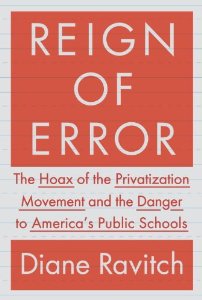
 Definitely go out and buy Reign of Error: The Hoax of the Privatization Movement and the Danger to Americas Public Schools by Diane Ravitch, which just been launched with proper publicity. She is a phenomenal woman—sending out a half-dozen e-mails a day, two books in the last decade, and traveling to speak throughout the USA. And…while she’s younger than me, she’s old enough to have rested on her laurels. Maybe it helps to change your mind, because my exhaustion comes (in part) from feeling it’s all been said before (including by me).
Reign of Error lays out step by step the relentless thirty year drive to either centralize the education of the young—on one hand—or divest it entirely into privatized hands on the other. Finally, the two sides have joined forces on a strategy that simultaneously does both. While this coalition has many old roots, in its current form it began with the fanfare around the publication of A Nation at Risk (1983). Ravitch was, at that time, a supporter of this bold statement that more or less accused America’s teachers and school boards of a plot to undermine American health and welfare of the international scene. We were, said the signers, at risk of becoming a second rate nation if we didn’t take this crisis seriously. I asked my colleague on the NBPTS, AFT leader Al Shanker, why he had signed on. He said it was a good strategy because only in a crisis is the nation willing to put the money into schooling needed to make it really first-rate. He said—as I recall (paraphrased), ‘It’s true our schools are not as bad as the report suggests, but we are entering a new period and they either have to change dramatically or what the report accuses them of will become true. We need a smarter citizenry.’
The trouble is that crying “wolf” has never been a great way to make sensible policy. Sometimes there is no choice (like Pearl Harbor). But the continuous claims that our public education system is destroying our nation has almost entirely led to bad policy.


