Tuesday, September 29, 2015

Teachers Object as NEA Considers Early Clinton Endorsement

Rank-and-File Teachers Object As Nation's Biggest Union Weighs Early Clinton Endorsement

Mirroring similar rifts within other unions, National Education Association members prepare to protest Sanders snub
An early NEA endorsement for Hillary Clinton would ignore the 30,000 members who have shown support for Sen. Bernie Sanders, say protesting union members. (Photo: Hillary Clinton/ Facebook)
A rumored presidential endorsement by the nation's largest union is exposing a rift between rank-and-file members who are "feeling the Bern" and leadership who appear more willing to err on the Clinton side of caution.
Various news reports have indicated that an announcement by the 3-million strong National Education Association is expected sometime this week.
According to an email obtained by Politico, the NEA PAC, the union’s political arm, is planning to hold an upcoming vote "recommending Hillary Clinton for the presidential primary" on the grounds that the former Secretary of State "is the best positioned candidate to win both the Democratic primary and general election," citing her "unmatched organizational strength, ground game, and fundraising ability to defeat the candidate of the Koch brothers."

CTJ Statement: Trump Tax Plan Would Cost Nearly $11 Trillion Over 10 Years | CTJReports

CTJ Statement: Trump Tax Plan Would Cost Nearly $11 Trillion Over 10 Years | CTJReports

The Surprising Things Seattle Teachers Won for Students by Striking

Author:  Valerie Strauss

Friday, September 25, 2015   Washington Post

Seattle teachers went on strike for a week this month with a list of goals for a new contract. By the time the strike officially ended this week, teachers had won some of the usual stuff of contract negotiations — for example, the first cost-of-living raises in six years — but also less standard objectives.

For one thing, teachers demanded, and won, guaranteed daily recess for all elementary school students — 30 minutes each day. In an era when recess for many students has become limited or non-existent despite the known benefits of physical activity, this is a big deal, and something parents had sought.

What’s more, the union and school officials agreed to create committees at 30 schools to look at equity issues, including disciplinary measures that disproportionately affect minorities. Several days after the end of the strike, the Seattle School Board voted for a one-year ban on out-of-school suspensions of elementary students who commit specific nonviolent offenses, and called for a plan that could eliminate all elementary school suspensions.

Saturday, September 26, 2015

Broad Plan : How to Take Over Public Schools in Los Angeles


Deirdre Fulton
September 23, 2015
Common Dreams
 
Last week the Los Angeles Times obtained a secret 44-page proposal drafted by the Eli and Edythe Broad Foundation and other charter advocates, that according to one critic would "do away with democratically controlled, publicly accountable education in LA." With the aid of a billionaires’ club of supporters, the plan is designed to charterize 50% of LA public schools. 


More than 1,000 teachers, students, parents, and community members protested at the opening of the Broad museum in downtown Los Angeles Sunday. , Mayra Gomez/UTLA Facebook photo, 
 
 
A California billionaire is enlisting other wealthy backers in a $490 million scheme to place half of the students in the Los Angeles Unified School District into charter schools over the next eight years—a plan at least one critic says would "do away with democratically controlled, publicly accountable education in LA."
The Los Angeles Times obtained a confidential 44-page proposal, "The Great Public Schools Now Initiative," drafted by the Eli and Edythe Broad Foundation and other charter advocates.
"Los Angeles is uniquely positioned to create the largest, highest-performing charter sector in the nation," the executive summary reads. "Such an exemplar would serve as a model for all large cities to follow."

Thursday, September 24, 2015

Our Kids: The American Dream in Crisis

Our Kids: The American Dream In Crisis.
Robert D. Putnam.
Review by Duane Campbell
This new book is an insightful and well researched analysis  of on the achievement gap, which Robert Putnam  correctly calls an opportunity gap for the current generation of young people.  I was drawn to the book by respect for his prior writing,  Bowling Alone . This new work  is of equal value in synthesizing social science research.  Perhaps it is of more value since we have major institutions-schools- in positions , that could contribute to the rebirth of equal, democratic opportunity.

In Our Kids, Putnam   describes major developments in our schools and our communities - the growing inequality of opportunity for the working class and the poor.
Educational writers have long chronicled several of the key concepts, the role of tracking, of concentrations of poverty and of race. This work excels because it is a very well informed outsiders sociological viewpoint of these issues.  Putnam and research associate Jen Sliva bring together extensive social science data and research to support the  many interpretive suggestions.

Monday, September 21, 2015

Teachers Are Winning in Seattle - And That is Good

On one block of the Central District last Thursday: dozens of teachers wearing bright-red Seattle Education Association T-shirts, hoisting “On Strike” and “Fair Contract Now” signs, singing and chanting and playing conga drums as passing cars honked their horns.
On another: an equally passionate gathering of teachers, students, and parents at Summit Sierra—one of Seattle’s first-ever public charter schools—wearing bright-blue “Keep Our Schools Open” T-shirts, toting hand-drawn “Don’t Close My School” .
Which is, more or less, what everyone is saying. From the teachers’ union to the Seattle Public School District, from the Washington State Charter Schools Association to the state Supreme Court: Save. Our. Schools.
It’s been a tumultuous few weeks for public education, to say the very least, and the news is giving us whiplash. Rallies, picket lines, 14-hour bargaining days, and monumental Supreme Court decisions are all making national headlines as some of the most fraught and long-standing debates in public education descend en masse on the state of Washington. The Seattle teachers’ union went on strike over contract issues for the first time in three decades, delaying the start of the new school year by more than a week; the state Supreme Court ruled Washington’s nascent charter-school law unconstitutional, effectively pulling public funding from the nine charters around the state that just opened their doors; and the state legislature is getting penalized $100,000 per day until it passes an education budget in line with the 2012 decision that condemned it for systematically underfunding public schools.
It’s a mess. But for a lot of educators, it’s pivotal. Despite plenty of frustration to go around, today’s mayhem does seem to have reached a fever pitch—and right now, teachers’ unions have the high note.
“I think the union has finally found its stride with the membership in a way it hadn’t previously,” said Laura Lehni, a history teacher at Washington Middle School and member of the SEA’s bargaining team, as passersby on South Jackson Street honked and cheered for the striking teachers last week. “The people you see out here on the lines, you probably wouldn’t have seen in years past. Now we’re seeing that educators have had enough. We’re not going to bend over for the district any more.”

Saturday, September 19, 2015

Seattle Teachers Strike- A success for Teachers and Students

Jeff Bryant
Teachers unions are routinely vilified by pundits and politicians on the right and left these days. So when schoolteachers in Seattle began the school year by going on strike, the editorial board of The Seattle Timeswas quick to accuse the teachers of “demanding too much.”
The editors called the strike “illegal,” “disruptive,” and “a symbol of excess for those who oppose more school spending.”
What seemed to bother this august body most was that teachers’ demands would “have a negative effect on broader efforts to reform the state education system.”
Now that a tentative settlement is in place (to be approved by the teachers on Sunday), and it appears teachers have been victorious in getting most of their demands met, it’s apparent what teachers were fighting for were issues that are in the best interests of their students.
“It’s a win for public education in many ways,” says Jesse Hagopian, a prominent spokesperson for the striking teachers. In a phone conversation, Hagopian – a Garfield High School teacher, editor of the book More Than a Score: The New Uprising Against High-Stakes Testing, and recipient of the 2013 “Secondary School Teacher of Year” award – tells me in a phone conversation, “For the first time, our union was able to make social justice the center of the debate. We took a huge step forward.”

Bernie Sanders Speaks at Liberty University

Tuesday, September 15, 2015

Trump and Immigration - A Time to Fight Back

Bernard Weisberger
September 14, 2015
Moyers & Company
 
Trump’s announced intention to deport 11 million “illegals” while building a wall from the Pacific to the Gulf of Mexico at no cost — details conveniently not provided — is simultaneously savage and ludicrous. Even more disturbing is the sluggishness of the response from Republican and Democratic opinion makers. Where is the outrage? Why is the counterattack left largely to Hispanic organizations? 


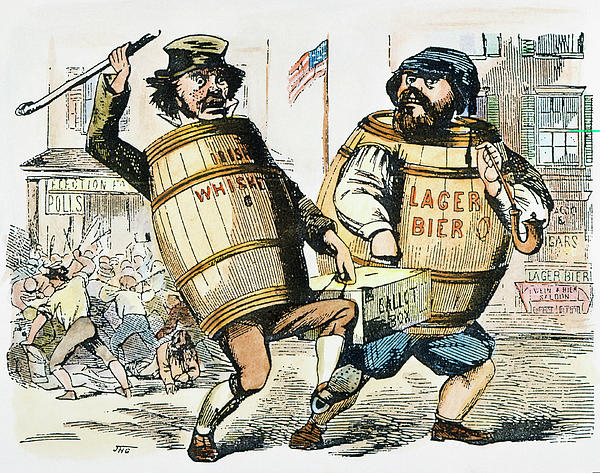
A Know-Nothing cartoon depicting stereotypes about whiskey drinking Irish and beer drinking Germans as they steal the ballot box while Americans fight at the polls., , 
 
 
It has so far annoyed but not really surprised me that Donald Trump, despite being an obnoxious bully, has defied expectations with a steady rise in the public opinion polls. It may be that his buffoonery and megalomania are simply more attractive to some early voters than rival candidates, with their solemn professions that what pushes them into the grind of campaigning is their dedication to promoting the public welfare.
But I am considerably more than annoyed when Trump puts himself at the head of the armies of the new nativism by using his bullhorn to echo the warnings of the movement’s Cassandras against the supposed “hordes” of undocumented immigrants pouring through our “open southern border.” His point of attack is the so-called “anchor babies” — children of pregnant mothers who supposedly sneak into the United States so that their children will be born here and automatically become citizens.

Monday, September 14, 2015

Students, Activism, and the Constitution


“Raising Issues About Citizens, Activism and the 
Constitution”

Friday, September 18, 2015Orchard Suite, University Union
3:00pm-4:00pm   Sacramento State
Dr. Duane Campbell, Sacramento State Professor Emeritus of Bilingual/Multicultural Education, will address how activism, action, and reflection are essential to efforts to protect, defend and extend our democracy. The courts alone will not protect our democracy, especially in light of the Supreme Court rulings on Citizens United, the Voting Rights Act and the rise of Donald Trump.  Thus, it falls to each generation to protect democracy – are you going to be part of the problem or part of the solution?
Donald Trump's attack on the Mexican American people is dumb and dangerous. 
Reception to follow after the talk. Sponsored by:The Serna Center


Duane Campbell is the electoral chair of the Sacramento Progressive Alliance and the former chair of Democratic Socialists of America. Event is part of the Constitution Week program at Sac State. 

Friday, September 11, 2015

Charter Schools May be Unconstitutional

Washington State Supreme Court: Charter Schools Are Unconstitutional - A Landmark Ruling

September 9, 2015
.


Court Rules Charter Schools Unconstitutional
By John Higgins, Seattle Times education reporter
September 8, 2015
Seattle Times
After nearly a year of deliberation, the state Supreme Court ruled 6-3 late Friday afternoon that charter schools are unconstitutional, creating chaos for hundreds of families whose children have already started classes.
The ruling - believed to be one of the first of its kind in the country - overturns the law voters narrowly approved in 2012 allowing publicly funded, but privately operated, schools.
The latest: 2 charters say they will stay open this year despite ruling
Eight new charter schools are opening in Washington this fall, in addition to one that opened in Seattle last year.
It was not immediately known what would happen with the schools that are already running. The parties have 20 days to ask the court for reconsideration before the ruling becomes final.
In Seattle, Summit Sierra, a new college-prep high school, opened Aug. 17 in the Chinatown International District with its inaugural freshman class of 130.
"We will absolutely be here ready for kids on Tuesday," said Executive Director Malia Burns.
School also started Aug. 17 at SOAR Academy and Summit: Olympus in Tacoma. Excel Public Charter School in Kent began Aug. 20, and Destiny Charter Middle School in Tacoma opened Aug. 24. Rainier Prep's first day of class was Tuesday.

Wednesday, September 09, 2015

Seattle Teachers Go On Strike

For the first time in 30 years, Seattle teachers are hitting the picket lines on Wednesday after the teachers union and the school board failed to negotiate a tentative agreement.
The Tuesday decision to strike—made with what the union describes as "an unprecedented, thunderous unanimous vote," closes schools on what would have been the first day of school for roughly 50,000 students.
The problems the public school teachers say are driving the strike include those teachers across the nation have also cited, including an over-reliance on standardized testing and  flawed methods for evaluating educators. The Seattle Education Association (SEA) outlines the issues summer-long negotiations have failed to resolve:
Professional pay: We need to attract and keep caring, qualified educators in Seattle, which is one of the most expensive cities in the United States. We've gone six years with no state COLA and five years with no state increase in funding for educator health care.
Fair teacher and staff evaluations: Educators should be evaluated fairly and consistently, and the focus should be on providing the support all educators need to be successful.
Reasonable testing: Too much standardized testing is stealing time away from classroom learning.
Educator workload relief: Current workloads mean many students aren't getting the help they need.
Student equity around discipline and the opportunity gap: We need to focus on equity issues in every school, not just some.
The administration's proposal to make teachers work more for free: It is unrealistic to expect teachers to work more hours without additional pay, and the district administration has been unable to explain how their proposal would help students.

Friedrichs v CTA


TEACHERS FILE FRIEDRICHS BRIEF: A group of California teachers filed the first salvo in a Supreme Court case that could impose right-to-work rules on government employees nationwide. Lawyers for Rebecca Friedrichs and several other teachers asked the high court to overrule its 1977 Abood precedent and prohibit unions from collecting non-member agency fees to cover bargaining costs. The plaintiffs say that unions such as the California Teachers Association "administer the largest regime of compelled political speech in the nation," according to the Sept. 4 brief. 
"California law makes these payments mandatory for every teacher working in an agency-shop school - which is virtually every teacher. This multi-hundred-million-dollar regime of compelled political speech is irreconcilable with this court's decisions in every related First Amendment context, as well as its recent recognition of 'the critical First Amendment rights at stake' in such arrangements," they said. 
Read the full brief, courtesy of On Labor: 
 Reposted from Politico, Morning Edition 

Tuesday, September 08, 2015

Bilingual Education and Common Core

English-Only to the Core

What the Common Core means for emergent bilingual youth

BY JEFF BALE

Children and their parents demonstrate against English-only Proposition 227. Oakland, California, 1998.
Photo credit: David Bacon
Among bilingual educators, there has been much debate about the Common Core State Standards (CCSS). Some of the most respected scholars of bilingual education have endorsed the Common Core and are working hard to make it relevant for English learners. Others have been more suspicious. Not only do the standards focus on English-only, critics note, but they were bankrolled by the Gates Foundation, pushed on states in a way that amounts to bribery by the Obama administration, and promise to worsen the impact of high-stakes standardized testing.
In fact, the genesis of the Common Core stands in direct contrast to how bilingual education programs were won, namely through grassroots, explicitly anti-racist organizing by students, parents, teachers, and community allies. The standards thus raise a key question: Given the history of bilingual education programs in the United States, is it possible to expand social justice for emergent bilingual youth through the Common Core?
Addressing that question has been challenging, given the inconsistent responses of professional and civil rights organizations to the standards. The National Association for Bilingual Education (NABE) issued a position statement in January 2013 with mixed messages. Although NABE’s membership passed a resolution opposing the Common Core, the statement explains that the group is “working collaboratively with policymakers, school administrators, and teachers” to ensure that implementing the Common Core does not negatively impact English learners. The TESOL (Teachers of English to Speakers of Other Languages) International Association issued a policy brief endorsing the standards.

Thursday, September 03, 2015

Teachers: I am My Union

When Chris Christie said that our union deserves “a punch in the face,” I was appalled but not surprised. When Scott Walker compared union members in Wisconsin to members of the terrorist organization ISIS, I was disappointed but not shocked. 
It’s no secret there is a well-funded operation out there whose only mission is to destroy unions and strip workers of our rights and dignity. Over-the-top comments from politicians are just more examples of how brutal it’s gotten.
But our unions aren’t faceless buildings. Unions are our members—our brothers and sisters who are out there every day working to improve our communities and provide for their families. That's how this country prospered after World War II, building a middle class through strong unions. And today, as our country wrestles with stagnant wages and growing inequality, Americans’ approval of labor unions is the highest it has been since 2008, according to a new Gallup poll. No wonder conservative politicians—who simply want the status quo—try to score political points by attacking us.
This Labor Day, let’s show the people who want to tear workers down the faces of the hard-working Americans they’re attacking. 

Monday, August 31, 2015

How the Ruling Class Remade New Orleans and Its Schools


Much-touted education “reform” has proven unsuccessful
 Thomas Jessen Adams
Source:   Jacobin
Abrasion School children

It’s one of those ironies that New Orleanians tend to especially appreciate. Today, on the tenth anniversary of the failure of the federally maintained levees, the keynote speaker at the annual Rising Tide Conference on the Future of New Orleans will beDeRay Mckesson [1].
Presumably, Mckesson’s invite was the result of his impressive work publicizing Black Lives Matters issues and protests across the country in the past year. But before McKesson became an activist in that movement, he was a standard-bearer for Teach For America and the New Teacher Project — education “reform” organizations that played a crucial role in aiding and abetting the destruction of New Orleans’ black middle class and propagating a pedagogical philosophy [2] that apes the worst of culture of poverty [3] rhetoric.

Such seeming incongruities are rampant this month in New Orleans, as they have been for the last ten years. Developers, urban planners, corporations, nonprofits, self-proclaimed activists, politicians, education “reformers,” hip consumers, middlebrow magazines, anarchists, urban farmers, bicycle enthusiasts, authenticity seekers, and “change agents” continually celebrate the city’s supposed rebirth, resilience, reform, rebuilding, re-whatever.
But it’s worth stepping back to consider whether such ironies are truly ironic, or rather just symptomatic of a larger condition that has plagued New Orleans — and the rest of the nation — over the past decade.
Since the levee failures, New Orleans has been ground zero for what on its face looks like a diverse cohort seeking to use the Katrina-produced “blank slate [4]” as a canvass [5] on which to enact their vision of twenty-first century reform. Black and white, gay and straight, wealthy and riddled with student debt, seventh-generation New Orleanian and recent Brooklyn-migrant, Republican and anarchist — little to nothing at the level of what the cultural studies aficionados might call positionality unites them.
Dig deeper though, and they share certain commonalities, commonalities integral to the only positionality that matters in the context of Katrina’s devastation and the resulting ten years of dislocation and upward redistribution of wealth: their political commitments and actions.
Indeed, what appears to be a motley group with every conceivable background and ascriptive subjectivity is, upon closer inspection, a class. It is a class well past the point of consolidation and one whose prerogatives have indelibly shaped the city’s rebuilding — dictating for whom New Orleans has and has not been rebuilt, all the while postulating and profiting from an ahistorical construction of authenticity, organic community, and ascriptive affinity as the basis for representation.
Mckesson is a particularly interesting case because he crystallizes these issues so well. One may ask how a dogged determination to end police violence against African Americans can be reconciled with a vision of education reform that cares nothing for questions of structural political economy, school funding, or the control of teachers over their classrooms, and instead supposes that the problem is that not enough teachers come from elite Northeastern colleges and universities; too many of them are old, lethargic, and evidently devoid of that pinnacle of neoclassical economics, “human capital”; and that poor students need to be cured of their Moynihan [6]-style tangle of pathologies.
The answer of course, is that they are not incompatible at all.
A deep and abiding commitment to dismantling a heavily militarized criminal-justice infrastructure does not necessitate that the committed individual oppose a national attack on democratic control over schools, the devaluation of teachers and their labor, an emphasis on market choice as a solution to structural inequality and disinvestment, or a base-level assumption that poverty and inequality are the results of damaged psyches and behavioral traits supposedly endemic to poor communities.
Instead, Mckesson’s appearance in New Orleans is a perfect encapsulation of the city’s last ten years. The “grand experiment” perpetrated on New Orleans teachers, students, and schools has always been done in the language of social justice, antiracism, and multiculturalism.
So has the broader grand experiment of the “new” New Orleans. New Orleans has not just been reconceived and reimagined — it has been rebuilt to serve and further specific material and ideological interests. It is a city increasingly designed not to produce equality but to give opportunity to the “worthy” while driving out [7] as many “unworthy” as possible. (The exception of course being those needed to staff the low-wage hospitality [8] and service industry, along with those whose labors [9] produce the city’s appeal as something timeless and supposedly outside the market and the profit motive — an appeal that is one of market culture’s most valuable commodities in contemporary capitalism.)
Any serious reckoning with the last ten years must start with the following facts about post-Katrina New Orleans.
Approximately 100,000 people, mostly African American, have not returned to the city. Real-estate values have doubled, tripled, and even quadrupled in some neighborhoods; rents have more than doubled in many neighborhoods; and the city’s public housing, well-built and largely unaffected by the floodwaters, has been turned over to private developers [10] and razed in favor of mixed-income complexes designed to eliminate the supposed pathologies of the poor while making developers a handsome profit. Meanwhile, countless publicly owned properties have been gifted to high-end, well-connected developers for a song.
Wages have stagnated to the point where the city is the second most unequal in the nation. Public transportation [11] is even more nonexistent than before the flood (no small feat).
Much-touted education “reform” has proven unsuccessful [12] even when judged by its proponents’ favored metric, high-stakes standardized tests, and has both incentivized schools to give up on the city’s most disadvantaged children and produced a generation of New Orleanians educated with the sole purpose of passing a standardized test. Effected through the mass firing [13] of veteran African-American teachers, the decimation of the traditional public school system also eviscerated the city’s black middle class. And finally, the removal of education policy from democratic control placed it in the hands of a variety of corporate-backed organizations.
University of New Orleans — a once-proud public university that regularly educated between 15,000 and 17,000 largely working-class students a year and produced cutting-edge research across various fields of human inquiry — has been so hollowed out that the very question of its continued existence is a cruel parlor game played every year by faculty and a student body cut nearly in half.
Of the $6.4 billion that was to be distributed [14] by the private infrastructure consultancy firm ICF International to help homeowners rebuild, only $1.5 made it to residents. Meanwhile, ICF’s stock price has almost tripled. The money that did reach residents was doled out in a manner reminiscent of redlining, increasing capital in the hands of the wealthiest New Orleans property owners — disproportionately white — while decreasing it in the hands of the poorest —disproportionately black. Not a cent was allocated at any level for renters to return, nor were any rental market controls put in place to aid in their homecoming.
The Avondale Shipyards [15], which paid middle-income wages and was formerly the region’s largest private employer, unceremoniously closed its doors in 2013 after suffering a slow and hardly noticed death.
A perfectly functional hospital [16] that was an important symbol of local identity and provided the city with a strong tradition of low-income and indigent care wasn’t reopened after the storm. Yet the city bulldozed a relatively unflooded, working-class neighborhood and spent $1.1 billion to build a shiny new hospital on the promise that it would attract high-income employees from out of state — whose income would, they insisted, trickle down.
The majority of the direct producers of New Orleans’ vaunted culture — its musicians, artists, culinary workers — make poverty wages. An even greater majority of their support staff — the dishwashers, bartenders, taxi drivers, maids, etc. who provide the labor infrastructure for New Orleans’ culture to be sustained — live on well below poverty wages.
Louisiana continues to lead the nation in incarcerated residents, the majority of who do their time in for-profit prisons. New Orleans has effectively criminalized [17] homelessness even while its percentage of homeless residents has risen to the second highest in the nation. The list could go on and on.
The political and social divisions that exist within the city are not simply red herrings that obscure the causes of this growing dislocation. The divisions themselves are the legitimating agents of this inequality.
To put it bluntly, New Orleans has become a tremendously profitable model city for global capital. Yet the lines of debate within the city virtually never break down along the question of who stands to make money and who stands to be further disenfranchised.
Equally as problematic, the grand experiment itself has furthered the ideological hegemony of this expropriation well beyond the confines of Orleans Parish. Countless self-identified liberals, progressives, and social justice advocates around the country and the world tout the city as the exemplar for education reform, film tax incentives, the development of a cultural economy, corporate-backed non-profit solutions to social problems, entrepreneurial culture, and such revolutionary developments as locally produced food, DIY art projects, and resistance through performance and consumer culture.
It is in this manner that New Orleans’ new ruling class has come to govern with absolute hegemony.
Homages to culture and culture-bearers; neighborhood and cultural preservation as end-goals; emphases on proportional racial representation, whether on the city council or in victimhood at the hands of terroristic police; social entrepreneurship, the notion of “doing well by doing good,” and “social justice” outsourced to corporate-backed nonprofits; advocation of urban amenities like bike lanes and locally sourced food markets; even taking down white supremacist monuments and renaming streets bearing the name of treasonous insurrectionists — all of this is perfectly compatible with the dislocations and expropriations of the last decade.
Indeed, these gestures are not simply compatible with the status quo, but serve to refract dissent and contentious politics into questions of subjectivity and identity that in fact provide a bulwark for the prerogatives of New Orleans as a city increasingly divided between those who it has been purposely rebuilt for and those who it has manifestly attempted to exclude.
More than anywhere else in the last ten years of American history, New Orleans exemplifies how equality and justice become functions of equitable distribution along lines of race, city nativity, gender, etc. — rather than evils to be defeated in and of themselves.
Charter school hucksters like Louisiana Superintendent of Education John White and millionaire businesswoman Leslie Jacobs; multi-millionaire developer and destroyer of public housing Pres Kabacoff and his legion of aspirants [18]; politicians ranging from former mayor Ray Nagin to current mayor Mitch Landrieu, along with the vast majority of the city council; former city councilman Oliver Thomas (who famously hoped to rid the city of “soap opera watchers” following the flooding); musical ambassador and public library embezzler [19] Irvin Mayfield; Teach for America and the New Teacher Project; actor, organic food provider-cum-profiteer, and would-be real-estate developer [20] Wendell Pierce; virtually every neighborhood association in the city; urban planning and revitalization groups from the local St Claude Main Street to the national Urban Planning Institute; elite interest groups like Tulane University, New Orleans Tourism Marketing Corporation, and Downtown Development District; countless more minor nonprofit hacks and wannabe power brokers.
All have played, and love to play, the game where justice and equality are defined along the lines of representationality, diversity, and multiculturalism.
It’s an easy and profitable game for them to play. Far too often, though, it’s also an easy game for the rest of us to play. We proclaim ourselves resilient. We speak of a rebirth. We glorify resistance through the market. We proclaim our culture and neighborhoods transhistoric and emphasize imagined forms of authenticity. Wecelebrate [21] groups disconnected from conceivable institutional power mechanisms demanding equitable representation.
Our politics — in New Orleans and all across nation — becomes about morality tales of injustice based on subject position, racial representation, or authentic embeddedness in some imagined organic community. It fails to recognize the cause of these injustices — the profit motive and a dire lack of institutional means to curtail it. And at the end of the day, it reinforces the rules of a game that at best allows for a more equitable distribution of inequality.

See footnotes on Jacobin Magazine site.


Creative Commons License
This work is licensed under a Creative Commons Attribution-NonCommercial 3.0 Unported License.