Showing posts with label Duncan. Show all posts

Friday, October 02, 2015

Arne Duncan Resigns

A major leader in the fake school reform crowd.
U.S. Education Secretary Arne Duncan came to Washington to reform K-12 schooling. But as he announced Friday that he plans to leave office in December, it appeared more likely that his legacy would be defined by the unprecedented distress among millions of Americans struggling to pay back student loans.
The Debt Collective, a pro-borrower group, said it hoped that the next secretary "has the wherewithal to clean up the department's mess and do what's right."
Duncan will be replaced by John B. King Jr., a senior adviser who has been doing the job of deputy secretary since January even as President Barack Obama has declined to nominate him for the post. Multiple news outlets reported Friday that Obama would not formally nominate King to be secretary either, avoiding a Senate battle. Like Duncan, King has spent most of his career so far focused on K-12 issues.

Tuesday, August 25, 2015

The Teacher Shortage is No Accident

In These Times · http://www.inthesetimes.com

BY Kevin Prosen


Like much else in the national education debate, panics about teacher shortages seem to be a perennial event. In a widely discussed article for the New York Times earlier this month, Motoko Rich called attention to sharp drops in enrollment in teacher training programs in California and documented that many districts are relaxing licensure requirements as a result, pushing more and more people into the classroom without full certification or proper training.

“It’s a sad, alarming state of affairs, and it proves that for all our lip service about improving the education of America’s children, we’ve failed to make teaching the draw that it should be, the honor that it must be,” mused Times columnist Frank Bruni.

That Bruni would bemoan such a state of affairs is ironic, as he has used his column over the years to repeatedly argue that teaching is too easy a profession to enter and too easy to keep, and amplified the voice of reformers who want to want to make the profession more precarious. But the reality is that speaking of a “shortage” at all is a kind of ideological dodge; the word calls to mind some accident of nature or the market, when what is actually happening is the logical (if not necessarily intended) result of education reform policies.

Wednesday, January 14, 2015

More testing from renewed NCLB

AFT’s Weingarten on Secretary Duncan’s ESEA Reauthorization Remarks

In discussing priorities for a revision of No Child Left Behind Secretary of education, Arne Duncan, insisted on  January 5, that the administration would not back away from annual testing for students and performance evaluations of teachers based in part on the results of the tests.

Annual testing has become a point of contention in the often-bitter discussions about how best to improve public education.

Monday, January 12, 2015
WASHINGTON—Statement from American Federation of Teachers President Randi Weingarten on Education Secretary Arne Duncan’s speech regarding the reauthorization of the Elementary and Secondary Education Act.
"As I've said before, any law that doesn't address our biggest challenges—funding inequity, segregation, the effects of poverty—will fail to make the sweeping transformation our kids and our schools need. Today, it was promising to hear Secretary Duncan make a call for equity, stressing, as we did through the Equity and Excellence Commission, the importance of early childhood education and engaging curriculum. It was encouraging to hear him laud the hard work of educators, who have had to overcome polarization and deep cuts after a harsh recession. And it was heartening to hear him acknowledge the progress our schools have made. However, the robust progress we saw in the first 40 years after the passage of ESEA has slowed over the last 10 years.

Friday, August 01, 2014

New President of NEA and Arne Duncan

Jeff Bryant:
For years, politicians and policy leaders have been running the nation’s public education system basically by the seat of the pants, drafting and passing legislative doctrine that mostly ignores the input from classroom teachers, research experts and public school parents.
What’s got teachers stirred up? How real and potent is this upsurge of their activism? Why should people who identify with progressive causes care? Salon recently posed those questions, and others, to Lily Eskelsen GarcĂ­a, the new president-elect of the National Education Association, the nation’s largest teachers’ union, at the recent Netroots Nation conference in Detroit.
First of all, congratulations on becoming the new NEA president.
Still president-elect. I take office Sept. 1. We have an incredible president, Dennis Van Roekel, who basically said a transition period should be a transition period, not go stand in the corner. So he gave me the president-elect title and told me I would take the press calls, go to Netroots, meet with Arne Duncan, start establishing where you want to go and be as vocal and as visible as you can possibly be. Our members have asked NEA to step up and take things to another level. There’s too much at stake for us. There are policies that need addressing and we have some of the best policy expertise in the nation, but those ideas need a face to the NEA, a face for the American teacher that is channeling the voices of these 3 million educators, and when you hear the words come out of her mouth it’s not just her opinion — it’s a whole lot of teachers and support staff who are saying here’s an important thing for the American people to hear and an important thing for Arne Duncan and President Obama to hear. So he told me to start being that voice today.
The voices of these teachers are important, aren’t they? And too often we don’t really hear their stories about what it’s really like to teach in American schools, do we? For instance, I was just at a meeting of the American Federation of Teachers, where a teacher told us about showing up to school one morning and finding a man had been shot to death in front of the building the night before. The body was still on the sidewalk as the kids were coming to school, and the teachers had to decide how they were going to handle this with the children. So many of our teachers are really serving as first responders for kids, aren’t they?

Tuesday, June 10, 2014

Corporate Democrats win first round against teachers in California

Jennifer Medina
June 10, 2014
The New York Times
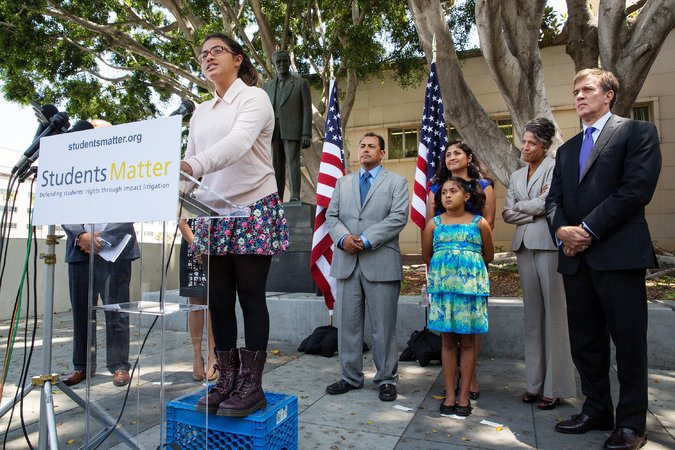
The decision, which was enthusiastically endorsed by Education Secretary Arne Duncan, brings a close to the first chapter of the case, Vergara v. California, in which a group of student plaintiffs backed by a Silicon Valley millionaire argued that state tenure laws had deprived them of a decent education by leaving bad teachers in place.

Julia Macias, at a news conference Tuesday, was one of nine students who claimed tenure laws left bad teachers in place.,Monica Almeida/The New York Times ,


“It's surprising that the court, which used its bully pulpit when it came to criticizing teacher protections, did not spend one second discussing funding inequities, school segregation, high poverty or any other out-of-school or in-school factors that are proven to affect student achievement and our children." Randi Weingarten. President. American Federation of Teachers.
LOS ANGELES — A California judge ruled Tuesday that teacher tenure laws deprive students of their right to an education under the state Constitution and violate their civil rights. The decision hands teachers’ unions a major defeat in a landmark case, one that could radically alter how California teachers are hired and fired and prompt challenges to tenure laws in other states.
“Substantial evidence presented makes it clear to this court that the challenged statutes disproportionately affect poor and/or minority students,” Judge Rolf M. Treu of Los Angeles Superior Court wrote in the ruling. “The evidence is compelling. Indeed, it shocks the conscience.”
The decision, which was enthusiastically endorsed by Education Secretary Arne Duncan, brings a close to the first chapter of the case, Vergara v. California, in which a group of student plaintiffs backed by a Silicon Valley millionaire argued that state tenure laws had deprived them of a decent education by leaving bad teachers in place.Observers on both sides expect the case to generate more like it in cities and states around the country. David Welch, a Silicon Valley technology magnate, spent several million dollars to create the organization that brought the Vergara case to court — Students Matter — and paid for a team of high profile attorneys, including Theodore J. Boutrous Jr., who helped win a Supreme Court decision striking down California’s same-sex marriage ban. While the next move is still unclear, the group is considering filing lawsuits New York, Connecticut, Maryland, Oregon, New Mexico, Idaho and Kansas and other states with powerful unions where legislatures have defeated attempts to change teacher tenure laws.

Friday, September 23, 2011

Duncan Waivers of NCLB

Statement by Randi Weingarten,President, American Federation of Teachers,

On Waivers for NCLB Requirements

WASHINGTON—No Child Left Behind needs to be fixed. Reauthorization, which is Congress' responsibility, is the appropriate avenue to do so. We applaud Sen. Tom Harkin (D-Iowa) and Rep. George Miller (D-Calif.) for their efforts to move that process forward, and we share their frustration that reauthorization is long overdue. In the absence of congressional reauthorization, we understand why the Obama administration is taking this action; we are keenly aware of the calls from parents, teachers and administrators for change—sooner rather than later. Waivers are an imperfect answer to the stalemate in Congress and, at best, can provide only a temporary salve.
Some of what the administration proposes is promising, some is cause for concern, and there are missed opportunities that could have enhanced both teaching and learning.
We are pleased that the administration's proposal includes more options prospectively for improving low-performing schools, recognizing that many of the remedies prescribed in NCLB were not flexible enough. The proposal also acknowledges the importance of adopting higher college- and career-ready standards, which could include the  Common Core State Standards, to prepare kids for a 21st-century knowledge economy.

Monday, August 09, 2010

Crooks, fools, charlatans, carpetbaggers, and school reform


Inexperienced Companies Chase U.S. School Funds
By SAM DILLON


With the Obama administration pouring billions into its nationwide campaign to overhaul failing schools, dozens of companies with little or no experience are portraying themselves as school turnaround experts as they compete for the money.
A husband-and-wife team that has specialized in teaching communication skills but never led a single school overhaul is seeking contracts in Ohio and Virginia. A corporation that has run into trouble with parents or authorities in several states in its charter school management business has now opened a school turnaround subsidiary. Other companies seeking federal money include offshoots of textbook conglomerates and classroom technology vendors.
Many of the new companies seem unprepared for the challenge of making over a public school, yet neither federal nor many state governments are organized to offer effective oversight, said Jack Jennings, president of the Center on Education Policy, a nonprofit group in Washington. “Many of these companies clearly just smell the money,” Mr. Jennings said.
Rudy Crew, a former New York City schools chancellor who has formed his own consulting company, said he was astonished to see so many untested groups peddling school improvement strategies.“This is like the aftermath of the Civil War, with all the carpetbaggers and charlatans,” Dr. Crew said.
_Note. Rudy Crew was once the Superintendent in Sacramento.
The Obama administration has dramatically increased federal financing for school turnarounds, to $3.5 billion this year, about 28 times as much as in 2007. Secretary of Education Arne Duncan is pushing to overhaul 5,000 of the nation’s 100,000 public schools in the next few years.

Sunday, May 23, 2010

Obama, Duncan, and Race to the Top

A chilling article. Pro Duncan.
http://www.nytimes.com/2010/05/23/magazine/23Race-t.html?pagewanted=all

Tuesday, May 12, 2009

Listening and Arne Duncan


Arne Duncan was on CSPAN yesterday explaining his view of budget and the possibilities of school reform.
He said little about NCLB. In the discussion of the stimulus bill, it was clear that California will receive a great deal of money for education. The proposals are approved. Most of the money will go to hire teachers who have been scheduled to be laid off.


Education Secretary Duncan is touring the US to listen and learn about NCLB. Invite him to your school and share how NCLB affects you. Email him at Arne.Duncan@ed.gov

Read more about the “Listening and Learning” tour at:
http://www.ed.gov/news/pressreleases/2009/05/05052009.html

This Tuesday, U.S. Secretary of Education Arne Duncan will begin the "Listening and Learning: A Conversation About Education Reform" tour with three events in West Virginia. In the coming months, Duncan will travel to 15 or more states to solicit feedback from a broad group of stakeholders around federal education policy in anticipation of the reauthorization of the Elementary and Secondary Education Act. The tour will gather input on the Obama administration's education agenda, including early childhood, higher standards, teacher quality, workforce development and higher education. On Tuesday's trip, Duncan will travel with West Virginia State Superintendent Steven Paine, First Lady and State School Board Member Gayle Manchin, and Berkeley School District Superintendent Manny Arvon.
"The primary purpose of the Listening and Learning tour is to have a national dialogue about how to best deliver a complete and competitive education to all children—from cradle through career," Duncan said. "We want to hear directly from people in the classroom about how the federal government can support educators, school districts and states to drive education reform. Before crafting education law in Washington, we want to hear from people across America—parents, teachers and administrators—about the everyday issues and challenges in our schools that need our national attention and support."
Other states targeted for potential events include Michigan; Vermont; California; Montana; Wyoming; New Jersey; Tennessee; North Carolina; Washington, D.C.; Ohio; Indiana; Florida; Utah; and Alaska. Additional states and events may be added during the course of the tour.
Duncan wants to ensure that he visits a mix of rural, urban, suburban and ethnically diverse districts, and hears from a broad range of stakeholders, including students, parents, teachers, administrators and community and business leaders. Specific events will vary from small group private meetings to large public forums.
The meetings and events will be taped, and reports and video summaries will be published on the Department's Website, www.ed.gov. Duncan said the tour will "help launch an open, honest conversation about education reform, because this issue touches everybody in America.
"Education is not just an economic issue," he said, it's a moral issue. It's the civil rights issue of our generation. We have an obligation to give every child in America an education that helps them succeed in their career and fulfill their role as active and involved citizens."

Saturday, May 09, 2009

NCLB : listening tour

Education Secretary Duncan is touring the US to listen and learn about NCLB. Invite him to your school and share how NCLB affects you. Email him at Arne.Duncan@ed.gov

Read more about the “Listening and Learning” tour at:
http://www.ed.gov/news/pressreleases/2009/05/05052009.html

This Tuesday, U.S. Secretary of Education Arne Duncan will begin the "Listening and Learning: A Conversation About Education Reform" tour with three events in West Virginia. In the coming months, Duncan will travel to 15 or more states to solicit feedback from a broad group of stakeholders around federal education policy in anticipation of the reauthorization of the Elementary and Secondary Education Act. The tour will gather input on the Obama administration's education agenda, including early childhood, higher standards, teacher quality, workforce development and higher education. On Tuesday's trip, Duncan will travel with West Virginia State Superintendent Steven Paine, First Lady and State School Board Member Gayle Manchin, and Berkeley School District Superintendent Manny Arvon.
"The primary purpose of the Listening and Learning tour is to have a national dialogue about how to best deliver a complete and competitive education to all children—from cradle through career," Duncan said. "We want to hear directly from people in the classroom about how the federal government can support educators, school districts and states to drive education reform. Before crafting education law in Washington, we want to hear from people across America—parents, teachers and administrators—about the everyday issues and challenges in our schools that need our national attention and support."
Other states targeted for potential events include Michigan; Vermont; California; Montana; Wyoming; New Jersey; Tennessee; North Carolina; Washington, D.C.; Ohio; Indiana; Florida; Utah; and Alaska. Additional states and events may be added during the course of the tour.
Duncan wants to ensure that he visits a mix of rural, urban, suburban and ethnically diverse districts, and hears from a broad range of stakeholders, including students, parents, teachers, administrators and community and business leaders. Specific events will vary from small group private meetings to large public forums.
The meetings and events will be taped, and reports and video summaries will be published on the Department's Website, www.ed.gov. Duncan said the tour will "help launch an open, honest conversation about education reform, because this issue touches everybody in America.
"Education is not just an economic issue," he said, it's a moral issue. It's the civil rights issue of our generation. We have an obligation to give every child in America an education that helps them succeed in their career and fulfill their role as active and involved citizens."

Wednesday, May 06, 2009

Arne Duncan and Chicago School Success?

*****************************
From Rethinking Schools Online, Spring 2009, Volume 23, No. 3. See http://www.rethinkingschools.org/archive/23_03/arne233.shtml
*****************************
Arne Duncan and the Chicago Success Story: Myth or Reality?

By Jitu Brown, Eric (Rico) Gutstein, and Pauline Lipman
When ex-President Bush was elected in 2000, he brought with him former Houston Superintendent of Education Rod Paige to be Secretary of Education. He also brought the "Texas miracle"-supposedly increased test scores attributed to Texas' strict accountability system. All eyes smiled on Texas as those measures quickly became part of No Child Left Behind, passed into law in 2001 by both political parties. Before the end of Bush's first term, Paige would leave in disgrace, thanks to revelations of cooked scores, forced-out students, and other barely legal means of inflating test results.

With the appointment by Barack Obama of Arne Duncan-a noneducator from the business sector who was Chicago's "chief executive officer"-as U.S. Secretary of Education, this phenomenon may repeat itself. For the past several years, Chicago's model of school closings and education privatization has received national attention as another beacon of urban education reform. This may have special relevance as the number of schools "identified for improvement" by NCLB criteria grows, numbering 11,547 nationally in the 2007-08 school year. Other school districts across the U.S. have already undertaken programs similar to Chicago's-New Orleans, in the wake of Katrina, has had a massive privatization of schools (see the special report on New Orleans in Rethinking Schools Vol. 21, No. 1), New York City has proposed closing and phasing out schools using criteria similar to Chicago's (e.g., test scores), and Philadelphia has followed suit as well, with a number of new charter schools. As Chicago Mayor Daley said in a 2006 press conference, "Together, in 12 years we have taken the Chicago Public School system from the worst in the nation to the national model for urban school reform." The Chicago Commercial Club's Renaissance Schools Fund Symposium, "Free to Choose, Free to Succeed: The New Market in Public Education," in May 2008, was attended by school officials from 15 states. The headline for a Dec. 30 article in the Washington Post claimed, "Chicago School Reform Could Be a U.S. Model." And outgoing Secretary Margaret Spellings praised Duncan as a national leader for his teacher incentive pay program.

However, Chicago school policy has not really been set by Duncan-Chicago's education agenda is bigger than him and is about more than schools.
Read the entire piece by clicking on the title.

Tuesday, February 10, 2009

Arne Duncan and NCLB

************************
From U.S. News and World Report, Thursday, February 5, 2009. See
************************
What Arne Duncan Thinks of No Child Left Behind
The new education secretary talks about the controversial law and financial aid forms
By Eddy RamĂ­rez , Kim Clark

Newly minted Education Secretary Arne Duncan has big plans for improving the nation's schools. His first order of business is drumming up support for a stimulus measure that includes an unprecedented $140 billion for education. The 44-year-old former leader of Chicago Public Schools says the money will modernize schools, help stave off teacher layoffs, and spur meaningful reforms. "The fact is that we are not just in an economic crisis; we are in an educational crisis," he says. "We have to educate ourselves to a better economy."

The subsequent item on his agenda will be fixing the Bush Administration's No Child Left Behind law. His opinion of it: "I think we are lying to children and families when we tell children that they are meeting standards and, in fact, they are woefully unprepared to be successful in high school and have almost no chance of going to a good university and being successful."

But Duncan is also interested in other people's opinions. He's meeting with the heads of the two national teachers unions and, if and when the stimulus passes, he plans to travel the country to gather input from school officials and families about ways to improve the federal testing law. Duncan also says he is in the market for ideas to rename the law.

He discussed some of those plans in an interview with U.S. News. Below are highlights of that conversation.
On a federal stimulus for schools: Duncan says a large chunk of the $140 billion destined for education will help states maintain and create jobs. "My concern is that hundreds of thousands of good teachers, not just bad teachers, are going to go, and that would be devastating," he says. "It is to no one's advantage if class size skyrockets or librarians get eliminated or school counselors disappear."

Duncan says the federal stimulus for schools would give him unprecedented leverage to innovate and improve schools. The stimulus provides for $15 billion in discretionary funds that he says he will give to states that agree to implement the following three pieces: expanding early childhood education, creating better student assessments, and improving teacher quality. "If we can bucket all these together and work with set of states with significant resources to make this happen, I think it's a game changer."
On fixing No Child Left Behind: As the former leader of Chicago Public Schools, Duncan lived through what he called the unintended consequences of President Bush's No Child Left Behind law. Duncan supports the focus on accountability for student achievement, but he wants to make the law less punitive. "I know there are schools that are beating the odds where students are getting better every year, and they are labeled failures, and that can be discouraging and demoralizing," he says.

Duncan also wants states to adopt academic standards that are more rigorous and aligned with those of other leading nations. "The idea of 50 states doing their own thing doesn't make sense," Duncan says, referring to the current patchwork of standards and tests. "I worry about the pressure because of NCLB to dummy those standards down."

Duncan says he is concerned about overtesting but he thinks states could solve the problem by developing better tests. He also wants to help them develop better data management systems that help teachers track individual student progress. "If you have great assessments and real-time data for teachers and parents that say these are [the student's] strengths and weaknesses, that's a real healthy thing," he says."

Asked if he will push for passage of a new version of NCLB, Duncan says that he first wants to go on a cross-country listening tour and that he hopes that Congress will reauthorize a new version of the law late in the year. "Having lived with this, I have a good sense of what makes sense and what doesn't," he says. "But I want to be clear that I want to get out there and learn from people. And I think ultimately we should rebrand [the law]."

Asked what he would call a new version of the law, Duncan answered, "Don't know yet. I'm open to ideas."
On higher education: Duncan did not offer too many concrete ideas on higher ed. He says community colleges will play a vital role for an extraordinary number of adults who need training for new jobs in the health, technology, and green sectors. That's why he wants to make sure that more students are prepared for college and leave college with a degree.
He says he will offer colleges incentives to graduate more students on time. "We need to get dramatically more of our students not just into college but through college," he says. Duncan also wants to remove barriers to college by making it easier for students to complete financial aid forms. "You need a Ph.D. to figure [the FAFSA] out," he says. "I think we have to simplify information and get information to students and families earlier.
-------------------
PHOTO SIDEBAR: Arne Duncan, Secretary of Education
***************************************

Tuesday, January 13, 2009

Hearings on Secretary of Education: Duncan

SENATE HEARING TUESDAY SPOTLIGHTS SCHOOL REFORM

Associated Press -- January 13, 2008
By Libby Quaid

Barack Obama's choice for education secretary, Arne Duncan, said Tuesday he wants to improve the No Child Left Behind law and lure more people into teaching.

And the nation's school children should be on notice: Duncan would like longer school days, Saturday school and summer school.

Duncan, the Chicago schools chief, got a friendly reception from Republicans and Democrats alike at his Senate confirmation hearing, a sign that his nomination will be approved swiftly.

Tennessee Republican Sen. Lamar Alexander, who served as education secretary under President George H.W. Bush, declared Duncan to be "the best" of Obama's nominees.

The education community is watching closely to see how Obama will proceed on President Bush's No Child Left Behind law, which passed with bipartisan support in 2001 but is deeply unpopular today. Obama has pledged to overhaul it but has been vague about how far he would go.

Duncan told the Senate Health, Education, Labor and Pensions Committee the law should not punish schools where only a handful of kids are struggling.

He praised the law for shining a spotlight on children who need the most help. No Child Left Behind holds schools accountable for progress among each group of kids, including those who have disabilities or are learning English.

But right now, a school is labeled as failing if only one group of kids is struggling, even when the rest of the kids are making gains. Give individual kids more tutoring and other support, Duncan said.

"Let's not take too blunt an instrument to an entire school," Duncan said. "Those teachers are doing a Herculean job, and we need to recognize that. We need to reward that."

Along the same lines, Duncan suggested he's open to letting more special ed kids take a modified version of the annual tests required by No Child Left Behind. He was responding to Georgia Republican Sen. Johnny Isakson.

"You want to have assessments that actually assess a student's ability," Duncan said. "If you give any child an assessment they can't read or pick up a pen, what benefit is that to the child? What are we as adults learning from that?"

No Child Left Behind prods schools to improve test scores each year, so that every student can read and do math on grade level by the year 2014. It was due for a rewrite in 2007, but the effort stalled. Lawmakers hope to try again within the next couple of years.

School reform advocates who want to keep the law have been heartened by the selection of Duncan, a big-city schools chief they view as a kindred spirit. Duncan has run Chicago public schools for the past seven years.

Yet it was hard to pin down exactly where Duncan stands on No Child Left Behind and other controversial issues.

"I have seen the law's power and its limitations," Duncan said in his testimony. "I agree with the president-elect that we should neither bury NCLB nor praise it without reservation."

At the same time, Duncan praised an idea unions have resisted, the idea of teacher pay raises tied to student performance. Duncan started a performance-pay program in Chicago with federal dollars from the Education Department.

"That's something that I want to look at, to not just support but also potentially increase," Duncan said. "We can't do enough to reward and recognize ... excellence."

Duncan said he intends to travel the country recruiting new teachers and to take steps to keep teachers on the job.

"Given the tough economic times, that actually helps our chances of recruiting great talent," Duncan said.

Duncan also said kids should spend even more time in the classroom. Kids in 200 schools came to class on Saturdays last year, Duncan said, and he brought 15,000 freshmen back to school a month early on a voluntary basis.

"I think our school day is too short, our week is too short, our year is too short," he said.

Duncan, 44, introduced his wife and children to the Senate Health, Education, Labor and Pensions committee, saying his interest in schools is obviously more than professional.

Duncan worked in Chicago schools under former schools chief Paul Vallas after heading an education nonprofit. Before that, he played professional basketball in Australia, where he worked with underprivileged kids as a social worker. He grew up working in his mother's tutoring program on Chicago's South Side.

In Chicago, Duncan managed to raise test scores and graduation rates, and he improved the quality of teaching.

His critics, however, say he shouldn't get credit for better test scores because they improved before he took over and state tests became easier during his tenure. Parents who opposed his aggressive school closings say they were disruptive to kids.

FAIR USE NOTICE
This site contains copyrighted material the use of which has not always been specifically authorized by the copyright owner. We are making such material available in our efforts to advance understanding of education issues vital to a democracy. We believe this constitutes a 'fair use' of any such copyrighted material as provided for in section 107 of the US Copyright Law. In accordance with Title 17 U.S.C. Section 107, the material on this site is distributed without profit to those who have expressed a prior interest in receiving the included information for research and educational purposes. If you wish to use copyrighted material from this site for purposes of your own that go beyond 'fair use', you must obtain permission from the copyright owner.

Wednesday, December 17, 2008

Duncan's Record

From the Chicago Catalyst.
Duncan's track record
by Sarah Karp and John Myers
December 15, 2008

In his seven years as CEO of Chicago Public Schools, Arne Duncan has taken on a host of urban education policy challenges to varying degrees of success.

This week, Catalyst revisits some of these signature initiatives, and weighs their significance on the national scene.

Today, we look at the efforts of the Secretary of Education designate to transform high schools, offer families more and better school choices and raise the performance bar for teachers, principals and administrators.

Reforming high schools

Duncan’s oft-stated goal was to create the “best urban school district in the nation.” Yet here, as elsewhere, high schools have made little progress.

Overall high school graduation rates improved under Duncan (up to 55 percent from 47 percent), as did college-going rates (up to 50 percent from 44 percent).

Also improved is the district’s accountability around making sure students go to college. Duncan created the Office of Post-secondary Education and charged it with tracking students after they graduate. CPS is one of the few urban districts that partners with the National Student Clearinghouse, a data warehouse, so it can keep tabs on its graduates. And this past year, Duncan personally pushed principals to get more students to fill out financial aid eligibility forms.

But even with these modest improvements, fewer than a third of the students who were freshmen in 2003 and graduated four years later enrolled in college.

Individual schools, particularly neighborhood high schools like Marshall in the impoverished West Garfield Park community, have not done much better under Duncan’s leadership. Marshall’s graduation rate, for instance, is 40 percent, up only four points; and its college-going rate actually declined 4 points to 31 percent.

Meanwhile, districtwide high school test scores remain stagnant—only 31 percent of juniors meet state standards—leading many to question whether CPS graduates can succeed in college or in the job market. All but two of the 10 lowest performing high schools in 2001 lost ground by 2008.

Duncan has used three strategies to fix high schools: Close them down and replace them with new, smaller schools (Renaissance 2010); fire school staff and reopen under new management (turnaround strategy); or infuse classrooms with new curriculum and materials (High School Transformation). On all fronts, long-languishing, often-ignored high schools got some much needed attention. Also, education experts laud the focus that these efforts have placed on what goes on in the classroom.

But problems with high schools are so entrenched and intertwined with poverty that it is difficult to predict whether these efforts will be enough.

High School Transformation, for instance, launched in 2005 with the promise of delivering carefully chosen curricula designed to engage low-income students, and the teacher training to go with it. Currently, 50 schools are participating at a cost of $80 million. The influx of equipment, such as laptops and science lab materials, has been especially welcome in resource-starved schools.

But the implementation has been rocky. Earlier this year, Catalyst reported that hundreds of students in the city’s worst high schools showed up weeks after the school year had begun. On average, students in these schools were absent 50 days or more. Teachers wound up spending weeks doing catch up and back tracking. Meanwhile, this problem has received little attention in recent years, and the one tool schools need to combat it—truancy officers—are long gone. [See High School Transformation]

Duncan concedes High School Transformation has its limits. To fill some of the gaps, he has created programs to keep freshmen on track academically, and to support small groups of students most at-risk of dropping out.

For individual students, these kinds of supports show promise. The question is: Can Duncan bring them to scale, especially nationally?

Also see:
http://www.truthout.org/121708R

Obama's Betrayal of Public Education?
Arne Duncan and the Corporate Model of Schooling
 
Creative Commons License
This work is licensed under a Creative Commons Attribution-NonCommercial 3.0 Unported License.