What do basketball legend Charles Barkley and the late Supreme Court Justice Oliver Wendell Holmes Jr. have in common? An understanding that taxes fund things that we need and value.
Holmes told a law clerk who complained about paying taxes, “I like to pay taxes. It’s what we pay for a civilized society.” More than a century later, Barkley came to a similar conclusion. He used to say he did not like paying taxes, until he got a call from basketball icon Bill Russell. Russell pointed out that money from taxes paid for the public schools Barkley attended growing up, and for police officers and firefighters in his community. Russell said, “Now that you got money, you don’t want to help other people out, but when you were poor other people took care of you.” Barkley replied, “You will never hear me complain about my taxes again.”
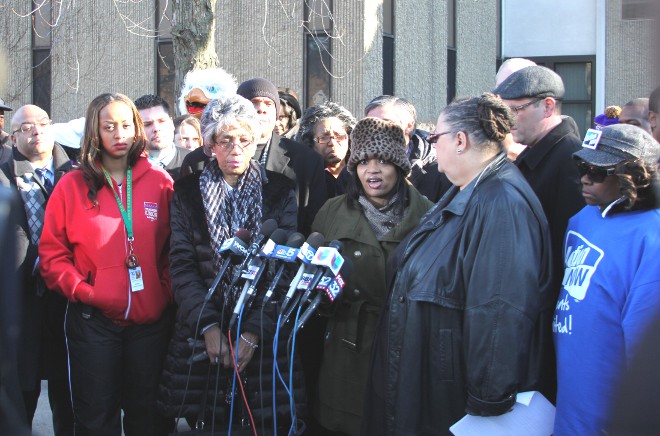
 Weingarten with AFT members in Oklahoma marching to the state Capitol April 2. Photo by Adam Derstine.
But many people do complain about paying their share for essential public services. Some wealthy Americans calculated that they could pay more in campaign contributions in order to pay less in taxes. The Republican-controlled Congress responded with a tax overhaul last December that lavishes the wealthiest 1 percent with 83 percent of the cuts. The nonpartisan Congressional Budget Office last week reported that the plan will increase the deficit to nearly $1 trillion in fiscal 2019, and that, by 2028, the national debt could equal nearly the entire value of all the finished goods and services produced in the country.
Republicans claimed that these massive tax cuts would pay for themselves and benefit all Americans. But retiring House Speaker Paul Ryan immediately backtracked on that pledge. Ryan said Congress would now “tackle the debt and the deficit” the tax cuts create, providing the GOP an excuse to make deep cuts to Social Security, Medicare, food stamps and other programs the neediest Americans depend on.
Americans are not fooled. A recent AFT- Democracy Corps poll found that most respondents have not personally benefited from the tax plan and are unhappy their wages are not keeping up with rising costs. They are angry the GOP plans to pay for tax cuts they don’t benefit from by shredding the social safety net. And they feel strongly the funds being redistributed to the rich should have been invested in public schools, healthcare or infrastructure.
Such investments are vital. Twenty- nine states still spend less on public education than they did before the Great Recession. And many states have seen devastating consequences after sharply cutting taxes. Kansas enacted an extreme form of trickle-down economics, on the premise that it would usher in an economic boom. Instead, state revenue plummeted, the deficit exploded and officials slashed spending on everything from road repair to Medicaid and public education. Kansans across party lines railed against the decimation of public goods and services, prompting the Legislature to pass a $1.2 billion tax increase last year, but the state is still struggling to fund essential public services.
Officials’ choices to cut taxes for the wealthy rather than invest in essential services lie at the heart of the teacher walkouts now gripping the country. In Oklahoma, income tax cuts and tax breaks for the oil and gas industry deprive the state of $1.5 billion a year. West Virginia lawmakers have cut taxes by more than $4 billion in the last decade.
These irresponsible tax cuts have made it impossible to, in Justice Holmes’ words, “pay for a civilized society.” In Oklahoma, textbooks are held together with duct tape, and, while a student was excited to be issued a textbook once used by country singer Blake Shelton, her mother was horrified to realize Shelton had used it nearly 40 years ago. Teacher pay in West Virginia and Oklahoma ranks 48th and 49th lowest, respectively, in the nation.
One of the starkest current examples of disinvestment is in Puerto Rico, where the governor is proposing to close 450 public schools in less than one year. In the wake of the devastation caused by recent hurricanes, this will further tear at the fabric of community life and promote the continuing exodus from the island.
Teachers, students and parents are standing up to prevent this catastrophe.
Meanwhile, it’s testing season in America’s schools. And while many so-called education reformers fixate on algorithms, outputs and accountability, the teachers waging these walkouts offer a reminder that, before anything else, we have to take care of the basics—investing in and supporting our students, their educators and their schools.
We all benefit from safe communities, great public schools and a civilized society. And we all have a responsibility to contribute our fair share to make that possible.