Sunday, July 23, 2023
Donald Trump Is Plotting to Make Himself Dictator
Donald Trump Is Plotting to Make Himself Dictator: His plan is to make the federal government his plaything, and many Republican elites are behind him.


Thursday, July 20, 2023
NEA. Republicans Make Massive Cuts to Education Funding
Republican Congressperson Kevin Kiley ( Rocklin) votes with extremist to cut education budget,
| ||||
|
Saturday, July 15, 2023
Republicans Propose Massive Cuts to Education
House Democrats warned that hundreds of thousands of teachers could lose their jobs if legislation advanced Friday by a Republican-controlled appropriations subcommittee becomes law.
The panel's draft Labor, Health and Human Services, Education, and Related Agencies funding bill for the coming fiscal year calls for nearly $64 billion in total cuts, a proposal that Democrats said "decimates support for children in K-12 elementary schools and early childhood education" and "abandons college students and low-income workers trying to improve their lives through higher education or job training."
The nonprofit Committee for Education Funding noted that the Republican proposal would impact "virtually all" education programs, hitting teacher funding, student aid, and more. The bill, one of a dozen appropriations measures that Congress is looking to pass by the end of September, would bring Department of Education funding to below the 2006 level, according to the group.
Rep. Rosa DeLauro (D-Conn.), the top Democrat on the House Appropriations Committee, said Friday that "we are witnessing a widespread attack on public education that should shock every American family."
"If left to their own devices," DeLauro added, "Republicans would gleefully take public education to the graveyard."
The GOP legislation would slash Title I grants to local educational agencies that serve children from low-income families by nearly $15 billion compared to fiscal year 2023 levels. Appropriations Committee Democrats said the massive cut "could force a nationwide reduction of 220,000 teachers from classrooms serving low-income students" amid a teacher shortage.
The legislation would also completely eliminate funding for a number of Education Department programs, including Federal Work-Study, Federal Supplemental Educational Opportunity Grants, Promise Neighborhoods, and Child Care Access Means Parents in School.
"Disgraceful to say the least," Rep. Barbara Lee (D-Calif.) tweeted in response to the GOP measure.
Jake Johnson, Common Dreams.
https://www.commondreams.org/news/republican-education-cuts
Tuesday, July 11, 2023
Fascist Economics in Florida Schools
DeSantis on Education

Desantis’ record on education resembles that of someone who was once insulted by a teacher and has been holding a grudge ever since. He has signed bills that weaken teachers unions, that attempt to outlaw honest teaching about race and gender and American history, and that undermine the existence of tenure and DEI programs on college campuses. He set his little fascist quislings loose on New College like rats given management duties in a restaurant kitchen, and he has proudly brought book banning back to the public schools. The unsurprising outcome of all of this is that fewer academics want to work in Florida’s universities, and Florida’s public schools are facing “the worst teacher and staff shortage we’ve ever seen,” with teacher vacancies doubling since Desantis took office. His response to engineering this decline of public education was to expand private school vouchers, which is kind of like burning down an apartment building and then offering people their choice of free apartments therein. If history is any guide, Florida’s future will bring worse K-12 schools, worse colleges and universities, angrier parents, teacher strikes, and a populace that is less educated. The classic ingredients of a thriving state!
Monday, July 10, 2023
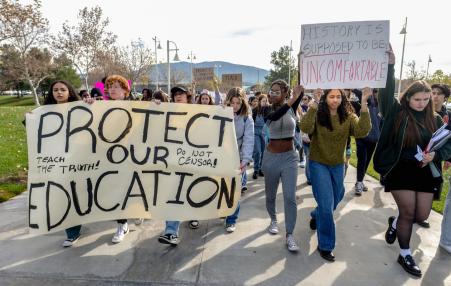
Angry Parents Protest Religious Right Interference in Southern California School District.
|


Saturday, July 08, 2023
Biden Appoints Elliott Abrams _ A War Criminal
Why the hell did President Joe Biden nominate a one-time protector of war criminals to a top administration post?
On the Monday before July 4—a black hole day for news—the White House let drop the word that it was appointing Elliott Abrams to the bipartisan US Advisory Commission on Public Diplomacy. The commission’s job is to oversee US government information programs designed to convey American diplomacy to the world. It keeps an eye on the US Agency for Global Media, which manages the Voice of America and similar programs. The commission essentially helps the United States present its idea of itself to the rest of the planet.
Why the hell did President Joe Biden nominate a one-time protector of war criminals to a top administration post?
On the Monday before July 4—a black hole day for news—the White House let drop the word that it was appointing Elliott Abrams to the bipartisan US Advisory Commission on Public Diplomacy. The commission’s job is to oversee US government information programs designed to convey American diplomacy to the world. It keeps an eye on the US Agency for Global Media, which manages the Voice of America and similar programs. The commission essentially helps the United States present its idea of itself to the rest of the planet.
This is a task for which Abrams is distinctly unsuited.
Long a stalwart in neoconservative circles, Abrams was one of the many cheerleaders in the early 2000s for the disastrous Iraq War. A decade earlier, in 1991, as a player in the Iran–Contra affair, he pleaded guilty to withholding information from Congress about the Reagan White House’s secret operation to arm the Nicaraguan Contras. In short: As a top State Department official, he engaged in a cover-up to hide the arguably illegal operation overseen by Oliver North.
But Abrams most odious (known) action occurred several years previously. As a top Reagan official, he dismissed reports that the US-trained-and-equipped military had massacred 1,000 civilians—including many women and children—in the Salvadoran town of El Mozote in December 1981. This was the largest mass killing in recent Latin American history. But Abrams wanted to protect the Salvadoran army, which the Reagan administration was showering with guns and money, despite its well-established record of human rights abuses. Abrams trash-talked American journalists who reported on the massacre and claimed the horrific reports were “implausible.” He praised the military unit that conducted this awful action. He suppressed the truth to assist killers.
The Iraq War, Iran-contra, covering up mass murder—Abrams represents the worst of American foreign policy over the past four decades.
The US Advisory Commission on Public Diplomacy can only have four of its seven members come from the same political party. That means Biden must appoint several non-Democrats. But why go with an apologist for war criminals?
Friday, June 30, 2023
The Coming Crisis in Public Educati
The Coming Public Education Crisis
A fiscal calamity awaits public schools once pandemic-related federal assistance ends.
Justin H. Vassallo Spring 2023A teacher interacts with students virtually in an empty classroom at Hazelwood Ele[1]mentary School in January 2022 in Louisville, Kentucky. (Jon Cherry/Getty Images)
Of all the social inequities that the COVID-19 pandemic highlighted in the United States, the crisis of public education is among the most intractable. Reports of staffing shortages and declining enrollment—twin problems especially acute for poorer districts contending with slashed budgets and meager classroom resources—have persisted even after the introduction of vaccines for children. With most state funding tied to student enrollment, shrinking attendance means smaller budgets to meet fixed operating costs and fewer funds to attract and retain talented educators. A fiscal calamity awaits public schools once pandemic-related federal assistance ends in September 2024.
Left unaddressed, the crisis portends the return of the “K-shaped” economic recovery—in which the well-off see strong gains and those already struggling experience more instability and income loss—that economists warned about in the early days of the pandemic. The actions of congressional Democrats and other party officials have been discouraging. In late 2021, House Democrats abandoned a proposed $100 billion for modernizing school infrastructure during negotiations over President Biden’s Build Back Better legislation. (The subsequent Inflation Reduction Act did not include meaningful provisions for education.) Absent a political reckoning that extends federal funding to restore programs and classroom resources to pre-pandemic levels, let alone make significant improvements, schools could face a new round of disenrollment at a moment when they are already struggling to recover the approximately 1.4 million pupils who withdrew during the first year of the pandemic.
https://www.dissentmagazine.org/article/the-coming-public-education-crisis/
Tuesday, June 27, 2023
Organizing for Education

|
|
|
|
|
|
|
|
Thursday, June 22, 2023
Chipmaker’s Scramble to Build Marred by Mistakes and Injuries
Chipmaker’s Scramble to Build Marred by Mistakes and Injuries: TSMC’s $40 billion semiconductor facility in Phoenix, an open shop that resisted signing an agreement with labor unions, has been tainted with accidents, alleged wage theft, and costly setbacks.
Anti Union $40 Billion, financed by U.S. Taxpayers.
Poverty and the Moral Majority
Moral Poverty Action Congress is underway, and California is in the house!
The PPC’s Moral Poverty Action Congress kicked off this past Monday. This gathering—the convergence on the nation’s capital of PPC groups from dozens of states, ours included—is a crucial opportunity for us to build on our work, raise our voices, strategize for the coming year, and meet with lawmakers, ensuring that the voices of poor and low-wealth individuals are well-represented in the upcoming election and beyond.
Here are just a few highlights:
- On Monday, Bishop Barber helmed a discussion with economists and public health policy practitioners on poverty; you’ll find a recap of that event below.
- The next day, PPC activists visited more than 400 legislative offices. Our state’s delegates visited all 52 California congresspeople and two senators.
- Bishop Barber and PPC activists raised their voices in front of the Supreme Court. Several shared personal stories of struggles with low wages and lack of health insurance and mourned loved ones lost to poverty.
- Congresspeople Pramila Jayapal (D-WA) and Barbara Lee (D-CA) participated in a press conference on the reintroduction of the Third Reconstruction Resolution. At least 11 more reps were in attendance, including Ro Khanna, who represents a swath of the South and East Bay.
Meanwhile, a timely Religion News op-ed by Bishop Barber and Rev. Theoharis lays bare the violence that poverty inflicts on millions. It opens with the tragic story of Bertha Montes from Los Angeles, who died after being denied a request for help at her job at McDonald’s and was forced to work while she was sick. The piece outlines the extensive evidence of policy harm and the mission of the Moral Poverty Action Congress.
We’ve been posting about the Congress on the CA PPC Facebook page, and you can check the national PPC website for updates and replays.
Finally, let’s not forget that the Congress is also a vital step toward our 2024 campaign, which will include actions at statehouses nationwide, our nonpartisan Get Out the Vote effort and the third Mass Poor People’s and Low-Wage Workers’ Assembly and Moral March on Washington and to the Polls.
Teacher Banned from Teaching About Racism
In February, as part of Black History Month, a high school teacher in South Carolina had to stop using Ta-Nehisi Coates’ memoir “Between the World and Me” in a lesson plan about systemic racism — because teachers are prohibited from making students feel uncomfortable about their race or gender in the state.
Students complained after Mary Wood, who teaches Advanced Placement Language Arts at Chapin High School in Chapin, South Carolina, included the book in a lesson intended to guide students through participating in civil debate, local news outlet The State first reported.
Wood’s lesson plan was a part of preparing for Advanced Placement tests and involved watching two videos about systemic racism, reading Coates’ memoir and doing research with a variety of sources. Then, students were meant to write essays on their understanding of the book and make an argument about whether they agreed with Coates that systemic racism is a problem in the U.S.
“This wasn’t one side or the other,” Wood, who has been teaching for 14 years, told HuffPost. “I wanted them to develop their own understanding.”
Students complained that the lesson made them feel ashamed to be white and were successful in blocking the section on systemic racism entirely.
“Hearing (Wood’s) opinion and watching these videos made me feel uncomfortable,” one student said in their complaint. “I actually felt ashamed to be Caucasian. These videos portrayed an inaccurate description of life from past centuries that she is trying to resurface.”
In 2021, South Carolina Republicans included a provision in the state budget stipulating that taxpayer dollars may not be used to teach lessons suggesting that any race or sex is inherently “racist, sexist, or oppressive whether consciously or unconsciously” or that cause anyone to feel “guilt, anguish or any other form of psychological distress on account of his race or sex.”
“If the goal is to undermine public education, they’re doing a good job of it,” Wood said of the lawmakers who passed the policy. “You cannot talk about glitter and rainbows and still get students to engage with differing viewpoints.”
Once the lesson, which Wood had taught the previous year without issue, was axed, she said she kept her head down and proceeded with an improvised lesson plan using AP tests from the past.
“I was mortified professionally and I felt my hands were tied,” she said. “I certainly didn’t want to use anything self-selected.”
“If the goal is to undermine public education, they’re doing a good job of it.”
Thursday, June 15, 2023
Poverty Action:

Four days away… The Moral Poverty Action Congress begins on Monday in Washington D.C., and California will be in the house! The Congress is a vital step toward our 2024 campaign, which will include actions at statehouses nationwide, our nonpartisan Get Out the Vote effort and the third Mass Poor People’s and Low-Wage Workers’ Assembly and Moral March on Washington and to the Polls. It provides a crucial opportunity for us to build on our work and strategize for the coming year, ensuring that the voices of poor and low-wealth individuals are well-represented in the upcoming election and beyond.
We’ll be posting about the Congress on the CA PPC Facebook page, and you can check the national PPC website for updates and livestreams.
|
Tuesday, June 06, 2023


Saturday, June 03, 2023
antiracismdsa: 16 migrants from Texas flown to Sacramento, droppe...
antiracismdsa: 16 migrants from Texas flown to Sacramento, droppe...: Migrants Flown to Sacramento 16 migrants from Texas flown to Sacramento, dropped off on doorstep of Catholic diocese BY ANDREW SHEELER, MA...
Friday, June 02, 2023
Why Democrats Rescued the Deal
Why Democrats Rescued the Deal: Today on TAP: More Democrats than Republicans voted for the Biden-McCarthy deal. Here’s why.
Tuesday, May 30, 2023
J.Luke Wood to become Sacramento State's President

May 24, 2023
Sacramento State’s incoming president is “Made at Sac State” and proud of it.
CSU trustees on Wednesday, May 24, announced the appointment of J. Luke Wood to lead the University as its ninth president. Wood is coming from San Diego State University, where he is vice president for Student Affairs and Campus Diversity and chief diversity officer.
Wood, 41, will assume the presidency July 16, after the departure of retiring President Robert S. Nelsen, who has led the University since 2015.
Wood is clear about his motivation to be president.
“It’s about investing back in the community that invested in me,” Wood said. “I know what Sac State is capable of doing. I was a Black male, former foster child, first-generation college student who struggled with food insecurity and housing insecurity, and was able to graduate because of the incredible people and systems of support that were in place.
“If Sac State can do that for me, it can do that for anyone.”
Wood, who earned his bachelor’s degree in Black History and Politics as well as a master’s degree in Higher Education Leadership at Sac State, has deep roots in Northern California.
“It’s really about furthering the good work that’s been done around student success, diversity and inclusion, and seeing how we can further continue those trajectories to continue to be even better every day.” - J. Luke Wood, incoming Sac State president
He grew up in the Siskiyou County town of McCloud and was raised along with his identical twin brother Joshua (also a Sac State alumnus) in a large foster home. While in high school, he attended the American Legion California Boys State summer program at Sac State.
“I just had a wonderful experience,” Wood said. “I got to see the campus, and after that there was no other institution on my radar.”
Wood was a highly engaged student leader during his time at Sac State, serving in Associated Students Inc. as a board member and in several vice president positions.
He met his future wife, San Diego State Child and Family Development Professor Idara Essien, while they were students at Sac State.
“We met at the Hornet’s Nest. I saw her and walked up to her. I walked her to class, and we’ve been together ever since,” Wood said. “Sac State gave me two degrees and a life partner.”
They have three children, ages 7 to 14, and frequently visit family in Sacramento.
Wood attended guest lectures at Sac State, as well as Hornet football playoff games last season.
“Sac State is my home base,” he said, emphasizing his enthusiasm for his new job as president.
“For me, it’s coming home.”
Wood credits Sac State’s Educational Opportunity Program, which helps low-income and educationally disadvantaged students succeed in higher education.
“I would never have graduated if not for EOP,” Wood said.
After leaving Sacramento, Wood attended Arizona State University, where he earned a master’s degree in Curriculum and Instruction in Early Childhood Education and a Ph.D. in Educational Leadership and Policy Studies with an emphasis in higher education.
Wood started at SDSU as a professor in 2011. The following year, he became co-director with Frank Harris III of the Community College Equity Assessment Lab (CCEAL), a research and practice center aimed at reducing equity gaps between students of color and their peers.
In 2017, he became the first Black faculty member named a Distinguished Professor at San Diego State.
Wood has served as SDSU’s chief diversity officer and member of the president’s cabinet since 2018, and was named vice president for Student Affairs and Campus Diversity in 2020.
Earlier this year, the California state Senate appointed Wood to serve on the newly established California Racial Equity Commission to address structural racism across the state.
An author of 16 books and more than 180 publications, Wood’s research focuses on racial inequality issues in education, particularly community colleges. He also studies the overexposure of suspensions of boys and students of color in K-12 schools.
“I’m a scholar, so I greatly value scholarship and high-quality teaching,” Wood said.
Wood has co-authored with Carlos Nevarez, Sac State interim provost and vice president of Academic Affairs, four books on leadership of colleges and organizational change.
“I couldn’t be more pleased to welcome Dr. J. Luke Wood to Sacramento State as our new president. I have worked with Dr. Wood as a scholar, colleague, and friend and I know his commitment to innovative, equity-based education will serve our students well,” Nevarez said. “Moreover, his experience perfectly aligns with Sacramento State’s strategic imperative as an Anchor University, and he will be a tireless fighter for inclusivity and belonging on our campus.
"I also want to thank President Nelsen for his service over the last eight years and for inspiring us all to put students’ success and wellness front-and-center in the work we do every day. I look forward to finding opportunities to work with Dr. Wood to build on President’s Nelsen’s exceptional legacy.”
Trustee Diego Arambula, chair of the Sacramento State Presidential Search Committee, called Wood a “champion for access, educational excellence, and student success.”
“He is an equity-driven leader with a demonstrated history of innovation, who will continue to elevate Sacramento State’s vision during its period of continued, transformational growth.”
Sacramento State has bucked a nationwide trend of declining college enrollment. Last fall, 30,883 students were enrolled at Sac State, compared with 29,000 in 2015 when Nelsen became president, making it the sixth-largest campus in the CSU system. Sac State in 2022-23 met enrollment targets set by CSU.
Four-year graduation rates have risen dramatically, jumping from 9% in 2016 to higher than 28% in fall 2022. Those improvements reflect University efforts to meet and surpass goals set in CSU’s Graduation Initiative 2025.
Further, a record 9,574 students graduated from Sac State in spring 2023.
“President Nelsen has done an incredible job in increasing graduation rates and creating a sense of community at Sac State,” Wood said. “So, it’s really about furthering the good work that’s been done around student success, diversity and inclusion, and seeing how we can further continue those trajectories to continue to be even better every day.”
On becoming Sac State’s ninth permanent president (there were two interim leaders), Wood joins a list that began with Guy West, who served from the 1947 founding to 1965. Other presidents were Robert Johns (1966-69), Bernard L. Hyink (1970-1972), James G. Bond (1972-78), and W. Lloyd Johns (1978-83).
Donald R. Gerth (1984-2003) was the University’s longest-serving president. Alexander Gonzalez (2003-15) followed and ultimately handed off to Nelsen.
Subscribe to:
Posts (Atom)


