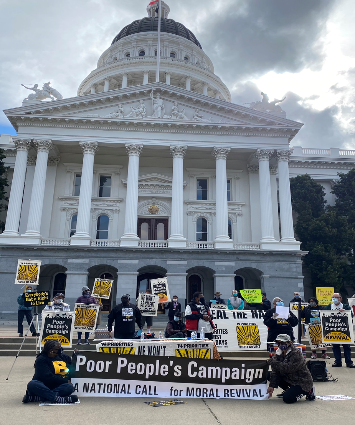
Coming to Sacramento March 2.
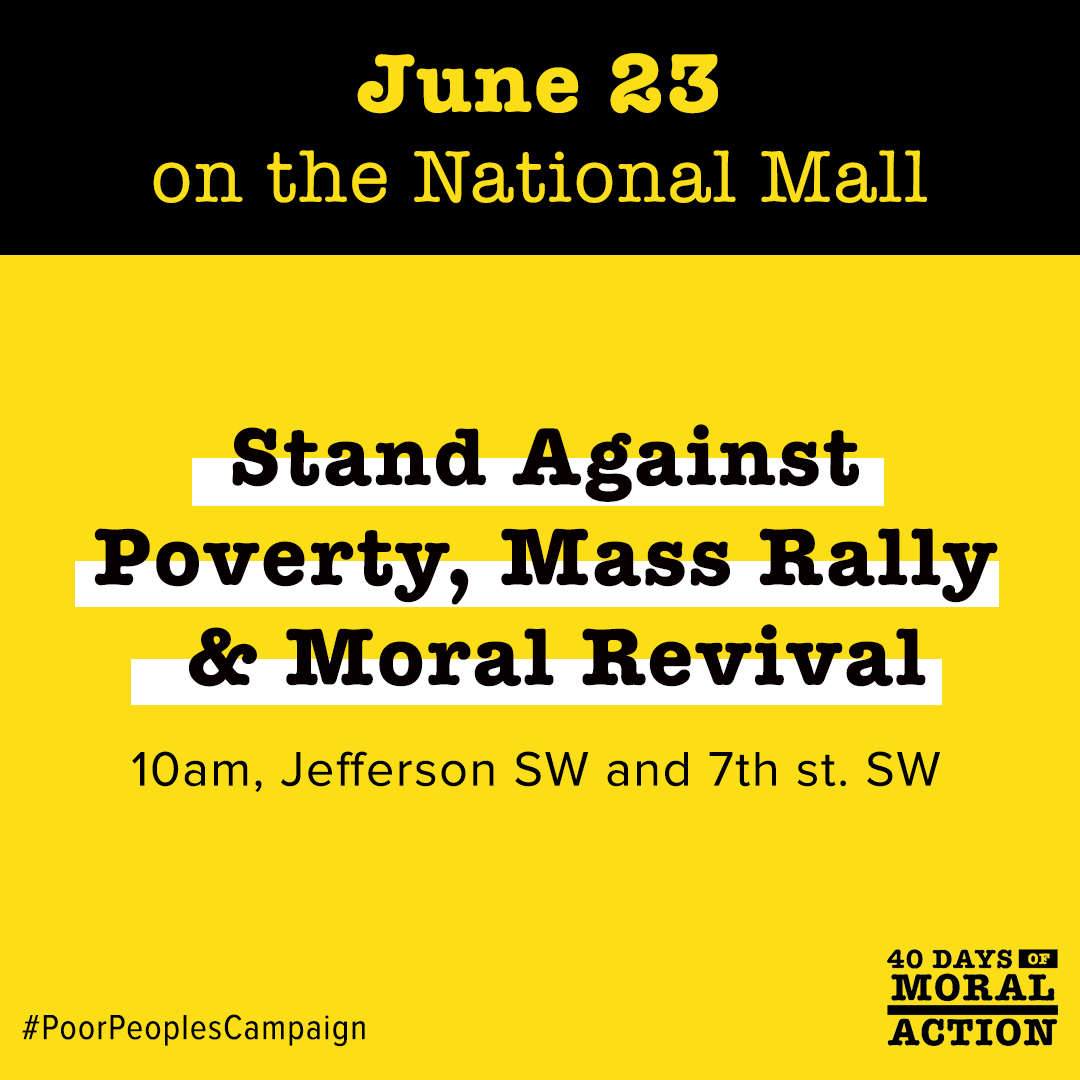
This morning at 10:00 am ET/7:00 am PT, the Poor People's Campaign: A National Call for Moral Revival will hold a national press conference in Washington D.C, launching 40 Weeks of Massive Voter Mobilization across the United States. PPC Campaign Co-Chairs Rev. Dr. William J. Barber II and Rev. Dr. Liz Theoharis together with poor and low-wage workers, faith leaders, and movement leaders from over 30 states will announce major plans for engaging millions of poor and low-wage voters ahead of the 2024 general election.
Join us online to demand an end to poverty as the 4th leading cause of death in this country, a living wage, full voting rights, healthcare for all, and the unity of love over the division of hate!
Then join us in the streets on March 2nd, 2024 at 11am local time for our Mass Poor People's and Low-Wage Workers' Moral March to State House Assemblies to bring our demands to our statehouses and call our state legislatures to the task of building a Third Reconstruction! |
|

Sacramento: The 42nd Annual “March for the Dream" Walk will take place on MLK Jr. Day, Monday, Jan. 15. Registration is free—no charge to participate! Free transportation back to City College is available if you cannot walk the entire route. Visit the MLK Walk website to learn more and register.
California Poor People's Campaign.,
Upcoming meetings |
We’re going to Sacramento! Mobilization meeting Saturday Jan. 20, 12pm | RSVP SEIU 721 building (1545 Wilshire Blvd., Los Angeles) Los Angeles is getting organized to go to Sacramento on March 2 as part of a national day of action that will take place in 30 states. We are calling for all hands on deck to organize this effort collectively—help with outreach, transportation, media and more is needed. Our March 2 actions will call politicians to account for allowing policies of violence to continue. We will demand they stop making concessions for the wealthy while leaving families and children to die in poverty.
Lunch and English/Spanish interpretation will be provided. Don’t forget to fill out this formand let us know you’ll be there.
Statewide organizing meetings Help us organize for the March 2 rally in Sacramento and other 2024 efforts. You’ll meet activists from around the state and take part in mobilizing our communities for these historic actions. It’s a place to lend a hand and to learn from one another. Drop in any Wednesday. |
Moral Poverty Action Congress is underway, and California is in the house!
The PPC’s Moral Poverty Action Congress kicked off this past Monday. This gathering—the convergence on the nation’s capital of PPC groups from dozens of states, ours included—is a crucial opportunity for us to build on our work, raise our voices, strategize for the coming year, and meet with lawmakers, ensuring that the voices of poor and low-wealth individuals are well-represented in the upcoming election and beyond.
Here are just a few highlights:
Meanwhile, a timely Religion News op-ed by Bishop Barber and Rev. Theoharis lays bare the violence that poverty inflicts on millions. It opens with the tragic story of Bertha Montes from Los Angeles, who died after being denied a request for help at her job at McDonald’s and was forced to work while she was sick. The piece outlines the extensive evidence of policy harm and the mission of the Moral Poverty Action Congress.
We’ve been posting about the Congress on the CA PPC Facebook page, and you can check the national PPC website for updates and replays.
Finally, let’s not forget that the Congress is also a vital step toward our 2024 campaign, which will include actions at statehouses nationwide, our nonpartisan Get Out the Vote effort and the third Mass Poor People’s and Low-Wage Workers’ Assembly and Moral March on Washington and to the Polls.

Four days away… The Moral Poverty Action Congress begins on Monday in Washington D.C., and California will be in the house! The Congress is a vital step toward our 2024 campaign, which will include actions at statehouses nationwide, our nonpartisan Get Out the Vote effort and the third Mass Poor People’s and Low-Wage Workers’ Assembly and Moral March on Washington and to the Polls. It provides a crucial opportunity for us to build on our work and strategize for the coming year, ensuring that the voices of poor and low-wealth individuals are well-represented in the upcoming election and beyond.
We’ll be posting about the Congress on the CA PPC Facebook page, and you can check the national PPC website for updates and livestreams.
|
|
Join Sacramento rally for National Day of Action
|
Call to Action: A Movement Declaration to Reconstruct American Democracy
But rather than being obstacles, these facts drive us forward. “Our votes are not supports but demands to be heard and to take action. A movement that votes does not vote for any party or any one person, we vote for our people and for our lives. We vote to summon a Third Reconstruction that can birth us out of an impoverished democracy and usher in a new world.”
Here is a summary of the seven steps:
|
June 7, 2021
WASHINGTON (RNS) — The faith-led Poor People’s Campaign is planning a march in the home state of West Virginia Sen. Joe Manchin to protest the moderate Democrat’s recent decision to oppose voting rights legislation and efforts to end the Senate filibuster.
Poor People’s Campaign co-chair the Rev. William Barber announcedvia Twitter on Monday (June 7) that his group will stage a “Moral March on Manchin” next week. The march is in addition to a separate protest against Manchin and Kentucky Republican Sen. Mitch McConnell scheduled to take place in Washington, D.C., later this month.
In an interview with Religion News Service, Barber said plans for the march came about at the request of activists in the state outraged by Manchin’s recent policy positions, which the pastor argued “hurt poor and low-wealth people.”
“They said it’s time to march on his office,” Barber said. “It’s time for people of all differences to stand together against him — we call it ‘from the hollers in the mountains to the hood.’”
The march is in reaction to an editorial Manchin published over the weekend in The Charleston Gazette-Mail. Although Manchin expressed support for a bill known as the John Lewis Voting Rights Advancement Act, he stated in the editorial he would vote against the For the People Act, a sweeping voting rights bill that passed the U.S. House of Representatives in March and enjoys support from prominent Democrats such as Senate Majority Leader Sen. Chuck Schumer of New York and Sen. Rev. Raphael Warnock of Georgia.
Warnock is among those who have expressed openness to eliminating the Senate filibuster to pass the bill, which would allow it to make it through the Senate with a simple 51-vote majority instead of the current requirement for a 60-vote supermajority. Similarly, the Poor People’s Campaign has decried the filibuster, which is seen by some activists as hamstringing efforts to pass an array of liberal-leaning bills.
But Manchin shot down hopes he would back such efforts in his editorial, describing the For the People Act as “partisan” and declaring he “will not vote to weaken or eliminate the filibuster.”
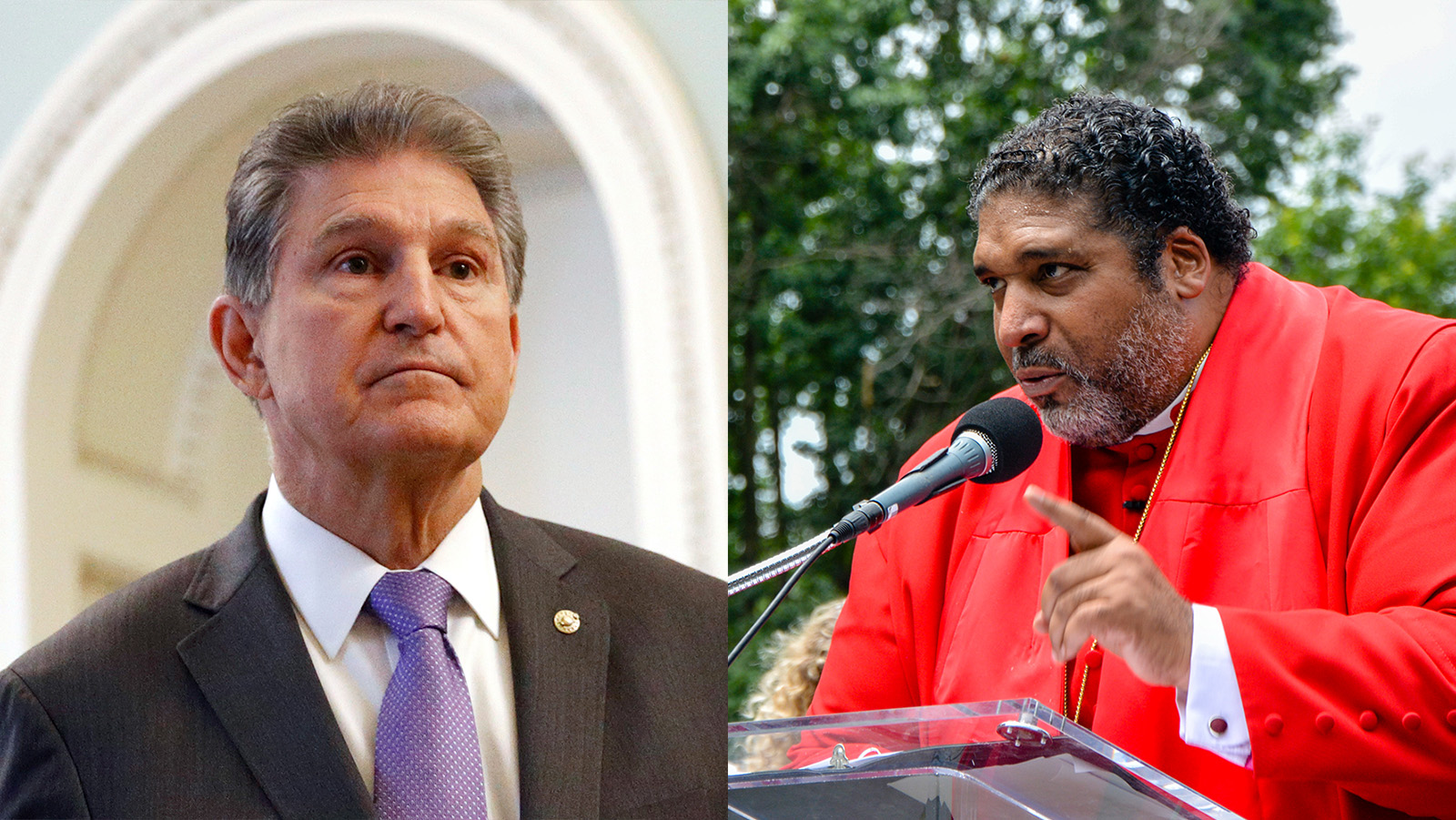
Sen. Joe Manchin, left, and the Rev. William Barber. (Left, AP Photo/Patrick Semansky. Right, RNS Photo/Jack Jenkins)
Barber blasted the positions of Manchin, a Catholic, as incongruous with Christianity.
“He claims to be a religious person, but the Scripture tells us in Matthew 23: ‘Woe unto those who tithe — who go through all the procedures — but leave undone weightier matters of the law, which is justice,'” he said.
Manchin’s office did not immediately respond to a request for comment.
RELATED: Poor People’s Campaign, lawmakers unveil sweeping resolution to tackle poverty
Barber noted representatives from the Poor People’s Campaign met with Manchin earlier this year to discuss, among other things, support for a $15 federal minimum wage (Manchin instead floated a lower figure). The meeting — which was requested by Manchin’s office after Barber’s group threatened demonstrations — included residents of West Virginia, one of several states where the Poor People’s Campaign regularly stages protests.
“We explained to (Manchin) why his defense of the filibuster was historically inaccurate and politically dangerous, and how his position against living wages was hurting over half of the workforce of West Virginia,” Barber said. He noted they also discussed how Manchin’s refusal to support the For the People Act “was hurting not just Black people, but white people, brown people and particularly poor and low-wealth people.”
Barber added: “Even if (Manchin) doesn’t change, we have to bear witness to how his policies are hurting the democracy, are a form of political and legislative violence, and that he is standing more on the side of the corporate lobbyists rather than poor and low-wealth workers and people across this country.”
Details of next week’s protest, scheduled for June 14, are still in flux. Although announced as a march, Barber said organizers are discussing the use of “other non-violent direct action.”
“Thousands upon thousands of people (in West Virginia) don’t agree with his economic position, or his position on voting rights, or his position on the filibuster — and it’s time for them to speak up,” Barber said.
| Only if the screams and tears and protests shake the very conscience of this nation can we hope for a better society on the other side of this |
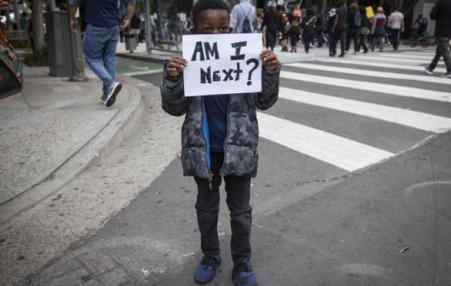
The systemic racism that killed George Floyd has taken untold souls from us for over 400 years.’, Christian Monterrosa/AP
|
Nproo one wants to see their community burn. But the fires burning in Minneapolis, just like the fire burning in the spirits of so many marginalized Americans today, are a natural response to the trauma black communities have experienced, generation after generation.
No one wants the fires – even activists on the ground have said this. But they have also shared how their non-violent pleas and protests have gone unnoticed for years as the situation has gotten out of hand. No one knows who and what is behind the violence, but we do know that countless activists, grassroots leaders and preachers were screaming non-violently long before now: “Change, America! Change, Minneapolis!” Rather than listen, many of those in power saw even their non-violent protest as an unwelcome development.
This is so often the case because many Americans struggle to imagine that our government’s policies and its long train of abuses demand radical transformation. Too many want to believe racism is merely caused by a few bad actors. We often turn racism into a spectacle, only considering the cruel legacy of racism when an egregious action escalates outrage to this level.
Black Americans have rarely been able to sustain such illusions. Deadly racism is always with us, and not only through police brutality. In the midst of the current pandemic we are painfully aware that our families bear a disproportionate burden of Covid-19 deaths. In some cities where racial data is available, we know that black people are six times as likely to die from the virus as their white counterparts. Even before Covid, large numbers of black Americans died because of the racial disparities in healthcare, which are systemic and not unintentional.
African Americans are three times more likely to die from particulate air pollution than our fellow Americans. The percentage of black children suffering from asthma is nearly double that of white people, and the death rate is 10 times higher. This is but a reflection of the fissures of inequality that run through every institution in our public life, where the black wealth gap, education gap and healthcare gap have persisted despite the civil rights movement, legal desegregation and symbolic affirmative action. We understand that the same mentality that will accept and defend the violence of armed officers against unarmed black people will also send black, brown and poor people into harm’s way during a pandemic in the name of “liberty” and “the economy”.
Many have cited Dr King to remind Americans that a riot is the language of the unheard. But I have been reflecting on the eulogy he offered when another man – a white man who came to Selma, Alabama, to work for voting rights – was brutally murdered by racist violence in 1965. At the funeral for James Reed, Dr King said it is not enough to ask who killed the victim in a case like the murder of George Floyd. Weak and unacceptable charges have been brought against the officer whose knee choked George Floyd, staying on his neck for three minutes after he went unconscious, but no charges have been filed against the other officers who stood by and watched. Even still, dealing with who did the killing is not all that justice demands. Dr King said the question is not only who killed him, but also what killed him?
Those of us who have faced the lethal force of systemic racism have also learned something else in the American story. We can be wounded healers
The systemic racism that killed George Floyd has taken untold souls from us for over 400 years. And it is killing the very possibility of American democracy today. I join those screaming that this is all screwed up, and it’s been screwed up far too long. But we are not screwed as long we have the consciousness and humanity to know what is right and wrong.
Those of us who have faced the lethal force of systemic racism have also learned something else in the American story. We can be wounded healers. We don’t have to be arbitrarily destructive. We can be determined to never accept the destruction of our bodies and dreams by any police, person or policy. We have learned that there is a force more powerful. When hands that once picked cotton have joined together with white hands and Native hands, brown hands and Asian hands, we have been able to fundamentally reconstruct this democracy. Slavery was abolished. Women did gain the right to vote. Labor did win a 40-hour work week and a minimum wage. The civil rights movement in the face of lynching and shooting did expand voting rights to African Americans.
If we take time to listen to this nation’s wounds, they tell us where to look for hope. The hope is in the mourning and the screams, which make us want to rush from this place. There is a sense in which right now we must refuse to be comforted too quickly. Only if these screams and tears and protests shake the very conscience of this nation –and until there is real political and judicial repentance – can we hope for a better society on the other side of this.
William J Barber II is co-chair of the Poor People’s Campaign: A National Call for Moral Revival, which is mobilizing poor people and their allies for a mass assembly and march on Washington in June 2020
|


 |
| Duane Campbell, Photo be Leisa Falkner |


 |
| Vince Villegas - Progressive Alliance |
 |
| DSA Members at PPC |