Thursday, August 28, 2014

Rethinking Schools- Teaching Ferguson

RS Logo
Teaching Ferguson
Compilation of blog posts and resources from Rethinking Schools,
Teaching for Change, and Zinn Education Project 

Teaching About Ferguson
by Julian Hipkins III

Credit: Reuters

As the new school year begins, first and foremost on our minds and in our hearts will be the killing of Michael Brown in Ferguson, Missouri. Teachers may be faced with students' anger, frustration, sadness, confusion, and questions.  Some students will wonder how this could happen in the United States. For others, unfortunately, police brutality and intimidation are all too familiar.

Here are a few ideas and resources for the classroom to help students think critically about the events in Ferguson and ways they can be proactive in their own communities.


Teach About Mike Brown. But Don't Stop There.
By Rethinking Schools magazine contributor RenĂ©e Watson
Credit: flickr user no scream @ the end
This time last summer, I researched articles and collected poems about police brutality, racial profiling, and the murders of black men in the United States. The George Zimmerman verdict was fresh on my mind and I wanted to talk about it with my students once school was back in session. I revised a lesson I had taught six years prior on the murder of Sean Bell that asked young people to turn their pain into poetry. And now, here I am again, swapping out the articles I used last year on Trayvon Martin with articles about Mike Brown. I have accepted that I may have to teach this lesson every school year.

Back to School, and to Widening Inequality

 Robert Reich
 American kids are getting ready to head back to school. But the schools they’re heading back to differ dramatically by family income. Which helps explain the growing achievement gap between lower and higher-income children. Thirty years ago, the average gap on SAT-type tests between children of families in the richest 10 percent and bottom 10 percent was about 90 points on an 800-point scale. Today it’s 125 points. The gap in the mathematical abilities of American kids, by income, is one of widest among the 65 countries participating in the Program for International Student Achievement.
On their reading skills, children from high-income families score 110 points higher, on average, than those from poor families. This is about the same disparity that exists between average test scores in the United States as a whole and Tunisia.
The achievement gap between poor kids and wealthy kids isn’t mainly about race. In fact, the racial achievement gap has been narrowing.
It’s a reflection of the nation’s widening gulf between poor and wealthy families. And also about how schools in poor and rich communities are financed, and the nation’s increasing residential segregation by income.

Wednesday, August 27, 2014

Groups protest Pro-corporate policies of Mexican G...

antiracismdsa: Groups protest Pro-corporate policies of Mexican G...: SACRAMENTO, Calif. — Mexican President Enrique Pena Nieto praised Gov. Jerry Brown and state lawmakers Tuesday for approving a series ...

Thursday, August 21, 2014

The U.S.'s Classist Educational System - And California's

by Peter Dreier.
America's education system is unequal and unfair. Students who live in wealthy communities have huge advantages that rig the system in their favor. They have more experienced teachers and a much lower student-teacher ratio. They have more modern facilities, more up-to-date computer and science equipment, and more up-to-date textbooks. They have more elective courses, more music and art offerings, and more extracurricular programs. They have better libraries, more guidance counselors and superior athletic facilities.
2014-07-25-EducationalInequalityposter.jpg
Not surprisingly, affluent students in well-off school districts have higher rates of high school graduation, college attendance and entry to the more selective colleges. This has little to do with intelligence or ability. For example, 82 percent of affluent students who had SAT scores over 1200 graduate from college. In contrast, only 44 percent of low-income students with the same high SAT scores graduate from college. This wide gap can't be explained by differences in motivation or smarts. It can, however, be explained by differences in money.

Wednesday, August 13, 2014

Another Opportunity Missed - Civic Education Policy Proposals in California

California education policy makers have once again written and published a nice looking report on school curriculum – this one on the need for improved civic education.  As is the norm for these tasks, a group of “well respected” civic leaders have participated.
They have written a report, Revitalizing K-12 Civic Learning in California, and they call it a Blue Print for Action. http://www.powerofdemocracy.org/wp-content/uploads/2014/02/CLTF-Final-Report.pdf
They call for a major revision of civic education.  That is fine. They also call for discussion of their proposals on social media.( p 42)   Well, here is some of the needed discussion. 

They even recognize the diversity of California students.  They say,
“Civic learning is also vital for our increasingly diverse California society. In 2012-
2013, our 6.2 million K-12 students were 53 percent Latino, 26 percent white,
9 percent Asian and 6 percent African American, with the remaining 6 percent
comprised of other ethnicities. In addition, an increasing number of our students
are not native speakers of English. Almost 4 in 10 kindergarteners are English
language learners. This diversity, and the attention it requires, is now acknowledged
in our school funding model. The Local Control Funding Formula (LCFF) recognizes
the necessity of investing in the reduction and ultimate removal of inequitable
outcomes in California public schools. Revitalizing civic learning opportunities, in
an equitable manner, can contribute to meeting these goals.”

While it is accurate that we have a general problem of civic engagement of the young,  it is also true that we have a very specific problem with the rate of Latino and Asian voter participation and  civic engagement.
 Rates of voting and voter registration provide a window into civic engagement.  The proportion of state voter  registration that is Latino and Asian has remained far below the proportions of these groups in the state’s overall population. In 2010, Latinos in the state made up 37.6% of the general population while they were on 21.2 % of the registered voters. The Asian population was 13.1 % of the state but  only 8.1 % of the registered voters.

Monday, August 11, 2014

Civil Rights and Civil Wrongs in Public Schooling

By Anthony Cody and Alan Aja.
From the very beginnings of No Child Left Behind, the strongest argument for attaching stakes to tests has been Civil Rights. This phrase is shorthand for equity in education, an end to the systemic neglect of children of color. And proponents of corporate reform have become adept at wrapping themselves in these concerns, while promoting policies that have devastating effects on students and their communities. Common Core is no exception to this.
From Politico last week came word that Common Core proponents have realized that they are losing the battle.
We’re so good at all our statistics and data and rational arguments . [but] emotion is what gets people feeling passionate,” Oldham said. “It may not be the most comfortable place for the business community . [but] we need to get better at doing it.
This message seems to connect with Mike Petrilli of the Thomas B. Fordham Institute, which has received Gates Foundation funding to evaluate the Common Core, as well as general operating grants. Petrilli said:
“We’ve been fighting emotion with talking points, and it doesn’t work,” said Mike Petrilli, executive vice president of the Fordham Institute, a leading supporter of the standards. “There’s got to be a way to get more emotional with our arguments if we want to win this thing. That means we have a lot more work to do.”
Step one: Get Americans angry about the current state of public education.
To that end, expect to start hearing from frustrated college students who ended up in remedial classes even though they passed all their state tests and earned good grades in high school. “These kids should be as mad as hell” that the system failed them, Petrilli said.

Saturday, August 09, 2014

Release of DC-CAS Proficiency Scores Affirms Need for Transparency, Change of Policy Strategy | Economic Policy Institute

Release of DC-CAS Proficiency Scores Affirms Need for Transparency, Change of Policy Strategy | Economic Policy Institute


Clearly Michelle Rhee's leadership of D.C. schools did not improve student achievement.

"Better than the Republicans", Not Good Enough

by Jeff Bryant,
A common admonition progressives have gotten used to hearing over the years is to support more conservative Democratic candidates because “Republicans are worse.”
This admonition makes some sense in electoral politics, when, in most cases, progressives face a ballot box decision where they have to choose the “lesser evil” instead of someone who wants to do something really horrible like roll back government policies to what was in favor a hundred years ago. Elections, after all, are societal constructions where you’re forced to make a choice between only two candidates, usually. To not vote at all forfeits your right to have a say-so in the matter. And few Americans get the opportunity to vote for third party candidates who have viable shots at winning.
But “better than the other side” loses any legitimacy in the policy arena, or at least it should. For sure, there are often trade-offs between adversaries in the legislative process. But when there’s not an actual bill facing an up-or-down vote, there’s simply no reason for progressives to accept policy positions from office holders on the basis of those positions being better than what the other side wants.
Yet progressives who push for polices reflecting their values are constantly scolded for exhibiting a “have it all fantasy.” They’re told to give centrist Democrats “credit” for positions where there is some agreement – such as marriage equality or climate change – and understand when those officials have to make deals with the other side. “That’s how the game is played,” goes the refrain.
When it comes to the education policy arena, “the game” has played into a disaster for the nation’s schoolteachers, parents, and students.

Thursday, August 07, 2014

The Myth of Teacher Tenure


by Diana D'Amico — July 23, 2014

In the stories of exorbitant costs and incompetence, teacher tenure laws have achieved mythic proportions. Judge Rolf Treu’s tentative decision in Vergara v. California may be the death knell for teacher tenure. But what will change as a result? A look to the past reveals that teacher tenure never really protected teachers and nor was it supposed to. Using history as a lens, this commentary explores the origination of tenure policies and the debates that surrounded them. This commentary argues that embedded in the tenure debates is a much larger problem that should concern us all.

In 1917, the president of New York City’s Board of Education told a reporter that the schools are “burdened and clogged with many teachers who are unfit” because of their “permanent tenure.”1 For nearly a century, critics have blasted tenure for putting the needs of adults above those of children. In the stories of exorbitant costs and incompetence, teacher tenure laws have achieved mythic proportions. Judge Rolf Treu’s tentative decision in Vergara v. Californiamay be the death knell for teacher tenure. But what will change as a result? A look to the past reveals that teacher tenure never really protected teachers and nor was it supposed to.  

Monday, August 04, 2014

Welcome to Sacramento Superintendent José Banda

Welcome to Sacramento.  We hope that you can establish a positive working relationship with the Board, the community, and the teachers.  Developing a positive relationship and sustained, consistent leadership is required for school improvement.

We regret the prompt attacks on your character and your contract by the Sacramento Bee editorial board.  You see they were staunch advocates for the prior Superintendent Jonathan Raymond, a Broad Foundation assisted superintendent.  He left promptly without an explanation. It is unusual for the Bee to attack a new superintendent before he has an opportunity to make some decisions. 
Duane Campbell, Director.
Democracy and Education Institute

Friday, August 01, 2014

New President of NEA and Arne Duncan

Jeff Bryant:
For years, politicians and policy leaders have been running the nation’s public education system basically by the seat of the pants, drafting and passing legislative doctrine that mostly ignores the input from classroom teachers, research experts and public school parents.
What’s got teachers stirred up? How real and potent is this upsurge of their activism? Why should people who identify with progressive causes care? Salon recently posed those questions, and others, to Lily Eskelsen GarcĂ­a, the new president-elect of the National Education Association, the nation’s largest teachers’ union, at the recent Netroots Nation conference in Detroit.
First of all, congratulations on becoming the new NEA president.
Still president-elect. I take office Sept. 1. We have an incredible president, Dennis Van Roekel, who basically said a transition period should be a transition period, not go stand in the corner. So he gave me the president-elect title and told me I would take the press calls, go to Netroots, meet with Arne Duncan, start establishing where you want to go and be as vocal and as visible as you can possibly be. Our members have asked NEA to step up and take things to another level. There’s too much at stake for us. There are policies that need addressing and we have some of the best policy expertise in the nation, but those ideas need a face to the NEA, a face for the American teacher that is channeling the voices of these 3 million educators, and when you hear the words come out of her mouth it’s not just her opinion — it’s a whole lot of teachers and support staff who are saying here’s an important thing for the American people to hear and an important thing for Arne Duncan and President Obama to hear. So he told me to start being that voice today.
The voices of these teachers are important, aren’t they? And too often we don’t really hear their stories about what it’s really like to teach in American schools, do we? For instance, I was just at a meeting of the American Federation of Teachers, where a teacher told us about showing up to school one morning and finding a man had been shot to death in front of the building the night before. The body was still on the sidewalk as the kids were coming to school, and the teachers had to decide how they were going to handle this with the children. So many of our teachers are really serving as first responders for kids, aren’t they?

Wednesday, July 30, 2014

New Senate Bill Fails To Address Root Causes of Central America refugees...

antiracismdsa: New Senate Bill Fails To Address Root Causes of Ce...: The Republican bill in the House is far worse. http://noticias.univision.com/video/488477/2014-07-29/noticiero-univision/videos/duras-co...

Thursday, July 17, 2014

The Democratic Party's Divide on Education - Teachers Unions

Democratic Party’s Divide on Education Policy gets Worse
Jeff Bryant
Political pundits who try to tamp down talk of divisions within the Democratic Party must not be paying any attention to education policy.
For quite some time, close observers of the nation’s education policy have been calling attention to the fault lines between education progressives in the Democratic Party and Third Way-style centrists, such as Secretary of Education Arne Duncan and Democrats for Education Reform, who lean toward a market-based, econometric philosophy for public education governance.
As Furman University education professor Paul Thomas recently wrote for Alternet, “While the Obama administration has cultivated the appearance of hope and change, its education policies are essentially slightly revised or greatly intensified versions of accountability reform begun under Ronald Reagan.”
But the Democratic Party’s divergence from real progressive values for governing our schools mostly went unnoticed in major media outlets until recently when a few light bulbs went off among political observers. Writing for Slate, Matt Yglesias noticed, “Education reform, not ‘populism’ divides Democrats.” Then, Connor Williams of the New America Foundation saw the light and explained for The New Republic, “In 2016, Democrats have good reason to run against Obama’s education record.”
Now, Jonathan Chait has penned a piece for New York Magazine, “Teachers Unions Turn Against Democrats,” in which he postulates that a “backlash” to President Obama’s education policies, energized by education historian Diane Ravitch, could lead to an alliance between teachers unions and, gulp, Republicans.

Wednesday, July 09, 2014

NEA Delegates call for resignation of Arne Duncan


by Motoko Rich

The long partnership between Democrats and teachers’ unions has frayed in recent years as the Obama administration has pursued policies that many teachers oppose, including performance ratings that link student test scores to evaluations and decisions about promotion or firing.

But the dissatisfaction hit a new level late last week when the National Education Association, the nation’s largest teachers’ union, with almost three million members, passed a resolution at its convention in Denver calling for the resignation of the secretary of education, Arne Duncan.

Why Does the Obama Administration Keep Getting It Wrong on Education Policy?

Tuesday, July 08, 2014

Child refugees on our border

antiracismdsa: Child refugees on our border: Dear President Obama:  July 3, 2014 We, the undersigned immigration, civil and human rights, faith, labor, anti-viole...

Over 200 groups sign letter to Obama about refugee children.

Sunday, July 06, 2014

Breton repeats deeply flawed Vergara claims

Sacramento Bee opinion columnist Marco Breton published a piece on Sunday,  July 6, noting that Progress ( on race relations) has been slow since the 1994 campaign of California  Proposition 187. The first half of the article where he recounts the history of the Prop. 187 effort is reasonably  well done.  The second half, where he uses Prop. 187 as a means to blame teachers for low school performance does not have evidence to support it.  He takes up the Vergara case, a topic of several posts here.  Breton cites the opinion of Judge Rolf M True. 
 Here is a response to Breton’s assertions by Jeff Bryant.
The campaign against public school teachers and their unions has evolved from casting insults to inflicting real injury. The recent ruling by a California judge in the Vergara v. California case made it a legal precedent to equate teachers’ employment security to an affront to students’ rights to a quality education.

Saturday, July 05, 2014

Let Teachers Teach, Stop Toxic Testing

by Félix Pérez
By one estimate, nearly one-third of school time is now spent preparing students to take standardized tests, administering the tests and reviewing the test results. Educators increasingly are saying, “Enough is enough!”
TAKE ACTION ›
Join the national campaign to put the focus of public education back on student learning. 
The national rising tide against over testing is about to enter a new phase if 9,000 educators gathering the next four days in Denver approve the “National Education Association Campaign Against Toxic Testing.”
An open letter  from NEA and the “educators of America” states, “It is time to end this toxic testing and implement real accountability in our public education system. As educators who have dedicated our careers and lives to our students and their success, we will not stand silent while commercial standardized testing is used to reduce our public education system to wreckage.”

Wednesday, July 02, 2014

When Teachers are left out of Common Core

by Jeff Bryant
This act is wearing thin.
As implementations of Common Core State Standards falter around the country, supporters of the new academic benchmarks continue a sort of dog and pony show to reinforce the message to “stay the course.”
The latest such example came from the Center for American Progress who staged a panel recently on “A Roadmap for a Successful Transition to the Common Core in States and Districts.” Typical of these sorts of affairs, the panel consisted of two Beltway think tank execs and two former pols now firmly ensconced in the private sector. There wasn’t an actual practicing educator in sight.
The report bears out the superficial substance of the PR event, a view from 30,000 feet up with seemingly no input from practicing teachers and principals on the ground.

Tuesday, July 01, 2014

Do Teachers' Unions Have Any Friends in the Obama Administration?

by Diane Ravitch
We are living in an era when the very idea of public education is under attack, as are teachers' unions and the teaching profession. Let's be clear: these attacks and the power amassed behind them are unprecedented in American history. Sure, there have always been critics of public schools, of teachers, and of unions. But never before has there been a serious and sustained effort to defund public education, to turn public money over to unaccountable private hands, and to weaken and eliminate collective bargaining wherever it still exists. And this effort is not only well-coordinated but funded by billionaires who have grown wealthy in a free market and can't see any need for regulation or unions or public schools.
In the past, Democratic administrations and Democratic members of Congress could be counted on to support public education and to fight privatization. In the past, Democrats supported unions, which they saw as a dependable and significant part of their base.
This is no longer the case. Congress is about to pass legislation to expand funding of charter schools, despite the fact that they get no better results than public schools and despite the scandalous misuse of public funds by charter operators in many states.

Friday, June 27, 2014

Fight Back to protect public education

EduShyster interviews Barbara Madeloni, the recently elected president of the 110,000 member Massachusetts Teachers Association, and she warns that we either fight for public education or we will lose it.
A former high school teacher, Madeloni was teaching teachers at the University of Massachusetts-Amerst, and she and her students refused to participate in edTPA. As she puts it, “The students with whom I was working didn’t want to submit videos of themselves teaching to Pearson. They didn’t want their work as student teachers to be reduced to a number on a rubric by people who didn’t know them, and 67 of 68 students ultimately refused to send their work.” Madeloni told the story to Michael Winerip of the New York Times; ten days after his story appeared, she was fired. (Winerip, a superb education writer, was later reassigned to cover “Boomers,” and the Times eliminated its weekly education column. Winerip rattled cages every Monday.)
Edushyster asks Madeloni what we can do to fight back against the reformers attacking teachers and public education.

Thursday, June 19, 2014

Local Control Funding and Sac City Unified Board

Sacramento City Unified Board meeting tonight.  6 PM. Serna Center.

At the June 5 meeting, the Community Priorities Coalition presented the board with alternatives.
Funding of California’s k-12 public education system is changing fundamentally.  Some schools will get much more money to educate kids. The centerpiece of the change is the Local Control Funding Formula, designed to send additional funds to districts where  “the need and the challenge is greatest.”  The law requires that  parents, students, teachers, and other community members be involved in the process of deciding how new funds are spent. Ed Source has an excellent guide to these changes.

    Sacramento City Unified’s plan for Local Control Funding is here.
   LCAP Timeline and Process- Within a PowerPoint presentation, which the district provides on its website, SCUSD outlines its LCAP development process, Community Planning Process, timeline, and lists potential community partners to engage with in LCFF implementation. A new budget will be submitted tonight and should be on the web site this PM. 
            The following was submitted to the Board on June 5. 
 We, the undersigned organizations, write to respectfully request your support for the consideration of these community needs into the district’s draft LCAP. These issue areas represent the concerns of our community members as found in our conversation with them through community town halls and our own surveys.
1)   Class size adjustments on select high-need schools – beginning with grades K-3 with gradual progress up the grade scale base on three years LCAP implementation
2)   Culturally competent professional training that would enhance school climate on diverse schools and create effective restorative justice and disciplinary policies for students
3)   Afterschool programs that are design to improve class performance and further classroom lessons

The passage of the Local Control Funding Formula (LCFF) provides SCUSD with a unique opportunity to be innovative in the way it addresses the concerns of its high-need students and schools. We believe that this first year of the LCAP is critical and will set strong precedence for the designs of LCAP in the coming years.
Organizations:  Black Parallel School Board, Hmong Innovating Politics, Hmong Mein Lao Community Action Network, La Familia Counseling Center, Making Cents work, People Reaching Out, Area Congregations Together, Democracy and Education Institute, and more.

    SCUSD did not incorporate the suggestions of the Community Priority Coalition to focus on class size reduction, changes in discipline, and faculty in service.  Instead, they propose to use the extra funds to finance the programs they already support.  In this the SCUSD board relies on the district staff.  That is, they plan to continue what they have been doing and to call it community participation.
   There will be conflicts over this since doing things the same way is not the purpose of the LCFF.  The district is moving itself into problems of accountability under the LCAP laws.   Other districts, notably San Francisco and Fresno have developed plans in cooperation with the parents in their districts.

Wednesday, June 18, 2014

Separate and Unequal continues

Sixty Years after Brown v. Board, Segregation Ensures That Schools Are not only Separate, but Sharply Unequal

“Though we made significant progress closing race-based gaps during the 1970s and 1980s, we have since reversed those gains, and students are segregated by both race and income as early as kindergarten,” said Garcia. “The segregation that so many of our children experience at school entry and, assuming it continues similarly, throughout their education, impedes their odds of success, and appears to pose particular disadvantages for black and Hispanic children.”
Minority students are not only much more likely than their white counterparts to be in heavily minority schools, but also to be surrounded by peers from low-income families. Three-fifths (60.5 percent) of white kindergartners are in classrooms in which only about 12 percent of their classmates are poor. Among black and Hispanic students, nearly as great a share (56.5 percent and 55.2 percent, respectively) are in classrooms in which nearly half of their peers are poor, while less than 5 percent of white children are in such heavily poor classrooms.
While the family characteristics of white children vary relatively little depending on the type of classroom they are in (unless that classroom is very heavily minority), family characteristics of black and Hispanic children vary substantially by their type of school. In extremely heavily minority schools, mothers of all racial groups are less educated than their average counterparts. Hispanic mothers are only half as likely to have at least a bachelor’s degree than the average Hispanic mother (2.5 percent versus 5.6 percent). Even in these schools, mothers of white children are no less likely to have bachelor’s degree, although these white moms are slightly more likely than average white moms to have no more than a high school diploma. These numbers reflect added disadvantage for minority students in two respects. First, the large proportion who attend heavily minority schools are disproportionately poor and their moms less educated. Second, the very few minority children in heavily white schools have a constellation of socioeconomic advantages that are extremely rare among their families.
Academic performance varies greatly, depending on the school’s level of segregation; the more heavily minority the school makeup, the less prepared students are on average in the fall, and the smaller their relative gains by spring. White, black, and Asian kindergarten students with better-than-average performance in the fall assessment are all clustered in schools with proportions of minority students between 10 and 50 percent. In contrast, the white students with the weakest school readiness skills attend the most heavily minority schools. Among Hispanic kindergartners, too, the highest-performing are in schools with a very low proportion of minority students, while Hispanic students in schools with 50 percent minority students or more start off less prepared than the average Hispanic student.
Finally, the authors’ findings appear to support more sophisticated analyses’ suggestions that income segregation underlies many apparent negative consequences of racial segregation. They recommend further research to determine whether this segregation persists through children’s later years and, more critical, the degree to which the patterns they find regarding the interactions among race, social class, and peer and school characteristics have independent impacts on children’s development.
“Instead of addressing ongoing school segregation, current policies not only dismiss segregation’s impacts but in some cases perpetuate and compound them,” said Weiss. “Factors such as families’ backgrounds and resources, peer effects, and school resources must all be considered when ensuring that future education policies are better aligned and more comprehensive.”
Published by the Economic Policy Institute. 

Note: a prior post chronicled how California schools were the most segregated and unequal for Latino Students.  

Monday, June 16, 2014

We Won't Give Up- Attacks on Teachers


National Education Association President Dennis Van Roekel is angry at people who would treat our children as commodities in order to yield profits, attack educators and create conflict rather than actually work to improve public education for all our students. Watch and hear what he has to say.

Tenure important for teachers

Due Process Prevents Capricious Firings: Diane Ravitch

Diane Ravitch, a historian of education, is the author of several books, including "The Great School Wars," a history of the New York City public schools.
A century ago, teaching was one of the few white-collar jobs open to women. Classes were large, salaries were low, and working conditions were poor. Supervisors and school boards, male-dominated, made many rules governing teachers' lives. In some cities, for example, school boards fired teachers if they married, or if they were allowed to marry, they were fired if they became pregnant.
In the early days of the formation of teachers' unions, teachers cared most about two issues: tenure and pensions. Teachers wanted some guarantee that they would not retire to a life of poverty. And they wanted assurance that they could not be fired for arbitrary and capricious reasons. They wanted to be sure that they could not be fired by a school board that wanted to hire a colleague's daughter or sister, or fired by a principal who didn't like their looks or their religion.
The Vergara decision in California strikes at one of the issues that matters most to teachers today. Unlike tenure in higher education, public school tenure is not a guarantee of a lifetime job. In elementary and secondary education, tenure is a guarantee that a teacher can be fired only for just cause, with due process.

Frankenstein Fears His Monster: The Gates Foundation Wants You To Boycott High-Stakes Tests | Common Dreams

Frankenstein Fears His Monster: The Gates Foundation Wants You To Boycott High-Stakes Tests | Common Dreams

Interesting. And Common Core Assessments in California ?

Thursday, June 12, 2014

Vergara v. State of California Decision |


Vergara v. State of California is a meritless lawsuit brought by Students Matter, an organization created by Silicon Valley multimillionaire David Welch and a private public relations firm for the sole purpose of filing this suit. Students Matter is supported by Michelle Rhee and Students First, Parent Revolution Executive Director Ben Austin, Billionaire and school privatizer Eli Broad, former lawmaker Gloria Romero, and other corporate education reformers with an interest in privatizing public education and attacking teachers’ unions. The suit challenges California statutes governing due process in teacher dismissals, using experience as a criteria during school layoffs, and the two-year probationary period for teachers. The suit wrongly alleges those laws are unconstitutional and hurt students. The defendant in the suit is the State of California. CTA and the California Federation of Teachers (CFT) intervened in the case to ensure all stakeholders have input in educational policy decisions and to protect the rights of educators. 
Simply put, this lawsuit highlights the wrong problems, proposes the wrong solutions, and follows the wrong process. This is yet another attempt by the usual corporate special interests to undermine the teaching profession and push their agenda on California public schools and students. Circumventing the legislative process to strip teachers of their due process rights will not improve student learning, will make it harder to attract and retain quality teachers in our classrooms, and ignores all the research that shows experience is a key factor in effective teaching. This is a blatant effort to legislate from the bench, keeping parents and educators out of education policy decisions.  

What the media avoids about the Vergara decision

Wednesday, June 11, 2014

A victory for the corporate "reformers" in the Vergara v California case


California judge Rolf Treu ruled Tuesday  in the Vergara  v.California case that California teacher tenure laws deprive students of their right to an education that is guaranteed  under the state Constitution and violates their civil rights. The decision is a major defeat for teachers’ unions and will presumably lead to challenges of tenure laws in other states.  The ruling overturned five state statutes giving California teachers firing protections and rights to tenure and seniority.
The implementation of the ruling has been stayed while under appeal.
The Sacramento Bee editorial board and Bee columnists Marcos Breton and Dan Walters, along with their candidate Marc Tucker each applaud the court ruling. Note what they say in their columns. They applaud this defeat of the teachers unions, they do not deal with the critical issue of adequate school funding.
What do the  sides  agree upon?
It is clear that many students in California receive a substandard education and that failing schools are concentrated in poor and minority neighborhoods.   The judge cites the long history of  successful law suites Serrano V. Priest I, II. III, and more that mandated changes in state funding to provide equal funding.  There is also general agreement that teacher quality is a significant factor in improving education.
The problem is that the remedy of the corporate “reformers”  and of  the court does not resolve the basic issues.  It deals with teacher placement, tenure, and freedom of speech, not the adequate funding of schools.   It may at most respond to the 1-3 % of  poor teachers in the classrooms.
California is one of a number of states that require  in their state constitution  that the state provide  adequate public education.  This has been reaffirmed numerous times in Serrano v. Priest 1,2,, 3 and cited again in this court ruling.  

Tuesday, June 10, 2014

Corporate Democrats win first round against teachers in California

Jennifer Medina
June 10, 2014
The New York Times
The decision, which was enthusiastically endorsed by Education Secretary Arne Duncan, brings a close to the first chapter of the case, Vergara v. California, in which a group of student plaintiffs backed by a Silicon Valley millionaire argued that state tenure laws had deprived them of a decent education by leaving bad teachers in place.

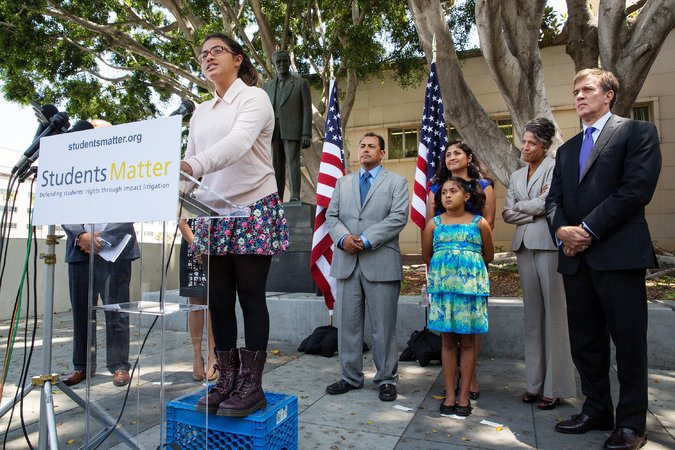
Julia Macias, at a news conference Tuesday, was one of nine students who claimed tenure laws left bad teachers in place.,Monica Almeida/The New York Times ,


“It's surprising that the court, which used its bully pulpit when it came to criticizing teacher protections, did not spend one second discussing funding inequities, school segregation, high poverty or any other out-of-school or in-school factors that are proven to affect student achievement and our children." Randi Weingarten. President. American Federation of Teachers.
LOS ANGELES — A California judge ruled Tuesday that teacher tenure laws deprive students of their right to an education under the state Constitution and violate their civil rights. The decision hands teachers’ unions a major defeat in a landmark case, one that could radically alter how California teachers are hired and fired and prompt challenges to tenure laws in other states.
“Substantial evidence presented makes it clear to this court that the challenged statutes disproportionately affect poor and/or minority students,” Judge Rolf M. Treu of Los Angeles Superior Court wrote in the ruling. “The evidence is compelling. Indeed, it shocks the conscience.”
The decision, which was enthusiastically endorsed by Education Secretary Arne Duncan, brings a close to the first chapter of the case, Vergara v. California, in which a group of student plaintiffs backed by a Silicon Valley millionaire argued that state tenure laws had deprived them of a decent education by leaving bad teachers in place.Observers on both sides expect the case to generate more like it in cities and states around the country. David Welch, a Silicon Valley technology magnate, spent several million dollars to create the organization that brought the Vergara case to court — Students Matter — and paid for a team of high profile attorneys, including Theodore J. Boutrous Jr., who helped win a Supreme Court decision striking down California’s same-sex marriage ban. While the next move is still unclear, the group is considering filing lawsuits New York, Connecticut, Maryland, Oregon, New Mexico, Idaho and Kansas and other states with powerful unions where legislatures have defeated attempts to change teacher tenure laws.

Local Control FF and Parent Engagement in LAUSD


The video shows parent engagement in the Local Control Budget Funding in Los Angeles. In Sacramento a community coalition has formed and conducted similar forums.  Feedback from the forums became a proposal by the Community Coalition on the LCAP budget  to the Sacramento City Unified School Board on June 5.  A final budget, including LCFF funds, will be passed at the regular board meeting on June 19.  The Education and Democracy Institute is a member of the Community Coalition.  See prior posts on Local Control Funding 
 
Creative Commons License
This work is licensed under a Creative Commons Attribution-NonCommercial 3.0 Unported License.