Showing posts with label universities. Show all posts

Saturday, March 07, 2026

ICE Out Now

 No Ice 


This is not normal. 

Normal is gone.  We can not go back to normal. 

Normal has been destroyed by  the greed and power of the oligarchy.  

The end of democracy – as we know it_ has been created by 

The Trump/MAGA fascist forces. 

We have been here before.

We have been here before. 1776, 1832, 1848, 1860, 1890’s, 1930’s, until 1965 in the South,  1942 Japanese concentration camps. 

 A new form of democracy can win. It will require all of us working together

The regime has had higher education in its sights since Trump returned to power -- and now it's unleashing ICE on campuses, too. 

Fascist regimes collapse if not propped up by their society's pillars of authority, from civil service to education. If that support isn't volunteered, the regime will demand it. The underlying purpose of ICE is to instill enough fear to trigger compliance; on college campuses, that violence is also intended to neutralize a source of authority that threatens Trump's own. 

We cannot let Trump's secret police terrorize college students or kneecap higher education. Alumni, concerned neighbors, students' loved ones -- anyone with a connection to a campus community -- has a role to play.

Go to Indivisible.  March 7, 2026. 

Tuesday, May 27, 2025

Trump's Assault on the Universities is fascism in practice

 Assault on the University and on Public Education.

The attacks by the Trump Administration on Harvard and other universities are a critical component of the present consolidation of fascist power in the U.S. 

Trump is attacking all of higher education.  May 27.2025. Chemerinsky. 

https://www.sacbee.com/opinion/op-ed/article307078651.html

https://www.nytimes.com/2025/05/25/opinion/teachers-education-trump-administration.html  

Universities are critical to the development of democracy.  I have my own concerns about the role of elite private universities, but the survival of universities, of free- open dialogue and investigation is currently at stake.

Most political assessments underestimate the substantive contribution to our society by the development of free public high schools in the 1920-1945 era. The creation of free open education system was a major contributing factor in the development of a more democratic society from 1940- 1960. Education promoted public participation in decision making about public issues such as health care, social security, unionization and more. 

The growth and extension of public universities in the post 1945 era had a similar effect on the expansion of democracy. All of this is under assault. 

Today’s fight to democracy included the defense of education itself- public, private, secondary schools and more. The assault on equal opportunity in public education is an adjacent struggle, one that deserves more attention.

Monday, December 11, 2023

Wealthy Donors and Universities


When wealthy donors oust university presidents over how they answer congressional questions

A frighteningly dangerous precedent

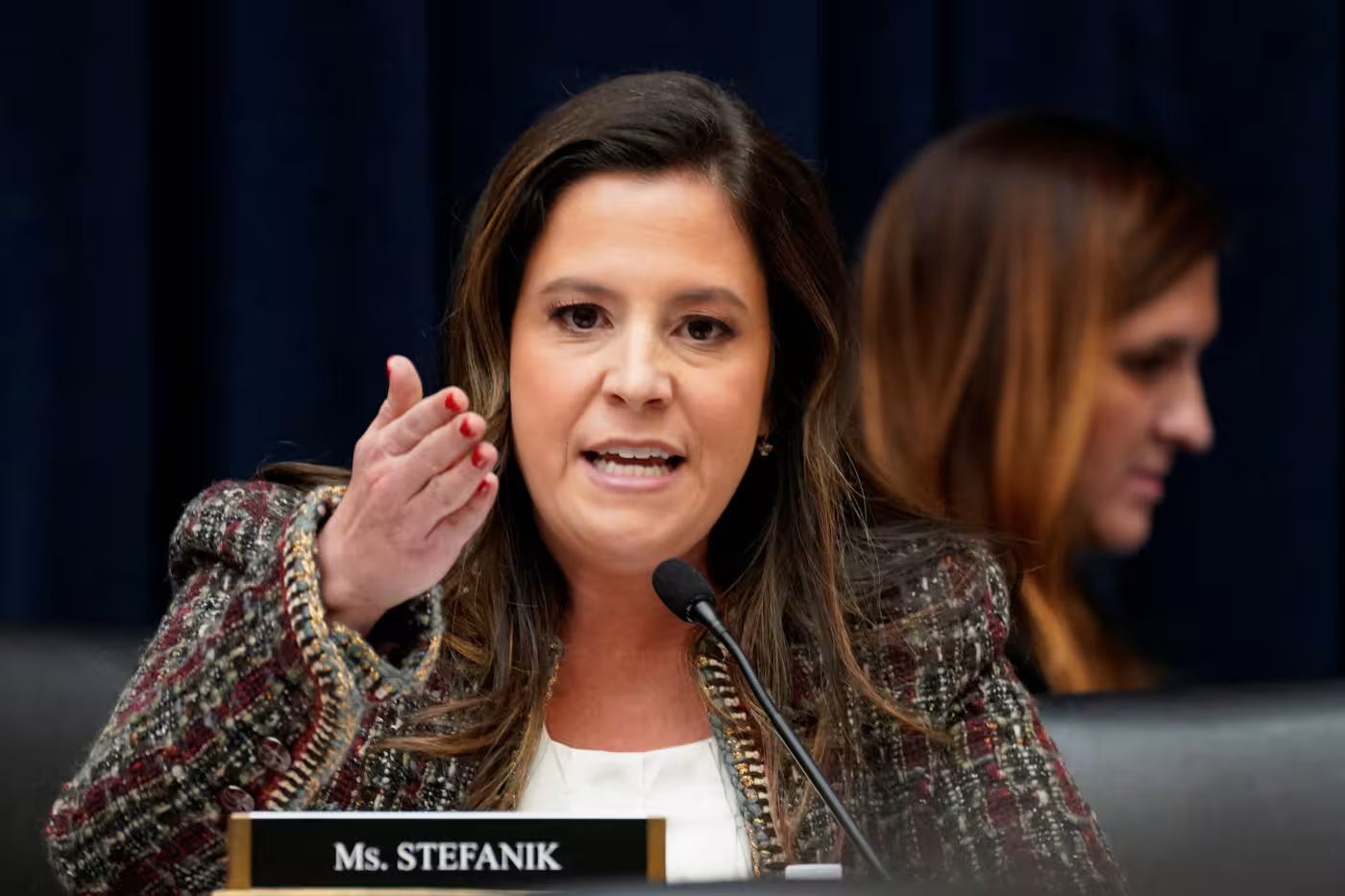
[Rep. Elise Stefanik]

Friends,

America’s prestigious universities play a big role in determining who gets into America’s wealthy elite. 

A degree from Harvard, Penn, or M.I.T., to take three examples, is a meal ticket to a lucrative job on Wall Street or a corporate law firm and to the richest and most influential people in the land. 

But as America becomes increasingly stratified by wealth, those tickets are easily abused. 

Universities that give preference in admissions to the children or grandchildren of major donors serve to widen inequality even further. 

Universities that allow major donors to influence what is taught or expressed on campus could be seen to suppress ideas that threaten the wealthy — which could chill freedom of expression and fuel social resentment.

Which brings us to the latest imbroglio. 

Last Tuesday, the presidents of the University of Pennsylvania, Harvard, and M.I.T. tried to give precise answers to questions from members of Congress about whether their university cultures had encouraged hostility towards Jews — hostility that has surged since Hamas’s October 7 attack on Israel and Israel’s attack on Gaza in response. 

In their opening remarks, all three denied it, and repeatedly condemned antisemitism. 

Then Elise Stefanik, a Republican representative from New York (and herself a Harvard graduate) asked a yes or no question: would calls for genocide of Jews on campus violate their codes of conduct or harassment policies? 

The presidents hedged. “If the speech turns into conduct, yes, it can be harassment,” Penn’s president, M. Elizabeth Magill, a former dean of Stanford Law School, replied in lawyer-like fashion. 

“I’m asking if specifically calling for the genocide of Jews — does that constitute bullying or harassment?” Stefanik pressed her point. 

“If it is directed and severe or pervasive, it is harassment,” said Magill.

“So the answer is yes?” 

“It is a context-dependent decision, congresswoman,” Magill said.

Faced with the same question, Harvard’s president, Claudine Gay, also temporized. “It can be,” she said, “depending on the context.” 

The university presidents should have answered unambiguously and unequivocally that calls for genocide of any group are intolerable. 

Their failure to do so has fueled a firestorm. 

Ross Stevens, a hedge fund manager, said he would withdraw a $100 million gift to Penn. Other wealthy Penn donors called for Magill to resign. 

Even prior to the hearing, a campaign had been launched by some of Wall Street’s most powerful figures to oust all three university presidents for failing to adequately condemn Hamas’s October 7 attack on Israel.

The influential board of advisers of Penn’s Wharton School’s, chaired by Marc Rowan of Apollo Global Management, one of the world’s largest private equity firms, called on alumni to withhold donations to Penn. 

The billionaire investor Bill Ackman, Harvard alumnus and head of New York hedge fund Pershing Square Capital Management, called for the three university presidents to be fired. 

The day after their testimony, Magill and Gay issued statements in efforts to contain the damage. 

But on Saturday evening, after an emergency meeting of Penn’s board of trustees, Magill resigned under pressure. 

Over the weekend, calls from donors for Harvard’s Claudine Gay to resign grew louder, as prominent donors demanded her ouster, too. 

I can well understand the anger and frustration of these donors. In their congressional testimony, the university presidents should have been clearer that their institutions do not tolerate calls for genocide. Period. 

But to use their power as major donors to force or seek the ouster of these presidents is almost as repugnant as the failures of these presidents to unambiguously condemn calls for genocide. It endangers the autonomy of America’s universities. 

Who’s kidding whom? Those of us who have spent our lifetimes teaching in prestigious universities are well aware of the influence of big donors. The major job of today’s university presidents is to solicit money, and their largest targets are typically denizens of Wall Street. 

For the same reason, boards of trustees are packed with wealthy alumni, often from the Street, who routinely veto candidates for university presidentships harboring views they find offensive. 

But not until now have major donors so brazenly used their financial influence to hound presidents out of office for failing to come out as clearly as the donors would like on an issue of campus speech or expression. 

As a Jew, I cannot help but worry, too, that the actions of these donors will fuel the very antisemitism they claim to oppose — based on the perilous stereotype of wealthy Jewish bankers controlling the world.

...
Editorial note. This is as good of a reason as possible to support public funded universities.

Wednesday, March 13, 2013

This is about digital capitalism, not digital democracy


This is not about digital democracy. It is about digital capitalism.  I woke up this morning to my usual New York Times and was astounded to read that my state senator, Darrell Steinberg, is proposing a bill to require the CSU, UC, and community colleges to grand credit to massive on-line courses, known as MOOCs.  Senator Steinberg is working with former Senator Dean Florez who is financed to promote such arrangements ( usually known as lobbying).
They claim that this is a response to lack of courses in the universities.   Note. This is not about offering more educational opportunities.  It is about making money for private corporations.
There is much to be said about this direction.  Future posts will develop several ideas in detail.  But, let us begin.
This move is a part of a much larger assault on public education including the massive expansion of Charter Schools.  See the post below by Stan Karp.  The state- ie. Senator Steinberg, creates a problem by underfunding the universities and colleges, and then offers a technological alternative-  one that will make certain corporations such as Pearson’s  very wealthy at state tax payers  expense.
This run at public education by offering what claims to be open education is primarily a corporate run for public funds- similar to the mass expansion of the Univ. of Phoenix and other for profit schools that get up to 80% of their funds from taxpayers while giving great profits to their owners and poor service to their students.  (See the Harkin committee report of the U.S. Senate). http://www.gpo.gov/fdsys/browse/committeecong.action?collection=CPRT&committee=health&chamber=senate&congressplus=112&ycord=0
Steinberg’s proposal will enrich the well connected with state funds while not adequately funding the state universities and colleges.

Thursday, November 01, 2012

Why is the vote on Prop 30 so close ?


 And, what can we do about it ?
by Duane Campbell
            A new Field  Poll says that if the election were held today 48 % would vote Yes on Prop. 30 to fund schools, colleges and public services, 38 % would vote no, and 14 % are undecided. That is too close.  This vote is our best opportunity to reverse the austerity cycle of budgeting used in California for the last 4 years since the economic crisis.
            My experience in tabling for Proposition 30 in  on the Sac State campus  for the last 6 weeks  has reminded me of a major problem – we are not communicating  with and educating the vast majority of people of the need to support public education and other public services.
In one recent experience a beyond middle age African American woman stopped by the table to discuss California Prop. 30, an effort to fund schools, universities, and public services.  I will use her case as an example.   Her experience as a college student was that her fees went up.  Over the last 4 years university fees went up over $ 2,400.  Her experience was that her fees were pushing her out of the university.   Her question,  why do my fees go up ?  Doesn’t the federal government pay for our education ?   Why should I have to vote on this ?

Saturday, April 14, 2012

Occupy the Universities


Giroux.
But there is more. It is also crucial not to allow casino capitalism to transform higher education into another extension of the corporate and warfare state. If higher education loses its civic purpose and becomes simply an adjunct of corporate and military power, there will be practically no spaces left for dissent, dialogue, civic courage, and a spirit of thoughtfulness and critical engagement. This is all the more reason to occupy colleges and use them as a launching pad to both educate and to expand the very meaning of the public sphere. Knowledge is about more than the truth; it is also a weapon of change. The language of a radical politics needs more than hope and outrage; it needs institutional spaces to produce ideas, values, and social relations capable of fighting off those ideological and material forces of casino capitalism that are intent in sabotaging any viable notion of human interaction, community, solidarity, friendship, and justice.
http://www.truth-out.org/occupy-colleges-now-students-new-public-intellectuals/1321891418

Thursday, March 03, 2011

Oppose the Right Wing/Republican assault on students, unions, and the California Dream


Oppose the Right Wing/Republican assault on students, unions, and the California Dream.
Students are needed to  build a resistance!
The nation,  including California, is suffering a severe recession.  In this crisis  we need to rebuild the promise of California.  That promise is a good job for all,  the opportunity to have  a rewarding career, a decent life,  and the chance for a good education.  The budget cut mania  does not promote good jobs nor  rewarding   careers.  It only digs the hole deeper. Cutting k-12 and higher education makes the state economy  worse.
   The  economic crisis has already  forced the cutting of higher education, of k-12 education, and of social welfare systems.
What caused this crisis ? It was caused by the greed and avarice of the financial class and aided by the politicians of both major political parties.   The  major banks and corporations looted the economy creating an international meltdown.  Now, they have been rewarded with bail out money.  The crisis was not caused by students, teachers, public employees  nor recipients of social security.   We already suffer from  cuts in parks,  in universities, in nurses, libraries and police and fire  protection.
   The  continuing economic decline has had a devastating impact on the California budget- and the budgets of 42 other states.   Revenues have continued to plunge and  legislatures  have been forced to make a series of deep cuts to virtually all of the state's programs, including the university systems.  Finance capital stole the future of many in this generation.
  For this year Governor Brown proposes a budget with  $14 billion in more cuts.  In addition, the Governor proposes ballot initiatives for June to extend the current tax rates for five more years.   Republicans are trying to keep these initiatives off the ballot.  If these taxes are not extended, the total cut to the budget will be some $26 billion dollars. The Governor’s  current budget proposal would reduce the state general funds allocated to the CSU to $2.29 billion in 2011/12, 12.5% less than the 2010/11 budget act –this on top of  over $4 billion in prior years’ cuts.   If the taxes are not extended, these cuts would at least double and tuition would increase by up to 50%.  These cuts would be devastating for students and working families.

Sunday, January 24, 2010

Students face a class struggle


At 2:29 p.m. on Jan. 12, Juan Macias, 19, a sophomore at San Francisco State University, sat in a cafe near the engineering firm where he works part time as an office assistant, staring at a laptop computer screen.

In one minute he would get a crucial opportunity to register for classes for the spring semester. “This is so nerve-wracking," he said as he waited for the clock to signal that his assigned registration period had begun.
Hours earlier, scrutinizing the class schedule, he considered about 30 courses — then had to rule all of them out. They were full. The last slot on the waiting list for a 146-seat introductory physics class he has been trying to join for a year had disappeared minutes before, taken by another student with an earlier registration period.
“You’re trying to compete with all the other students, when we all want education,” said Mr. Macias, a business major. “It really makes me angry.” His classes — the ones that had an opening — begin on Monday.


Thursday, November 19, 2009

The Right to a great public education; California


We've got to stop cutting public education. To ease the budget crisis, one state after another is taking an ax to higher education. This is cruel and shortsighted.
Cruel because it denies students the right to a decent education. Shortsighted because how will this generation of students get prepared to compete globally or even to clean up the financial mess brought about by Wall Street?
I'm a product of the worst and best public education California has to offer. I grew up in an East Los Angeles housing project in the 1970s and 1980s. I attended overcrowded public schools in the inner city. Like many racial minorities from America's barrios and ghettos, I received an inadequate education.
While I excelled in mathematics, I was never taught to read or write at a competent level throughout my K-12 schooling. To complicate matters, the longest paper assigned to me in high school was two pages long.
I taught myself how to properly read and write while going through college to compensate for my poorly funded K-12 education. But what will happen to those without this same self-drive that I learned from my Mexican immigrant mother? Fortunately, I also benefited from affirmative action and from numerous educational outreach programs and policies like Occident College's Upward Bound - a preparatory program for students from disadvantaged communities.
If not for such programs, I wouldn't have made it to UCLA as an undergraduate. I wouldn't have earned a master's degree in urban planning there. And I wouldn't be pursuing my doctorate at Berkeley.
So I worry about those who grow up in poor neighborhoods without the same educational safety nets that allowed for me to attend some of the best universities in this country. I can't help but be concerned about the plight of my wife's elementary school students in East Los Angeles today.
Those who fight affirmative action and against government-sponsored early educational outreach programs conveniently wash their hands of any responsibility toward those who lack the financial resources and access to human capital to go to college.
And fewer and fewer have those resources, with one state after another raising tuition and other fees. These fee hikes couldn't come at a worse time.
If we care about equality of opportunity, if we are concerned about our ability to compete in the global economy, it's time to give everyone, including those from America's barrios and ghettos, a shot at a great public education.
ABOUT THE WRITER
Alvaro Huerta is a doctoral student at the University of California at Berkeley and a visiting scholar at UCLA's Chicano Studies Research Center. He wrote this for Progressive Media Project, a source of liberal commentary on domestic and international issues; it is affiliated with The Progressive magazine. Readers may write to the author at: Progressive Media Project, 409 East Main Street, Madison, Wis. 53703; e-mail: pmproj@progressive.org; Web site: www.progressive.org. For information on PMP's funding, please visit http://www.progressive.org/pmpabout.html#anchorsupport.
This article was prepared for The Progressive Media Project and is available to MCT subscribers.


Reblog this post [with Zemanta]

Saturday, August 29, 2009

Stealing from the Youth


Stealing From the Youth

by Joseph Palermo
There’s an ancient saying that we do not inherit our society from our ancestors, but borrow it from our children. On July 21, the California State University Board of Trustees approved a fee increase requiring undergraduate students this fall to pay $4,026 a year, an increase of about $1,000 over the previous year (and this fee hike came after years of previous increases). The fee hikes, the denial of enrollment to 40,000 students, the layoffs of faculty and staff, the budget cuts and furloughs, the stuffing of more students into fewer classes, etc. are all sacrificing California’s future for a short-term “fix” that in reality is not a “fix” at all. The 2010-2011 year will likely bring more bleak budgetary news. By blocking any new revenue streams to fund higher education, Governor Arnold Schwarzenegger and the Senate Republican minority are not only taxing California’s young people and their families, they are crippling the state’s future.
The degrees from CSU awarded during these furlough years might lead future employers to look upon them as suspect, perhaps even as inferior. The teachers, nurses, technicians, journalists, criminal justice professionals, and others we teach could have the quality of their training questioned. It’s not fair to the students and their families to be forced into buying an inferior product for grossly inflated prices. Students are paying more than ever for a CSU education even though they’ll be spending less time with professors, have fewer course offerings, and be crammed in overcrowded classrooms.
These budget cuts and student fee increases have gone on for years now, but 2009-2010 will be the cruelest year of all. In past budget cycles, CSU Chancellor Charles Reed and the Board of Trustees have responded with a shrug, saying simply: “We’ll manage.” Reed recently told the press that CSU is still a “bargain” compared to other institutions.
Really? A “bargain?” Or is it a bargain basement sell-off? Some students are transferring to other colleges that are more prestigious and only cost a little more in tuition.
There has been a profound lack of leadership among our elected officials in the state Capitol and in Long Beach, where the Chancellor and Trustees preside. Now the CSU administration has been finally forced to acknowledge that the latest round of devastating cuts will adversely affect the quality of education: “Cuts of this magnitude will naturally have consequences for the quality of the education we can provide,” a side letter to the furlough agreement states.
The California Faculty Association has stood and will continue to stand with students and their families. The record is clear. CFA has opposed every single increase in student fees whenever the issue has been raised in the Legislature. As a faculty organization we have consistently lobbied state legislators and the governor’s office to invest in California’s higher education. To that end we have voiced our strong support of Assembly Bill 656, sponsored by Assembly Majority Leader Alberto Torrico (D-Fremont), because it is a sensible and fair effort to secure funding for the CSU. The Republican minority in the State Senate and our Republican governor squashed it, and by doing so they denied the necessary funding for the CSU system that would have helped us avoid what we are seeing today — cuts, furloughs, and fee hikes. (It’s a tax on CSU students and their families. The pay cut is also a tax on faculty and staff.)
In order NOT to tax ExxonMobile, Shell Oil, and other oil conglomerates that have made record profits in the tens of billions of dollars off California consumers in recent years, the Republicans blocked Torrico’s oil severance tax proposal that would have provided a billion dollars for higher education. They also blocked a tax on cigarettes that would have adverted cuts as well. And they did so for blind ideological reasons with a total disregard for what is in the best interest of the state of California. They sided with Big Oil and Big Tobacco to penalize college students who are just trying to increase their skill and knowledge levels to be productive members of the state’s workforce and to make California’s future as bright as its past.
Somebody should ask Governor Schwarzenegger and the Republicans in the Legislature why they insist on taxing students instead of oil and tobacco corporations. That’s why students were chanting outside the Chancellor’s office when he approved the fee hike: “TAX OIL, NOT STUDENTS!”
At his annual convocation to college staff and faculty, the president of CSU, Chico, Paul Zingg, pointed out that over the past 10 years state revenues have gone up while the percentage of the state general fund for higher education has gone down. Over the same time period general fund spending for prisons has gone from $5 billion to $11 billion. California spends about $50,000 per prisoner, and less than one-tenth of that to support a student in the CSU system. How can a state that spends more on prisons each year than on higher education create a better future for its citizens? President Zingg called it a “rejection of history and common sense.” “Education is as fundamental to our state as waterways, railroads, highways and the Internet,” he said.
It won’t be easy, but CSU professors can absorb these pay cuts and we will absorb them. We’ll manage. We’ll get by. We can take the hit as our faculty union voted in favor of doing so in the name of protecting higher education in California. CFA approved a 9.23 percent cut in our remuneration that will be reflected in a 9.23 percent reduction in our teaching activities. We’ve done our part.
The professors will endure. But the students and their families are the true victims here. They’re getting ripped off. CSU students are taking on extra jobs and piling on extra units to get through faster just to make ends meet. The quality of their education is suffering even while they go into debt, work long hours, and stretch themselves thin with heavy unit loads to obtain a degree. If it is true that we do not inherit our society from our ancestors, but borrow it from our children, then the current downsizing of the CSU system represents a wholesale larceny against our children and our future.
Joseph Palermo is Associate Professor of American History at CSU, Sacramento. He’s the author of two books on Robert F. Kennedy: In His Own Right (2001) and RFK (2008).

Posted with permission.

Friday, December 19, 2008

Rebuild our State Universities

Rebuild America. Rebuild our State Universities & Colleges.
A New Deal in the New Millennium for Higher Education
Resolution adopted by the California Faculty Delegates Assembly, October 19, 2008
A paradigm shift is sweeping the world. The historic financial crisis has created a broad new openness,
not seen for 25 years, to the idea that public institutions are a social good and government should play a
significant role in maintaining economic stability.
Yet, while Congress has infused massive amounts of American’s tax dollars in an attempt to staunch the
financial bleeding on Wall Street, it is not clear what commitment will be made to rebuild our human
infrastructure – to bail out the people of the United States.
We do know that broad access to quality higher education is a key ingredient to a positive outcome for
the American people. Educators and business leaders agree that the very survival of a strong U.S.
economy requires a highly educated work force.
Affordable, accessible, quality education is good for an individual’s personal finance, but more
importantly, it is good and essential for our society’s prosperity.
For years, the California Faculty Association has asserted, argued and demanded attention to and
proper funding for quality public higher education that is accessible and affordable for every Californian,
particularly in the California State University.
Yet for nearly two decades we have witnessed the persistent erosion of public support for our state
universities and colleges across the nation. In California, our state has cheated our students by
surreptitiously and gradually leaching away funding per student over the years. Any hope of relief was
undermined by enormous cuts in 2002 and 2003, totaling more than a half billion dollars in the CSU
alone.
We call on our elected leaders, nationally and here in California, to fundamentally change their thinking
about the role and funding of public higher education. It is unacceptable to praise the university on the
one hand while destroying it with the other; now we must reverse course and rebuild.
Today, we must think of the California State University, and all our nation’s public colleges and
universities, as solutions to a downward economic spiral.
Here in the CSU, just since October 1, there has been a 21% increase in applicants for the Fall 2009
school year. It is well documented that in periods of high unemployment, more people seek retraining
and more people rely on public universities. We need to invest in public higher education today so that
we don’t need to rescue millions of young people in the future.
The bail out of the banks in such a bold and massive way has revealed that we can afford to take
dramatic action when we have the will to do so.
A New Deal for a New Millennium that invests significant resources of similar size into public higher
education likewise could have a dramatic effect – if we can muster the will.
Consider this:
 $70 billion, just one-tenth of the amount of the Wall Street bailout, would nearly double the total
state funding allocated to higher education in the United States in 20071.
 $700 billion is more than ten times the size of the federal Dept. of Education Budget for 2007.2
 $700 billion would cover $20,000 in tuition and expenses in each of four years in school for 8.7
million California State University students.
 $700 billion would provide an additional $318,000 to spend on each of the 2.2 million students
enrolled in the public community colleges and universities in California last year.
 $700 billion could send 5.4 million students to a public university somewhere in the United States
this year.3
 For every $1 invested in the California State University, $4.41 is returned to our state economy.
The CSU contributes $7 billion to California’s economy – revenue we cannot afford to part with
given the deep deficit we already face.4
A crisis of this magnitude calls for bold action. That is why we call on our nation’s leaders to:
 Initiate a “New Deal in the New Millennium for Higher Education” to get our people into college
and to keep them there all the way to a degree. We propose a federal program for higher
education in the amount of $70 billion -- just 10 percent of what our nation is spending on Wall
Street and the banks.
 Establish college-going grants similar to the World War II G.I. Bill, and student loan debt
forgiveness for all students who take jobs in public service. Public financial aid should be
provided to rescue our students from the hands of private financial institutions.
We also call on California’s lawmakers and higher education policy makers to:
 Join us in our call for a “New Deal in a New Millennium for Higher Education” that will enable us
to rebuild the California State University and the other segments of our state’s public higher
education system.
 Restore the $215 million cut from the CSU budget in the 2008/09 state budget. And work to add
funding above the minimal levels established in Gov. Schwarzenegger’s funding promises in
future years. A real commitment will yield real results for California and the nation.
 Reopen the doors to the 10,000 students who were turned away this year due to budget cuts.
New graduates and unemployed adults alike need opportunity to become tax paying participants
in California.
 Roll back tuition and fees to 2002 levels before the intensive period of fees increases began that
now total 113%. We can’t afford to block students from getting an education because they can’t
afford to pay.
Furthermore, we call on our colleagues in universities and colleges across the nation to
 Join with us in working for and inaugurating this “New Deal in a New Millennium” to rebuild public
higher education in America.
###


REFERENCES
1
Grapevine, “An annual compilation of data on state tax appropriations for the general operation of higher education,”
www.grapevine.ilstu.edu
2
US Department of Education, www.ed.gov
3
Columbia Journalism Review, “What Can You Buy for $700 Billion?” 9/23/08, www.cjr.org
4
ICF Consulting, “Working for California: The Impact of the California State University,” 2005.
 
Creative Commons License
This work is licensed under a Creative Commons Attribution-NonCommercial 3.0 Unported License.