Thursday, January 17, 2019

What Would End the LA Strike ?

My colleague Jennifer Medina talked to Alex Caputo-Pearl, the president of United Teachers Los Angeles, just before Mayor Eric Garcetti announced that negotiations between the union and the district would resume today.  NY Times.
A meeting is scheduled for noon at City Hall, with the mayor’s staff serving as a mediator between the two groups. 
Mr. Caputo-Pearl, said that neither he, Mr. Beutner nor the mayor would be at the table for the negotiations. “We’re going to let our teams dig into it and then we’ll be involved soon enough,” he said late last night. He did not make any predictions about when the strike would end. 
“We’re going to continue to strengthen our picket lines, which have been growing with the support from our community and parents,” he added. “We’re going to pursue both tracks, both picketing and bargaining at the same time.” 
The interview has been condensed and lightly edited. 
Jennifer Medina: How long do you expect the strike to last? What would end it? 
Alex Caputo-Pearl: In the bigger picture we need to see a real commitment to reinvesting in neighborhood public schools. We need to see that there is willingness to substantially invest in that, to use the $140 million from the governor. We need to see that there is really reinvestment in class size reduction, staffing issues, counselors. We want to see some regulation on the charter industry, so that it does not just keep growing without limits. We need to know they have some basic rules of engagement and accountability. Those are some of the key issues. 
You’ve talked about making the picket lines even stronger to make the attention to Los Angeles public schools really make a difference. What do you want the wider public — particularly those without a connection to the schools here — to understand? 

Tuesday, January 15, 2019

Billionaires Vs. Teachers in Los Angeles

The Los Angeles teachers' strike isn't all about wages. At its core, the strike is a fight against a hostile takeover of public schools by the superrich.

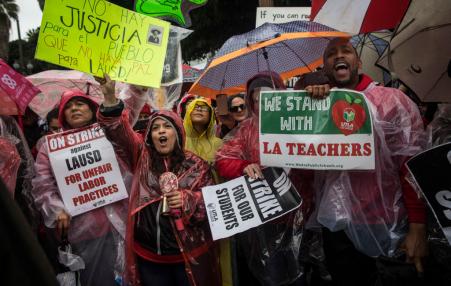
People rally in the streets of downtown in the pouring rain during a United Teachers Los Angeles strike on January 14, 2019 in Los Angeles, California. , Barbara Davidson / Getty Images

Unlike many labor actions, the Los Angeles teachers’ strike is not really about wages or benefits. At its core, this is a struggle to defend public schools against the privatizing drive of a small-but-powerful group of billionaires.
The plan of these business leaders is simple: break-up the school district into thirty-two competing “portfolio”networks, in order to replace public schools with privately run charters. As firm believers in the dogmas of market fundamentalism, these influential downsizers truly believe that it’s possible to improve education by running it like a private business. Not coincidentally, privatization would also open up huge avenues for profit-making — and deal a potentially fatal blow to one of the most well-organized and militant unions in the country, the United Teachers of Los Angeles (UTLA). As union leader Arlene Inouye explains, “This is a struggle to save public education; the existence of public education in our city is on the line.”
It’s always important to “know thy enemy.” But this is especially true for the educators’ movement in Los Angeles, which is directly challenging an unholy alliance of the some of richest individuals in the United States. Here’s a short primer on the corporate “who’s who” aiming to destroy public schools in LA — and across the nation.
The Walton Family
In a watershed moment for the drive to take over Los Angeles public education, pro-charter billionaires spent an unprecedented $9.7 million to buy the 2017 Los Angeles school board elections. A key funder of this campaign to elect charter school acolytes was none other than the Walton Family, best known as the founders of Walmart.

Why The LA Teachers’ Strike Matters

3 reasons to pay attention to the LA teacher strike. The Conversation: “The first mass teacher labor action of 2019 is unfolding in California as the United Teachers Los Angeles walked out for the first time in 30 years. This strike, which began on Jan. 14, isn’t just important to people in Los Angeles. Here are three reasons the nation should pay attention. With 640,000 students, and about 500,000 enrolled in the district’s public schools, Los Angeles represents the second largest school district in the United States. The only bigger district is New York City. Like strikes in Oklahoma, Arizona, Kentucky, Colorado and North Carolina, the Los Angeles teachers’ strike is essentially about greater investment in public education. For the Los Angeles teachers, this includes a 6.5 percent salary increase to make up for what the union calls ‘stagnant wages.’ The average teacher makes almost 19 percent less in wages than comparable workers. But beyond wages, teachers have begun to demand a greater commitment to investment in public education from their governing bodies, either school boards or state legislatures. The Los Angeles teachers strike suggests that the wave of teacher protests is not over. Teacher strikes and work stoppages have been preceded by a nationwide teacher shortage that continues to grow across many states, which do not have enough certified math, special education, science, and in increasing cases, elementary teachers – to meet the needs of their students. In California 80 percent of districts reported a teacher shortage in the 2017 to 2018 school year. Teacher shortages are most often blamed on low teacher pay, one of the commonalities across teacher strikes. As long as public schools remain underfunded, the nation can expect to see more teacher strikes in other school districts and states in the near future.”

Progressive Breakfast 

Quality essay on the Strike - here.  for Labor Notes here.

Monday, January 14, 2019

How to Win a Teachers Strike

You need a movement to win a strike.

DSA members on this morning's picket line. 


https://www.rethinkingschools.org/articles/you-need-rank-and-file-to-win-how-arizona-teachers-built-a-movement

30,000 Teachers On Strike in Los Angeles


Teachers and employees of the Los Angeles Unified School District, the nation’s second-largest school system, say that working conditions have become untenable. Despite California’s reputation as a progressive bastion, the state still spends relatively little on public education — about half as much as New York spends on the average child. 
Now, educators are demanding higher pay, smaller class sizes and the hiring of more support staff like counselors and librarians.

Sunday, January 13, 2019

Los Angeles Teacher _ The Strike


My brothers and sisters, the 31,000 UTLA teachers who will strike, do so at great risk of their personal and professional well-being. There is every indication the Los Angeles Unified School District will make every attempt to prolong the strike in an attempt to weaken the union’s attempt to improve the school and classroom environment for the over 600,000 students who attend classes in the district’s schools.
Although 98% of us authorized this strike and are prepared to go the long haul to guarantee its success, a strike of this magnitude brings along with it a number of challenges. Teachers will be on the picket line each and every day without pay for the duration of the strike.
Like too many of us are all too familiar with, my comrades live paycheck-to-paycheck, have pressing healthcare issues, and children of their own, also students in LAUSD public schools.  Any amount you can contribute will help in any of a number of ways to alleviate some of the stress teachers will inevitably encounter. Thank you for supporting UTLA teachers and this crucial moment in the history of public education.

Thursday, January 10, 2019

Teachers to hold "Teach In" at Tornillo Detention ...

 Teachers to hold "Teach In" at Tornillo Detention ...: In February, educators will gather outside a massive detention camp for migrant children and stage a 24-hour "teach in."  ...

Note; The Los Angeles Teachers' Strike date has been postponed until Monday. 

Wednesday, January 09, 2019

Los Angeles Teachers Strike Approaches


The Los Angeles school district has $2 billion in reserves, but it’s not willing to use the money to create the conditions educators need to help students succeed.
Educators in L.A. have been bargaining for 20 months, fighting not just for fair salaries but for every child in the city to have a safe and welcoming place for learning, and against the austerity measures for public schools the district’s superintendent continues to promote.
The members of United Teachers Los Angeles are fighting for issues that, sadly, are too familiar: adequate funding for public schools, full-time counselors and nurses in every school, smaller class size, fair compensation and community schools.
And the boss? Superintendent Austin Beutner is intent on dismantling the school district and prioritizing charters, which syphon off $600 million a year. What he doesn’t prioritize—20 months after the contract expired—is neighborhood schools or a fair agreement with the district’s educators.

Tuesday, January 08, 2019

Why the Los Angeles Teachers Strike Matters


The January 10 strike date announced by the United Teachers of Los Angeles (UTLA) has heightened tensions in an already contentious dispute with Los Angeles Superintendent Austin Beutner, who represents the Los Angeles Unified School District (LAUSD) in negotiations. However, far more is at stake in Los Angeles and for the rest of us than a traditional contract struggle.
Given how many students LAUSD educates, the possibility of a strike by its union is huge news. LAUSD has 694,000 in its schools. The entire state of Oklahoma educates about that same number of students in its public schools.
The reforms LAUSD has demanded in Los Angeles schools are based on the bipartisan project to convert public education into a lucrative market for wealthy investors. Merrill-Lynch heralded this change in a 1999 report for prospective investors: “A new mindset is necessary, one that views families as customers, schools as ‘retail outlets’ where educational services are received, and the school board as a customer service department that hears and addresses parental concerns.”
Networks of wealthy billionaires and the foundations they create have advocated and imposed reforms nationally, even globally, we see today in LA schools: using standardized tests to control what and how children learn; creating charter schools to weaken neighborhood schools and undermine parent loyalty to public education; creating new revenue sources for corporations to profit from education; and weakening teachers unions. The “portfolio model” LAUSD has announced it will adopt fragments the school system into networks operated by private charter management organizations.

Los Angeles Teachers Prepare for a Strike


Alex Caputo-Pearl, the union president, center, at a rally in December.
Damian Dovarganes/Associated Press
Los Angeles public school teachers are preparing to strike on Thursday — the culmination of months of failed negotiations and what educators say is years of disinvestment in the nation’s second-largest school system. 
District officials have said that the money simply isn’t there and that the frustration should be directed at the state. 
My colleagues Jennifer Medina and Dana Goldstein reported in this piece that the strike will affect 900 schools, 30,000 teachers and more than 600,000 students. That’s where you come in. 

The impending strike highlights the fact that despite California’s reputation as a center of liberal policy, it spends relatively little on public education. School spending levels, about $11,000 per student in 2016, are far below those in other blue bastions; for example, California spends about half as much as New York on the average child.

Education advocates on all sides of the labor impasse in Los Angeles say that it is the neediest students who are hurt most by funding constraints. More than a fifth of public school students in California are still learning English, the highest percentage in the country.
ADVERTISEMENT
“California has been underfunding its schools for many, many years,” said Pedro Noguera, a professor of education at the University of California, Los Angeles, who has worked closely with Los Angeles and New York public schools.


The state has only recently begun to restore deep cuts made during the last recession, when California was hit particularly hard. “It’s not even close to where we should be,” Professor Noguera said. “I would not say that the state has deliberately starved the schools, but there has been no leadership from the state.”
Underlying the debate between the two sides is a situation they agree is a major problem: that high-needs school districts like Los Angeles, where 82 percent of students are low-income, bear the brunt of the burden from the state’s low education spending.

With many wealthy and white families opting to choose charter or private schools, or move to other surrounding school districts, the Los Angeles school district is disproportionately African-American and Latino. A study from U.C.L.A.’s Civil Rights Project found that Latino students in Los Angeles are more segregated than anywhere else in the country.
In other districts in California — Oakland, in particular — as well as in Virginia and Indiana, teachers angry over pay and limited resources have raised the possibility of protests.


California Today is edited by Julie Bloom, who grew up in Los Angeles and graduated from U.C. Berkeley.

Wednesday, January 02, 2019

The Problem of Border Security

antiracismdsa: The Problem of Border Security: On December 11, President Donald Trump hosted an  Oval Office sit-down  with incoming House Speaker Nancy Pelosi (D-CA) and Senate Min...

Monday, December 31, 2018

Will Los Angeles Teachers Strike Jan 10 ?


UTLA December Rally 
Bill Raden, Capital and Main
Fasten your seatbelts Los Angeles, it’s going to be a bumpy strike. That was the subtext to a tumultuous week that saw over 50,000 L.A. teachers, students and families take to the streets Saturday to support a union faced with budgetary saber-rattling by Los Angeles Unified, and that climaxed on Wednesday with United Teachers Los Angeles president Alex Caputo-Pearl setting a January 10 walkout date — unless Los Angeles Unified negotiators meet key union demands for investments in the district’s highest-poverty students.
Caputo-Pearl’s announcement came a day after L.A. Unified superintendent Austin Beutner erroneously claimed that the union had accepted the district’s six percent pay raise offer, as recommended in Tuesday’s report by state-appointed fact-finders who also urged LAUSD to kick in the modest equivalent of a one to three percent salary increase for new hires to reduce class sizes, and for both sides to work together to lobby Sacramento for more state funding.
Fact-finding panel chairman David A. Weinberg mostly punted on 19 of 21 unresolved equity demands that form the heart of what UTLA has framed as a fight to save L.A.’s “civic institution of public education.” The union won some minor points, like the allowing of teacher input on charter co-locations, and on scrapping a district privilege to unilaterally lift class size caps during fiscal crunches. But by accepting at face value LAUSD’s latest claims of imminent bankruptcy, Weinberg left unanswered a critical question: How could LAUSD annually project catastrophic, three-year deficits and still have its unrestricted cash reserves balloon from $500 million to nearly $2 billion during the same five-year period?
 Read more

Capital and Main

U.S. Falls Further Behind

Does the U.S. government’s priority for military spending explain, at least partially, the discrepancy between the worldwide preeminence of the U.S. armed forces and the feeble global standing of major American domestic institutions?


Maybe those delirious crowds chanting “USA, USA” have got something. When it comes to military power, the United States reigns supreme. Newsweek reported in March 2018: “The United States has the strongest military in the world,” with over 2 million military personnel and vast numbers of the most advanced nuclear missiles, military aircraft, warships, tanks, and other modern weapons of war. Furthermore, as the New York Times noted, “the United States also has a global presence unlike any other nation, with about 200,000 active duty troops deployed in more than 170 countries.” This presence includes some 800 overseas U.S. military bases.

In 2017 (the last year for which global figures are available), the U.S. government accounted for over a third of the world’s military expenditures―more than the next 7 highest-spending countries combined. Not satisfied, however, President Trump and Congress pushed through a mammoth increase in the annual U.S. military budget in August 2018, raising it to $717 billion. Maintaining the U.S. status as “No. 1” in war and war preparations comes at a very high price.

That price is not only paid in dollars—plus massive death and suffering in warfare―but in the impoverishment of other key sectors of American life. After all, this lavish outlay on the military now constitutes about two-thirds of the U.S. government’s discretionary spending. And these other sectors of American life are in big trouble.

Let’s consider education. The gold standard for evaluation seems to be the Program for International Student Assessment of the Organization for Economic Cooperation and Development, which tests 15-year old students every few years. The last test, which occurred in 2015 and involved 540,000 students in 72 nations and regions, found that U.S. students ranked 24th in reading, 25th in science, and 41st in mathematics. When the scores in these three areas were combined, U.S. students ranked 31st―behind the students of Slovenia, Poland, Russia, and Vietnam.

Friday, December 28, 2018

What Are California Teachers Paid ?

California teachers saw a modest pay bump in 2018, with average teacher pay exceeding $80,000, new state figures show.
The average teacher salary in 2018 was $80,680, up 2 percent from 2017, according to the data. Staffing declined slightly, falling by about 1,700, or 0.6 percent, from 2017 to 2018.

Cloud Database by Caspio
Go to the Sac Bee site to compare teachers’ salaries. 
Among other findings: The average superintendent salary in 2018, excluding part-timers, was roughly $200,000. That figure reflects base pay and does not include the stipends and bonuses incorporated into many school chiefs’ contracts.
The data also show that teacher pay continues to vary widely by district. Twenty school districts, mostly in the Bay Area, paid their teachers, on average, more than $100,000 in 2018. Another 17 districts, mostly in rural areas, paid their teachers an average salary that fell below $50,000 annually. The disparities in pay reflect, at least in part, the wide variations in housing expenses and community affluence in different regions of California.
Among large districts in the Sacramento region, the highest average teacher pay is found in Roseville. The lowest average pay is found in Natomas and the city of Sacramento.
The figures come from an annual survey published by the California Department of Education.Roughly 22 percent of districts -- most of them very small -- did not report 2018 teacher pay data to the state. Districts that reported salaries educate about 99 percent of students in California.

Friday, December 21, 2018

Facing the Border Wall

antiracismdsa: Facing the Border Wall: Two thousand years ago, a young mother and father fled for their lives and left everything behind for the safety of their child. Their na...

Thursday, December 20, 2018

Trump Imposes new asylum procedure

antiracismdsa: Trump Imposes new asylum procedure:    The Trump administration announced a new migration policy Thursday that will require asylum seekers who cross the Me...

Wednesday, December 19, 2018

Who Killed Jakeline ( Caal) Maquin ? The Border Patrol Did.

Trump and the Border Wall


Barefoot children. In diapers. Choking on tear gas. Mothers running in terror.

Now a 7 year old girl--Jakelin Maquin--has died from dehydration and exhaustion in U.S. Customs and Border Protection custody. The ACLU blamed “lack of accountability, and a culture of cruelty within CBP” for the girl’s death.

This is inhuman. I can’t shake the sense that the ground is cracking under my feet. I want to share what this makes me think and feel - I hope you stick with me here.

Trump gave the order to use CS gas on families and children at the border. I saw the pictures, and felt outrage. Then Trump distracted the media with his personal reality show. The photos were knocked off the front page with the next crisis.

I’m not OK with this. I’m guessing you aren’t either. But we are not powerless.

In June, I 
went to McAllen, Texas with my then-five year old son on Father’s Day. There is another picture that seared into my soul there - toddlers looking out of the armored windows of a bus as it left the detention center and their parents behind. I will never, ever forget the fear in their eyes.

Monday, December 17, 2018

Los Angeles and Oakland Teachers Rally Amid Deadlocked Contract Talks


A Los Angeles school board meeting turned raucous days ahead of two solidarity rallies to be held Saturday in L.A. and Oakland.
Published By
LAUSD school board photo and video by Bill Raden.

Two California teachers unions, which are currently deadlocked in separate contract talks with their respective school districts, are on the verge of launching the West Coast’s biggest teacher walkout since 1989. What happens next will decide far more than fair wages for career educators. At stake are broader principles of equity, expressed as contract demands for smaller class sizes and less testing, the addition of sufficient health and social services staff, and an investment in community schooling and fair funding — aimed at restoring public education as a public good for all Californians, rather than as a private interest granted to the lucky few.
While they await the results of a state-mediated fact-finding process, United Teachers of Los Angeles (UTLA) and the Oakland Education Association (OEA) have declared Saturday, December 15, a day of solidarity, and have invited all to join teachers in a rally to defend public education. The Oakland action kicks off at Omni Commons at 11 a.m., while L.A.’s march and rally begins at Grand Park at 10 a.m.


Saturday, December 15, 2018

antiracismdsa: Young Girl from Guatemala Dies in ICE Custody

antiracismdsa: Young Girl from Guatemala Dies in ICE Custody: 7-Year-Old Migrant Girl Dies From Neglect In ICE Custody Jakeline Maquin  NBC News A 7-year-old Guatemalan girl who crossed th...

Friday, December 14, 2018

Sacramento Teachers Present Alternative Budget Proposal

Teachers from across the District united together to present SCTA’s Students First Rebalancing Budget Proposal to address the budget fiasco at Sac City at the December 13, 2018 School Board meeting.  You can view our video by clicking here.
Despite increase in income of over $100 million in recent years, bureaucratic bloat and financial mismanagement jeopardize our children’s educational opportunities.
We believe it our responsibility to try to offer real solutions to the sac city’s budget fiasco.
That’s why we proposed today to the school board a proposal that would save the district $60 million, balance the budget, curb bureaucratic bloat by redirecting resources back to the classroom to lower class sizes, expand arts and music opportunities, provide summer learning opportunities and to put Sac City on a path to becoming the destination district in California.  You can view our proposal by clicking here.
We sincerely hope the superintendent will accept our offer to meet and join with us to find real solutions to this budget crisis.  Our children deserve no less.

Wednesday, December 12, 2018

Diane Ravitch On Gavin Newsom's Three Educational Challenges

Diane Ravitch

As Gavin Newsom prepares to take office, education looms large on the list of California’s top priorities. The nation’s most populous state faces major questions on everything from the cost of higher education to growing demands for increased oversight of charter schools. Capital & Main asked education scholar Diane Ravitch what advice she would give Newsom. Here is her response.
--------------------------------------------------------------------
The incoming administration of Governor-elect Gavin Newsom will not be cleaning up a mess. Governor Jerry Brown has been a good steward of the state during his time in office.

But Newsom faces three distinct challenges in the field of education. Although Governor Brown significantly increased spending for education, California has large unmet needs and much catching-up to do to maintain its edge as an incubator of talent and innovation, and of equal opportunity for all.

First, the state must substantially increase funding for K-12 education, which would enable districts to pay teachers better salaries, reduce class sizes and assure that all children, regardless of where they live, have access to a well-equipped, well-staffed school. The latest federal data (2016) show that California spends somewhat less than the national average per pupil. California’s per-pupil spending is $11,420, compared to a national average of $11,841. California is one of the richest states in the nation but spends far less than states such as New York, New Jersey, Connecticut, Massachusetts, Maryland, Wyoming and North Dakota. California spends about the same on its students as states like Iowa, Kansas, Louisiana and South Carolina, where the cost of living is far less than in California.

Second, California must recommit to the long established tradition that tuition for higher education must be free to all residents of the state. This principle was reiterated in the state’s Master Plan in 1960, but ended by Governor Ronald Reagan. The low-cost availability of higher education and the large pool of educated talent it created were the principle drivers of the state’s economic development and success. The primary reason that students drop out of college is cost, not ability. The state should recommit to provide higher education to all who wish to pursue it, by removing cost as a barrier to their opportunity and ambition.

Third, California must regulate the charter school industry, whose lobbyists have defeated all efforts to hold charter schools accountable and transparent. Where public money goes, public accountability must follow.

Charter schools now enroll 10 percent of the children in the state, and their representatives should have no more than 10 percent of the seats on the state board. Charters should be made subject to open-meetings laws and laws prohibiting conflicts of interest and nepotism. The law governing charters should be revised so that they are authorized solely by the district in which they are physically located, with no appeals to the county or state board. If there is no need for them, they should not exist.

Before any charter is authorized, there must be a determination of its fiscal impact on the host district. The host district should supervise the charter to assure that it is operating in accordance with state laws and serving the needs of students in the district. Every charter should enroll at least the same proportion of students with disabilities and English language learners as the district in which it is located.

Charters should be as accountable for their enrollment, discipline policies, finances and academic performance as district public schools. Charters should complement, not compete with, district public schools. They are all working towards the same goals, which is the development of every child’s abilities, equal opportunity and preparation for citizenship.

Diane Ravitch

Copyright Capital & Main

CAPITAL & MAIN NEWSLETTER

Keeping the Dream Alive

·      Students participate in a panel discussion during the "Keeping the Dream Alive" gathering in the University Union Ballroom on Dec. 3. (Sacramento State)
Hundreds of educators and allies of so-called Dreamers filled the University Union Ballroom at Sacramento State for the third annual “Keeping the Dream Alive” conference, where personal stories of hope provided inspiration for those looking to improve the college experience for undocumented students. 
The Dec. 3-4 conference highlighted best practices to promote success, remove barriers and reduce fear for students laboring under ongoing uncertainty about the future of DACA (Deferred Action for Childhood Arrivals) and the program’s protection for Dreamers, whose status remains at risk.
“ 'Keeping the Dream Alive’ is about moving forward ... education in the K-12, community college and higher-education system (for students) who are seeking to advance their lives, become educated, and contribute to society,” said Viridiana Diaz, assistant vice president of strategic diversity initiatives.
The conference provided an opportunity to share knowledge, expertise and emerging practices on topics from supporting resource centers and safe spaces for undocumented high school students to maximizing funding for college and finding legal solutions.
This year’s theme, “Rising Beyond the Unimaginable: Visionary Approaches to Promoting Success Among Undocumented and Mixed-Status Students,” has special significance in the current national political climate, University President Robert S. Nelsen said.
“With DACA still in limbo, our students continue to face uncertainty about their future," said Nelsen, a member of the Presidents’ Alliance on Higher Education and Immigration. "Now more than ever, we have a responsibility to intensify our efforts and show them just how deeply we care and that we plan to support them despite the actions or inactions of our government.” 
Alma Valverde, a dream center coordinator at Santa Rosa Junior College, was among more than 300 participants seeking practical knowledge to share.
“I want to bring back a lot of ideas on how to increase student activism and awareness and intercampus collaboration and relations with the high schools,” said Valverde. “The variety of interests has stood out so far to me, so it’s not just supporting a section of students, it’s also how to develop allies.”
Amanda Staack, an undocumented-center advisor at Humboldt State University, also hopes to become an agent of change within the CSU.
“Scholars without Borders is a student-run center, so we’re looking to find ways to navigate and find resources on our campus, and also to institutionalize it and to make connections with other people and what they’re doing,” she said.
Attendees heard stories about personal struggles related by speakers such as Aurora Chang, assistant professor and program chair in Higher Education at Loyola University’s School of Education.
Chang, once an undocumented immigrant from Guatemala, was reared in a family of eight in Richmond. She encouraged participants to “write the text you have always dreamed of reading,” telling them “our stories are our resistance.”
Author and inspirational speaker Reyna Grande echoed that advice, telling her story of entering the United States illegally and eventually becoming the first person in her family to graduate from college.
“One of the things I thought when I succeeded crossing the border after my third attempt, I thought there would be no more borders for me to cross," she said. "And then I realized that I came to a country that loves to put up borders for its immigrant populations, so I have been crossing borders ever since.” 
In 2015, the University opened its Dreamer Resource Center that provides academic and financial guidance, access to legal immigration services, and support for 500-800 students each year. For more information, visit the Dreamer Resource Center website. - Anita Fitzhugh

-->CSU Media Services

Tuesday, December 11, 2018

Migrants Have a Right to Asylum

Faith Leaders at the border on Tuesday. 

Faith leaders to U.S. authorities: Migrants have international right to U.S. asylum. NBC: “Over 200 religious leaders and advocates gathered at the U.S.-Mexico border on Human Rights Day to send a message to the Trump administration, arguing that migrants stalled in Mexico who have not been allowed to enter the U.S. have a right under international law to seek asylum. AFSC brought faith leaders from different religious denominations together for a press conference at the Border Field State Park in San Diego on Monday to call on the U.S. to respect people’s human right to migrate, end the militarization of border communities and end the detention and deportation of immigrants. Once the conference ended, the hundreds of people gathered at the park started a procession towards the San Diego-Tijuana border in solidarity with the thousands of migrants who are living in crowded tent cities and shelters after having traveled more than 2,000 miles towards the U.S.-Mexico border in a caravan that started in Central America. ‘We can do better. Our sacred texts tell us to tear down walls, to welcome the immigrant and to treat everyone as if they are God’s children,’ said Rev. Dr. Liz Theoharis as she walked in the procession, holding a sign that read ‘El Amor No Conoce Fronteras,’ Spanish for love knows no borders.”

Monday, December 03, 2018

Central American Exodus Caravan


Sunday, Dec 9, 12:30pm, Central American Refugee Caravan: How do we ensure a moral and lawful response? Dr. Duane Campbell and Cori Ring-Martinez provide caravan updates and background on the root causes of the refugee crisis, followed by discussion of our individual, collective, and national responsibility to asylum seekers based on human rights and international law. Refreshments. First United Methodist Church, 2100 J St. Sacramento. FMI: 916-225-8511
 
Creative Commons License
This work is licensed under a Creative Commons Attribution-NonCommercial 3.0 Unported License.