Showing posts with label working class. Show all posts

Wednesday, November 20, 2024

Democrats Must Choose: The Elites or the Working Class


Editors’ note. 

As a first step. Note.  74,118,950 people in the US voted for our positions. They voted for a continuation of democracy. That is an incredibly strong force to work within.  In California 9, 036, 667 voted against the Trump campaign and 5,220, 663 voted in favor. 


Certainly the left lost.  And, some in the left contributed to the loss including the elected leadership of DSA. That issue requires some deep thinking. 


Democrats Must Choose: The Elites or the Working Class

Bernie Sanders.  November 12, 2024.


The results of the 2024 election have confirmed a reality that is too frequently denied by Democratic Party leaders and strategists: The American working class is angry — and for good reason.


They want to know why the very rich are getting much richer, and the CEOs of major corporations make almost 300 times more than their average employees, while weekly wages remain stagnant and 60 percent of Americans live paycheck to paycheck.

They want to know why corporate profits soar while companies shut down factories in America and move to low-wage countries.

They want to know why the food industry enjoys record breaking profits, while they can’t afford their grocery bills.

They want to know why they can’t afford to go to a doctor or pay for their prescription drugs, and worry about going bankrupt if they end up in a hospital.

Donald Trump won this election because he tapped into that anger.

Did he address any of these serious issues in a thoughtful or meaningful way? 


Absolutely not.


What he did do was divert the festering anger in our country at a greedy and out-of-touch corporate elite into a politics that served his political goals and will end up further enriching his fellow billionaires.

Trump’s “genius” is his ability to divide the working class so that tens of millions of Americans will reject solidarity with their fellow workers and pave the way for huge tax breaks for the very rich and large corporations.

While Trump did talk about capping credit card interest rates at 10 percent, and a new trade policy with China, his fundamental explanation as to why the working class was struggling was that millions of illegal immigrants have invaded America and that we are now an “occupied country.”

In his pathologically dishonest world, undocumented immigrants are illegally participating in our elections and voting for Democrats. They are creating massive amounts of crime, driving wages down, and taking our jobs. They are getting free health care and other benefits that are denied to American citizens. They are even eating our pets.

That explanation is grossly racist, cruel, and fallacious. But it is an explanation.

And what do the Democrats have to say about the crises facing working families? What is their full-throated explanation, pounded away day after day in the media, in the halls of Congress, and in town meetings throughout the country as to why tens of millions of workers, in the richest country on earth, are struggling to put food on the table or pay the rent? Where is the deeply felt outrage that we are the only major country on earth not to guarantee health care for all as a human right while insurance and drug companies make huge profits?

How do they explain supporting billions of dollars in military aid to the right-wing extremist government of Prime Minister Benjamin Netanyahu, which has created an unprecedented humanitarian disaster in Gaza that is causing massive malnutrition and starvation for thousands of children?

In my view, the Democrats lost this election because they ignored the justified anger of working class America and became the defenders of a rigged economic and political system.

This election was largely about class and change and the Democrats, in both cases, were often on the wrong side. As Jimmy Williams Jr., the president of the Painters Union, said, “The Democratic Party has continued to fail to prioritize a strong, working-class message that addresses issues that really matter to workers. The party did not make a positive case for why workers should vote for them, only that they were not Donald Trump. That’s not good enough anymore!”

As an Independent member of the US Senate, I caucus with the Democrats. In that capacity I have been proud to work with President Biden on one of the most ambitious pro-worker agendas in modern history.

Tuesday, June 04, 2024

Trump Didn't Lift Up the Working Class. He Stepped on Its Neck


The former president now seeking reelection had plenty of opportunities to raise wages or offer better worker protections. We know exactly what he did instead.

LAWRENCE WITTNER

May 21, 2024Common Dreams


On our blog.

https://www.dsanorthstar.org/blog/trump-didnt-lift-up-the-working-class-he-stepped-on-its-neck


10

Although Donald Trump, as president, proclaimed in his 2020 State of the Union address that he had produced a “blue-collar boom” in workers’ wages, the reality was quite different. Using his control of the executive branch of the U.S. government, Trump repeatedly undermined the wages of American workers by blocking raises and imposing wage reductions.

Only the preceding year, Trump derailed vital wage legislation. In July 2019with the pathetically low federal minimum wage stuck at $7.25 per hour for a decade and some 13 million workers holding two or more jobs to support their familiesthe Democratic-controlled House of Representatives passed the Raise the Wage Act. If enacted, the legislation would have gradually increased the federal minimum wage to $15 per hour over a six-year period. But, instead of supporting the legislation or proposing an alternative, the Trump White House announced that, if the Senate passed the House bill, Trump would veto it. Consequently, the measure died in the Republican-controlled Senate. According to the AFL-CIO, the legislation would have raised the pay of 40 million American workers.

That same year, Trump’s Department of Labor succeeded in rolling back planned wage increases for millions of workers by restricting eligibility for overtime pay. In 2016, the last year of the Obama administration, the Labor Department had issued a rule substantially raising the income level below which workers were paid time and a half for work done beyond 40 hours per week. But the Trump Labor Department, seizing on a delay in implementation occasioned by a judicial decision, lowered the level by more than $20,000, thus depriving 8.2 million American workers of the right to overtime pay secured under Obama.

In August 2018, Trump canceled a scheduled 2 percent pay raise for millions of civilian federal employees, leading to criticism even from some Republicans. This action, plus other administration assaults on the rights of public employees, led to a massive flight of workers from government service. By the fall of 2019, there were 45,000 vacancies in the Department of Veterans Affairs alone. To fill these vacancies, the Trump administration hired large numbers of temp workers at low wages and with minimal benefits.

Yet another administration policy that undercut workers’ wages emerged with the Trump Labor Department’s issuance of a “joint-employer” rule.The Fair Labor Standards Act of 1938 had been fashioned to ensure that businesses using staffing companies or subcontractors would be accountable for complying with basic workplace protections. Even so, the Trump administration’s joint-employer rule substantially limited liability for wage and hour violations, thereby making it harder for workers to hold all parties accountable. As a result, U.S. workers lost an estimated $1 billion annually thanks to subcontracting or wage theft by employers. 

Of course, not all Trump administration attempts at holding down wages succeeded. In 2017, the Trump Labor Department proposed that employers could simply pocket workers’ tips, as long as the workers were paid the minimum wage. Economists estimated that this policy would lead to the loss of $5.8 billion per year in tips for workers, 80 percent of whom were women. But after the discovery that Trump’s Secretary of Labor had gone to great lengths to hide his department’s findings about how harmful the new policy would be, Congress stepped in and amended the Fair Labor Standards Act to prohibit employers from seizing the tips of their employees.

Another Trump administration failure occurred in connection with reducing the wages of farmworkers, some of the most exploited, lowest-paid workers in the United States. In mid-2019, the Labor Department proposed a new regulation that would change the rules of the H-2A visa program, used by agricultural employers to hire migrant farmworkers for seasonal workfor example, by President Trump’s wineries. As one of the rules changes would lower wage rates for H-2A farmworkers and, consequently, for their U.S. counterparts, the United Farm Workers challenged it in federal court and, ultimately, prevailed.

Read more. 

https://www.commondreams.org/opinion/trump-working-class


Saturday, February 19, 2022

Sunday, January 01, 2017

The Election and Resistance

by Joseph M. Schwartz 
The Need for a Class Politics
What motivation did Hillary Clinton’s campaign provide for working-class voters of all races to turn out? Her ads stressed her “competence, experience and expertise” and the deep character flaws of her opponent, including his horrific misogyny. No doubt misogyny played a role in Clinton’s defeat. But, Clinton failed to emphasize her platform’s call to raise the minimum wage to $15 per hour, create jobs through public investment in infrastructure and alternative energy, and oppose “free trade agreements.” She never fully embraced the platform imposed on her by the forces behind her social democratic rival, Bernie Sanders. Yet Sanders’s message did resonate with white working-class voters and millennials of all races. In addition, the symbolism of a woman running for president failed to win enough white working-class or college-educated women.
Many working-class-voters view the Democrats as the party of white, socially liberal, bicoastal elites who look down upon the non-college educated. Both Republican and neoliberal Democratic politicians have embraced a racial politics that attacks antipoverty programs as creating dependence, while supporting with varying degrees of ambivalence universal social welfare programs such as Social Security and Medicare.
Narrow Victory for Trump
We should not exaggerate the size of the Trump victory. Elections are often won on the margin. Clinton won the popular vote by at least 2 million votes (or over one percent out of over 137 million votes cast), and if we didn’t have the Electoral College system (created to give increased political weight to the slave states), she would be president of the U.S. The deciding votes were approximately 97,000 or just enough to fill a large stadium. Clinton lost Pennsylvania by 68,000 votes, Michigan by 11,000, and Wisconsin by 18,000. None of these states had gone Republican since 1988. But small margins can mask seismic shifts. Trump’s support from white, college-educated voters dropped 10% from Romney’s 2012 total, while his non-college-educated white vote rose 10% higher than Romney’s. Clinton’s projected final vote total of over 65 million is about two million below Obama’s popular vote total of 2012 and about five million below his 2008 total. Trump’s vote rose slightly above Romney’s total, with an important uptick in small town and rural America, particularly in the Rust Belt (more among irregular voters than Obama-Trump switchers). Clinton lost in part because she failed to energize the Democratic base, particularly among working-class African Americans and socially liberal white working-class voters, many of whom stayed home.
As of this writing in mid-November, we still need to see actual electoral data, but exit polls indicate that Clinton probably lost whites without a college education by 70-30; and this ten-point swing away from the 2012 Democratic total explains Trump’s margins in rural and small-town white America. Trump’s victory did not depend solely on the white working class, as a good chunk of non-college-educated white voters are relatively affluent small business owners or contractors.
Clinton won the votes of the one-third of the electorate making under $50,000 a year by about 12 points; Obama won that cohort by well over 20%. (Close to half of voters making $50,000 or less are voters of color.) If the Democrats are to make gains against the Republicans in the 2018 and crucial 2020 elections (which will determine reapportionment), they have to make decreasing social inequality the centerpiece of their political appeal.

Thursday, November 13, 2014

The Democrats abandon the working class

by William Grieder,
The blowout election of 2014 demonstrates that the Democratic Party is utterly out of touch with ordinary people and their adverse circumstances. Working people have known this for some time now, but this year, the president made the disconnection more obvious. Barack Obama kept telling folks to brighten up: the economy is coming back, he said, and prosperity is just around the corner.
A party truly connected to the people would never have dared to make such a claim. In the real world of voters, human experience trumps macroeconomics and the slowly declining official unemployment rate. An official at the AFL-CIO culled the following insights from what voters said about themselves on Election Day: 54 percent suffered a decline in household income during the past year. Sixty-three percent feel the economy is fundamentally unfair. Fifty-five percent agree strongly (and another 25 percent agree somewhat) that both political parties are too focused on helping Wall Street and not enough on helping ordinary people.

Instead of addressing this reality and proposing remedies, the Democrats ran on a cowardly, uninspiring platform: the Republicans are worse than we are. Undoubtedly, that’s true—but so what? The president and his party have no credible solutions to offer. To get serious about inequality and the deteriorating middle class, Democrats would have to undo a lot of the damage their own party has done to the economy over the past thirty years.

Monday, July 22, 2013

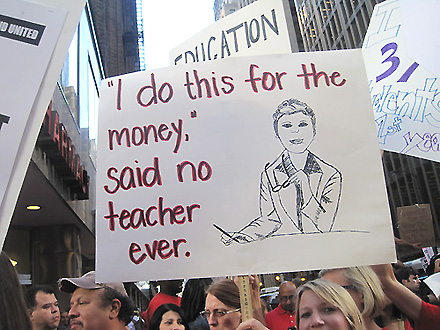
The War on public school teachers

Michael D. Yates
July 22, 2013
The Bullet
 
If those who are prosecuting this onslaught against our public schools succeed, they will have made workers more insecure, created a compliant, alienated, and low-wage labour force, and devised new ways to make money – a massive testing industry, for-profit schools, consulting services. They will also have put another nail in the coffin of democracy.


The U.S. working-class was slow to respond to the hard times it faced during and after the Great Recession of 2007-2009. Finally, however, in February, 2011, workers in Wisconsin began the famous uprising that electrified the country, revolting in large numbers against Governor Scott Walker's efforts to destroy the state's public employee labour unions.
 
Creative Commons License
This work is licensed under a Creative Commons Attribution-NonCommercial 3.0 Unported License.