Showing posts with label May Day. Show all posts

Friday, May 01, 2026

Why MayDay : Robert Reich

 Friends,

Warner Bros. Discovery shareholders voted last Thursday on the Ellison family’s purchase of the company. Some 1.743 billion shares were cast in favor of the sale; 16.3 million were cast against it, a ratio of roughly 99 to 1.

1. Great for a Handful of Super-Wealthy, but Bad for Workers and Bad for America

This vote came soon after more than 4,000 workers in the media industry — directors, screenwriters, producers, actors, editors, cinematographers, musicians, and composers — signed a letter predicting an industry disaster if the sale went through.

That’s because, as my friend Harold Meyerson from The American Prospect has noted, such deals typically saddle the purchased companies with gigantic debts that buyers incur to make the deal — in the case of Warner Bros. Discovery, $79 billion — and this debt, in turn, requires that buyers slash costs (especially payrolls) to pay off some of it. 

More than 70 percent of all the shares in Warner Bros. Discovery are held by institutional investors — including the Vanguard Group, BlackRock, and State Street. These institutions voted for the sale because they believe it will make their shares more valuable. 

The sale will also make certain individuals a lot of money. David Zaslav, the CEO of Warner Bros. Discovery, stands to collect some $886 million for shepherding it, in addition to his regular pay package (which was $51 million in 2024). Oracle’s Larry Ellison and his son, David, the new owners of Warner Bros. Discovery, are already among the richest people in the world. 

But what about the workers in the industry who’ll lose their jobs as a result of the sale? What about all the people whose wages will be slashed? What about Los Angeles, which may lose a sizable portion of its major industry? 

And what about the concentration of so much of the news business — so much of what Americans learn about what’s happening — under these two Trump suck-ups? 

If Trump’s Justice Department approves the deal (do birds fly?), CBS News and CNN — along with CBS entertainment (home to Stephen Colbert, whose contract is about to run out and who will be taken off the air because of his criticisms of Trump) and Comedy Central (home to Jon Stewart) and HBO (John Oliver) and TikTok (where 1 out of 5 Americans now get their news) — are all about to become one giant mega-media monopoly under the control of Trump allies, the Ellisons.
2. The Moral Bankruptcy of Shareholder Capitalism 

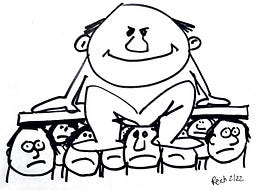
At the heart of modern American capitalism is the assumption that a corporation exists for only one purpose: to make its shares more valuable. 

That goal trumps (excuse me) all other goals — such as raising workers’ wages, improving workers’ job security, creating more jobs, enhancing the quality of life for the community where a company is headquartered or does business, making life better for the inhabitants of the nation and the world, even protecting democracy. 

In fact, if shareholders can make more money by shafting these other “stakeholders” and destroying these other values, that’s thought to be perfectly fine. It’s simply the way “impersonal market forces” work. It’s “efficient.”

Before the 1980s, American capitalism ran on a very different principle: that large corporations had responsibilities to all their stakeholders. “The job of management,” proclaimed Frank Abrams, chairman of Standard Oil of New Jersey, in a 1951 address, “is to maintain an equitable and working balance among the claims of the various directly affected interest groups … stockholders, employees, customers, and the public at large.” 

The sentiment may seem quaint or inauthentic today, but in the three decades after World War II, it laid the basis for rapid economic growth and, with strong unions, an equally rapid expansion of the American middle class. 

It reflected the sincere views of corporate executives. Many had endured the Great Depression and the war and felt some responsibility for America’s future well-being. These views helped legitimize the role of the large corporation in the public’s mind.

Today, shareholder capitalism has replaced stakeholder capitalism — and most Americans are excluded from its benefits. 

Over 92 percent of the value of all the shares of stock owned by Americans is owned by the richest 10 percent. More than half is owned by the richest 1 percent. And even they have turned over their votes to giant institutions like Vanguard, BlackRock, and State Street, which have no concern for the well-being of anyone or anything other than the short-term value of the shares they buy or sell.

We are witnessing the logical ending point of shareholder capitalism. 

As the share values of America’s biggest corporations continue to soar — even as (and in many cases, because) they eliminate tens of thousands of jobs — the goal of “maximizing shareholder returns” is revealing itself to be morally bankrupt and economically rotten. 

And as Artificial Intelligence takes over a growing amount of the work Americans do, the gap between share values (including the wealth of top investors and executives) and the incomes of most Americans will widen into a chasm. 
3. Toward a New Stakeholder Capitalism

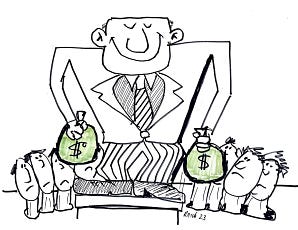
But here’s the good news: We don’t have to stick with shareholder capitalism. We don’t have to be victims of “impersonal market forces” over which we supposedly have no control. 

We can have control. The market is a human creation. It is based on laws that humans devise. We can make laws that alter market forces to serve the interests of the vast majority instead of mainly the oligarchs at the top. 

Over the last four decades, corporate laws have been shaped by wealthy individuals to channel a large portion of the nation’s total income and wealth to themselves. 

If America’s super-wealthy continue to have unbridled influence over laws and gain control over the assets at the core of Artificial Intelligence, they will end up with almost all the wealth, all the income, and all the political power. Under such conditions, our economy and society simply cannot endure. 

Laws can and should be changed to produce a new version of stakeholder capitalism that shares the wealth more widely. 

How? For example, corporations could be required to provide long-term employees with the same number of shares as are held by investors. Profitable corporations could be required to provide their workers a portion (a quarter?) of their profits. 

Corporations whose highest-paid executives earn more than 100 times their lowest-paid employees should have to pay a surtax. Corporations over a certain size (worth, say, $1 trillion or more) or having more than a certain share of their markets (say, 25 percent) should be broken up. Unfriendly (hostile) takeovers should be banned (as they were, in effect, before 1980).

The “stepped-up basis” rule that allows the wealthy to pass assets to their heirs without ever paying capital gains taxes on them should be eliminated. Vast accumulations of private wealth (say, in excess of a billion dollars) should, after a certain number of years, automatically be turned over to a fund providing subsistence incomes — a universal basic income. 

State corporate laws shouldn’t empower corporations to make any campaign donations (effectively reversing Citizens United). 

Sound radical? Maybe it is. But shareholder capitalism doesn’t work — as illustrated by the Warner Bros. Discovery fiasco. Unless radical changes are made, that fiasco is just a taste of what’s to come. If Artificial Intelligence isn’t to destroy capitalism and obliterate democracy, we’re going to have to come up with something that does work, and soon. 

Happy May Day, 2026. 

Robert Reich, 

Thursday, April 30, 2026

May Day With Class


This May Day—when, traditionally, labor and immigrant activists have honored the struggles of workers’ fight for a better life—was already going to be different. As of earlier in the week, over 5,000 actions were scheduled, to make clear a workers’ agenda, not a billionaires’ agenda, should be the priority in America.

May Day organizers are union and nonunion alike, and it’s the first time I can remember so many nonunion workers participating in a labor action. I hope you can join us to stand up for our rights; find your local actions here.

Then, just yesterday, the Supreme Court took away more rights from Americans by gutting the Voting Rights Act, which was passed during the depths of Jim Crow racism to assure that people historically discriminated against had representation.

But if you don’t believe that was yet another power grab—like the 2018 Janus case that eliminated the obligation for people with union representation to pay union dues—just look at what the governor of Louisiana did immediately after yesterday’s decision.

Gov. Jeff Landry announced he will suspend a primary that was already in progress, to redraw congressional lines to give the Republicans a shot at keeping the majority in Congress. The announcement came less than 24 hours after the Supreme Court’s Louisiana v. Callais decision was issued. Billionaires and their allies know, like you know, that elections are key to who has power. Once again, they are attacking the power of regular folks to vote. 

The folks seeking to take power away from workers are acting with intention—and we must act with intention too.

One way to take action is to protest, but another is to vote. So tomorrow, let’s show up to register to vote.

The billionaires and their allies are trying to silence us. Don’t let them. Check your registration now.

Thank you if you’re already registered to vote; that’s fantastic! I would ask one more thing of you: Please ask one person to register to vote—a co-worker, a neighbor, a voting-age family member. If they are not registered, tell them to visit aft.turbovote.org.

The people trying to rig the rules are counting on us to feel overwhelmed and give up. But we will not. Just like Janus didn’t end our voice at work, Callais will not stop us from exercising our voice in our government.

We care. We fight. We show up. We vote. And we’re not done fighting.

Thank you

In solidarity,
Randi Weingarten. American Federation of Teachers.

P.S. So, what do you have planned for May Day? Reply with what you’ll be doing, and if you have great photos, be sure to tag us on social media!  

Monday, April 27, 2026

Speaking Truth: And May Day


 The only good way to take down an authoritarian is democratically. Here’s another truth: Every mass mobilization that Indivisible has helped organize -- from Hands Off a year ago to No Kings I, II, and III -- has been historically large, powerful, and joyfully nonviolent. We defend our constitutional rights by using our constitutional rights. Sometimes we use those rights to say uncomfortable truths loudly.

So here are some more truths: Trump is an authoritarian. He's a convicted rapist who's all over the Epstein files. His secret police force has murdered Americans. His regime serves billionaires and himself at the expense of everyone else. He violates the Constitution constantly, including recklessly starting a war with Iran. He's deeply unpopular. His own coalition is fracturing. And he's currently on track for an electoral blowout in midterm elections that he's openly threatening to sabotage.

Proclaim some truth with your community this Friday on May Day. Earlier this year, the heroes of Minnesota organized the “Day of Truth and Freedom” -- a day where the people of the Twin Cities flexed their economic power to raise the alarm against the occupying regime. Indivisible is backing the May Day Strong coalition for a similar, national effort this Friday. In many communities we’ll see schools closed down, workers off the job, and stores empty. This is a tactical escalation -- the kind of peaceful action we’ll have to supercharge if Trump tries to sabotage the midterms.

The more we insist on the truth, the more inevitable it becomes that members of this regime will have to face that truth one day. That day is coming, and the people doing No Kings are bringing it.


Your weekly to-dos

  1. Join May Day Strong's Mass Call ahead of Friday’s day of action (Weds 8pm ET/5pm PT). You’ll hear from organizers mobilizing across the country about the importance of economic disruption as a tactic in fighting authoritarianism and how you can take part in the day of action this Friday (If you haven’t already, find a May Day event near you. There are already more than 3,000 events planned across the country.)


 It’s time to talk about truth, organizing, and strategic nonviolence again. Anybody even a little acquainted with Indivisible knows we believe political violence is a threat to democracy, full stop. This is a core belief in no small part because we know authoritarian regimes use political violence to justify repression of the nonviolent opposition. 

The truth is Trump is an authoritarian, and it’s important that we say the truth. After a fringe extremist attacked the White House Correspondents’ dinner this weekend, Trump immediately tried to blame nonviolent, pro-democracy protests. He told 60 Minutes, “The reason you have people like that is you have people doing No Kings.” 

Well, as one of the millions of “people doing No Kings,” I call bullshit.

This is all right out of the authoritarian playbook. In a deeply researched piece looking for practical lessons on global democratic backsliding, Zack Beauchamp found that authoritarians succeed in consolidating power by preventing their opposition from raising the alarm about their efforts to consolidate power. Trump may be in mental decline, but he still understands that much. Democracy dies in darkness, so it’s the pro-democracy organizer’s job to keep the lights on.

The regime does not like that. Like clockwork, regime-aligned media kicked in over the weekend to blame Democrats and call for them to “tone down” the rhetoric. Even putting aside the hypocrisy and concern-trolling from Trump and his allies, the correct response to the tone police is to refuse to tone down the truth. Sugarcoating the truth only serves those who want us to believe lies.  


In solidarity,
Ezra Levin 
Co-Executive Director, Indivisible


Thursday, April 23, 2026

Mayhaps: May Day and the Rebirth of Labor’s Imagination Labor

 Mayhaps: May Day and the Rebirth of Labor’s Imagination


Apr 20 

Written By Fred Glass


For many years I taught labor history at night to working students at City College of San Francisco. Since Bay Area workers and their unions had carried out two consequential general strikes (San Francisco in 1934, and Oakland in 1946), each semester I assigned my pupils an essay question:  Is it possible—or even desirable—for our region’s workers, if faced with oppressive circumstances, to replicate those feats today?

My students’ essays appeared along a range of responses between two poles. On one end, no, not possible, even if desirable, due to changed conditions like suburban distances between home and workplace, along with the decline of union density. On the other, yes, both desirable and possible, because new communications technologies allow ideas and organizing to spread rapidly online, and labor’s steep decline means that workers are angry enough to make it happen. Few students in either camp thought it would be an easy lift, reflecting a general sense of limited horizons for labor-led progressive change in the late twentieth and early twenty first centuries.

The 1946 Oakland General Strike was the very last one American workers had managed to put together, literally a lifetime ago. But metaphorically, post-January 23, 2026, we might now be onto a new calendar. In the wake of the powerful “No Work, No School, No Shopping” day that erupted in the Twin Cities, alongside a steady drumbeat of growing demonstrations and electoral successes against the Trump regime, there’s wind in the sails for mass action on May Day 2026.

Just in my neck of the woods many events have already taken place, and more are on the boards, combining planning, training and coalition building for that once-unpopular holiday, officially observed in one hundred or so nations across the globe but not in the country that birthed it. I hear from a friend in Minneapolis that he’s been going to meetings attended by hundreds of people dedicated in a serious way to making May 1 another day of action. 

We shouldn’t underestimate the significance of what happened January 23. In the midst of a brutal occupation by poorly trained, heavily armed troops operating with seeming impunity on behalf of their fascist mission of ethnic cleansing, the ordinary people of Minneapolis organized themselves to defend their streets, their democratic rights, their immigrant neighbors, and their idea of a decent society to demand “ICE out!”. Somewhere around 75,000 people showed up on a cold Minnesota winter day to freeze the gears of the local economy and the occupation. 

It was pretty close to a general strike, and unlike all the other dozen-plus city-wide general strikes in American history it was waged not around an economic struggle between workers and bosses, but on behalf of a political idea, more like what happens every so often in other countries. Which is very much in the spirit of May Day.

Tools are there to be found

Doing such things will not suddenly become easier. The Minnesota circumstances are unique, with an unprecedented level of assault running into a recent baseline increase in labor-community alliance and activism. The ICE invasion reignited the embers of powerful alliance-building and union contract victories that peaked in 2024. But every city has its own local history, culture and traditions of collective action, and despite the diminished capacities of the labor movement, the tools are there to be found—providing they are sought out seriously.

One hurdle is the legitimate fear of labor leadership over legal consequences for calling a general strike, forbidden by the anti-labor Taft-Hartley Act of 1947, a federal legislative backlash by the Republican-controlled Congress against the 1946 strike wave. Unions can be fined and labor leaders jailed for overtly calling for sympathy strikes. Thus while mostly supportive behind the scenes, unions were muted in their participation in the May 1 2006 “Day Without Immigrants” demonstrations and the November 2011 “Day of Action” in Oakland that shut down the docks and shuttered many businesses in support of Occupy Oakland’s call for a general strike. 


Read more. 

https://www.californiadsa.org/news/mayhaps-2026apr


Tuesday, April 21, 2026

May Day Mobilization -NEA

 A step toward unity. 

Saturday, April 18, 2026

May Day and A Day Without Immigrants


May Day and No Kings 2026

A Day Without Immigrants 


by Harry Targ


This year May Day will continue the historic mass mobilizations for social and economic justice of recent historic No Kings rallies. The original May Day was designed to remember the May 1, 1886 rally in Chicago for the 8-hour day. At that rally more than 300,000 workers from 13,000 businesses walked off their jobs to demand justice for workers. 


At a subsequent rally two days later at another rally an unknown person threw a bomb, violence broke out, police and others were killed. Anarchist leaders of the rallies, the Haymarket Martyrs, were charged with the violence, which they had nothing to do with. Subsequently eight martyrs were convicted, four of whom were executed for crimes they did not commit. Three years later, a federation of socialists workers, the Second International, declared May 1 an International Workers Day to remember the Haymarket Martyrs and at the same time to continue to rally for worker rights, from social and economic justice to ending war. Almost 70 countries around the world honor May Day as an official holiday today, and workers in many more countries celebrate the day and workers’ rights even though it is not an “official” holiday.


Today working people, most of the population of the United States, still need social and economic rights, labor rights, and would benefit from dramatic cuts in military spending and increases in social spending. As a result, millions of people in the United States have marched and rallied for social and economic justice, defending democratic institutions, and against wars in recent No Kings rallies, the most recent being March 28. Given the threats of fascism at home and world war overseas, activists are asking “What do we do now?’ One answer is to step up the militancy while honoring May Day, the International Workers Day.


​“Coming off the heels of the massive energy from the No Kings mobilizations, people are ready to take action and keep fighting for a democracy of, by, and for the people,” says Indivisible Co-Founder Leah Greenberg, whose organization started the No Kings protest. 


On May 1, Indivisibles will be joining people across the country with a clear message: we demand a government that invests in our communities, not one that enriches billionaires, fuels endless war, or deploys masked agents to intimidate our neighbors.” 


https://paydayreport.com/no-kings-organizers-pivot-to-may-day-general-strike/


As Ralph Chapin. the lyricist of the industrial Workers of the World wrote in 1915 in the workers' anthem, “Solidarity Forever”:


“In our hands is placed a power greater than their hoarded gold,

Greater than the might of armies, magnified a thousand-fold.

We can bring to birth a new world from the ashes of the old.

For the union makes us strong”

Sunday, May 01, 2022

May Day

 Dear Friends,

Let me take this opportunity to wish each and every one of you a very happy May Day.

The concept behind May Day is extremely profound. It is the understanding that real power lies in solidarity, and that when working people in our country and around the world come together, there is nothing that can stop us in the struggle for justice. 

It is also a day in which we recommit ourselves to take on the incredible greed and power of the corporate elite and the exploitation and misery they create — not just here in the United States, but internationally.

Clearly, one of the great crises facing the global community today is that the basic right of ordinary people to control their own lives at home and at the workplace is on the defensive.

And the root of this crisis is the fact that a handful of incredibly wealthy people are exerting enormous economic and political power over the planet.

These are people who are so addicted to greed that they are willing to step over working people, many with families and young children, in order to satisfy a pathological desire for more, more and more wealth. 

Unbelievably, in the global economy today, the top 1 percent owns more wealth than the bottom 99 percent, and a handful of billionaires own more than the bottom half of the people around the world — and that is more than 3.7 billionpeople.

And things have only gotten worse during the pandemic.

Thursday, April 29, 2021

May Day _ Immigrant Justice


 National Day of Action for Immigrant Rights

Sat May 1 throughout California | details
On International Workers Day and Immigrant Rights Day, we recognize and celebrate workers and their right to organize. This May Day also concludes the first 100 days of Biden’s administration. In the next 100 days, the President and the Congress will decide whether to create the pathway to citizenship for the approximately 10 million undocumented people who call this country home.

At this week’s Moral Monday, viewers were urged to attend Movimiento Cosecha’s May Day Action in Washington DC, where activists and allies will demand sweeping immigration reform. We Californians can show our support at actions taking place across the state. Find a May Day event near you.

Tuesday, May 01, 2018

Bring Back May Day


Most of the world recognizes May 1 — May Day — as International Workers’ Day. Here in one of the few countries that doesn’t, it’s worth pausing to ask how U.S. workers are doing.
At an event last December, Fight for $15 organizer Terrence Wise recalled “going to bed at night, ignoring my own stomach’s rumbling, but having to hear my three little girls’ stomachs rumble. That’s something no parent should have to endure.”
Wise was marking the launch of the Poor People’s Campaign: A National Call for Moral Revival.
Last month, the Institute for Policy Studies and the Poor People’s Campaign released The Souls of Poor Folk, a report on 50 years of change in the issues that affect working people, and particularly those at the bottom. We looked at systemic racism, poverty, militarism, and ecological devastation.
We found some startling and unhappy results. For the most part, workers like Wise are struggling hard to get by.
With the destruction of industries and the cities that housed them, the nature of our economy has shifted. Although the official unemployment rate is low, employment today often means low-wage work that offers little job security.
Our society’s treatment of workers has changed, too. For example, 28 states have passed so-called “right to work” laws that undermine the ability of workers to organize.

That’s meant steadily declining union membership, which keeps workers from getting their fair share of the wealth produced by the U.S. economy over the past 50 years. Despite enormous growth in the overall economy, wages for the bottom 80 percent of workers have remained largely stagnant.

Monday, April 24, 2017

The Coming May Day Strike May be the Biggest in over a Decade

by Sarah Aziza, Working In These Times 
This article was first posted by Waging Nonviolence.
When 26-year-old Catalina Adorno hit the road on March 28, she knew it would be at least six weeks before she’d sleep again in her own bed. Since that day, Adorno, a Mexican-born New Jersey resident with a strong voice and bright laugh, has criss-crossed from Pennsylvania to Maine as part of a regional support team for Movimento Cosecha, a national immigrant rights coalition. Her stops have included major cities and small towns, as she and her three teammates work to mobilize Cosecha’s vast network of “local circles” ahead of a massive day of coordinated action slated for May 1.
On April 3, Adorno’s team stopped off in Washington, D.C. to hear Cosecha spokesperson Maria Fernanda Cabello make the formal call for a May 1 nationwide strike. The planned action, billed as “A Day Without an Immigrant,” is set to be the largest immigrant rights action for at least a decade, with hundreds of thousands already pledging to stay home from work for a day in protest of systemic discrimination towards the immigrant and undocumented communities. At the press conference, Cabello pointed to the massive labor and capital power represented by the immigrant community, including 11 million undocumented residents. The May 1 protest, asserted Cabello, would be the next step in a strategy of harnessing this power to “change the conversation on immigration in the United States.”
It’s a lofty goal for an organization that formed less than two years ago, but Cosecha has a strong track record already. Drawing inspiration from farmworkers and their leaders—Dolores Huerta, Larry Itliong and Cesar Chavez—as well as “the thousands of African-Americans who stood up to the racist Jim Crow system,” Cosecha is an energetic movement that has grown quickly. Its ranks include a national team and hundreds of part-time volunteers across the country, which enabled Cosecha to play major role in several waves of direct action, including scores of campus walkouts and multiple protests outside Trump Towers.

Monday, May 02, 2016

May Day and the U.S. Labor Movement


Erica Smiley May 1, 2016
The American Prospect
Some cast the labor movement as dying or even dead, but even amid attacks on collective bargaining workers are finding innovative ways to organize.

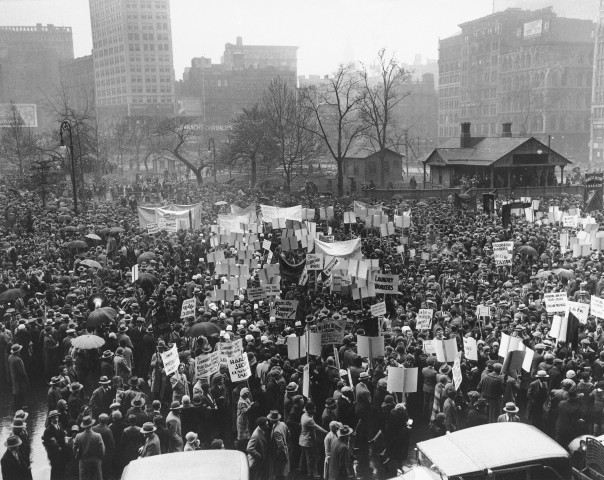
General view of the great crowds of organized and unorganized workers who took part in the May Day demonstration in Union Square, New York, May 1, 1929. , AP, 
On May 1, 1886, hundreds of thousands of railroad, mine, and factory workers in the United States put their livelihoods on the line and participated in a national strike to demand an eight-hour workday. They were attacked by strikebreakers and police, but their uprising led to the creation of a holiday to honor workers—May Day—now known as International Workers Memorial Day in many countries around the world.
These working men and women also achieved their immediate demand: a standard workday limited to eight hours. And while it took several more decades of struggle, the U.S. labor movement eventually won a much bigger victory: the legal right to form unions and collectively negotiate with their employers.
Today, this right is under attack in the face of some employers’ and lawmakers’ successful efforts to undercut unions through legal restrictions, retaliation, and intimidation. Indeed, only a small share of the U.S. workforce retains the right to consistently negotiate binding contracts.
Yet collective bargaining remains workers’ best weapon to fix an out-of-balance economy. According to the International Monetary Fund, the decline in unionization in the United States and many other countries over the past few decades is directly associated with an increase in the share of national income going to the top 10 percent of the population. Most CEOs are free to negotiate their own salaries and bonuses. Working people deserve the same freedom to engage in negotiations over how they will be compensated for their hard work. 

Tuesday, May 07, 2013

Defend Immigrant Rights


Defend Immigrant Rights  - Duane Campbell

International Worker's Day – May Day – 2013 took on special meaning this year, as the drumbeat for immigration reform got louder and louder. As part of an ongoing campaign, the Service Employees International Union and allied organizations – such as Mi Familia Vota, Community Center for Change and other labor unions and immigrants’ rights groups – celebrated May 1 with major actions in over 70 cities across the nation.


The current immigration bill proposed in the U.S. Senate has some positive provisions, but it falls short because it includes a guest worker program as well as an extensive further militarization of the border.  The bill being drafted in the Republican-controlled House will probably be worse.

Democratic Socialists of America (DSA) favors both the permanent extension of the DREAM Act and broader immigration reform legislation that would grant immediate permanent resident status to all undocumented workers and their children and would establish an expeditious and non-punitive road to citizenship for those workers and their families.

We also oppose all workplace discrimination based upon immigration status, and oppose any and all guest worker programs because they exploit the workers and undercut all workers’ rights to secure humane wages and working conditions, especially in the service and agricultural sectors.

DSA participates in the global struggle for equitable economic development and labor rights to reduce the forces that push desperate people to emigrate. We understand that massive migrations of workers, refugees and asylum seekers are a consequence of a global political and economic system that works for the benefit of transnational corporations at the expense of the vast majority of the peoples of the world. We also believe that low-wage workers of color, including immigrants, will be central to the “movement of movements” that is critical to the development of a “new new Left.”

See prior post: “A Working Class View of Immigration Reform,” by David Bacon.

Duane Campbell is a professor emeritus of bilingual multicultural education at California State University Sacramento, a union activist for over 40 years, and the chair of Sacramento DSA. He blogs on politics, education and labor at www.choosingdemocracy.blogspot.com and www.talkingunion.wordpress.com.


Sunday, May 01, 2011

May Day : Born in the U.S.A,


May Day.  Born in the U.S.A.  by Michael Hirsch
For generations, May Day, the International Workers Day celebrated by working people in more than 200 countries, was ignored in the United States, the country of its origin. In fact, the annual holiday is as American as cherry pie, commemorating as it does the 1886 nationwide general strike in which U.S. trade unionists — largely foreign-born — walked off the job in support of an eight-hour workday.
This year’s observance marks the 125th anniversary of that campaign to humanize the workday — and of the tragedy at Chicago’s Haymarket Square that followed three days later. New Yorkers will mark the day in a rally in support of labor and immigrant rights in lower Manhattan’s Foley Square. < editor. in New York City>
Back in 1886, when the typical work day was 10, 12 or even 14 hours long and joblessness was rife, the demand for a work day limited to eight hours at decent wages was viewed as dangerously radical. The eight-hour-day movement was spearheaded by two organizations, the craft-dominated Federation of Organized Trades and Labor Unions (the forerunner of the American Federation of Labor) and the Knights of Labor.

 
Creative Commons License
This work is licensed under a Creative Commons Attribution-NonCommercial 3.0 Unported License.