The only question is whether American citizens today can uphold that commitment. |
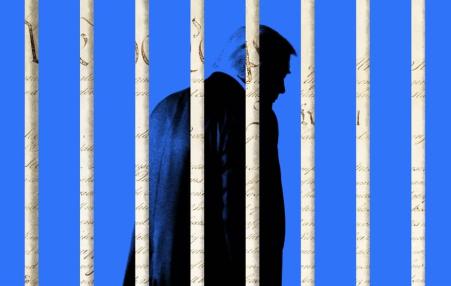 , Illustration by Jared Bartman / The Atlantic. Sources: Chip Somodevilla / Getty; U.S. National Archives and Records Administration. |
As students of the United States Constitution for many decades—one of us as a U.S. Court of Appeals judge, the other as a professor of constitutional law, and both as constitutional advocates, scholars, and practitioners—we long ago came to the conclusion that the Fourteenth Amendment, the amendment ratified in 1868 that represents our nation’s second founding and a new birth of freedom, contains within it a protection against the dissolution of the republic by a treasonous president. This protection, embodied in the amendment’s often-overlooked Section 3, automatically excludes from future office and position of power in the United States government—and also from any equivalent office and position of power in the sovereign states and their subdivisions—any person who has taken an oath to support and defend our Constitution and thereafter rebels against that sacred charter, either through overt insurrection or by giving aid or comfort to the Constitution’s enemies. The historically unprecedented federal and state indictments of former President Donald Trump have prompted many to ask whether his conviction pursuant to any or all of these indictments would be either necessary or sufficient to deny him the office of the presidency in 2024. Having thought long and deeply about the text, history, and purpose of the Fourteenth Amendment’s disqualification clause for much of our professional careers, both of us concluded some years ago that, in fact, a conviction would be beside the point. The disqualification clause operates independently of any such criminal proceedings and, indeed, also independently of impeachment proceedings and of congressional legislation. The clause was designed to operate directly and immediately upon those who betray their oaths to the Constitution, whether by taking up arms to overturn our government or by waging war on our government by attempting to overturn a presidential election through a bloodless coup. The former president’s efforts to overturn the 2020 presidential election, and the resulting attack on the U.S. Capitol, place him squarely within the ambit of the disqualification clause, and he is therefore ineligible to serve as president ever again. The most pressing constitutional question facing our country at this moment, then, is whether we will abide by this clear command of the Fourteenth Amendment’s disqualification clause. We were immensely gratified to see that a richly researched article soon to be published in an academic journal has recently come to the same conclusion that we had and is attracting well-deserved attention outside a small circle of scholars—including Jeffrey Sonnenfeld and Anjani Jain of the Yale School of Management, whose encouragement inspired us to write this piece. The evidence laid out by the legal scholars William Baude and Michael Stokes Paulsen in “The Sweep and Force of Section Three,” available as a preprint, is momentous. Sooner or later, it will influence, if not determine, the course of American constitutional history—and American history itself. Written with precision and thoroughness, the article makes the compelling case that the relevance of Section 3 did not lapse with the passing of the generation of Confederate rebels, whose treasonous designs for the country inspired the provision; that the provision was not and could not have been repealed by the Amnesty Act of 1872 or by subsequent legislative enactments; and that Section 3 has not been relegated by any judicial precedent to a mere source of potential legislative authority, but continues to this day by its own force to automatically render ineligible for future public office all “former office holders who then participate in insurrection or rebellion,” as Baude and Paulsen put it. Among the profound conclusions that follow are that all officials who ever swore to support the Constitution—as every officer, state or federal, in every branch of government, must—and who thereafter either “engaged in insurrection or rebellion” against the Constitution or gave “aid and comfort to the enemies” of that Constitution (and not just of the United States as a sovereign nation) are automatically disqualified from holding future office and must therefore be barred from election to any office. Regardless of partisan leaning or training in the law, all U.S. citizens should read and consider these two simple sentences from Section 3: No person shall be a Senator or Representative in Congress, or elector of President and Vice President, or hold any office, civil or military, under the United States, or under any State, who, having previously taken an oath, as a member of Congress, or as an officer of the United States, or as a member of any State legislature, or as an executive or judicial officer of any State, to support the Constitution of the United States, shall have engaged in insurrection or rebellion against the same, or given aid or comfort to the enemies thereof. But Congress may by a vote of two-thirds of each House, remove such disability. The Fourteenth Amendment was promulgated and ratified in the context of postbellum America when, even after losing the Civil War, southern states were sending men to Congress who had held prominent roles in the Confederacy or otherwise supported acts of rebellion or insurrection against the United States. The two of us have long believed, and Baude and Paulsen have now convincingly demonstrated, that notwithstanding its specific historical origin, Section 3 is no anachronism or relic from the past; rather, it applies with the same force and effect today as it did the day it was ratified—as does every other provision, clause, and word of the Constitution that has not been repealed or revised by amendment. |


