Wednesday, January 15, 2025

SCUSD is a Safe Haven district to protect immigrant children


March 7, 2017 or Alex Barrios: 916-752-3705

Sacramento City schools launch ‘Safe Haven’

campaign to protect undocumented students

Community leaders pledge support for the district’s efforts to inform every student

and their families of the legal rights of the undocumented by distributing tens of

thousands of ‘know your rights’ fliers at all schools, coordinating with community

organizations to provide legal resources in classrooms, and covering all campuses

with banners and lawn signs promoting inclusion and welcoming all students.

SACRAMENTO, CA—The Sacramento City Unified School District (SCUSD) today announced the launch

of a campaign to protect its undocumented students and staff amid growing fears of deportation in

immigrant communities. The campaign is the first of its kind in California and is the next step in

SCUSD’s national leadership on protecting and standing up for undocumented students and their

families. District leaders were joined today by State Assemblymember Jim Cooper, County Supervisor

Patrick Kennedy, City Councilmember Eric Guerra and dozens of students, teachers and community

members.

“Our Safe Haven policy was the first step we took to protect our kids,” said SCUSD Vice President

Jessie Ryan. “Today, we are taking an even bigger step by launching a full campaign to make sure

every undocumented student and parent in our school district knows their rights if approached by

immigration officials.”

In December, SCUSD approved Resolution 2915 which directed Superintendent José Banda to support

the creation of a Safe Haven district that included compliance with a 2011 federal policy that

immigration enforcement officials could not enter district campuses or facilities without prior written

approval from the Superintendent. The resolution also restricts the sharing of student files that can

be used to determine a student’s immigration status.

The district became one of the first districts in the state to adopt a Safe Haven policy, which has since

been described by State Superintendent of Public Instruction Tom Torlakson as a model for the rest

of California. “This resolution sent a strong message up and down the state that if federal

immigration officials try to come on to our schools or use our data to target undocumented students

and their families, we will take proactive measures to protect them,” said Ryan.With today’s announcement, SCUSD is taking further steps to ensure that undocumented students,

staff and families are aware of their rights and feel welcome and included. The district announced it

will distribute tens of thousands of “know your rights” cards in multiple languages to all students and

will assist in coordinating immigration attorneys and providers of other resources to help these

individuals at school sites. District officials also want to reinforce a message that all students are

welcome. The district will begin hanging up multi-colored banners and lawn signs at every school site

with the message: “Safe Haven: ALL students are welcome”. It will also be running a series of ads and

promotional videos on social media to underscore the contributions of undocumented students and

families in the community. Parents, teachers and community members will be encouraged to join the

campaign by signing pledge cards in support of the Safe Haven effort.

“Our campaign is going to reinforce one common theme—that ALL students are welcome at our

schools and that undocumented students play a valuable role in the everyday life of our campuses,

and that they are a part of the fabric of our district,” said SCUSD Superintendent José Banda.

According to Banda, the district will leverage all of its resources and community connections to help

and protect its students.

For SCUSD Board Member Mai Vang, the Safe Haven campaign is very personal. “My parents came to

this country decades ago as refugees,” said Vang, whose parents attended SCUSD schools. “Like

many of the immigrant families that we are seeking to protect today, my parents came here fleeing

an unsafe environment, in need of opportunities that were not possible in their home land. They did

not let hateful rhetoric or people push them out.”

SCUSD is one of the most diverse school districts in the country. As many as one in five of its students

and families could be affected by federal immigration policies. The district has:

• More than 43,000 students

• 48 different spoken languages that include Spanish, Hmong, Armenian, Korean, Tagalog,

Cantonese, Arabic, Vietnamese and Russian

• 64% qualify for free or reduced lunch

• 17,104 are of Latino descent

• 34,896 are students of color

• In 2015-16, nearly one-third of students were English language learners or non-native

speakers

For more information visit www.scusd.edu/safe-haven-district.

# # #

Tuesday, January 14, 2025

If Republicans Deny Disaster Aid on Political Grounds …

If Republicans Deny Disaster Aid on Political Grounds …: Today on TAP: How will the next Democratic House respond to the inevitable Florida hurricane?
California. 

Monday, January 13, 2025

Choose Democracy Resources

  Choose Democracy Resources:

We're also noticing something else that seems important. We think of it as a kind of spiritual conditioning. We see it most strongly this way: people are turning to other people. People are largely showing up for each other in grief and support and opening homes to care for each other. The direction we all need to go is more love, more neighborliness of that kind, and more open doors. So we want to affirm the ways people aren't only strategizing and planning, but also spending time with people they trust and love and licking their wounds. This is a very human thing to do.

Over at Choose Democracy we're taking an inhale after some intense weeks. We wanted to just take a moment to share what we've been up to and some resources we're tracking that may be useful to you.

VIRAL RESOURCES

We're grateful and blown away that Daniel's article on 10 ways to be prepared and grounded now that Trump has won has gone viral with over 1.2 million views. It's a helpful piece to acknowledge different roles and ways of processing. 

It's since been reprinted thousands of times. This has led to many follow-up interviews, three we wanted to highlight: Daniel talked more about the roles on The Authoritarian Podcast and talked in depth through each of the key points with the podcast The Majority Report. And lastly,adrienne marie brown and Autumn Brown's podcast (How to Survive the End of the World) had a longer-view flowing conversation about where we are.

More; 


https://www.dsanorthstar.org/blog/choose-democracy-resources-jan13-2025


Note: Choose Democracy is an organization.  It is not this blog. this blog is named Choosing Democracy.  That is the title of a book that I wrote. 


Labor’s Prodigal Son Returns

Labor’s Prodigal Son Returns: SEIU rejoins the AFL-CIO, even as arresting labor’s decline remains a daunting challenge.

Saturday, January 11, 2025

The California Fires; Reality


The California Fires.  View from California


https://robertreich.substack.com/p/the-great-fire


For all of those voters who have under funded local emergency services. 

Sunday, January 05, 2025

The Trump Insurrection of Jan.6.


Monday, Jan. 6, 2025,  marks the fourth anniversary of Donald Trump's deadly January 6 insurrection.

And Donald Trump—who pledged to pardon the insurrectionists on his "first day"—is just days away from taking office.1


Robert Reich, 


The man who instigated a riot at the U.S. Capitol four years ago tomorrow to stop the certification of Joe Biden as president will be certified president.

The peaceful transfer of power lies at the heart of American democracy, but Trump sought to overturn the result of the 2020 election and has not been held accountable.

We must never forget his treachery. 

When Vice President Mike Pence walked into the Capitol four years ago tomorrow, on January 6, 2021, he faced a withering pressure campaign by Trump, who had already twisted the arms of governors and election officials around the country to change the result of the election in his favor. 

Pence was about to throw out the slates of false electors that Trump and his henchmen had hyped for weeks — coaxing loyalists in five swing states to submit signed certificates falsely claiming they were “duly elected and qualified” members of the Electoral College.

But as Pence began the electoral vote count, thousands of Trump supporters, many of them armed, stormed the Capitol. Some chanted they wanted to “hang Mike Pence” for refusing to block the certification. 

They came directly from a rally Trump held on the Ellipse, in which Trump repeated his false claim that the election had been stolen and told the crowd, “If you don’t fight like hell, you’re not going to have a country anymore.” 

According to the indictment from the office of Special Counsel Jack Smith, Trump directed those supporters to the Capitol “to obstruct the certification proceeding and exert pressure” on Pence. The indictment further states: 

“After it became public on the afternoon of January 6 that the Vice President would not fraudulently alter the election results, a large and angry crowd — including many individuals whom the Defendant had deceived into believing the Vice President could and might change the election results — violently attacked the Capitol and halted the proceeding.”

The FBI estimates that between 2,000 and 2,500 people entered the Capitol Building during the attack, some of whom participated in vandalism and looting, including of the offices of members of Congress. Rioters also assaulted Capitol Police officers. They occupied the empty Senate chamber while federal law enforcement officers defended the evacuated House floor. 

Within 36 hours, five people had died. One was shot by Capitol Police; another died of a drug overdose; and three died of heart attacks or strokes, including a police officer who died the day after being assaulted by rioters. Many were injured, including 174 police officers. Four other officers who responded to the attack died by suicide within seven months.

“President Trump was wrong,” Pence said subsequently. “I had no right to overturn the election. And his reckless words endangered my family and everyone at the Capitol that day, and I know history will hold Donald Trump accountable.”

But Trump has not been held accountable. 

A week after the attack, the House of Representatives impeached Trump for incitement of insurrection. In February 2021, after he had left office, the Senate voted 57–43 in favor of conviction but fell short of the required two-thirds majority, resulting in his acquittal.

Senate Republicans then blocked a bill to create a bipartisan independent commission to investigate the attack, leaving the House to organize its own select committee.

After an 18-month investigation including more than 1,000 witnesses and nine televised public hearings, the House’s select committee identified Trump as the “central cause” of the Capitol attack by the pro-Trump mob. 

The panel, made up of seven Democrats and two Republicans, voted unanimously to recommend charges to the Justice Department to prosecute Trump for seeking to overturn the results of the 2020 election. 

Following a special counsel investigation by the Justice Department, Trump was indicted on four charges in August 2023. 

But after Trump’s reelection to the presidency, all charges were dismissed.

Of the 1,424 people charged with federal crimes relating to the riot, 1,010 pled guilty,and 1,060 have been sentenced. Enrique Tarrio, then the chairman of the Proud Boys, received the longest sentence, a 22-year prison term.

***

Trump and his lackeys in the Republican Party have since promoted a revisionist history of the event — downplaying the severity of the violence, spreading conspiracy theories, and portraying those charged with crimes as hostages and martyrs.

Trump has tried to recast the violent events as a “day of love.” He has promised that in the first day of his new administration he would consider pardons for those who have been prosecuted for their roles on January 6.

On December 8, 2024, in his first broadcast news interview since the 2024 election, Trump said members of the House committee that investigated the riot “should go to jail.”

***

That Donald J. Trump — the same person who instigated a coup four years ago tomorrow, when Congress last gathered to certify an election — will become president on January 20 is an assault on the rule of law and the foundations of our democracy. 

We must never forget. January 6, 2021, should live in infamy, as should Trump. 

Share


How Trump Inverted the Violent History of Jan. 6

The president-elect and his allies have spent four years reinventing the Capitol attack — spreading conspiracy theories and weaving a tale of martyrdom to their ultimate political gain.

https://www.nytimes.com/2025/01/05/us/politics/january-6-capitol-riot-trump.html


Saturday, January 04, 2025

Friday, January 03, 2025

Tesla Is Cooked : Subsidies

Tesla Is Cooked: Unless Donald Trump gives the company lots of government subsidies, that is.

Thursday, January 02, 2025

The Battle We Face


Bernie Sanders
December 31, 2024
Common Dreams
If there was ever a moment when progressives needed to communicate our vision to the people of our country, this is that time. Despair is not an option.

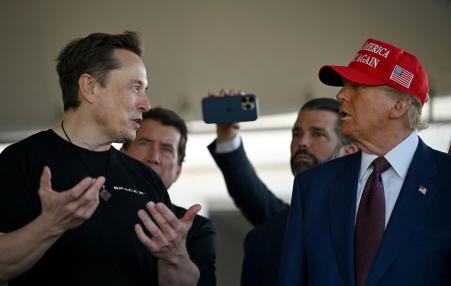
Elon Musk speaks with Donald Trump at a viewing of the launch of the sixth test flight of the SpaceX Starship rocket, in Brownsville, Texas, November 19., Brandon Bell/Pool via REUTERS


As we enter this new year, it’s important to reflect upon the reality that we are living in a pivotal and volatile moment in American history. Within that context our job is not only to understand what’s happening all around us, but to determine the best way forward to create a nation and world that benefits all people, not just the wealthy and powerful few.

And right now, the defining issue of our time is that we are moving rapidly toward an oligarchic and authoritarian society in which billionaires not only dominate our economic life, but the information we consume and our politics as well.

Today, we have more income and wealth inequality than we’ve ever had.

Today, we have more concentration of ownership than we’ve ever had.

Today, we have more corporate control of the media than we’ve ever had.

Today, we have more billionaire money buying elections than ever before.

Today, we have a president-elect who is a pathological liar, who has little regard for the rule of law, who is suing media outlets that criticize him and threatening to jail his political opponents.

A manifestation of the current moment is the rise of Elon Musk, and all that he stands for.

Within the last two years alone Mr. Musk, the richest man in the world, has used his wealth to purchase the largest media platform on the internet, spent hundreds of millions of dollars to elect a president and give Republicans control of the House and Senate, was nominated to fill an unelected, non-confirmable position in charge of making huge budget cuts, succeeded in getting Congress to abandon a bill he didn't like, and then threatened to unseat elected officials if they did not follow his orders to shut down the government during the holidays. He is also forging alliances with autocrats throughout the world, and supporting a far-right party in the coming German elections.

But it’s not just Musk. Billionaire owners of two major newspapers overrode their editorial boards' decisions to endorse Kamala Harris, while many others are kissing Trump’s ring by making large donations to his inauguration committee slush fund.

In the midst of all this, a simple question must be asked. What do Musk, Bezos and the other billionaires want? What is motivating them? What kind of nation and world are they trying to create? While it would take a book to answer that question, let me jot down a few obvious observations.

They do not believe in democracy—the right of ordinary people to control their own futures. They firmly believe that the rich and powerful should determine the future. Left alone, they will dominate both major political parties and, through their media ownership, control the flow of information.

They do not accept what most major religions, in one form or another, have historically taught us to be ethical behavior: to do unto others as you would have them do unto you. They believe that greed, and the accumulation of wealth and power is a virtue, and that the strong should dominate the weak.

Their vision is one where the government serves the rich at the expense of working families and the poor. It is a vision where breaking unions and exploiting workers is good, making huge profits off human illness is good, monopolization of the economy and the media is good, racism, sexism and xenophobia is good, producing carbon emissions and destroying our planet is good, providing tax cuts for the richest Americans is good, making money by putting poor people into prisons is good, and on and on it goes...

That is what the oligarchs want.

We, as progressives, have a vision that is radically different.

Can we create an economic system based on the principles of justice, not greed? Yes, we can.

Can we transform a rigged and corrupt political system and create a vibrant democracy based on one person, one vote? Yes, we can.

Can we make health care a human right as we establish a system designed to keep us healthy and extend our life expectancy, not one based on the profit needs of insurance companies and the pharmaceutical industry? Yes, we can.

Can we, in the wealthiest country on earth, provide free quality public education and job training for all from child care to graduate school? Yes, we can.

Can we combat climate change and protect the very habitability of our planet for future generations, and create millions of jobs in the process? Yes, we can.

Can we make certain that artificial intelligence and other exploding technologies are used to improve the quality of life for working people, and not just make the billionaire class even richer. Yes, we can.

And even though we are not going to succeed in achieving that vision in the immediate future with Trump as president and Republicans controlling Congress, it is important that vision be maintained and we continue to fight for it.

As part of that effort, we’ve got a lot of strategizing and work in front of us. For example, how do we effectively communicate our ideas to the vast majority of Americans who are with us, even while the billionaire class of this country controls so much of the media.

How do we leverage our collective power to elect progressives to local, state and federal positions while a small number of billionaires and their super-PACs are buying elections.

How do we mobilize the working class around the day to day issues which impact their lives: building the trade union movement, health care, housing, education, family based agriculture and so much more.

How do we fight back, on a day to day basis, against the reactionary policies of the Trump administration?

Will this effort be easy? No, of course it will not.

Can it be done? We have no choice.

If there was ever a moment when progressives needed to communicate our vision to the people of our country, this is that time. Despair is not an option. We are fighting not only for ourselves. We are fighting for our kids and future generations, and for the well-being of the planet.

Thank you for standing with me in that fight. Let’s go forward together.

Bernie Sanders. 


Wednesday, January 01, 2025

Teachers Turn to Study Groups As History is Whitewashed by the Right.

Jesse Hagopian, Ursula Wolfe-Rocca 
December 30, 2024
Truthout

It is hard to overstate the burdens public school educators have been asked to carry over the last several years.

There are the perennial stressors: inadequate funding, crumbling infrastructure, the inundation of schools with standardized testing, and too little time to plan, grade and collaborate with colleagues. Then came the COVID-19 pandemic: isolation, building closures, remote teaching, reopenings and severe staff shortages. Wielding the cudgel of “learning loss,” elites laid the blame for the traumatic impacts of a pandemic at the feet of teachers and public schools.

And through all that, there has been the steady and sinister growth of book bans, curricular gag orders and the criminalization of trans-affirming policies — all of which seek to muzzle educators from telling the truth and extending care to students. Today, almost half of all public school students have a teacher who has been prohibited from teaching the truth about systemic racism in U.S. history. As one teacher told the Zinn Education Project, “I’m terrified to say anything about enslavement because it might make students ‘uncomfortable.’ I also can’t recommend any books because a parent might not like it and then I could be charged with a felony.”

The impact of the relentless attacks on educators from right-wing forces is difficult to quantify, but a 2022 surveyprovides some insight into the harm being caused. According to a report by the National Education Association, “A staggering 55 percent of educators are thinking about leaving the profession earlier than they had planned.” The report also reveals that a disproportionate percentage of Black (62 percent) and Latinx (59 percent) educators — already underrepresented in the field — are considering an early departure from teaching. Many factors are pushing educators away, from health risks during the pandemic to low pay and a lack of respect that stems from politicians who aim to scapegoat educators for the social problems they refuse to address. Especially distressing is the toll taken by the ongoing criminalization of truth in education. As one teacher from Tennessee shared regarding the impact of educational gag order legislation on her decision to leave teaching, “I just can’t. I can’t do this. I really value being honest with students. I really don’t think I can navigate teaching in such a watered-down type of way.”

The fear of retribution for teaching the truth has created such a chilling effect that an astounding two-thirds of U.S. teachers now report self-censoring discussions on race, gender identity and sexuality in their classrooms.

But there is another story about teachers — buried beneath the headlines of doom and despair — that must be told to fully understand this era of education; this is a story about solidarity, community, hope and resistance.

As we have seen educators come under attack for teaching the truth about U.S. history, we have also seen them rise up and fight back. For the past three years, hundreds of educators have participated in the annual Teach Truth National Day of Action, organizing banned book swaps, historical walking tours, rallies, and more. In addition, thousands of educators have participated in the Black Lives Matter at School Week of Action, and many are increasingly joining the call for the Year of Purpose activities.

There is one story of educator resistance that has not been reported on: the Teaching for Black Lives (T4BL) study groups and the more than 3,795 educators from across the country — including in states that have prohibited anti-racist education — who have come together over the last several years to read, learn, reflect, and struggle for justice in classrooms and schools. Hundreds of T4BL study groups have formed since 2020, including groups comprised of teachers across Florida, educators from Wake County School District (K–12) in North Carolinaand educators from Hayward Unified School District (pre-K–12) in California.

Two-thirds of U.S. teachers now report self-censoring discussions on race, gender identity and sexuality in their classrooms.

At most schools, isolation is the norm. Teachers scarcely have time to use the bathroom between classes, answer emails and plan lessons during their prep periods, and eat a nourishing meal during their lunch “break.” We have yet to see a place on a school’s daily bell schedule labeled “time to build meaningful relationships with other adults in the school.” Too often, professional development is imposed on educators and feels tangential to the most pressing issues in education. Study groups provide educators with a reliable structure of support and community, while allowing educators to direct their own professional development.

“Participating in this study group has reminded me that I am not alone in my district. This work can often feel really isolating, and it was so encouraging to meet with colleagues who are also passionate about equity,” says Crystel Weber from Gresham, Oregon. Similarly, Sarae Pacetta from Portland, Maine, reflects, “Our study group has been an anchor for all of us.…We are each other’s touchstones when we need to process an issue.”

No doubt, this moment calls for copious and varied forms of organizing — in our unions, at our local school and library boards, and in collaboration with community and parent groups. But as we fight the current wave of attacks on education, it is critical that we ground ourselves in what we are fighting for, not just against. Small, educator-led communities of study and reflection can provide that grounding. Study group members have told us that their groups have been a vital source of strength, support and guidance during budget cuts and right-wing attacks on education. “Having a national network of support and like-minded colleagues is a balm during these challenging times,” said one study group member.

A mainstay of school mission statements is that the educational program should create “life-long learners.” Yet, this value is rarely prioritized by school leaders when it comes to educators. Study groups encourage educators to claim time to learn — through book study and discussion, online classes and participatory workshops. We cannot apply principles of equity and justice that we ourselves have not learned.

“I’ve learned so much about the accurate and hidden history of Black Americans and how our systems continue to affect them,” says Teri McAllister, a teacher in Everett, Washington, on the impact of collective study. “This learning experience has deepened my commitment to creating change.”

Heidi Given from Somerville, Massachusetts, shares, “Our study group provided a platform to explore histories we were never taught, and to develop pedagogical practices for sharing those histories with our students.”

Yet these groups aren’t just about educators deepening their understanding of Black history and intersectional social issues; the T4BL study groups have also inspired educators to move from discussion to action, and to tackle issues of racial justice directly within their communities and schools.

The role of study groups is frequently underestimated in historical accounts of social change, yet these gatherings are often the bedrock of movements for social justice.

A T4BL study group in Florida — a state where draconian laws have been deployed to fire educators who teach the truth about racism — inspired educators to get active in their union to organize against the onslaught of anti-education bills imposed on them in recent years. In Madera, California, a T4BL study group took a deep dive into the discipline data at their school, and a member reported that their group “completely restructured” their school discipline approach. This included hiring an intervention specialist and transforming the position of the teacher who had supervised in-school suspensions to abandon a punishment model and become a trained restorative justice practitioner who “works closely with our intervention specialist, counseling team, and student psych services.” In Kansas City, Missouri, study group leader Michael Rebne and other educators participated in Teach Truth Days of Action by organizing events at historic sites to highlight the importance of truthful education, especially as right-wing anti-history bills threaten to mandate lies and omissions in classrooms across the country.

The role of study groups is frequently underestimated in historical accounts of social change, yet these gatherings are often the bedrock of movements for social justice. Study groups create spaces for individuals to explore ideas, develop critical consciousness and build the ideological foundations necessary for collective action. From the Black freedom struggle to the labor movement, study groups have brought together individuals eager to learn, strategize and ultimately transform society.

In the early 20th century, Black intellectuals and activists such as W. E. B. Du Bois and the members of the Niagara Movement met regularly in study groups to discuss racial justice and civil rights, laying the groundwork for the NAACP. During the civil rights movement, study groups were instrumental in the formation of the Student Nonviolent Coordinating Committee (SNCC), where young activists learned about direct action and Black liberation. In 1962, the Afro-American Association (AAA) emerged as a study group at Merritt College in Oakland, California, bringing together Huey P. Newton and Bobby Seale alongside other students and educators to explore Black history and revolutionary ideas. Some of the texts they studied included Frantz Fanon’s The Wretched of the Earth and the speeches and writings of Malcolm X. The discussions and debates they engaged in through the AAA laid the ideological groundwork that eventually inspired Newton and Seale to establish the Black Panther Party. In the late 1960s and 1970s, the Black Panther Party used study groups to educate members about systemic racism, political economy and the global struggle for liberation.

This important tradition continued into the 21st century. In 2008, for example, educators in Chicago started a study group around Naomi Klein’s The Shock Doctrine, which explains how the richest 1 percent have enriched themselves in the neoliberal era by taking advantage of political and economic crises to amass even more wealth and promote free market policies. Through their discussions, they examined the forces driving the privatization of public education and the urgent need for a new approach to unionism. This group of educators formed into the Caucus of Rank-and-File Educators, which soon ran Karen Lewis for president of the Chicago Teachers Union. Her victory marked a turning point as the union, under Lewis’s leadership, led some of the most significant teacher strikes in modern history, using a social justice unionism lens to advocate for teachers, students, and their communities.

In a time when forgetting history has been mandated by law, we must remember the power of study groups as an antidote to isolation and fear. As T4BL study group coordinator Jill Groff put it: “I would share that when the apathy seemed pervasive and morale was low, being in this group lit a fire of hope to keep me going and remember my why. I so appreciate the fellowship and support of people who genuinely love kids, all kids, and go above and beyond every day to fight for them, to make lessons to inform and empower, and just to be in a space with so many wonderful educators with shared values and goals.”

 
Creative Commons License
This work is licensed under a Creative Commons Attribution-NonCommercial 3.0 Unported License.